





⭐ What's new in 0.16.0
0.16.0 takes missing data, background knowledge, and pair direction further. Simulate missing values whose cause you know. Then fit incomplete data with MVPC, which corrects PC when missingness depends on other variables, or with EM for the score searches, NOTEARS, DAGMA, and CALM. Tell a method that one variable causes another by some path, that it does not, or that two variables share a hidden common cause. LOCI reads the direction of a pair whose noise changes with the cause, and made no more errors than its authors' code. MVPC is supported, and so is EM in NOTEARS, hill climbing, and Tabu search. EM in the other searches is experimental, as are the new claims in the methods we have not measured. Drawings also mark intervened variables, and every HSIC p-value stays precise far below 1e-16.
See the release card · Posts: Ready for real data · Pairwise direction
Andrey is a causal discovery package for Python.
- Fast: The fastest causal discovery package.
- Accurate: more than 80% fewer errors than other popular packages.
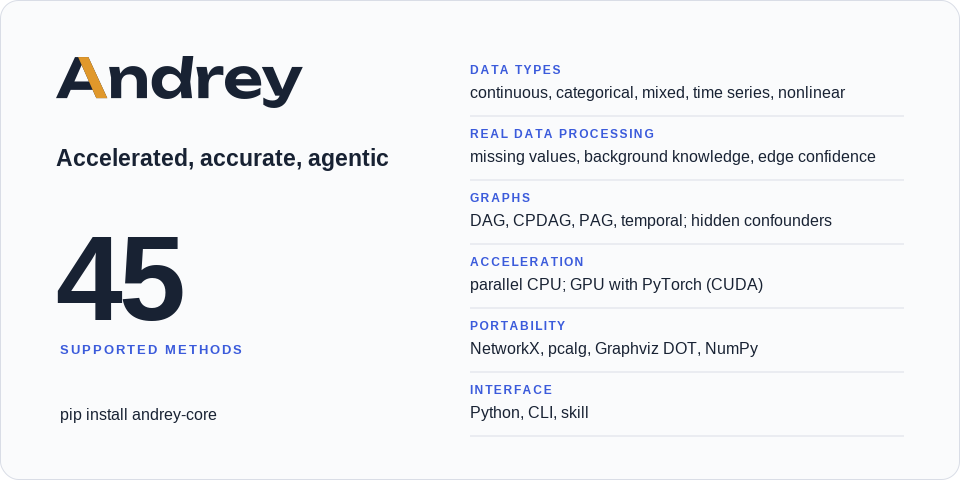
- One API: 45 supported methods, each one function call.
- Any data: continuous, categorical, mixed, time series, nonlinear, hidden confounders.
- Agent-ready: a command line that answers in JSON, and a skill for coding agents.
uv add andrey-core
pip install andrey-core
You install andrey-core and then import andrey.
- Optional extras:
andrey-core[torch]for GPUs and CALM,andrey-core[viz]for charts and graph layouts - From GitHub, the latest release:
uv add "andrey-core @ git+https://github.com/Abel-ai-lab/andrey@main" - Installation guide: the extras, a PyTorch build for your GPU, and building Andrey from source
What's inside
| Family | Methods | Returns |
|---|---|---|
| Constraint-based | pc, fci, gfci, cdnod, fci_jci, icp, iamb, inter_iamb, mmpc |
CPDAG, PAG, DAG, Undirected graph |
| Score-based | ges, gies, gnies, xges, hc, tabu, exact_search, calm, notears*, dagma*, mmhc, rsmax2 |
CPDAG, DAG |
| Permutation-based | boss, grasp, boss_fci, grasp_fci, igsp, ut_igsp |
CPDAG, PAG |
| Functional causal models | direct_lingam, ica_lingam, multi_group_direct_lingam, cam, resit |
DAG |
| Temporal causal discovery | varma_lingam, longitudinal_lingam, pcmci, pcmciplus, jpcmciplus, lpcmci, granger, dynotears |
Temporal graph |
| Latent variables | gin, rcd, bottom_up_parce_lingam, camuv |
DAG, PAG |
| Pairwise direction | anm, pnl, loci |
Two-node DAG |
* Experimental: no published benchmark yet, and the API may change.
Quick start
Learn the protein-signaling network of Sachs et al. (2005) from 853 cells, and score it against the known network:
import andrey
from andrey.data import load_dataset
from andrey.metrics import score

sachs = load_dataset("sachs")  # 853 cells, 11 proteins, and the known network
out = andrey.pc(sachs.data)    # learn a graph
print(out)

scores = score(out.structure, sachs.graph)
print({k: round(scores[k], 2) for k in ("shd", "skeleton_precision", "skeleton_recall")})
pc  cpdag  |  11 nodes  |  8 edges (6 undirected, 2 directed)

  raf -- mek
  plc -- pip3
  pip2 -- pip3
  erk -- akt
  erk -- pka
  akt -- pka
  p38 -> pkc
  jnk -> pkc

  indep_test: fisherz
  tie_break: rank
{'shd': 11, 'skeleton_precision': 1.0, 'skeleton_recall': 0.47}
PC finds 8 edges, all among the known network's 17. The structural Hamming distance (SHD) counts the edges to add, remove, or reorient to reach the known network: 11 here (9 edges are missing, and 2 are oriented where the known network's CPDAG leaves them undirected), and 17 for a graph with no edges.
For your own data, pass a pandas DataFrame or a NumPy array: one row per sample, one column per variable. From a shell or an agent:
andrey run pc --data your_data.csv # JSON when piped, a summary in a terminal
To give your coding agent Andrey's skill, paste this prompt into it:
Install Andrey's agent skill: make sure the andrey-core package is installed, run
`andrey --skill`, and save its output as andrey/SKILL.md in your skills folder.
Learn more
- Documentation: guides and the API reference.
- Examples: notebooks, one method or task each, and demos that run in your browser.
- Release cards: benchmark details for each release.
- Why Andrey is fast
- FAQ and changelog.
- Roadmap: the planned work, stage by stage.
Andrey is in alpha: the API may change between releases, so pin the version you use. Linux is supported; macOS and Windows install and run on the CPU, with no guarantee yet (Testing). Apple GPUs are not supported in the alpha.
Citing, license, contributing
If you use Andrey in your work, please cite it, or use the citation file:
@software{andrey,
  author = {{Abel AI Lab}},
  title = {Andrey: Accelerated, accurate, agentic causal discovery},
  year = {2026},
  version = {0.16.0},
  url = {https://andrey.abel.ai},
}
Andrey is released under the Apache License 2.0. Bug reports and pull requests are welcome in the issue tracker; the contributing guide explains how to set up a development environment.
Andrey is inspired by causal-learn, pgmpy, Tetrad, and many other causal discovery packages.
1 maintainer

Metadata
1 maintainer
Release files for andrey-core 0.16.0
For a detailed explanation of source distributions (sdists) and built distributions (wheels), please see the package formats documentation.
Source distribution (sdist)
| File | Size | Uploaded | Provenance | Actions |
|---|---|---|---|---|
| andrey_core-0.16.0.tar.gz | 950.4 kB | With provenance | Details for andrey_core-0.16.0.tar.gz |
Built distribution (wheel)
| File | Interpreter | ABI | Platform | Actions Reset |
|---|---|---|---|---|
| andrey_core-0.16.0-py3-none-any.whl | Python 3 | none | any | Details for andrey_core-0.16.0-py3-none-any.whl |
Total release size: 2.0 MB
Release files / andrey_core-0.16.0.tar.gz
| Download URL | andrey_core-0.16.0.tar.gz |
|---|---|
| Size | 950.4 kB |
| Tags | Source |
|
SHA-256 checksum How to use checksums |
17d1e657f4bde302c3cda12b4ffdfbd87005efd538c5948658e935b9ab83d201
|
|
BLAKE2b-256 checksum How to use checksums |
c35213bf66543e91d4e42ed8eeee470852070d77359445a37ca353003d5b218a
|
| Upload date | |
|
Uploaded using Trusted Publishing? What is trusted publishing? |
Yes |
| Uploaded via |
twine/7.0.0 CPython/3.13.16
|
Provenance
Provenance describes where a file came from. On PyPI, provenance is shared via attestations, which provide a verifiable record of the build or publishing details. View details, limitations and caveats.


PyPI Publish Attestation
PyPI verified that this artifact, at this checksum, originated from the publisher listed below.
Signed by GitHub Actions, verified by PyPI on Nov 10, 2026.
Transparency logRelease files / andrey_core-0.16.0-py3-none-any.whl
| Download URL | andrey_core-0.16.0-py3-none-any.whl |
|---|---|
| Size | 1.1 MB |
| Tags | Python 3 |
|
SHA-256 checksum How to use checksums |
f606eb5ce75641d1436ed710bb7838520ed0e4aa35a4c925e245a09792a7f086
|
|
BLAKE2b-256 checksum How to use checksums |
ec0ddee073134aafd5e0b2151cc557001514fda532756e75319a630a25ce9171
|
| Upload date | |
|
Uploaded using Trusted Publishing? What is trusted publishing? |
Yes |
| Uploaded via |
twine/7.0.0 CPython/3.13.16
|
Provenance
Provenance describes where a file came from. On PyPI, provenance is shared via attestations, which provide a verifiable record of the build or publishing details. View details, limitations and caveats.
PyPI Publish Attestation
PyPI verified that this artifact, at this checksum, originated from the publisher listed below.
Signed by GitHub Actions, verified by PyPI on Nov 10, 2026.
Transparency logSecurity for andrey-core 0.16.0
Provenance
Provenance describes where a file came from. On PyPI, provenance is shared via attestations, which provide a verifiable record of the build or publishing details. View details, limitations and caveats.
Full provenance
Both files in this release have been uploaded with provenance metadata.
Attestation for andrey_core-0.16.0.tar.gz
PyPI Publish Attestation
PyPI verified that this artifact, at this checksum, originated from the publisher listed below.
Signed by GitHub Actions, verified by PyPI on Nov 10, 2026.
Transparency logA note on package security
PyPI is a repository for distributing packages, not a service for auditing them. While third-party security researchers and our staff do their best to detect and remove malicious packages, PyPI cannot guarantee the quality, security or suitability of any given package.
To learn more about protecting yourself from malicious actors, visit our package security documentation.














