
ann-router



Turning a photo, a sentence or a product into a vector — a list of numbers placed so that similar things land close together — is how most AI search works. A search engine, a recommendation system finding "more like this", a chatbot pulling the right paragraph out of a document: all of them do this.
The hard part comes next: finding the closest vectors to a query inside a database of millions or billions of them.
Checking every one of them does not scale, so real systems run an approximate search instead — trading a small, controlled amount of accuracy for a search that stays fast no matter how large the database grows.

The Promise
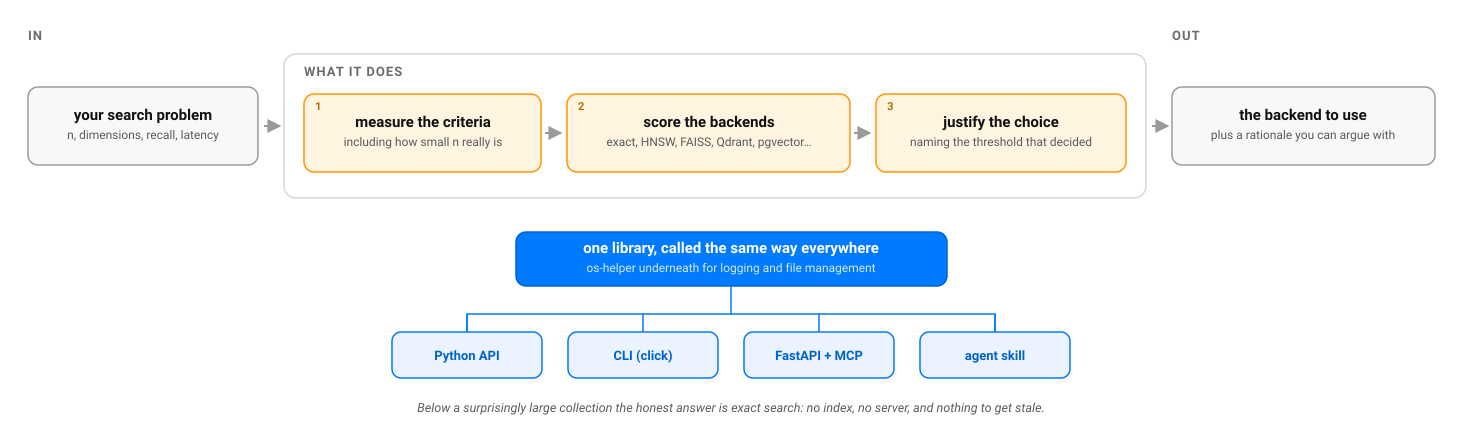
ann-router belongs to the AI Helpers suite. It is a router: you describe
your approximate-nearest-neighbour (ANN) search problem in measured terms (how
many vectors, how many dimensions, how much accuracy you actually need), and it
selects, justifies, and can instantiate the right engine for that problem,
instead of marrying you to a single library that fits today's corpus and not
tomorrow's.
Local-first by design. A routing decision is a pure function of the criteria you pass plus a probe of the machine you are on: no account, no API key, no telemetry, no network call. The engines it then builds run inside your own process unless you deliberately point one at a server.
It is an indispensable component for RAG (retrieval-augmented generation: an AI system that looks up the relevant text before answering, instead of relying only on what a language model memorized during training).
It is the vector-search sibling of
best-engine-ai-helper
(which picks the best local LLM for a machine).
Same philosophy: measure the criteria → select the engine → return a discussable rationale.
The engines it routes among:
exact (brute force) · turbovec · HNSW (hnswlib) · FAISS (IVF/PQ) · Annoy · Qdrant · pgvector
(ScaNN was evaluated and dropped: no Apple-Silicon wheel exists, and the project has abandoned it as a supported backend; see CHANGELOG.md.)
Importing the package is cheap: no engine's optional dependency is loaded at
import time, so import ann_router costs only the four declared core
dependencies (numpy, click, pyyaml, os-helper), and a backend whose dependency
is absent simply reports itself unavailable while the router routes around it:
this is lazy importing.
Status
None of this is a one-off script. Every change runs through continuous
integration (CI, automated checks triggered by each push and pull request):
lint and format checks, then the full test suite, defined in
.github/workflows/tests.yml,
before anything reaches main. Each release is a semantic-versioned
(MAJOR.MINOR.PATCH) git tag, visible with git tag (the current one is
v0.3.0), published to PyPI (the Python Package Index) as ann-router, so
pip install ann-router always installs a version that already passed that
gate.
The version number stays honest about where the project actually stands. At 0.3.x the public interface can still move between releases, and no other published AI Helpers package depends on ann-router yet. Read it today as a standalone routing utility with a tested, CI-gated core, not as a component with years of production mileage behind it elsewhere.
The recall floors pinned in tests/conftest.py (RECALL_THRESHOLDS) are the closest thing to a production contract this project makes: versioned numbers a release cannot quietly slip below.
Documentation
Why route instead of just picking FAISS (or any one engine)?
Because the right engine is a function of the problem, and the problem changes:
a corpus of a few hundred vectors wants an exact scan (instant, recall 1.0); a
corpus with constant inserts/deletes wants turbovec (O(1) mutation); one needing
SQL WHERE-filters wants pgvector; a frozen, memory-tight corpus wants Annoy.
Hard-coding one library gets one of these right and the rest wrong. See
LANDSCAPE.md.
How it works
Installation
Local (conda)
A minimal environment.yaml pins Python + pip and delegates every actual
dependency to requirements.txt:
git clone https://github.com/warith-harchaoui/ann-router.git
cd ann-router
conda env create -f environment.yaml
conda activate ann-router
pip install -e '.[all]'        # or [hnsw]/[faiss]/... for one engine at a time
Server (Docker)
A single image builds every pip-installable backend plus the HTTP API door:
docker build -t ann-router .
docker run --rm -p 8018:8018 ann-router

# Or through Compose, which carries the port and a health probe — and, behind
# --profile backends, the two backends that need a server (qdrant, pgvector)
docker compose up --build
docker compose --profile backends up --build
curl -X POST localhost:8018/route -H 'content-type: application/json' \
    -d '{"n_vectors": 500000, "dim": 768, "dynamic": true}'
Plain pip
git clone https://github.com/warith-harchaoui/ann-router.git
cd ann-router
pip install 'os-helper'
pip install .
Add engines as needed (per-backend extras), or everything at once:
pip install 'ann-router[hnsw]'      # one engine
pip install 'ann-router[all]'       # every pip-installable engine + cli + api
Full, platform-specific instructions, including the Apple Silicon annoy caveat and pgvector notes, are in INSTALL.md.
Quick start
import numpy as np
import ann_router as ar

# 1. Describe the problem in measured terms.
criteria = ar.Criteria(
    n_vectors=2_000_000,
    dim=768,
    dynamic=True,  # frequent adds/removes
    target_recall=0.85,  # below HIGH_RECALL=0.9, turbovec's calibrated ceiling
    hardware=ar.detect_hardware(),
)

# 2. Ask which backend, and why.
choice = ar.route(criteria)
print(choice.backend)
# turbovec
print(choice.rationale)
# corpus receives frequent updates: turbovec offers O(1) add_with_ids/remove(id)
# with no index rebuild, plus TurboQuant 2-4 bit (~16x) compression — graph
# indexes degrade under deletes, so they are avoided here. target_recall=0.85
# is below HIGH_RECALL=0.9, within turbovec's calibrated range.

# 3. Or route + build in one call, then search.
vectors = np.random.default_rng(0).standard_normal((5_000, 768)).astype("float32")
index, choice = ar.auto_index(vectors, ar.Criteria(n_vectors=5_000, dim=768))
print(choice.backend)
# hnsw           (5 000 is already past the calibrated EXACT_MAX_N=1000)
ids, distances = index.search(vectors[:3], k=10)
print(ids.shape)
# (3, 10)
At the house default target_recall=0.95, this same dynamic=True corpus routes
to hnsw instead: turbovec's own calibration
(bench/results/calibrated_policy.yaml)
consistently undershoots recall 0.9, so the router prefers HNSW's better recall
over turbovec's O(1) mutation once the target climbs past HIGH_RECALL=0.9.
Every backend speaks the same ANNIndex interface:
index.build(vectors, ids=None)
index.add(vectors)
index.add_with_ids(vectors, ids)
index.remove(ids)
ids, distances = index.search(queries, k)
index.save(path)
index.load(path)
Backend.capabilities()  # supports_remove / supports_filter / persistent / needs_gpu ...
Operations a backend genuinely cannot do (e.g. Annoy.remove) raise a clear
NotSupported; a backend whose dependency is missing raises BackendUnavailable
with the pip install line that fixes it.
The five doors (one core, five surfaces)
- Library: everything above (
ann_router). - CLI:
ann-router, built with click. Subcommands:route,build,search,bench,capabilities. - HTTP API:
uvicorn ann_router.api:app([api]extra, or the Docker image above):POST /route,GET /capabilities,GET /bench. - MCP server:
ann-router-mcp, equivalentlypython -m ann_router.mcp_server([mcp]extra), the sameroute/capabilities/benchoperations as the HTTP API, auto-exposed as MCP tools viafastapi-mcpathttp://127.0.0.1:8019/mcp(Streamable HTTP, not stdio). - Skill:
skills/ann-router/SKILL.md, so an agent knows when to reach for the router.
ann-router route --n-vectors 2000000 --dim 768 --dynamic --markdown
ann-router bench --n 5000 --dim 128 -k 10
ann-router capabilities
How selection works
The decision tree (tunable via policy.yaml / ANN_ROUTER_POLICY):
flowchart TD
    Q[["n_vectors, dim, target_recall,<br/>dynamic, persistence, hardware..."]]
    Q --> D1{n < EXACT_MAX_N?}
    D1 -->|yes| EXACT([exact])
    D1 -->|no| D2{frequent updates?}
    D2 -->|yes| D2R{target_recall <<br/>HIGH_RECALL?}
    D2R -->|yes| TURBOVEC([turbovec])
    D2R -->|no| HNSW
    D2 -->|no| D3{n >= FAISS_MIN_N<br/>and GPU/batch?}
    D3 -->|yes| FAISS([faiss])
    D3 -->|no| D4{persistence or<br/>metadata filtering?}
    D4 -->|yes, DB in place| PGVECTOR([pgvector])
    D4 -->|yes, no DB| QDRANT([qdrant])
    D4 -->|no| D5{tight memory<br/>budget?}
    D5 -->|yes| ANNOY([annoy])
    D5 -->|no| HNSW([hnsw · default])

    classDef exact fill:#808080,color:#fff,stroke:#808080
    classDef turbovec fill:#AF52DE,color:#fff,stroke:#AF52DE
    classDef faiss fill:#FF9500,color:#fff,stroke:#FF9500
    classDef pgvector fill:#28CD41,color:#fff,stroke:#28CD41
    classDef qdrant fill:#79DBDC,color:#003333,stroke:#79DBDC
    classDef annoy fill:#FFCC00,color:#3d2e00,stroke:#FFCC00
    classDef hnsw fill:#007AFF,color:#fff,stroke:#007AFF
    classDef decision fill:#F8F8F8,color:#000000,stroke:#F8F8F8

    class EXACT exact
    class TURBOVEC turbovec
    class FAISS faiss
    class PGVECTOR pgvector
    class QDRANT qdrant
    class ANNOY annoy
    class HNSW hnsw
    class D1,D2,D2R,D3,D4,D5,Q decision
| # | If the criteria say… | Route to | Because |
|---|---|---|---|
| 1 | n < EXACT_MAX_N |
exact | a brute-force scan is already instant and exact (recall 1.0) |
| 2 | frequent updates + target_recall < HIGH_RECALL |
turbovec | O(1) add/remove, no rebuild; TurboQuant 2-4 bit (~16×) |
| 3 | n >= FAISS_MIN_N + GPU/batch |
FAISS | IVF+PQ scales; GPU batch throughput |
| 4 | persistence + metadata filters | Qdrant / pgvector | on-disk HNSW + payload/SQL WHERE filtering |
| 5 | read-only + tight memory | Annoy | frozen, memory-mapped, very lean |
| 6 | stable in-memory (default) | HNSW | best recall/latency when the index rarely changes |
The shipped values are EXACT_MAX_N=1000, FAISS_MIN_N=20000 and
HIGH_RECALL=0.9, each carrying its calibration note in
ann_router/policy.yaml.
Row 1's EXACT_MAX_N scales with Criteria.latency_budget_ms: a brute-force
scan's cost is ~linear in n for fixed dim, so a budget looser than the 10 ms
reference extends the exact/ANN crossover proportionally, and a tighter one
shrinks it; see ann_router.policy.effective_exact_max_n.
EXACT_MAX_N/FAISS_MIN_N are calibrated from measured recall/latency data
rather than guessed; see
bench/README.md
for the sweep and
bench/results/decision_tree.md
for this project's own tree with the measured thresholds filled in, per
embedding dimension. ann_router/policy.yaml ships the conservative
reduction of those per-dim values into the single scalars the table above
uses (see bench/results/calibrated_policy.yaml for the full evidence).
The router returns not just the name but the criteria that drove it and the alternatives it considered (including any preferred-but-uninstalled engine it fell back from), so the choice is auditable and overridable.
How close was the call?
The rules are threshold-based, so a rationale can read equally confident a hair
either side of a boundary. target_recall=0.89 routes to turbovec;
target_recall=0.90 routes to hnsw. One percentage point — well inside the
noise of how anyone picks a recall target — changes the engine, and nothing in
the wording suggests it.
So every decision also carries sensitivity: the small changes to your criteria
that would change the answer, nearest first.
choice = route(Criteria(n_vectors=500_000, dim=768, dynamic=True, target_recall=0.89))
choice.sensitivity
# [{'criterion': 'target_recall', 'from': 0.89, 'to': 0.9,
#   'backend': 'hnsw', 'relative_change': 0.0112}]
An empty list is the reassuring case: no criterion flips the verdict within 25 %, so the pick is robust to how roughly you measured.
It is a probe, not a hand-written note, which is why it catches things nobody
would have thought to mention. At n_vectors=900 it flags the latency
budget as well as n_vectors — both sit near a boundary there:
route(Criteria(n_vectors=900, dim=128)).sensitivity
# [{'criterion': 'latency_budget_ms', 'from': 10.0, 'to': 9.0,
#   'backend': 'hnsw', 'relative_change': 0.1},
#  {'criterion': 'n_vectors', 'from': 900, 'to': 1008,
#   'backend': 'hnsw', 'relative_change': 0.12}]
Criteria (the input spec)
n_vectors, dim, target_recall, latency_budget_ms, memory_budget_gb,
dynamic, metadata_filtering, hardware (cpu/gpu/apple_silicon,
auto-detectable), persistence, batch_queries, metric
(cosine/l2/ip). Only n_vectors and dim are required.
More
- EXAMPLES.md: a runnable cookbook.
- LANDSCAPE.md: how ann-router compares to just picking one engine.
- CODING.md: the coding standard this repo holds itself to.
- bench/README.md: the measured calibration harness.
- CONTRIBUTING.md · CHANGELOG.md · TRIGGERS.md
Author
Warith HARCHAOUI, Ph.D.
License
BSD-3-Clause; see LICENSE.
1 maintainer

Metadata
1 maintainer
Release files for ann-router 0.3.2
For a detailed explanation of source distributions (sdists) and built distributions (wheels), please see the package formats documentation.
Source distribution (sdist)
| File | Size | Uploaded | Provenance | Actions |
|---|---|---|---|---|
| ann_router-0.3.2.tar.gz | 90.4 kB | Without provenance | Details for ann_router-0.3.2.tar.gz |
Built distribution (wheel)
| File | Interpreter | ABI | Platform | Actions Reset |
|---|---|---|---|---|
| ann_router-0.3.2-py3-none-any.whl | Python 3 | none | any | Details for ann_router-0.3.2-py3-none-any.whl |
Total release size: 167.6 kB
Release files / ann_router-0.3.2.tar.gz
| Download URL | ann_router-0.3.2.tar.gz |
|---|---|
| Size | 90.4 kB |
| Tags | Source |
|
SHA-256 checksum How to use checksums |
6b6a097ad7341b5afab96444c727e15e5eafd82e67a605f0ac475df8b64194f6
|
|
BLAKE2b-256 checksum How to use checksums |
8a23d8706066da01034077e83b884403ba442ce285be1e7b87116a5b96e29ad8
|
| Upload date | |
|
Uploaded using Trusted Publishing? What is trusted publishing? |
No |
| Uploaded via |
twine/7.0.0 CPython/3.13.13
|
Release files / ann_router-0.3.2-py3-none-any.whl
| Download URL | ann_router-0.3.2-py3-none-any.whl |
|---|---|
| Size | 77.2 kB |
| Tags | Python 3 |
|
SHA-256 checksum How to use checksums |
df7675d83853872dd3586e280f6bc7d6fdd015bc84de2cd3e733eba24b8ff0e9
|
|
BLAKE2b-256 checksum How to use checksums |
62c48e854d28c5e78051e48c26dd73cdb3290bcc5c81870f5d6239d83c46e00f
|
| Upload date | |
|
Uploaded using Trusted Publishing? What is trusted publishing? |
No |
| Uploaded via |
twine/7.0.0 CPython/3.13.13
|
Security for ann-router 0.3.2
Provenance
Provenance describes where a file came from. On PyPI, provenance is shared via attestations, which provide a verifiable record of the build or publishing details. View details, limitations and caveats.
No provenance found
None of the files in this release were uploaded with provenance metadata.
A note on package security
PyPI is a repository for distributing packages, not a service for auditing them. While third-party security researchers and our staff do their best to detect and remove malicious packages, PyPI cannot guarantee the quality, security or suitability of any given package.
To learn more about protecting yourself from malicious actors, visit our package security documentation.














