











Overview
The PyMAPDL project supports Pythonic access to MAPDL to be able to communicate with the MAPDL process directly from Python. The latest ansys-mapdl-core package enables a more comprehensive interface with MAPDL and supports:
-
All the features of the original module (for example, Pythonic commands and interactive sessions).
-
Remote connections to MAPDL from anywhere via gRPC.
-
Direct access to MAPDL arrays, meshes, and geometry as Python objects.
-
Low-level access to the MAPDL solver through APDL math in a SciPy- like interface.
Here's a quick demo of PyMAPDL within Visual Studio Code:
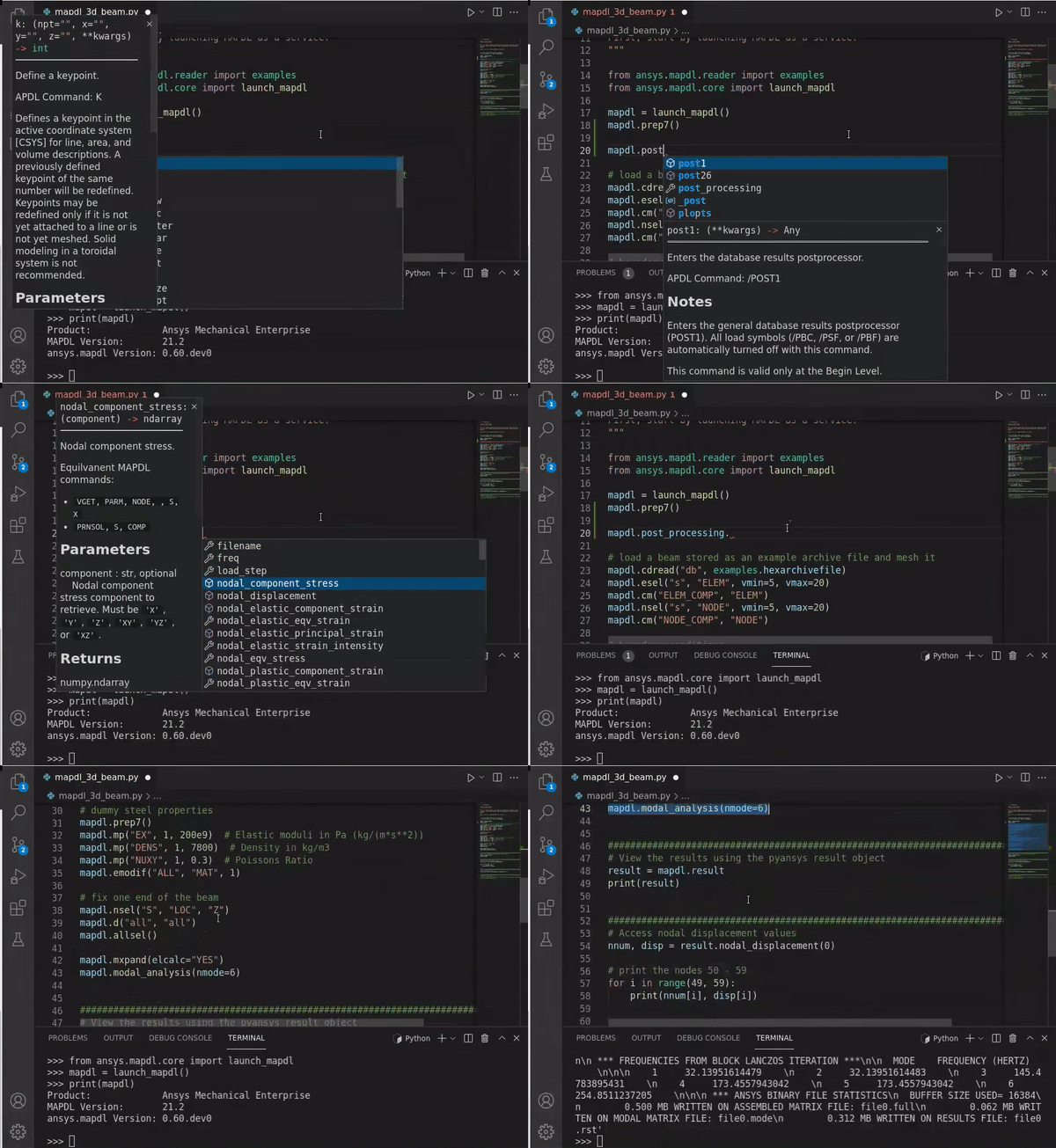
PyMAPDL works within Jupyter Notebooks, the standard Python console, or in batch mode on Windows, Linux, and even macOS.
Documentation and issues
Documentation for the latest stable release of PyMAPDL is hosted at PyMAPDL Documentation.
In the upper right corner of the documentation's title bar, there is an option for switching from viewing the documentation for the latest stable release to viewing the documentation for the development version or previously released versions.
You can also download the PyMAPDL cheat sheet. This one-page reference provides syntax rules and commands for using PyMAPDL.
For troubleshooting, visit Troubleshooting PyMAPDL
On the PyMAPDL Issues page, you can create issues to report bugs and request new features. On the PyMAPDL Discussions page or the Discussions page on the Ansys Developer portal, you can post questions, share ideas, and get community feedback.
To reach the project support team, email PyAnsys Core team. Unfortunately, this team cannot answer specific library questions or issues. You must use the PyMAPDL Issues and PyMAPDL Discussions pages for raising issues, request new features, and asking questions.
You can contribute to PyMAPDL by developing new features, fixing bugs, improving the documentation, fixing typos, writing examples, etc. To learn how to contribute to PyMAPDL, visit Contributing section.
AI-Assisted Development with Specialized Agents
PyMAPDL includes specialized AI agent configurations to help with development, testing, documentation, and code review. These agents work with any LLM-enabled IDE (GitHub Copilot, Cursor, JetBrains AI, etc.):
- Documentation Specialist: Reviews docs, validates docstrings, checks spelling and style
- PyMAPDL Developer: Writes features, fixes bugs, ensures code quality
- Test Engineer: Maintains test coverage, implements mocking strategies
- Code Reviewer: Comprehensive PR reviews ensuring quality standards
See AGENTS.md for detailed agent specifications and .github/HOW_TO_USE_AGENTS.md for usage examples.
Project transition - legacy support
This project was formerly known as pyansys, and we'd like to thank
all the early adopters, contributors, and users who submitted issues,
gave feedback, and contributed code through the years. The
pyansys project has been taken up at Ansys and is being leveraged in
creating new Pythonic, cross-platform, and multi-language service-based
interfaces for Ansys's products. Your contributions to
pyansys has shaped it into a better solution.
The pyansys project is expanding beyond just MAPDL, and while
there are many new features and changes to the original Python module,
many steps have been taken to ensure compatibility with legacy code
while supporting new features. The original Python module has been
split up into the following projects and modules:
For more information on each project, visit their GitHub pages.
Citing this module
If you use PyMAPDL for research and would like to cite the module and source, you can visit Zenodo and generate the correct citation. For example, the BibTex citation is:
@software{alexander_kaszynski_2020_4009467,
  author       = {Alexander Kaszynski},
  title        = {{pyansys: Pythonic interface to MAPDL}},
  month        = nov,
  year         = 2021,
  publisher    = {Zenodo},
  version      = {0.60.3},
  doi          = {10.5281/zenodo.4009466},
  url          = {https://doi.org/10.5281/zenodo.4009466}
@software{alex_kaszynski_2021_5726008,
  author       = {Alex Kaszynski and
                  James Derrick and
                  German and
                  natter1 and
                  FredAns and
                  jleonatti and
                  simonmarwitz and
                  1081 and
                  Daniel Correia and
                  Doug Addy and
                  JackGuyver and
                  jazztekk and
                  jkbgbr and
                  spectereye},
  title        = {pyansys/pymapdl: v0.60.3},
  month        = nov,
  year         = 2021,
  publisher    = {Zenodo},
  version      = {v0.60.3},
  doi          = {10.5281/zenodo.5726008},
  url          = {https://doi.org/10.5281/zenodo.5726008},
}
Because the citation here might not be current, visit the link above to obtain the most recent citation.
License and acknowledgments
PyMAPDL is licensed under the MIT license.
ansys-mapdl-core package
makes no commercial claim over Ansys whatsoever.
This tool extends the functionality of MAPDL by adding a Python
interface to the MAPDL service without changing the
core behavior or license of the original software. The use of the
interactive APDL control of PyMAPDL
requires a legally licensed local copy of Ansys.
To get a copy of Ansys, visit Ansys.
1 maintainer

Download files
Download the file for your platform. If you're not sure which to choose, learn more about installing packages.
Source Distribution
Built Distribution
Filter files by name, interpreter, ABI, and platform.
If you're not sure about the file name format, learn more about wheel file names.
Copy a direct link to the current filters
File details
Details for the file ansys_mapdl_core-0.74.1.tar.gz.
File metadata
- Download URL: ansys_mapdl_core-0.74.1.tar.gz
- Upload date:
- Size: 1.9 MB
- Tags: Source
- Uploaded using Trusted Publishing? Yes
- Uploaded via: twine/6.1.0 CPython/3.13.14
File hashes
| Algorithm | Hash digest | |
|---|---|---|
| SHA256 |
c11d76500aaeb57941daae68c30f17d9a739b106cc091a663d8ec6c02005fce5
|
|
| MD5 |
4dc64ff5ff20a68444624dbf662d86be
|
|
| BLAKE2b-256 |
712bef0d45617f3708c0d9d1c0993f43299936e88e67838fd77bcd238edacbcc
|
Provenance
The following attestation bundles were made for ansys_mapdl_core-0.74.1.tar.gz:
Publisher:
ci.yml on ansys/pymapdl
-
Statement:
-
Statement type:
https://in-toto.io/Statement/v1 -
Predicate type:
https://docs.pypi.org/attestations/publish/v1 -
Subject name:
ansys_mapdl_core-0.74.1.tar.gz -
Subject digest:
c11d76500aaeb57941daae68c30f17d9a739b106cc091a663d8ec6c02005fce5 - Sigstore transparency entry: 2496413202
- Sigstore integration time:
-
Permalink:
ansys/pymapdl@78839539e5ca00ff8c66bf67f8f3f5adb247cc7b -
Branch / Tag:
refs/tags/v0.74.1 - Owner: https://github.com/ansys
-
Access:
public
-
Token Issuer:
https://token.actions.githubusercontent.com -
Runner Environment:
github-hosted -
Publication workflow:
ci.yml@78839539e5ca00ff8c66bf67f8f3f5adb247cc7b -
Trigger Event:
push
-
Statement type:
File details
Details for the file ansys_mapdl_core-0.74.1-py3-none-any.whl.
File metadata
- Download URL: ansys_mapdl_core-0.74.1-py3-none-any.whl
- Upload date:
- Size: 3.0 MB
- Tags: Python 3
- Uploaded using Trusted Publishing? Yes
- Uploaded via: twine/6.1.0 CPython/3.13.14
File hashes
| Algorithm | Hash digest | |
|---|---|---|
| SHA256 |
8f746bb1c2a4f5421ac4362fb61bb5a04ebce4f6477fc91702c653b8a24395cc
|
|
| MD5 |
955144974c8fa77f0ae96052e068adb2
|
|
| BLAKE2b-256 |
f46dad86211063fe0b13e8079377473c5a40737af9976f1582eab0a362d04477
|
Provenance
The following attestation bundles were made for ansys_mapdl_core-0.74.1-py3-none-any.whl:
Publisher:
ci.yml on ansys/pymapdl
-
Statement:
-
Statement type:
https://in-toto.io/Statement/v1 -
Predicate type:
https://docs.pypi.org/attestations/publish/v1 -
Subject name:
ansys_mapdl_core-0.74.1-py3-none-any.whl -
Subject digest:
8f746bb1c2a4f5421ac4362fb61bb5a04ebce4f6477fc91702c653b8a24395cc - Sigstore transparency entry: 2496413289
- Sigstore integration time:
-
Permalink:
ansys/pymapdl@78839539e5ca00ff8c66bf67f8f3f5adb247cc7b -
Branch / Tag:
refs/tags/v0.74.1 - Owner: https://github.com/ansys
-
Access:
public
-
Token Issuer:
https://token.actions.githubusercontent.com -
Runner Environment:
github-hosted -
Publication workflow:
ci.yml@78839539e5ca00ff8c66bf67f8f3f5adb247cc7b -
Trigger Event:
push
-
Statement type:







