

AnyPINN
Solve differential equations with Physics-Informed Neural Networks.
Modular. Training-agnostic. Inverse-problem-first.


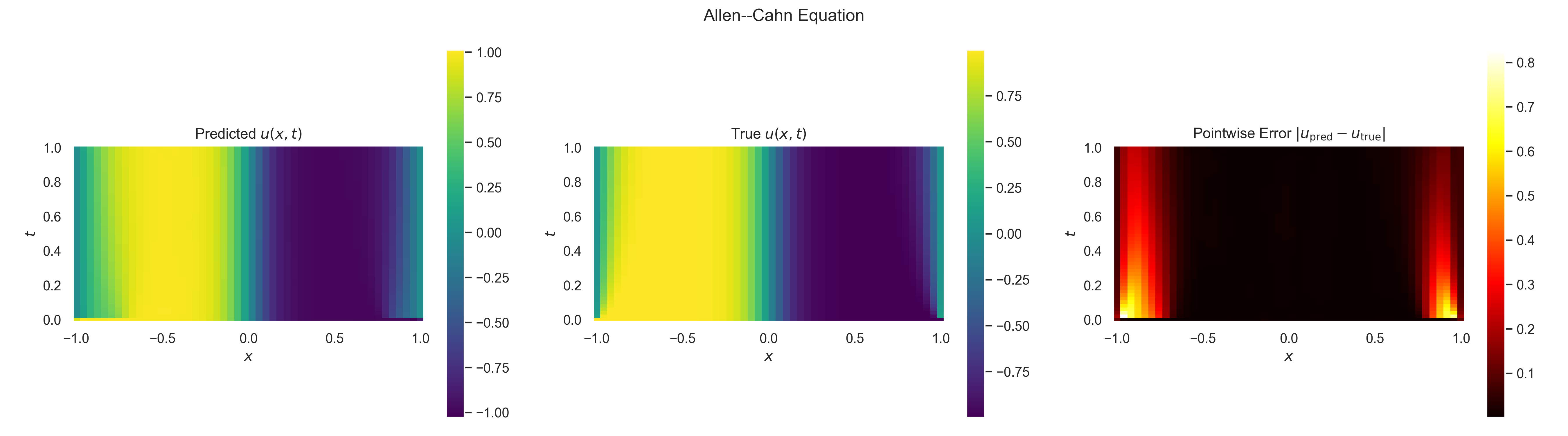
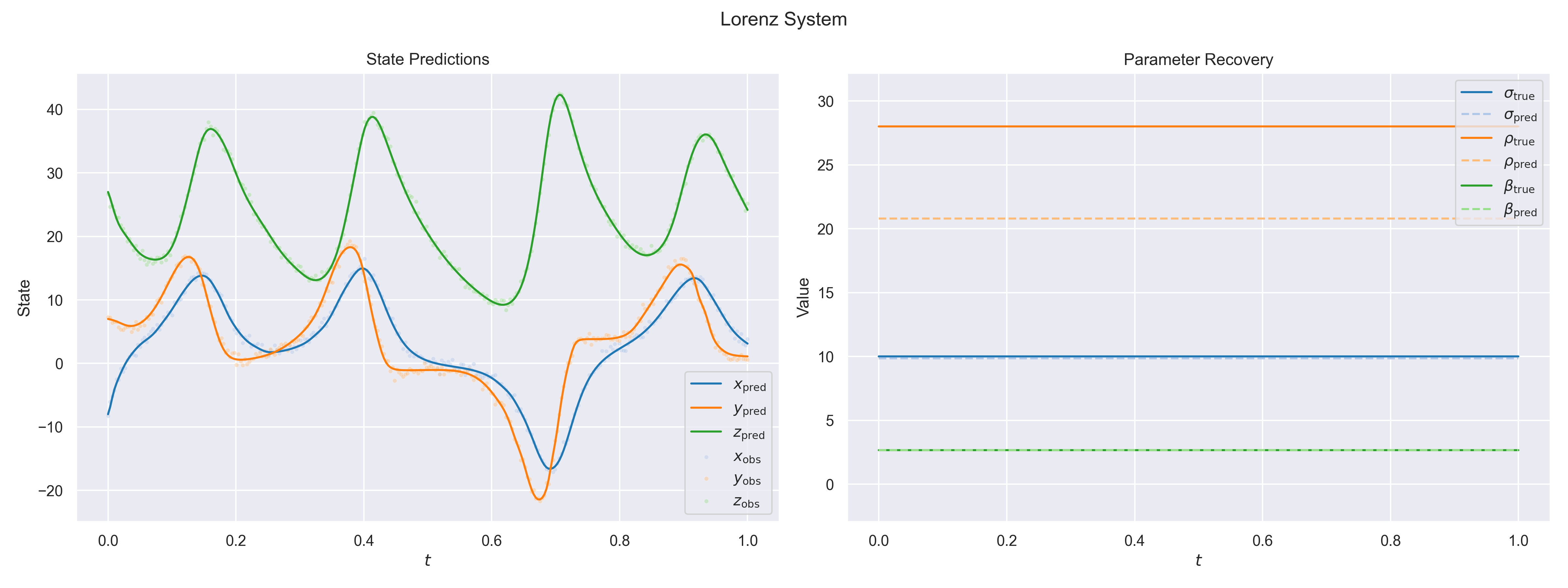
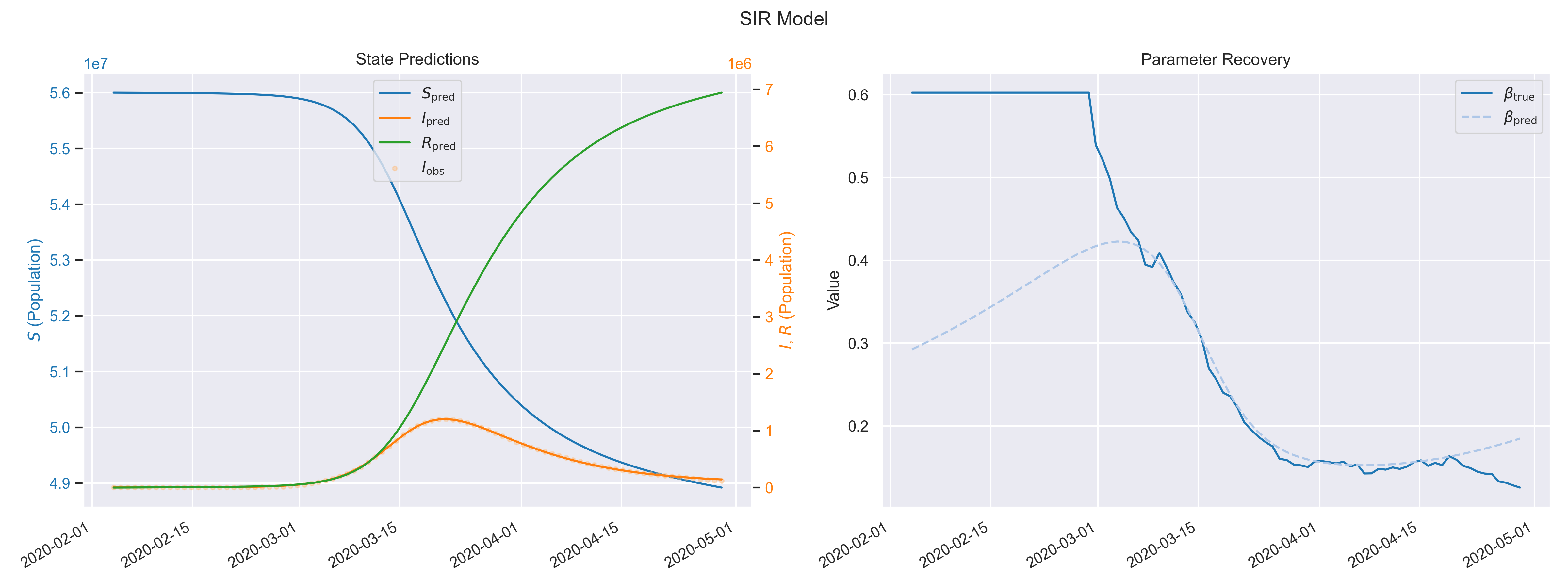
Most PINN libraries make you wire up every loss term, collocation grid, and training loop by hand before you see a single result. AnyPINN gives you a working experiment in one command and then lets you peel back every layer when you're ready.
🚀 Quick Start
The fastest way to start is from the terminal. The command below generates a complete, runnable project interactively, no manual setup needed. uvx lets you run it without installing anything permanently:
uvx anypinn create my-project
pipx works the same way:
pipx run anypinn create my-project
Run anypinn create --help to see all available flags and templates. For a full walkthrough covering project structure, configuration, training, and next steps, see the Getting Started guide.
👥 Who Is This For?
AnyPINN is built around progressive complexity. Start simple, go deeper only when you need to.
| User | Goal | How |
|---|---|---|
| Experimenter | Run a known problem, tweak parameters, see results | Pick a built-in template, change config, press start |
| Researcher | Define new physics or custom constraints | Subclass Constraint and Problem, use the provided training engine |
| Framework builder | Custom training loops, novel architectures | Use anypinn.core directly, no Lightning required |
💡 Examples
The examples/ directory has ready-made, self-contained scripts covering epidemic models, oscillators, predator-prey dynamics, and more, from a minimal ~80-line core-only script to full Lightning stacks. They're a great source of inspiration when defining your own problem.
🔬 Defining Your Own Problem
If you want to go beyond the built-in templates, here is the full workflow for defining a custom inverse problem. The example below uses an ODE; PDEs follow the same pattern with different building blocks (PDEResidualConstraint, DirichletBCConstraint, etc.).
1: Define the equation
Write a function that returns derivatives given the current state and parameters:
from torch import Tensor
from anypinn.core import ArgsRegistry

def my_ode(x: Tensor, y: Tensor, args: ArgsRegistry) -> Tensor:
    k = args["k"](x)        # learnable or fixed parameter
    return -k * y           # simple exponential decay
2: Configure hyperparameters
from dataclasses import dataclass
from anypinn.problems import ODEHyperparameters

@dataclass(frozen=True, kw_only=True)
class MyHyperparameters(ODEHyperparameters):
    pde_weight: float = 1.0
    ic_weight: float = 10.0
    data_weight: float = 5.0
3: Build the problem
from anypinn.problems import ODEInverseProblem, ODEProperties

props = ODEProperties(ode=my_ode, args={"k": param}, y0=y0)
problem = ODEInverseProblem(
    ode_props=props,
    fields={"u": field},
    params={"k": param},
    hp=hp,
)
4: Train
import pytorch_lightning as pl
from anypinn.lightning import PINNModule

# With Lightning (batteries included)
module = PINNModule(problem, hp)
trainer = pl.Trainer(max_epochs=50_000)
trainer.fit(module, datamodule=dm)

# Or with your own training loop (core only, no Lightning)
optimizer = torch.optim.Adam(problem.parameters(), lr=1e-3)
for batch in dataloader:
    optimizer.zero_grad()
    loss = problem.training_loss(batch, log=my_log_fn)
    loss.backward()
    optimizer.step()
For complete walkthroughs, see the custom ODE guide and the PDE forward problems guide.
🏗️ Architecture
Four layers with a strict dependency direction: outer layers depend on inner ones, never the reverse.
graph TD
    EXP["Your Experiment / Generated Project"]

    EXP --> CAT
    EXP --> LIT

    subgraph CAT["anypinn.catalog"]
        direction LR
        CA1[SIR / SEIR]
        CA2[DampedOscillator]
        CA3[LotkaVolterra]
    end

    subgraph LIT["anypinn.lightning (optional)"]
        direction LR
        L1[PINNModule]
        L2[Callbacks]
        L3[PINNDataModule]
    end

    subgraph PROB["anypinn.problems"]
        direction LR
        P1[ResidualsConstraint]
        P2[ICConstraint]
        P3[DataConstraint]
        P4[ODEInverseProblem]
        P5[PDEResidualConstraint]
        P6[DirichletBC · NeumannBC]
    end

    subgraph CORE["anypinn.core (pure PyTorch)"]
        direction LR
        C1[Problem · Constraint]
        C2[Field · Parameter]
        C3[Config · Context]
    end

    CAT -->|depends on| PROB
    CAT -->|depends on| CORE
    LIT -->|depends on| CORE
    PROB -->|depends on| CORE
For a detailed breakdown of each layer, see the Architecture guide.
🤝 Contributing
See CONTRIBUTING.md for setup instructions, code style guidelines, and the pull request workflow.
1 maintainer

Release files for anypinn 0.25.8
For a detailed explanation of source distributions (sdists) and built distributions (wheels), please see the package formats documentation.
Source distribution (sdist)
| File | Size | Uploaded | |
|---|---|---|---|
| anypinn-0.25.8.tar.gz | 43.7 MB | Details |
Built distribution (wheel)
| File | Interpreter | ABI | Platform | Reset |
|---|---|---|---|---|
| anypinn-0.25.8-py3-none-any.whl | Python 3 | none | any | Details |
Total release size: 43.8 MB
Release files / anypinn-0.25.8.tar.gz
| Download URL | anypinn-0.25.8.tar.gz |
|---|---|
| Size | 43.7 MB |
| Tags | Source |
|
SHA-256 checksum How to use checksums |
3c171e3cb52f241af13828295d7e178e82409fdba9a0aefd295ef64f64e418ce
|
|
BLAKE2b-256 checksum How to use checksums |
606aff0d6ec69c3435b9d42594143e08663fdfccdb0d1a9b1a34d7528887cd82
|
| Upload date | |
|
Uploaded using Trusted Publishing? What is trusted publishing? |
Yes |
| Uploaded via |
twine/6.1.0 CPython/3.13.12
|
Provenance
Provenance describes where a file came from. On PyPI, provenance is shared via attestations, which provide a verifiable record of the build or publishing details. View details, limitations and caveats.


PyPI Publish Attestation
PyPI verified that this artifact, at this checksum, originated from the publisher listed below.
Signed by GitHub Actions, verified by PyPI on May 5, 2026.
Transparency logRelease files / anypinn-0.25.8-py3-none-any.whl
| Download URL | anypinn-0.25.8-py3-none-any.whl |
|---|---|
| Size | 132.8 kB |
| Tags | Python 3 |
|
SHA-256 checksum How to use checksums |
f16ab41b0659d3427cd610c489336e0ccdf1d019f5b25ee5855ee55900f606e8
|
|
BLAKE2b-256 checksum How to use checksums |
fadc7c7e6db4e72ce06393bb7ec1c53dd95835292a503995bb0ea91a1532c298
|
| Upload date | |
|
Uploaded using Trusted Publishing? What is trusted publishing? |
Yes |
| Uploaded via |
twine/6.1.0 CPython/3.13.12
|
Provenance
Provenance describes where a file came from. On PyPI, provenance is shared via attestations, which provide a verifiable record of the build or publishing details. View details, limitations and caveats.
PyPI Publish Attestation
PyPI verified that this artifact, at this checksum, originated from the publisher listed below.
Signed by GitHub Actions, verified by PyPI on May 5, 2026.
Transparency log













