

aqta-verify-receipt



Check what an AI was allowed to do, without trusting the company that ran it.
Seal signs each AI decision that passes through it, at the moment it happens: model calls and agent actions, refusals included. This package checks those signed records on your own machine. No account, no call to Aqta. Change one field and the check fails.
Try it in 10 seconds
curl -sO https://app.aqta.ai/samples/sample-receipt.json
pip install aqta-verify-receipt
aqta-verify-receipt sample-receipt.json --key 9Y3Eiq6V8QjRDUM5nPqSwKIOPQaoEU4SbagfYFdvWa4
# ✓ valid  ALLOWED  520a…853a94  pinned issuer key
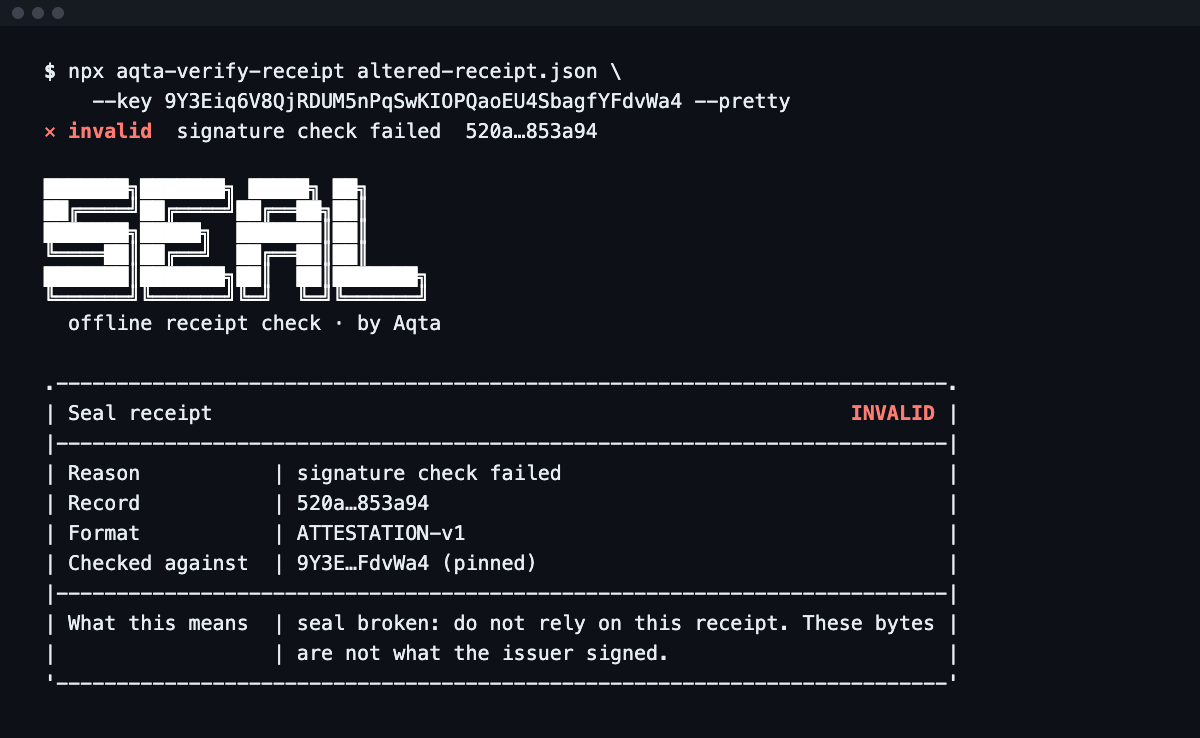
Now change "outcome" in the file and run it again:
✕ invalid signature check failed 520a…853a94
Try it in one line
npx aqta-verify-receipt receipt.json --key <issuer key> --pretty
pipx run aqta-verify-receipt receipt.json --key <issuer key> --pretty
--pretty prints the compact line, then a card that says what the check proves and what it does not. It never changes the verdict or the exit code. On the sample receipt above:
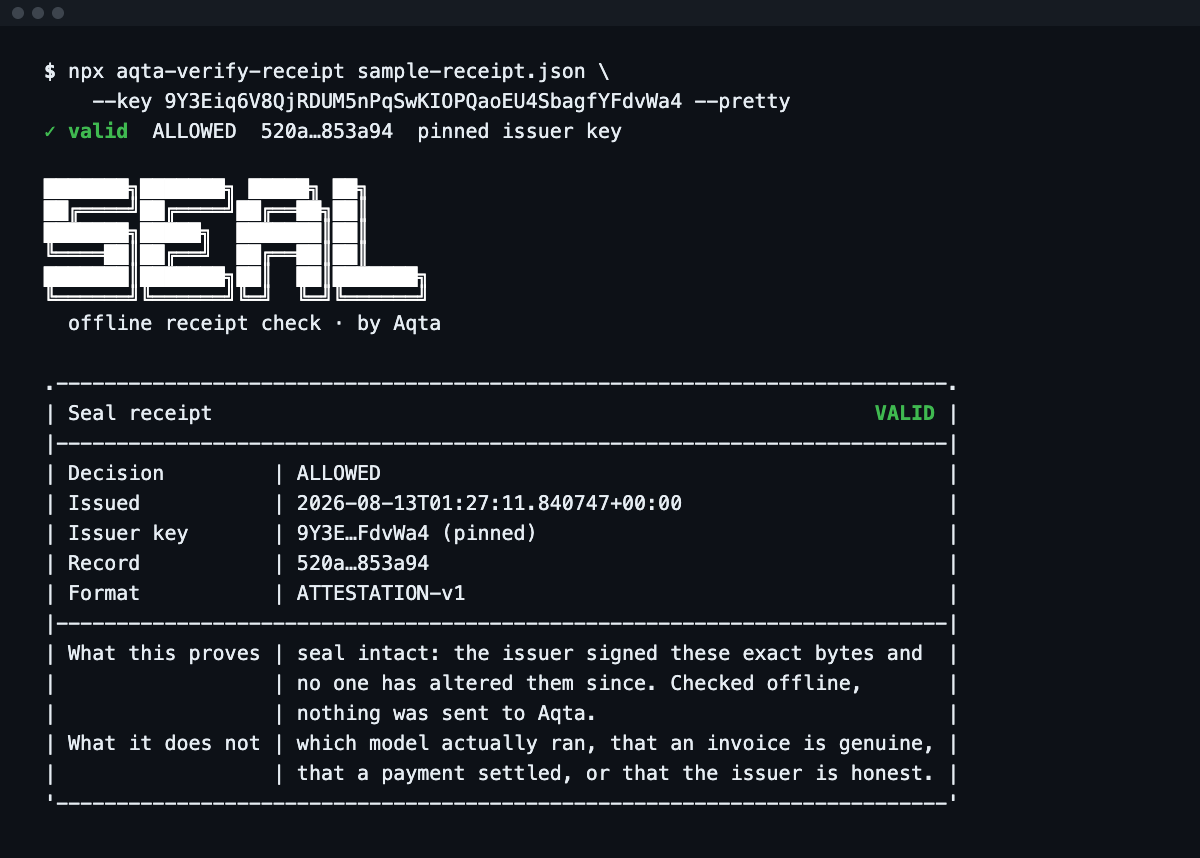
And on a copy with "outcome" changed:
Why it exists
- A log is kept by whoever runs the system. A signed record can be checked by anyone else, offline, against a published key.
- Two verifiers, written separately: this one and the TypeScript (npm) one. They must return the same verdict on every published test vector.
- In use: Authority Arena, an open evaluation of 21 AI models, checks all 1,529 of its signed records with this package.
30-second check
pip install aqta-verify-receipt
aqta-verify-receipt receipt.json \
  --key 9Y3Eiq6V8QjRDUM5nPqSwKIOPQaoEU4SbagfYFdvWa4
Default output is one compact line (words carry meaning; colour is optional):
✓ valid ALLOWED 2d41…871e94c pinned issuer key
Invalid:
✕ invalid signature mismatch 2d41…871e94c
Optional human-readable card (the compact line and exit code are the result;
--pretty prints that same line first, so head -1 still gives it, then the
card, which says what the signature proves and what it does not):
aqta-verify-receipt receipt.json --key <pinned> --pretty
✓ valid  BLOCKED  0000…000002  pinned issuer key

███████╗███████╗ █████╗ ██╗
██╔════╝██╔════╝██╔══██╗██║
███████╗█████╗  ███████║██║
╚════██║██╔══╝  ██╔══██║██║
███████║███████╗██║  ██║███████╗
╚══════╝╚══════╝╚═╝  ╚═╝╚══════╝
  offline receipt check · by Aqta

.--------------------------------------------------------------------------.
| Seal receipt                                                       VALID |
|--------------------------------------------------------------------------|
| Decision         | BLOCKED                                               |
| Issued           | 2026-04-23T10:15:30.000000+00:00                      |
| Issuer key       | alWz…7oix4E (pinned)                                  |
| Record           | 0000…000002                                           |
| Format           | ATTESTATION-v1                                        |
|--------------------------------------------------------------------------|
| What this proves | seal intact: the issuer signed these exact bytes and  |
|                  | no one has altered them since. Checked offline,       |
|                  | nothing was sent to Aqta.                             |
| What it does not | which model actually ran, that an invoice is genuine, |
|                  | that a payment settled, or that the issuer is honest. |
'--------------------------------------------------------------------------'
The header is block letters and the card frame is plain ASCII. When the
terminal is not UTF-8, when NO_UNICODE is set, or with --ascii, the header
becomes plain ASCII letters and so does every mark. The card fits an 80-column
terminal, carries no colour when piped or under NO_COLOR, and never changes
the exit code or the verdict. scripts/pretty-interop-sweep.mjs compares it
across both reference CLIs on every vector.
Or pipe:
curl -sS https://api.aqta.ai/v1/receipts/YOUR_RECEIPT_ID/public | aqta-verify-receipt - \
  --key 9Y3Eiq6V8QjRDUM5nPqSwKIOPQaoEU4SbagfYFdvWa4
| Exit | Meaning |
|---|---|
0 |
valid |
1 |
invalid |
2 |
usage / IO |
Current production key id: aqta-att-01269bb4b6a7d950
(/v1/attestation/public-key).
Pin that string; do not re-fetch it inside a verify loop. Keys rotate and
receipts do not: a receipt verifies against the key current when it was
signed, and the permanent key record (with retired keys and their validity
windows) is at
app.aqta.ai/security/issuer-keys.txt.
Library
from aqta_verify_receipt import verify_receipt, fetch_published_public_key

# Once per environment: fetch, then pin somewhere you control.
trusted = fetch_published_public_key()

result = verify_receipt(receipt, trusted_public_key=trusted)
if not result.valid:
    raise ValueError(result.reason)
CLI
aqta-verify-receipt <file|-> --key <base64url> [--no-strict] [--json] [--pretty] [--ascii] [-q]
aqta-verify-receipt <file|-> --integrity-only [--no-strict] [--json] [--pretty] [--ascii] [-q]
| Flag | Meaning |
|---|---|
--key |
Pin the issuer key. Required unless --integrity-only. |
--integrity-only |
Signature vs embedded key only; returns untrusted. Anyone can self-sign. |
--no-strict |
Allow unknown top-level fields |
--json |
One JSON object on stdout |
--pretty |
Optional human-readable card after the compact line |
--ascii |
Plain ASCII output: no block letters or Unicode marks |
-q |
Silent; exit code only |
NO_COLOR=1 disables colour and NO_UNICODE=1 gives plain ASCII output. Meaning never depends on colour alone.
Pinning is required by default. Without --key, pass --integrity-only
(embedded key only; anyone can self-sign; result is marked untrusted).
Dependencies
cryptography (>= 42) for constant-time Ed25519. Nothing else.
Chain profile (draft)
GRANT-v1 and USE-v1 are draft specifications, not frozen; their wire
formats may change. --profile chain checks a bundle of GRANT-v1 approvals,
USE-v1 records and the ACTION-v1 records they authorised, and returns PASS,
FAIL or INCOMPLETE. Missing evidence is INCOMPLETE, never PASS, and
without --approver-keys an authorised action is INCOMPLETE.
aqta-verify-receipt bundle.json --profile chain --key <issuer key> --approver-keys <k1,k2>
Exit 0 PASS, 1 FAIL, 3 INCOMPLETE, 2 usage or IO. --key is required;
--integrity-only and --no-strict are refused. Library:
from aqta_verify_receipt import verify_chain, then
verify_chain(bundle, trusted_public_key=..., approver_keys=[...]).
Opt-in only: nothing selects this profile from a record's shape. The two
separately written verifiers, this one and the TypeScript one, must return the
same verdict and reason on every vector in
test-vectors/chain/.
Transparency proofs
A receipt signature answers what the issuer asserted. It cannot answer whether that entry is in the issuer's log, or whether the log has only ever grown.
from aqta_verify_receipt import verify_inclusion_proof, verify_consistency_proof

result = verify_inclusion_proof(proof)
if not result.valid:
    raise ValueError(result.reason)
RFC 6962 inclusion and consistency verification, plus the signed-tree-head signature. Written separately from the TypeScript implementation rather than ported, and checked against the transparency vectors in the repository.
An inclusion proof establishes that what you were shown is genuinely in the log. It does not establish that what you were not shown is irrelevant. That is omission, and it is open.
Scope
A small offline verifier for signed Seal records and their log proofs. It reads a record and a key, and reports a verdict. It does not store, send or host records, and it never contacts Aqta.
Licence
Apache-2.0. Aqta Technologies Limited.
If you implement or cite the ATTESTATION-v1 format itself, credit under CC-BY-4.0: see the repo CITATION.cff.
1 maintainer

Metadata
1 maintainer
Release files for aqta-verify-receipt 1.4.2
For a detailed explanation of source distributions (sdists) and built distributions (wheels), please see the package formats documentation.
Source distribution (sdist)
| File | Size | Uploaded | Provenance | Actions |
|---|---|---|---|---|
| aqta_verify_receipt-1.4.2.tar.gz | 56.6 kB | With provenance | Details for aqta_verify_receipt-1.4.2.tar.gz |
Built distribution (wheel)
| File | Interpreter | ABI | Platform | Actions Reset |
|---|---|---|---|---|
| aqta_verify_receipt-1.4.2-py3-none-any.whl | Python 3 | none | any | Details for aqta_verify_receipt-1.4.2-py3-none-any.whl |
Total release size: 104.5 kB
Release files / aqta_verify_receipt-1.4.2.tar.gz
| Download URL | aqta_verify_receipt-1.4.2.tar.gz |
|---|---|
| Size | 56.6 kB |
| Tags | Source |
|
SHA-256 checksum How to use checksums |
6e293353e0142cad933c2611f3649257b28ab2753d3c6ce4ae52e13c6781d77d
|
|
BLAKE2b-256 checksum How to use checksums |
e40b32794bdd85e9d664afdf5c3148ea096542be56ed4da695c16fed3057c81f
|
| Upload date | |
|
Uploaded using Trusted Publishing? What is trusted publishing? |
Yes |
| Uploaded via |
twine/7.0.0 CPython/3.13.16
|
Provenance
Provenance describes where a file came from. On PyPI, provenance is shared via attestations, which provide a verifiable record of the build or publishing details. View details, limitations and caveats.


PyPI Publish Attestation
PyPI verified that this artifact, at this checksum, originated from the publisher listed below.
Signed by GitHub Actions, verified by PyPI on Nov 18, 2026.
Transparency logRelease files / aqta_verify_receipt-1.4.2-py3-none-any.whl
| Download URL | aqta_verify_receipt-1.4.2-py3-none-any.whl |
|---|---|
| Size | 47.9 kB |
| Tags | Python 3 |
|
SHA-256 checksum How to use checksums |
19c6a1343da1defe50923a5e1dbb6b42da60656963c5f60b4fbae46c2aeb51bb
|
|
BLAKE2b-256 checksum How to use checksums |
3d6f785ee2d3432733767911136e94ad85e441a9a74bb129dec9f34aff6e4a76
|
| Upload date | |
|
Uploaded using Trusted Publishing? What is trusted publishing? |
Yes |
| Uploaded via |
twine/7.0.0 CPython/3.13.16
|
Provenance
Provenance describes where a file came from. On PyPI, provenance is shared via attestations, which provide a verifiable record of the build or publishing details. View details, limitations and caveats.
PyPI Publish Attestation
PyPI verified that this artifact, at this checksum, originated from the publisher listed below.
Signed by GitHub Actions, verified by PyPI on Nov 18, 2026.
Transparency logSecurity for aqta-verify-receipt 1.4.2
Provenance
Provenance describes where a file came from. On PyPI, provenance is shared via attestations, which provide a verifiable record of the build or publishing details. View details, limitations and caveats.
Full provenance
Both files in this release have been uploaded with provenance metadata.
Attestation for aqta_verify_receipt-1.4.2.tar.gz
PyPI Publish Attestation
PyPI verified that this artifact, at this checksum, originated from the publisher listed below.
Signed by GitHub Actions, verified by PyPI on Nov 18, 2026.
Transparency logA note on package security
PyPI is a repository for distributing packages, not a service for auditing them. While third-party security researchers and our staff do their best to detect and remove malicious packages, PyPI cannot guarantee the quality, security or suitability of any given package.
To learn more about protecting yourself from malicious actors, visit our package security documentation.














