
AQVEN
Discover what your AI workflow needs to work reliably. AQVEN is a Python framework and a local Studio for building reliable LLM workflows: multi-step pipelines of models, tools and human review. Your coding agent runs the experiments. You see the evidence and decide.
Documentation · Quickstart · Use cases · Studio · GitHub
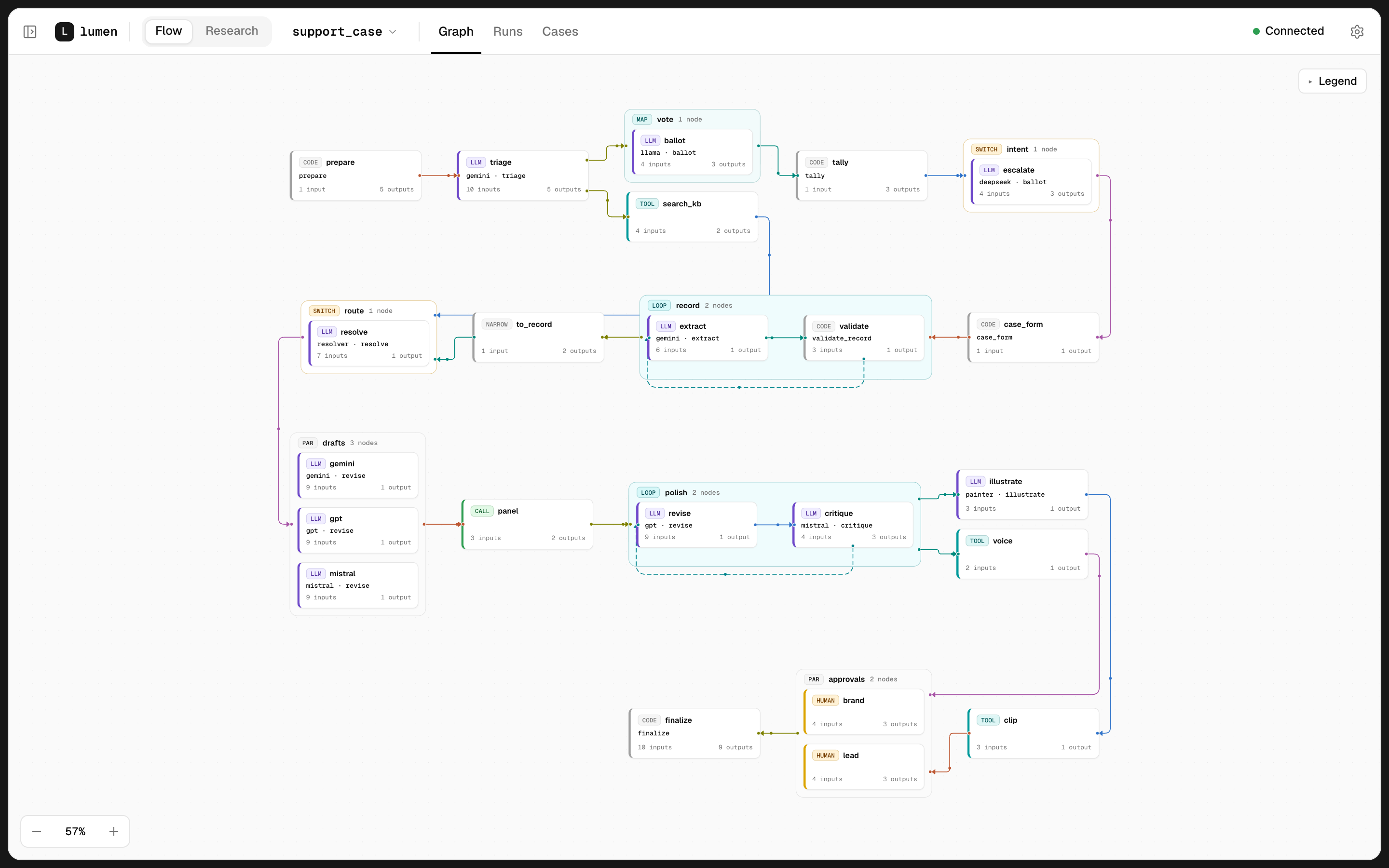
AQVEN keeps an AI workflow as typed files in your repository: a flow, one file per step, prompts in
Markdown, and declared types, agents and tools. aqven check validates every connection and simulates
every flow before you spend a token. Studio, a local browser app in the same install, shows each run
step by step. Your coding agent (Claude Code, OpenCode, Codex or any MCP client) works on the same files through AQVEN's
MCP server, and runs experiments whose verdicts AQVEN computes.
AQVEN is in alpha: expect changes between releases.
What it's for
- Find. "What am I missing?" Your agent explores cases and variants you wouldn't try yourself.
- Explain. "Why did this fail?" Follow a bad answer back to the step where it started.
- Compare. "What should I change?" Models and prompts side by side, with cost and latency.
- Confirm. "Can I trust this change?" A verdict on held-out cases that is allowed to say inconclusive.
- Build. "How do I keep it readable as it grows?" Typed files in your repo, checked before a run costs a token.
Install
You need uv. AQVEN runs on Python 3.14, and uv fetches it for you. Studio ships inside the package: no Node.js toolchain, nothing to build.
uv tool install aqven
aqven new my_project --template minimal --provider openrouter
cd my_project
uv run aqven check my_project
errors: 0, warnings: 0
aqven new writes the project, installs its environment and generates typed Python models. It also
prepares the project for a coding agent: AGENTS.md, CLAUDE.md, an .mcp.json that registers AQVEN's
MCP server, and Claude Code hooks that run aqven check as the agent works. aqven check needs no API key
and no network.
Work with your coding agent
Start Claude Code in the project, approve the aqven server, and hand it a task. It builds the flow,
explores on working cases and confirms once on held-out cases; you read the first traces and make the
decisions. Open Studio next to it with uv run aqven dev my_project.
For OpenCode, Codex, Cursor or another MCP client, see How to set up a coding agent outside Studio.
Commands
| Command | What it does |
|---|---|
aqven new |
creates a project from a template, installs its environment and generates its models |
aqven check |
checks the project and simulates every flow without network or tokens |
aqven run |
runs a flow locally and prints run events as they happen |
aqven dev |
starts the project server and opens Studio in the browser |
aqven serve |
the project server without a browser: Studio API, engine and MCP |
aqven mcp |
MCP over stdio, for a coding agent outside Studio |
Built on
Pydantic AI calls the models, DBOS checkpoints every run on SQLite, the official MCP Python SDK serves and consumes MCP, and FastAPI serves Studio and the API. Runs locally.
FAQ
What is AQVEN? A Python framework and a local Studio for building reliable LLM workflows. A workflow is a set of typed files in your repository: a flow, one file per step, prompts in Markdown, and declared types, agents and tools. AQVEN checks the files before a run, runs the flow with checkpoints, and runs experiments on cases to tell you whether a change helped.
Is AQVEN open source? No. It is source-available under the AQVEN License 1.0.0, which is based on the PolyForm Shield License 1.0.0. You may use it for any purpose, including production and commercial products, and the workflows you build are yours to sell. You may not use it to provide a product that competes with AQVEN, and you may redistribute AQVEN itself only free of charge and for a non-commercial purpose. See License below.
Which Python version does it need? Python 3.14. uv fetches it for you.
Which coding agents does it work with? Claude Code and Codex in Studio's chat. In your own
terminal: Claude Code, OpenCode and Codex from the files aqven new writes into the project, and any
other MCP client, such as Cursor, through AQVEN's MCP server.
Which model providers can I use? The provider catalog has 28 entries through Pydantic AI, from OpenAI, Anthropic and Google to OpenRouter, Mistral, DeepSeek, Groq and Ollama.
Do I need an account or a hosted service? No. AQVEN runs on your machine. aqven check needs neither a
model key nor the network; a real run needs a key for the provider you choose.
What does aqven check do? It validates every file, type reference, binding and prompt, then simulates
a run of every flow with stand-ins for the model calls, so most wiring mistakes surface before a run costs
a token.
Does a "confirmed" verdict guarantee quality? No. A verdict holds for the cases, checks and versions it measured. It is evidence for a decision, not a guarantee about every future output.
How is AQVEN different from an eval library? Eval libraries typically score the outputs of an app you already have. AQVEN also holds the workflow itself as typed files that are checked before they run, and its experiments write the question down before any data and give a verdict on held-out cases that is allowed to say "inconclusive". If you only need to score an existing app, an eval library is the lighter choice.
License
AQVEN is source-available, not open source, under the AQVEN License 1.0.0, based on PolyForm Shield 1.0.0. Use it for any purpose, including in production and in commercial products you build with it. You may not use it to provide a product that competes with AQVEN, and you may redistribute AQVEN itself only free of charge and for a non-commercial purpose. Full terms: LICENSE.
Copyright Kirill Burkhanov.
1 maintainer

Metadata
1 maintainer
Release files for aqven 0.0.6
For a detailed explanation of source distributions (sdists) and built distributions (wheels), please see the package formats documentation.
Source distribution (sdist)
| File | Size | Uploaded | Provenance | Actions |
|---|---|---|---|---|
| aqven-0.0.6.tar.gz | 2.1 MB | Without provenance | Details for aqven-0.0.6.tar.gz |
Built distribution (wheel)
| File | Interpreter | ABI | Platform | Actions Reset |
|---|---|---|---|---|
| aqven-0.0.6-py3-none-any.whl | Python 3 | none | any | Details for aqven-0.0.6-py3-none-any.whl |
Total release size: 4.8 MB
Release files / aqven-0.0.6.tar.gz
| Download URL | aqven-0.0.6.tar.gz |
|---|---|
| Size | 2.1 MB |
| Tags | Source |
|
SHA-256 checksum How to use checksums |
7055000d4928d9920e3620afe3fc5251dc180ad88d651f9c317cca8d50c6e970
|
|
BLAKE2b-256 checksum How to use checksums |
c46b31ce8daac2652caa8717e507ffca60f0eb4d48e17672e1e2d8458d29bf07
|
| Upload date | |
|
Uploaded using Trusted Publishing? What is trusted publishing? |
Yes |
| Uploaded via |
uv/0.12.15 {"installer":{"name":"uv","version":"0.12.15","subcommand":["publish"]},"python":null,"implementation":{"name":null,"version":null},"distro":{"name":"Ubuntu","version":"26.04","id":"resolute","libc":null},"system":{"name":null,"release":null},"cpu":null,"openssl_version":null,"setuptools_version":null,"rustc_version":null,"ci":true}
|
Release files / aqven-0.0.6-py3-none-any.whl
| Download URL | aqven-0.0.6-py3-none-any.whl |
|---|---|
| Size | 2.7 MB |
| Tags | Python 3 |
|
SHA-256 checksum How to use checksums |
8bd0a96c47e2f47e13afe866aa760855153fde99318c25d9ed7d6fe9c009a4e9
|
|
BLAKE2b-256 checksum How to use checksums |
8e913d019dd5122662a649ec5a6f29185d8e4802b7cb13a7c55111feb41d3412
|
| Upload date | |
|
Uploaded using Trusted Publishing? What is trusted publishing? |
Yes |
| Uploaded via |
uv/0.12.15 {"installer":{"name":"uv","version":"0.12.15","subcommand":["publish"]},"python":null,"implementation":{"name":null,"version":null},"distro":{"name":"Ubuntu","version":"26.04","id":"resolute","libc":null},"system":{"name":null,"release":null},"cpu":null,"openssl_version":null,"setuptools_version":null,"rustc_version":null,"ci":true}
|
Security for aqven 0.0.6
Provenance
Provenance describes where a file came from. On PyPI, provenance is shared via attestations, which provide a verifiable record of the build or publishing details. View details, limitations and caveats.
No provenance found
None of the files in this release were uploaded with provenance metadata.
A note on package security
PyPI is a repository for distributing packages, not a service for auditing them. While third-party security researchers and our staff do their best to detect and remove malicious packages, PyPI cannot guarantee the quality, security or suitability of any given package.
To learn more about protecting yourself from malicious actors, visit our package security documentation.














