
Archkeel
The agent declares before it submits. The check is deterministic.


Archkeel checks architecture boundaries and declared changes in AI-assisted code. It compares an accepted commit with a candidate, checks their scans against the configured contract, and verifies that the candidate matches an expectation published before its first submission.
It catches two failure modes that finding-only diffs miss:
- the architecture changed without being declared;
- the scanner saw less of the program, so the result looks clean only because the graph became blinder.
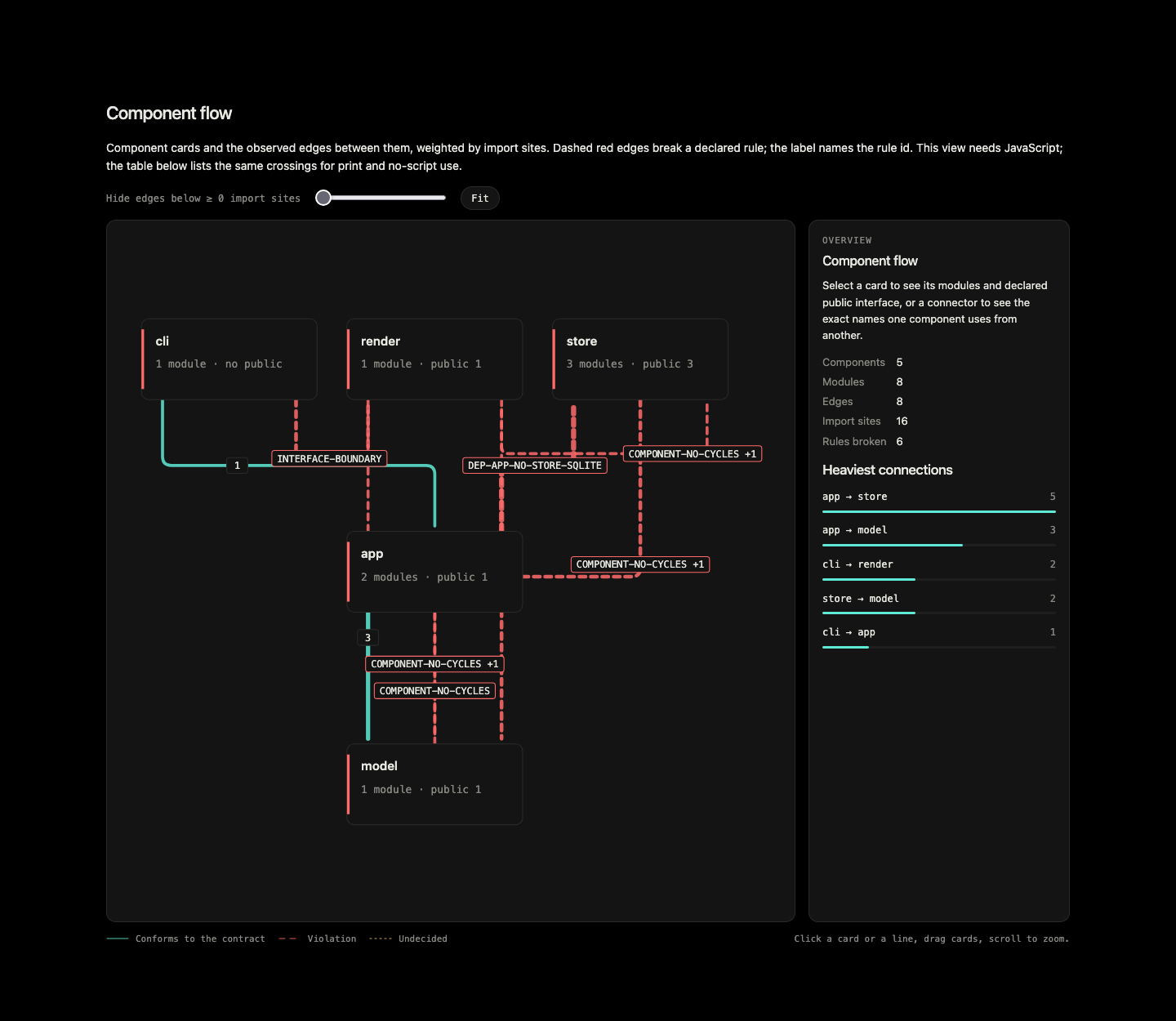
A real negative case from the fixtures/F-architecture tour:
shop.store.repository imports Money and breaks
DEP-STORE-NO-MONEY. In the open HTML report, Violations only collapses
secondary detail and leaves the verdict, failures, unknowns and evidence available; Component
flow's Violating edges only control keeps only broken edges at the current level.
Both change the view, never the verdict or evidence. This capture uses Fit overview
and focuses on app;
All components and groups restores the unassigned module omitted by that focus.
Labels without space on their edge move beside the graph and name their source and target;
select one for its complete rule evidence.
Modules without a unique declared owner remain reachable through a navigation-only
Unassigned modules group; it does not create a component boundary or verdict.
Try the demo · Onboard your project · How it works · Reference · Roadmap
Implemented and planned work is tracked in the roadmap.
What it does, on one sample
Everything below uses fixtures/F-architecture, a small shop with five components where
store is large enough to need an architecture of its own. make demo-onboarding is an
INTERVIEW-MODE REPLAY: it runs command implementations against pre-approved decision fixtures.
No live agent or architect approvals occur; tests pin the printed results to the commands.
1. The agent drafts; interview decisions come from the architect
archkeel init observes packages and imports, drafts one component per subpackage with its
public interface, and writes no dependency rules. It derives 20 open ordered pairs from the
draft, heaviest first. validate refuses that draft. The replay then checks the committed,
architect-attributed fixture contract; that fixture stands in for an earlier interview and is
not a live approval in this run.
decided_by records authorship for rules, requires entries and component public lists. In
auto mode, the agent can author decisions; that attribution does not mean a human approved them.
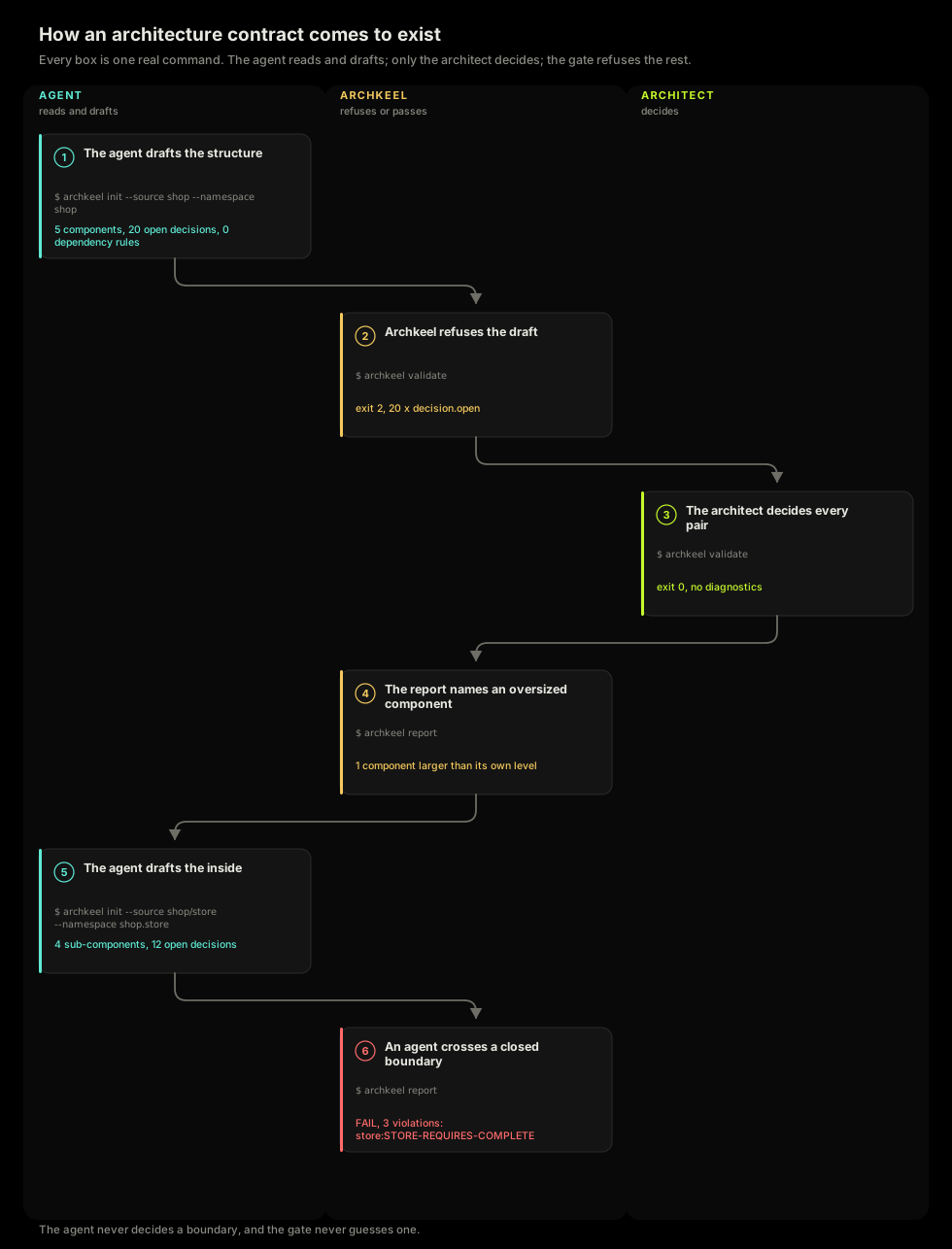
Rendered from the replay results, not by hand. make demo-onboarding prints the
same seven steps. Committed decision fixtures stand in for earlier interview answers.
2. A component that outgrows its level gets one of its own
The report names store: 7 modules where the whole level has 5 components. That is a claim,
not permission to split. init --source shop/store --namespace shop.store --force separately
drafts backend, codec, repository and sqlite, with 12 open pairs. The approved nested
fixture maps shop.store.sqlite to api and records three requires entries: api → backend,
repository → backend, and repository → codec. complete_requires makes every absent pair
forbidden. These are replayed fixture decisions, not approvals made during the demo.
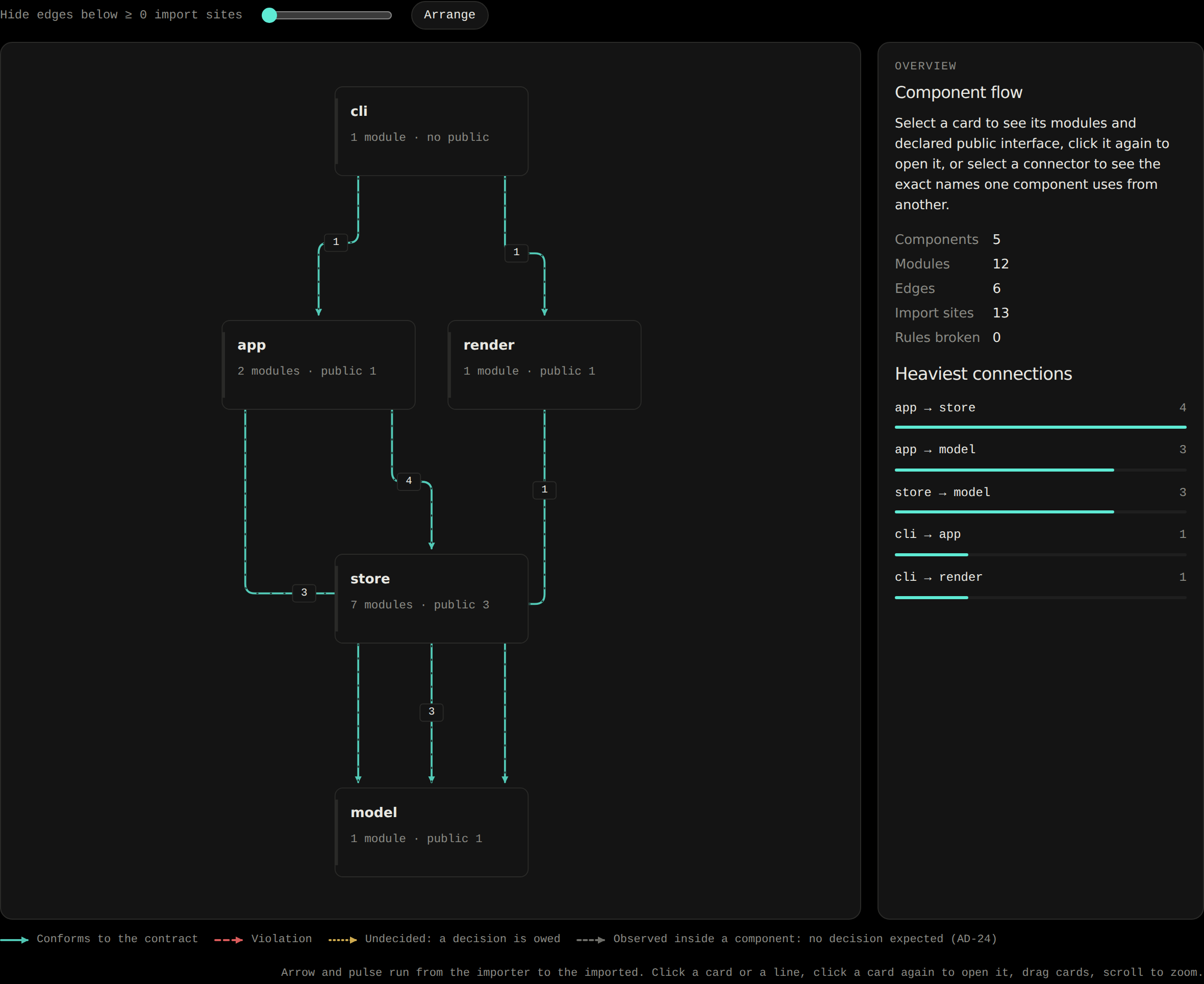
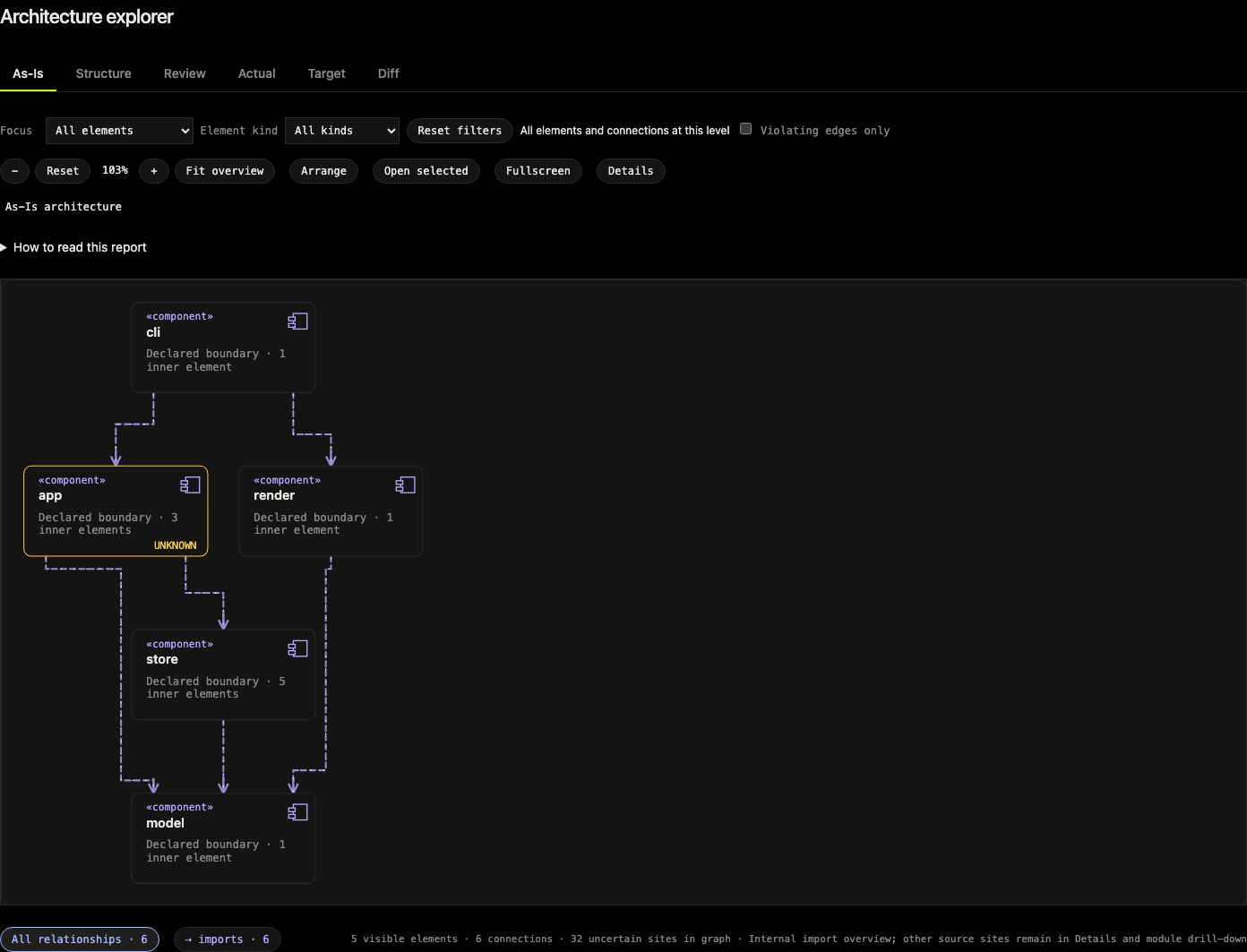
Fit overview shows the five components and their scoped json dependency.
The interactive diagram starts at 100% zoom; scroll to explore it. Every edge carries its
import sites; teal means the displayed imports were checked without an edge violation or UNKNOWN.
store shows 7 modules against a level of 5 components — that is the claim.
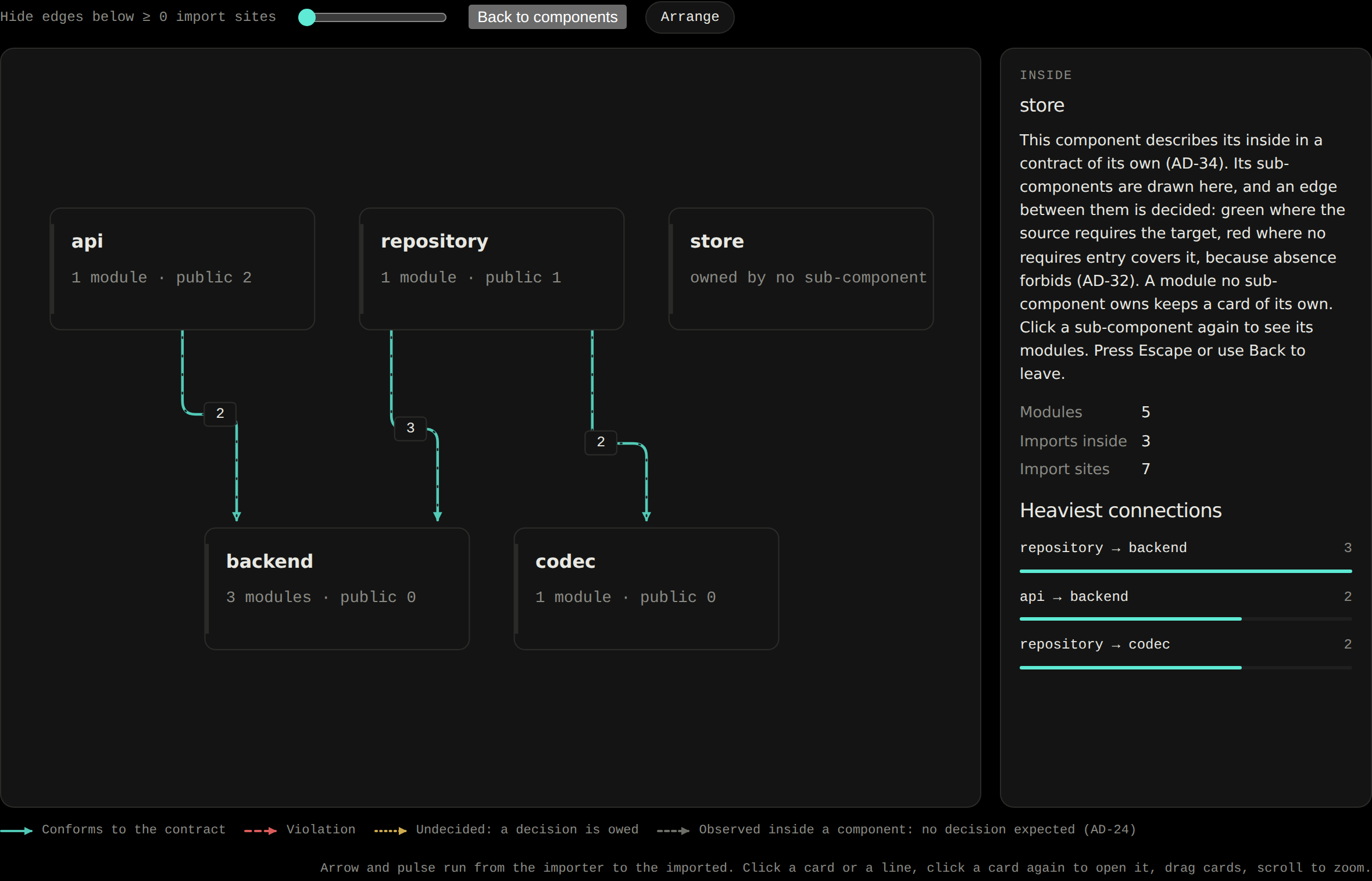
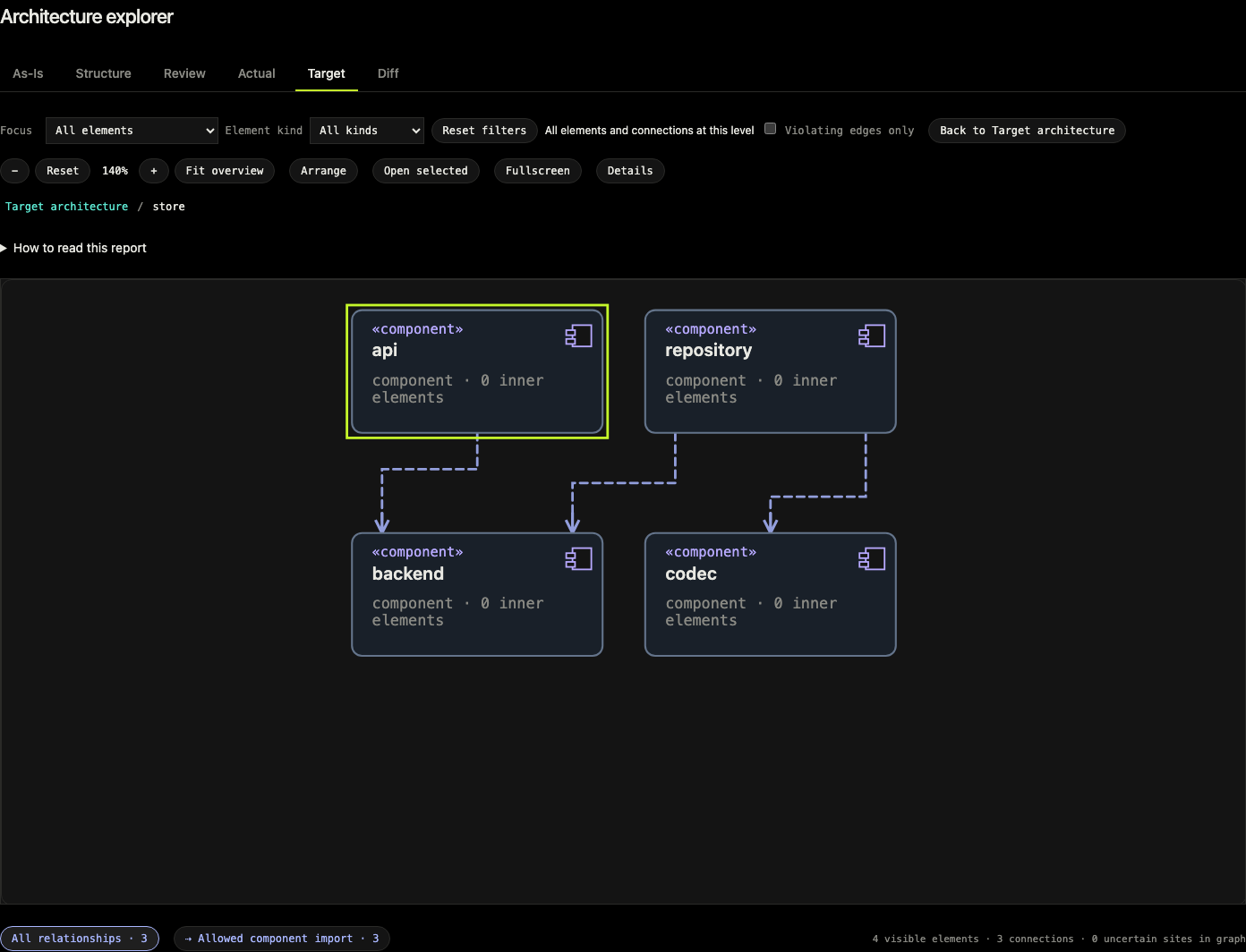
Fit overview after opening store: the level its own contract declares —
api, repository, codec, backend — with their
three crossings at 3, 2 and 2 import sites, and shop.store, the module no
sub-component owns, carried rather than dropped.
3. Validation names the boundary, the level and the fix
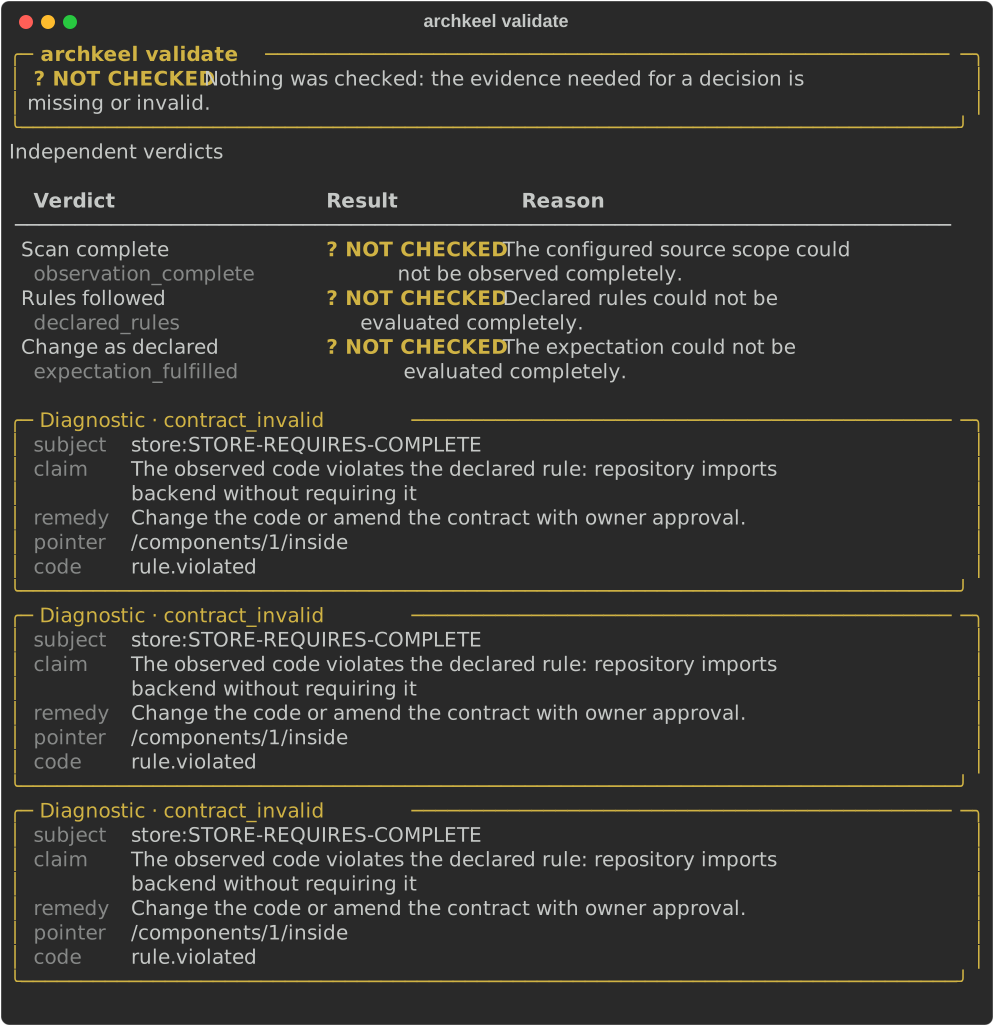
This negative fixture removes a required dependency. Validation exits 2 and names three
rule.violated diagnostics under store:STORE-REQUIRES-COMPLETE: repository imports backend
without requiring it. The incomplete aggregate remains NOT CHECKED; it is not a green gate.
Concrete import sites are available in the HTML report's evidence.
What each side gets out of it
| For the architect | The target is a file you own, not a description of the code. The distance between the two is measured, not argued. You decide once per pair and see every decision an agent made on your behalf. |
| For the agent | A boundary it can read before it writes, and a refusal it can act on: the rule id, the level that declares it, the importing module, and the contract to change. No taste, no review latency, no guessing which of ten findings matters. |
| For the review | Two failure modes a finding diff cannot see: architecture that changed without being declared, and a scan that got blinder so the result only looks clean. |
Why Archkeel
An agent can keep tests green and introduce no new architecture finding while making the code harder to analyze. If the gate compares finding identities only, that change passes.
Fixture A is the smallest example:
 def run(key: str) -> int:
-    return first() + second()
+    handlers = {"first": first, "second": second}
+    return handlers[key]()
The refactor introduces no new forbidden import, cycle, or private crossing. But static call resolution gets worse:
| Observation | Accepted | Candidate |
|---|---|---|
| Resolved calls | 2 of 2 | 0 of 1 |
| Unresolved calls | 0 | 1 |
| New finding fingerprints | 0 | 0 |
| Archkeel verdict | baseline | FAIL |
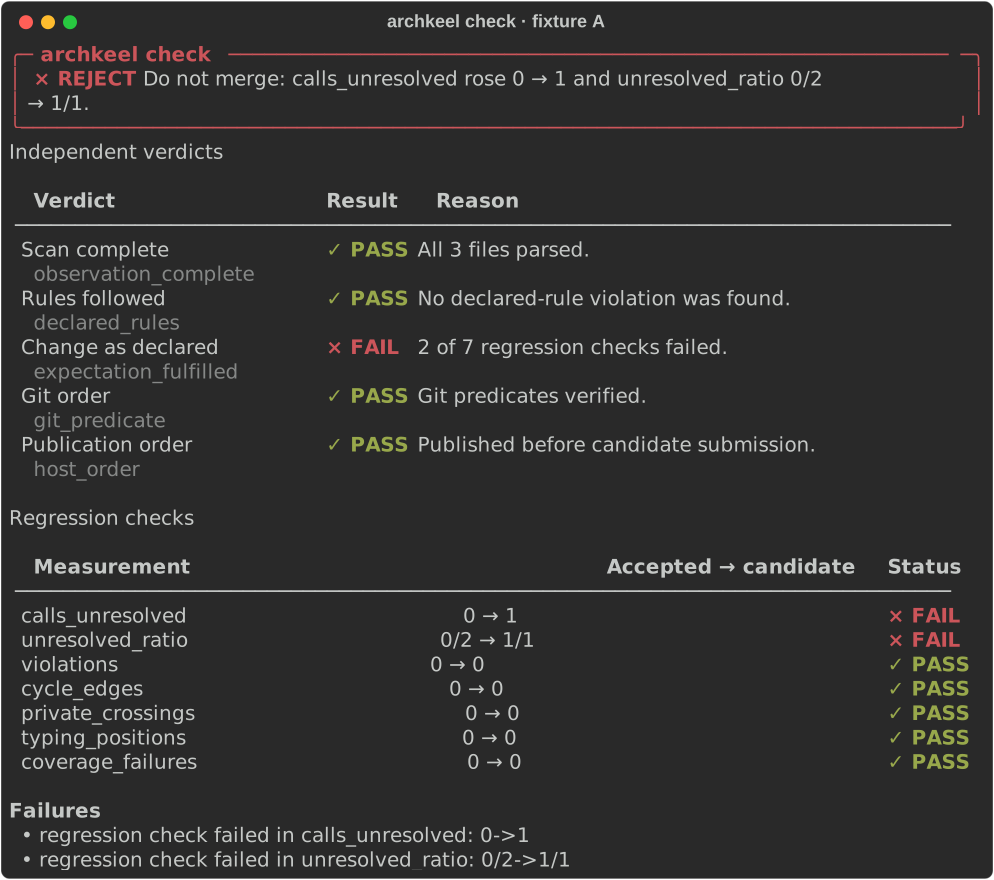
expectation_fulfilled: FAIL
regression check failed in calls_unresolved: 0->1
regression check failed in unresolved_ratio: 0/2->1/1
The same result names the call behind the count in unresolved_call_changes: handlers[key]
in sample.work.run at sample/work.py:9, reason expression is dynamic (AD-100).
Archkeel compares raw measurements as well as finding counts and fingerprints. The ratio check uses integer cross-multiplication, never rounded percentages:
U_candidate × T_accepted <= U_accepted × T_candidate (when both T > 0)
What the gate adds
- Precommitment with evidence. The agent publishes the intended change before it submits the candidate. Git ancestry and host records prove the order; author timestamps do not.
- Coverage-aware regression checks. A disappearing edge is not mistaken for an improvement just because a finding disappeared with it.
- Explicit uncertainty. An incomplete scan, broken lock, empty scope, or runtime mismatch
returns exit
2with a diagnostic. A complete report may instead exit0withdeclared_rules: UNKNOWNwhen a rule names the positions it could not decide; neither case is displayed asPASS. - Verdict is not coverage.
PASSrequires complete evaluator evidence for every required rule and no violation among decided positions. Missing scope proof staysUNKNOWN.
Archkeel complements tests, linters, and human review. It does not replace any of them. Its job is narrower: keep architecture changes declared, observable, and mechanically checkable.
Review surface
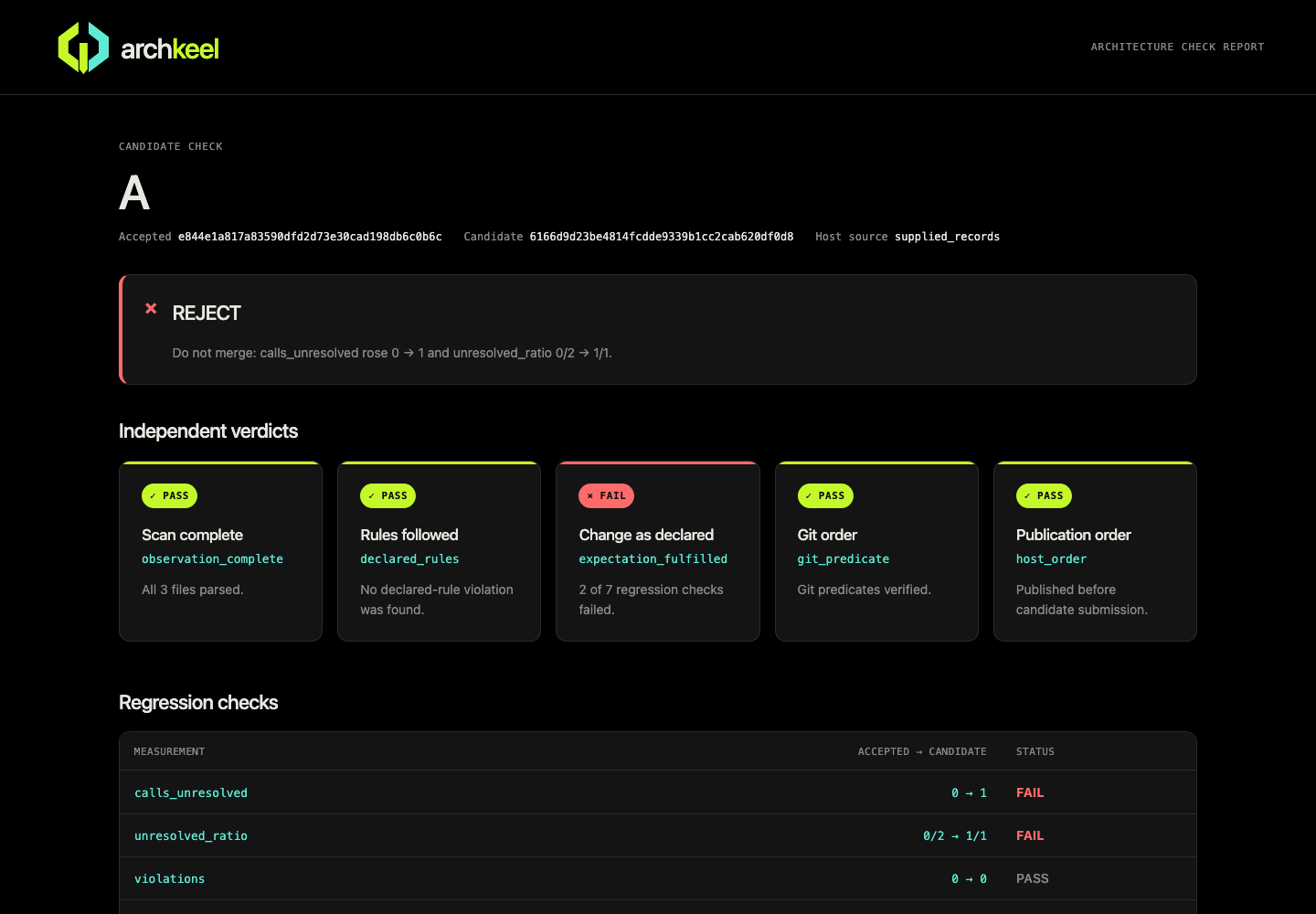
The HTML report is designed for a reviewer making a merge decision:
archkeel report --only violations
archkeel report --only violations --rule DEP-STORE-NO-MONEY
archkeel report --only violations --component store
archkeel report --only calls --component store   # unresolved and partial calls (AD-100)
archkeel report --baseline known-violations.json # read-only fingerprint comparison
- Decision first.
PASS,REJECT, orNOT CHECKEDand one sentence explaining it are visible before details, in the HTML report and in the terminal. - No blended score. Scan completeness, contract compliance, expectation matching, Git order and publication order remain separate verdicts.
- Unknown stays visible. Missing or invalid evidence includes the affected subject, unknown claim, and remedy. An UNKNOWN non-declaration rule keeps the aggregate verdict UNKNOWN; a known violation remains FAIL.
- Evidence stays inspectable. Exact counts, fingerprints, source locations, digests, and runtime provenance remain available beside the verdict.
- Rules say what was checked. Each rule has its own result, reason, owner and source. PASS requires evaluator evidence; a permission is a declaration, not a passed check. Search and filter rules and findings without changing the observation (AD-117).
- Known debt stays debt. An explicit baseline adds fingerprint counts, not exemptions.
Known findings keep a FAIL marker; new findings are red. Mixed occurrence counts do
not pretend to identify which source line is old.
Missing rules or undecided evidence cannot make old findings appear resolved.
Resolution is relative to current rules;
validate --againstchecks contract widening. - Violations can take focus.
Violations onlyworks in the already-open report: it hides secondary detail and non-violating flow edges without changing the verdict, totals or evidence. - Nested flow stays inspectable. Physical folders lead to every observed module, including
import-only package initializers. Explicit
insidecontracts can nest; their rules and findings remain attached to that level. Child APIs stay local unless the parent explicitly publishes them; internal and outward APIs need not match (AD-112). Folders alone are not contracts. An inside connection is green only when all its displayed imports were checked, with no relevant UNKNOWN or edge violation (AD-110). No finding alone is not a conformance claim. Structure and Review remain keyboard-operable, and the diagram can restore its complete current scope with “All components and groups”; visible and total counts disclose focus and threshold filtering. - Readable before filtering. The diagram starts at 100% zoom with all groups and edges. Scroll to explore; use Fit for an overview. Focus keeps every direct neighbor, and Arrange preserves your filters and zoom (AD-116).
- Claims are named, never gated on.
reportandvalidateprint what the five review claims found in the terminal and underclaimsin--json, while the HTML report lists the candidates. Current self counts live infixtures/D-self/result.json. Unread bindings are lexical candidates; the claim does not assess whether an interface requires them. Statically provenEnum.MEMBERuses in field annotations and defaults reference their enum class (AD-108). None of these claims reaches an exit code. - Declared facades include ordinary modules.
boundary_typesfollows an imported entry from an ordinary module only when its unchanged literal__all__explicitly exports that unique binding; unclear export evidence stays UNKNOWN. A type's proven export through its owner's facade counts as public without exposing the implementation module (AD-109). - Facade shape stays measured, not inferred. The report shows declared export counts,
re-exports, names defined in a facade, unused re-exports, consumers per export and coupling
width. These facts do not claim a barrel is complete (AD-88). A contract may set a target for
one facade's names or one component pair's imported names.
validatenames every counted name over it, a baseline freezes today's names so a new one fails, and a count it cannot complete is UNKNOWN, never PASS (AD-99).
A rule can fail and still contain undecided evidence. The UNKNOWN filter keeps that mixed result visible without relabelling its confirmed violation as uncertainty.
Try the demo
The demo builds three small Git repositories and runs the real checks. Fixture A is rejected because the call graph got blinder, Fixture B because its expectation was published too late, and Fixture C passes.
git clone https://github.com/rapiddweller/archkeel.git
cd archkeel
make demo
make demo-screenshots OUTPUT=<directory> also captures each HTML report as PNG and each
terminal view as SVG.
make demo-onboarding replays the loop from What it does, on one sample
on the two-level shop: what init drafts, what validate refuses, what the architect decides,
and what the gate says when an agent crosses a boundary inside the level.
Replay a report-capable catalog row to a new JSON report and HTML sidecar:
make demo-architecture VARIANT=class-a-recursive-wide-package OUTPUT=demo-output/architecture.json
make demo-onboarding
archkeel validate --root fixtures/F-architecture   # exit 0, both levels
archkeel report   --root fixtures/F-architecture   # UNKNOWN: store:STORE-REQUIRES-COMPLETE
archkeel validate --root fixtures/F-architecture --config archkeel-tests.toml   # its tests' own scope
Every violation the tool can find has a catalogued variant that produces it, listed in docs/architecture-demo.md.
Onboard your project
Requirements: Python 3.11+ and a Git repository with at least one commit.
uvx archkeel skill install claude    # or codex
uvx archkeel init
uvx archkeel validate
The contract is your target architecture, not a copy of the code. init observes the only
top-level package, or the one your pyproject.toml's [project] name names when a test package
sits beside it, and writes archkeel.toml, architecture-contract.json and
docs/architecture/architecture.md: one component per subpackage, drafted public interfaces and
no dependency rule. Every ordered component pair is an open decision; init --json and
validate --json list them heaviest first, each with the exact allowed_dependency and
forbidden_dependency rule to choose from. The component table and init --json's
draft_sizes also carry each drafted component's modules and inner edges, so a directory
that hides an outsized sub-package is visible before you decide anything about it. The
installed skill runs onboarding in one of two
modes: an interview, where the agent reads your ADRs and documents, recommends and asks only about
conflicts and gaps, or explicitly delegated auto mode, where the agent decides. Every rule records
decided_by; a requires entry and a component may too. Reports count entries marked
agent-decided; attribution does not authenticate a human review. The prompt is in
docs/onboarding.md; the
rule catalog is in docs/rules.md.
The skill reviews physical packages recursively, including uncontracted interiors. More than
seven children prompts a cohesion review, not an automatic split; green rules do not certify
the whole design. It records deferred areas and preserves existing contracts during assessment.
Use root_layout when a package root must expose an exact set of immediate packages or modules;
the root module and missing future children are ignored, while an unexpected child is a normal
baselineable violation.
Optionally declare exact Python files and one-sentence responsibilities in
declarations.modules at the deepest existing contract. Target groups each declared Python file
under the deepest uniquely matching component within its declaring scope, using configured roots
and namespace. This is navigation, not ownership; files without a unique component match remain
visible under “Modules outside components”. Diagram, Actual, Target, and Diff share one explorer
shell while preserving their distinct evidence and hierarchy. Existing declared Diagram cards with
zero observed modules remain visible but do not prove observed existence or populate physical
frames. Select once for Details; use
Enter, double-click, or Open selected to drill one level. Details shows complete responsibilities
and the searchable declaration list in every view.
Diff shows declared files that are absent and observed files without a target.

When a later contract edit merges or renames components, archkeel validate --write-graph
rewrites the edges of the page's marked component graph and leaves the rest of the page alone;
a graph with a subgraph, a labeled edge or a style is left for you to edit by hand.
If your contract states the architecture you are heading for, the code that has yet to reach it is violating it — by design. Freeze those known violations once and gate on the difference, instead of weakening the contract to make it green:
archkeel validate --baseline known-violations.json --write-baseline   # initial file, then review it
archkeel validate --baseline known-violations.json                    # in CI
archkeel validate --baseline known-violations.json --write-baseline   # resolved-only cleanup
archkeel validate --baseline known-violations.json --write-baseline --accept-new  # deliberate widening
archkeel validate --root mobile --baseline known-violations.json      # reads mobile/known-violations.json
The baseline path is relative to --root, like the contract, or absolute inside it, so a second
code base in a subdirectory is gated from the repository root against its own file; a path
outside the root is baseline.invalid, exit 2 (AD-103).
The gate exits 1 on a violation the file does not state, and on one it states that nobody
violates any more, so the budget only shrinks. An existing baseline is compared before a write:
resolved-only drift may be written, while new or increased fingerprints refuse the write unless
--accept-new is explicit. Results expose deterministic baseline_new and baseline_resolved
counts of changed fingerprints, not violation occurrences. One fingerprint contributes one even
when its occurrence count changes by more than one. Each entry names its violation by rule and
subjects rather than by line, so unrelated edits above it do not move it. Running that loop day
to day — gating CI, keeping the target from widening, working the backlog down — is
docs/target-first.md.
The contract may also select deterministic scalars under declarations.measurement_budgets.
Baseline schema 1.2 and later stores their accepted values. A rise fails; a fall must be written
back. Archkeel uses this itself for cycle edges, private crossings, typing positions, unresolved
calls and untyped private accesses (AD-89). Facade and coupling budgets put a target in the
contract (declarations.facade_budgets, declarations.coupling_budgets); baseline schema 1.3
adds each one's accepted names, so a new name fails while a known gap to the target passes
(AD-99).
With --against <ref>, a calls_unresolved change names its call sites (AD-100).
A package rename is accepted only when the selected historical --config and both layouts prove
the move; Python candidates always scan that config, even when its roots and namespace are
unchanged. Missing historical config or a copied old package leaves the comparison unrenamed.
Baseline roles, introduced in schema 1.1, also prove when a resolved importer was the last reach
of one exact public module or symbol. validate --baseline reports the resolved violation,
suppresses only that matching interface.unused twin, and says to remove the now-unreached
entry; old 1.0 files and unrelated roles stay fail-closed (AD-85).
To install it permanently instead, run pip install archkeel. Every command explains itself
with archkeel <command> --help.
Quickstart
Observe the current repository:
archkeel report
The command writes the canonical architecture.json and a self-contained
architecture.report.html beside it. A terminal shows the decision and verdicts; pipes and
--json receive the JSON result.
The HTML report keeps Actual (the complete observed module tree), Target (declared components, package scopes, physical layout, and requirements), and Diff (violations, UNKNOWN evidence, unmapped modules, and absent declared targets) distinct inside one explorer shell. Diagram keeps its observed cards and imports; optional physical frames require a unique declared scope containing every actual module in the card. They add no Target-only cards or edges. Target edges remain declarations, not observed imports or proof that a declared child exists. Selecting an item shows its declared responsibility only when stable identity, exact module file, or a unique package match establishes the correspondence; this does not describe observed behavior. Use Enter, double-click, or Open selected to drill one level. Components without a responsibility remain in Target and its searchable index as “No declared responsibility.” This marks missing design information; rule verdicts stay unchanged. Switching among Actual, Target, and Diff keeps the selected scope or module when a unique counterpart exists. Otherwise, the view opens the nearest unique ancestor or root and explains the fallback.
Physical frames from declared root_layout rules describe file
layout, not semantic ownership; only populated frames and their ancestors appear. Selecting a component shows its placement status (declared,
inferred, multiple, ambiguous, or unmapped), scope, and reason in Details; unresolved
entries stay visible. Target details retain exact public, requires.through, rationale, and
provenance declarations. A null dependency rank means order is unresolved because of a cycle or a
dependency on one; it does not make that dependent cyclic or change the architecture verdict.
The shared Details pane starts closed, preserves selection identity, and exposes complete
responsibilities plus the searchable declaration list in every view. Fullscreen and Restore use
the same explorer state; no view infers execution order from declarations or imports. Local
browser tests exercise 100% initial zoom, native scrolling, and selection identity across views.
Package headers keep names compact, abbreviating only measured overflow; Details preserves the
full identity. Connectors attempt to bypass headers; an unsolved route keeps its edge and reports a
layout warning, not an architecture failure. Switching views retains the explorer bounds.
Checked on DATAMIMIC CE
On 1 October 2026, the CE experiment checkout (b38899c9 plus local changes) yielded 491 parsed
modules, 102 violations and 155 counted UNKNOWN positions. Desktop browser checks exercised the
root, nested runtime/tasks, cross-view identity and the reproduced header-routing defects.
The report keeps observed imports, declared targets and their differences separate.
This proves that a real nested repository can be scanned and explored. It does not prove CE is finished, every boundary is well designed, or runtime behavior matches the import graph. UNKNOWN remains unresolved work. Fit overview can shrink labels; use 100% and scroll for detail.
--output X.json writes the JSON report and X.report.html.

Check a candidate against its published expectation:
archkeel check \
  --root /repo \
  --baseline "$B" \
  --expectation-commit "$E" \
  --head "$H" \
  --expected expectation.json \
  --expected-digest "$DIGEST" \
  --accepted-branch main \
  --branch candidate
Run the Python version required by the repository being scanned. A mismatch is
reported as runtime_mismatch with exit 2, not as broken source code.
How it works
flowchart TB
    B["Locked accepted state"] --> O["Observe accepted + candidate"]
    E["Expectation published first"] --> H["Candidate submitted"]
    H --> O
    O --> C{"Deterministic check"}
    C --> P["0 · pass"]
    C --> R["1 · reject"]
    C --> U["2 · unverifiable"]

    classDef locked fill:#141414,stroke:#C5F82A,color:#E8E8E2
    classDef declared fill:#141414,stroke:#5EEAD4,color:#E8E8E2
    classDef candidate fill:#141414,stroke:#8A8A84,color:#E8E8E2
    classDef gate fill:#C5F82A,stroke:#C5F82A,color:#0D1F05
    classDef result fill:#141414,stroke:#2A2A28,color:#E8E8E2

    class B locked
    class E declared
    class H,O candidate
    class C gate
    class P,R,U result
A check answers three independent questions. It never compresses them into a single score.
| Verdict | Question | Typical failure |
|---|---|---|
observation_complete |
Did the scan see everything it claims to see? | Incomplete scan, empty scope, rule without subjects |
declared_rules |
Does the code obey the architecture contract? | Forbidden import between components |
expectation_fulfilled |
Did the candidate match the declaration without regressions? | Coverage regression, undeclared change, late expectation |
Exit codes
| Exit | Meaning |
|---|---|
0 |
Complete report or successful check |
1 |
Rejected because at least one verdict is FAIL, or validate --baseline found a violation the baseline does not state, or one it states that nobody violates any more |
2 |
Unverifiable input, always with at least one diagnostic |
Every exit 2 diagnostic contains:
kind · subject · unknown_claim · remedy
A broken lock is therefore not interpreted as an empty accepted state.
The M → B → E → H protocol
gitGraph
    commit id: "M · accepted"
    commit id: "B · lock only"
    branch candidate
    commit id: "E · expectation only"
    commit id: "H · implementation"
| Commit | Contract |
|---|---|
| M | Accepted state. Archkeel re-observes it. |
| B | Lock-only child of M and tip of the accepted branch. It binds the config, checker, and observation digests. |
| E | Child of B that changes only the expectation file. It must be published before the first submission of H. |
| H | Descendant of E. It must not modify the lock, config, architecture contract, or expectation. |
E's selected_changes may be [], declaring that the candidate has no semantic change at all. A
refactor is a legal move under the protocol even when it moves nothing architectural. That
declaration is not weaker than naming changes: Archkeel then fails the check on any semantic
change at all, in any delta dimension, not only the six guardrail ones (AD-39). A non-empty
declaration still lets an added, undeclared entry through in most dimensions, but not in
dependency_edges: a new edge selected_changes never named is a guardrail failure there too
(AD-44).
Agent workflow
- Start from the lock commit B.
- Write the intended architecture change and commit it alone as E — or declare
selected_changes: []when the change is not meant to be architectural at all. - Publish E before submitting implementation work.
- Implement the change in one or more commits ending at H.
- Run
archkeel check. Fix the code or revise the proposal in a new protocol cycle; do not rewrite protected inputs inside H.
Fixture B writes its expectation after implementation by deriving it from the observed delta. Its architecture findings are otherwise clean. Archkeel still rejects it:
host_order: FAIL
expectation_fulfilled: FAIL
expectation was not published before the first candidate submission
Precommitment proves "published before submission." It does not prove that no private edit existed before publication.
Host evidence
In GitLab CI, Archkeel reads merge-request diff versions through glab to
establish publication order.
For local testing, replay captured host records:
uv run archkeel check ... --host-records records.json
A local replay validates the record shape and behavior. It does not prove host authenticity.
Development
Run the complete project gate, including Archkeel's own contract validation:
make gate
This runs the locked release checks (Ruff, strict mypy, pytest, builds and smoke tests) and then
archkeel validate --root . --baseline architecture-baseline.json --json. CI uses this same
Make entry point. make check remains the faster source, type and test loop.
CI also runs the interactive report checks with pinned Playwright and Chromium:
make browser-install
make report-browser OUTPUT=test-artifacts/report-browser
The browser lane uses only synthetic demo fixtures and checks deep/wide navigation, filters, status labels, narrow screens and the no-JavaScript fallback. Screenshots and traces are written under the chosen output directory; use a new directory for each run.
A change to Python code under src/ or to an architecture contract moves the saved
self-observation that check compares against; regenerate it with make self-observation. The
contributing guide lists what a
pull request needs.
Run the full release check, build both distributions, and install each one in isolation:
make release-check
Reproduce the protocol fixtures:
make fixtures
Archkeel checks itself
architecture-contract.json holds Archkeel to the rules it sells, and every rule was proven by a deliberate violation:
- Every pair decided. Seven components, so 42 ordered pairs, decided by nine
requiresentries and onecomplete_requiresrule: a pair no entry names is forbidden, not open. All 19 rules carry a rationale and are decided by the architect. The architecture guide names the quality goal each required edge serves. - Deterministic core.
irandchecknever import adapters or presentation; the CLI is the composition root. The analyzer'srequiresentry goesthrougharchkeel.ir.modelandarchkeel.ir.codeconly, so any otherirmodule is a violation. - No dynamic shortcuts.
getattr,hasattr,setattr,delattr,vars,__dict__,cast,eval,exec, dynamic imports andtype: ignoreare forbidden everywhere. - Confined dependencies.
packagingonly in the analyzer runtime gate,richonly in the terminal view,rich_argparseonly in the CLI's root module: each names its one module exactly, never as a prefix of the modules below it. - Complete and acyclic. Every module belongs to exactly one component, and neither components nor modules form a cycle.
- A second level where one was owed.
checkholds 13 modules and 27 dependency edges between them, more than the whole top level holds, so it declares a contract of its own:entry,policyandfoundation, whose crossings itsrequiresentries cover at 29, 14 and 2 import sites. The flow view opens it as a level of its own, and the one module no sub-component owns keeps a card of its own.
make check reobserves the repository and compares it with
fixtures/D-self: the
canonical model in architecture.json, the digests in provenance.json, and the verdicts
report printed in result.json. The gate target adds the contract validation; CI uploads the
self-observation separately as evidence.
Current boundaries
Archkeel is deliberately strict about what it can prove:
- Competing implementations: review is still required when no declared rule or observed regression exposes them.
- Private crossings: private cross-package imports remain confirmed findings. A private
attribute rooted in an untyped or
Anyparameter is measured and named as UNKNOWN because static source does not prove which component owns the runtime object. Typed parameters, locals and public attributes are excluded. - Precommitment: publication order is proven; private editing order is not.
- Analyzer runtime: Archkeel's Python must be at least the target repository's Python.
- Onboarding:
initdetects the only top-level package, or the onepyproject.toml's[project] namenames when several sit side by side (AD-47); other layouts need--sourceand--namespace. It never decides a dependency; the architect or, in auto mode, the agent does, anddecided_bykeeps the difference visible. - Validation baseline: the file is compared, never authenticated;
check's digest chain does not cover it.--write-baselinecompares an existing file before updating it;--accept-newis required to accept new or increased violations or measurement values.validate --against <ref>classifies a padded entry or raised budget as a widening like any other and fails it without an amendment (AD-61), but only when a reviewer or CI runs it with--against; nothing forces that flag on every gate. - Scan scope: a run observes the roots and the one namespace its configuration names, and
its scan-complete reason names those roots. Tests beside the product are a second scope with
their own
--configfile and contract (AD-101); a green product run says nothing about them. - Static observation: runtime behavior, data flow and performance are not observed; see docs/known-limits.md.
- Compatibility shims: moved-module shims are declared in
declarations.compat; migration entries remain visible work, and logic or product imports fail closed (AD-87). - Dart:
language = "dart"checks the import graph from directive headers; what it cannot see is UNKNOWN. Demo: fixtures/G-dart.
Roadmap
Completed work and the ordered UI, CI and release plan live in docs/roadmap.md. Items remain planned until their listed evidence exists.
License
MIT © 2026 Rapiddweller Asia Co., Ltd.
Maintained by Alexander Kell.
1 maintainer

Metadata
1 maintainer
Release files for archkeel 0.8.2
For a detailed explanation of source distributions (sdists) and built distributions (wheels), please see the package formats documentation.
Source distribution (sdist)
| File | Size | Uploaded | |
|---|---|---|---|
| archkeel-0.8.2.tar.gz | 375.3 kB | Details |
Built distribution (wheel)
| File | Interpreter | ABI | Platform | Reset |
|---|---|---|---|---|
| archkeel-0.8.2-py3-none-any.whl | Python 3 | none | any | Details |
Total release size: 788.0 kB
Release files / archkeel-0.8.2.tar.gz
| Download URL | archkeel-0.8.2.tar.gz |
|---|---|
| Size | 375.3 kB |
| Tags | Source |
|
SHA-256 checksum How to use checksums |
2851a5cf10e03650d0334bffbd47abf2b8223414aedfd3f08e26c09f8b40b248
|
|
BLAKE2b-256 checksum How to use checksums |
be8759f0a8c020d62235f31401940de73991993c8f8bef3676a954936ffe58a0
|
| Upload date | |
|
Uploaded using Trusted Publishing? What is trusted publishing? |
Yes |
| Uploaded via |
uv/0.12.13 {"installer":{"name":"uv","version":"0.12.13","subcommand":["publish"]},"python":null,"implementation":{"name":null,"version":null},"distro":{"name":"Ubuntu","version":"24.04","id":"noble","libc":null},"system":{"name":null,"release":null},"cpu":null,"openssl_version":null,"setuptools_version":null,"rustc_version":null,"ci":true}
|
Provenance
Provenance describes where a file came from. On PyPI, provenance is shared via attestations, which provide a verifiable record of the build or publishing details. View details, limitations and caveats.


PyPI Publish Attestation
PyPI verified that this artifact, at this checksum, originated from the publisher listed below.
Signed by GitHub Actions, verified by PyPI on Oct 1, 2026.
Transparency logRelease files / archkeel-0.8.2-py3-none-any.whl
| Download URL | archkeel-0.8.2-py3-none-any.whl |
|---|---|
| Size | 412.7 kB |
| Tags | Python 3 |
|
SHA-256 checksum How to use checksums |
727de0e7c8ee11c50afb2be1e112282e14acf98a58353347c2c3824d0a50b463
|
|
BLAKE2b-256 checksum How to use checksums |
9f51f7de6a6bf313ca95ecf8371b87ca4ce846f2f270a241d864ea9ec9c82ff5
|
| Upload date | |
|
Uploaded using Trusted Publishing? What is trusted publishing? |
Yes |
| Uploaded via |
uv/0.12.13 {"installer":{"name":"uv","version":"0.12.13","subcommand":["publish"]},"python":null,"implementation":{"name":null,"version":null},"distro":{"name":"Ubuntu","version":"24.04","id":"noble","libc":null},"system":{"name":null,"release":null},"cpu":null,"openssl_version":null,"setuptools_version":null,"rustc_version":null,"ci":true}
|
Provenance
Provenance describes where a file came from. On PyPI, provenance is shared via attestations, which provide a verifiable record of the build or publishing details. View details, limitations and caveats.
PyPI Publish Attestation
PyPI verified that this artifact, at this checksum, originated from the publisher listed below.
Signed by GitHub Actions, verified by PyPI on Oct 1, 2026.
Transparency log













