
Production readiness platform for AI agent pipelines — detects silent failures, captures full state, enables step-level replay.
Verified details
These details have been verified by PyPIProject links
GitHub Statistics
Maintainers

Project description




Production readiness platform for AI agent pipelines.
Your LangGraph pipeline runs. No exception. But three nodes later something crashes with a KeyError. The node that crashed didn't cause it — some node upstream returned a dict with a missing field, and nothing caught it.
ARGUS sits between your nodes and catches silent failures, semantic degradation, and contract violations before they reach production.
Install
pip install argus-agents
Setup — pick whichever fits your code
Option A — pass graph to constructor (recommended):
from argus import ArgusWatcher

watcher = ArgusWatcher(graph)      # attaches monitoring automatically
app = graph.compile()
result = app.invoke(initial_state) # run auto-saves when the last node finishes
print(watcher.run_id)              # access the run ID directly
Option B — separate watch call:
from argus import ArgusWatcher

watcher = ArgusWatcher()
watcher.watch(graph)       # before graph.compile()
app = graph.compile()
result = app.invoke(initial_state)
Option C — after compile (new in v0.5.0):
from argus import ArgusWatcher

watcher = ArgusWatcher()
app = graph.compile(checkpointer=memory)
app = watcher.watch_compiled(app)   # works on already-compiled graphs
result = app.invoke(initial_state)
All three work. No changes to your node functions. Runs are saved automatically for linear and fan-out/fan-in graphs. Only cyclic graphs (with back-edges) need a manual watcher.finalize() call.
ArgusWatcher parameters
| Parameter | Type | Default | Description |
|---|---|---|---|
graph |
StateGraph |
None |
LangGraph graph to monitor. If passed, watch() is called automatically. |
max_field_size |
int |
50_000 |
Max characters per field before truncation in stored outputs. |
validators |
dict |
None |
Per-node semantic validators. Use "*" as key to run on every node. Each validator is a (bool, str) callable. |
strict |
bool |
False |
Enable extra checks: nested error keys, rate-limit responses, empty lists, type mismatches. Recommended for CI/staging. |
investigate |
bool | str |
True |
LLM root-cause investigation. True = on failure only, "always" = every node, False = off. |
redact_keys |
set[str] |
None |
Field names to redact from stored outputs (e.g. {"password", "api_key"}). |
persist_state |
bool |
True |
Save run records to .argus/runs/. Set False for ephemeral monitoring. |
record_http |
bool |
True |
Record all external HTTP/API calls for deterministic replay. Saved to disk per run. |
semantic_judge |
bool |
False |
Enable LLM-powered quality judge on every node output. Requires OPENAI_API_KEY. |
judge_model |
str |
"gpt-4o" |
Model for the semantic judge and investigation. |
# Example with multiple options
watcher = ArgusWatcher(
    graph,
    semantic_judge=True,
    judge_model="gpt-4o-mini",
    strict=True,
    record_http=True,
    redact_keys={"api_key", "token"},
    validators={
        "summarize": lambda o: (len(o.get("summary", "")) > 10, "Summary too short"),
    },
)
What it catches
Silent failures — a node returns {} or drops a required field. No exception, pipeline keeps running. ARGUS compares each node's output against the next node's type annotations and flags it before the crash happens downstream.
Semantic failures — structure is fine but the value is wrong. Pass a validator:
watcher = ArgusWatcher(graph, validators={
    "classify": lambda o: (o.get("label") in ["yes", "no"], "unexpected label"),
    "*":        lambda o: ("error" not in o, "error key present"),
})
"*" runs on every node.
Crashes — full traceback captured per node, with a one-line root cause:
└─  KeyError: 'score'
└─  at pipeline.py:47  →  result = state["score"] * weight
└─  Field 'score' was absent from the incoming state
Strict mode — additional patterns: nested error keys, rate limit responses, empty required lists, list[int] vs list[str] type mismatches. Use in staging/CI:
watcher = ArgusWatcher(graph, strict=True)
Output
argus  run-abc12345  ·  2024-04-05 12:30  ·  1243 ms
status  ●  silent_failure

   1  fetch       43 ms    ✓  pass
   2  validate    12 ms    ⚠  silent failure
      └─  Field "score" is missing
      └─  process received bad state
   3  process    891 ms    ✗  crashed
      └─  KeyError: 'score'
      └─  Field 'score' was absent from the incoming state

root cause   validate
Parallel nodes shown as a grouped panel. Cyclic graphs show each iteration separately. Human interrupt chains stitched into one trace on resume.
Rerun
A 10-node pipeline fails at node 7. You fix the bug. Instead of re-running nodes 1–6 and burning API credits:
argus replay <run-id> node_7
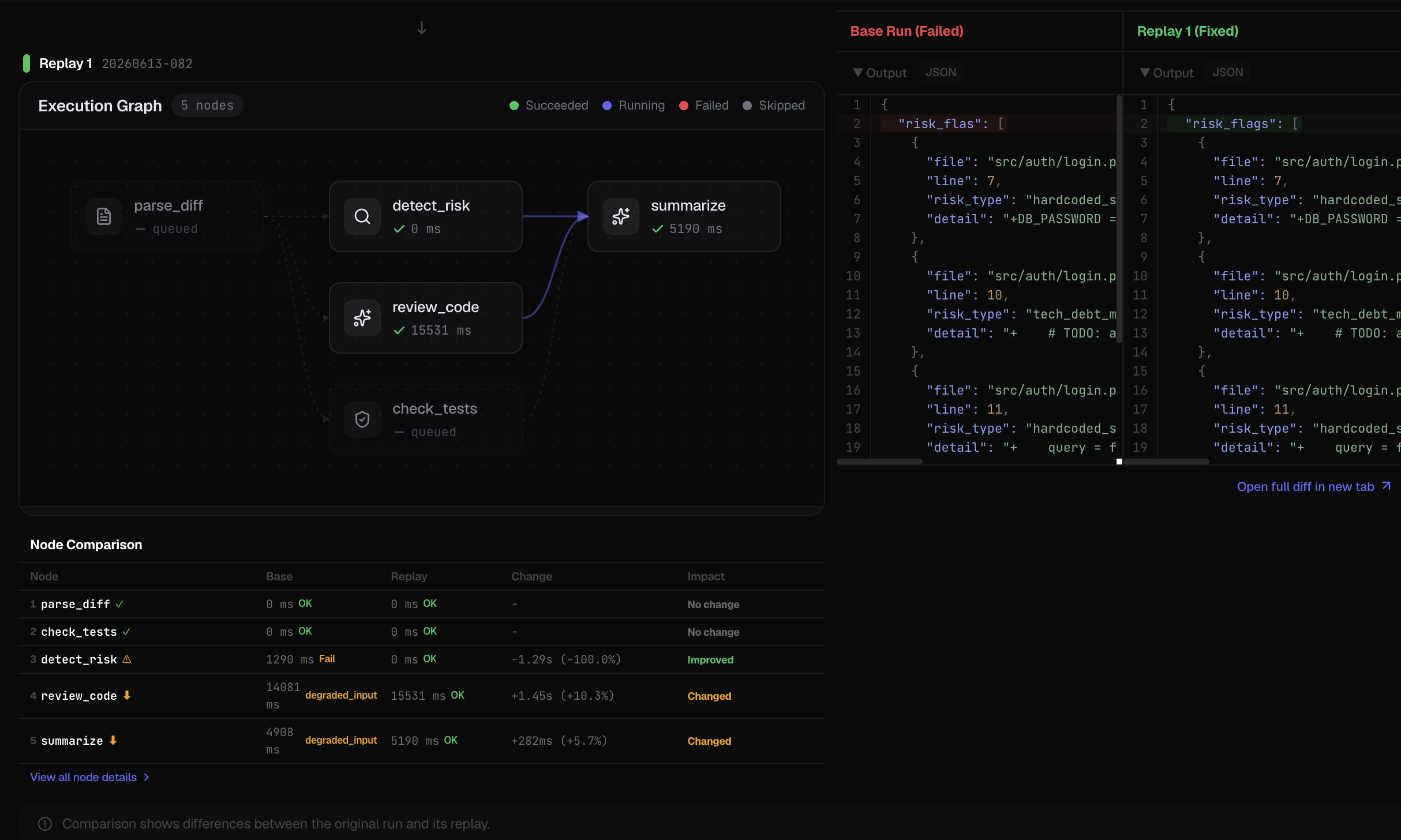
ARGUS restores the exact state at node 7 from disk and runs from there. Upstream outputs stay frozen. Only node 7 onward re-executes with your fixed code.
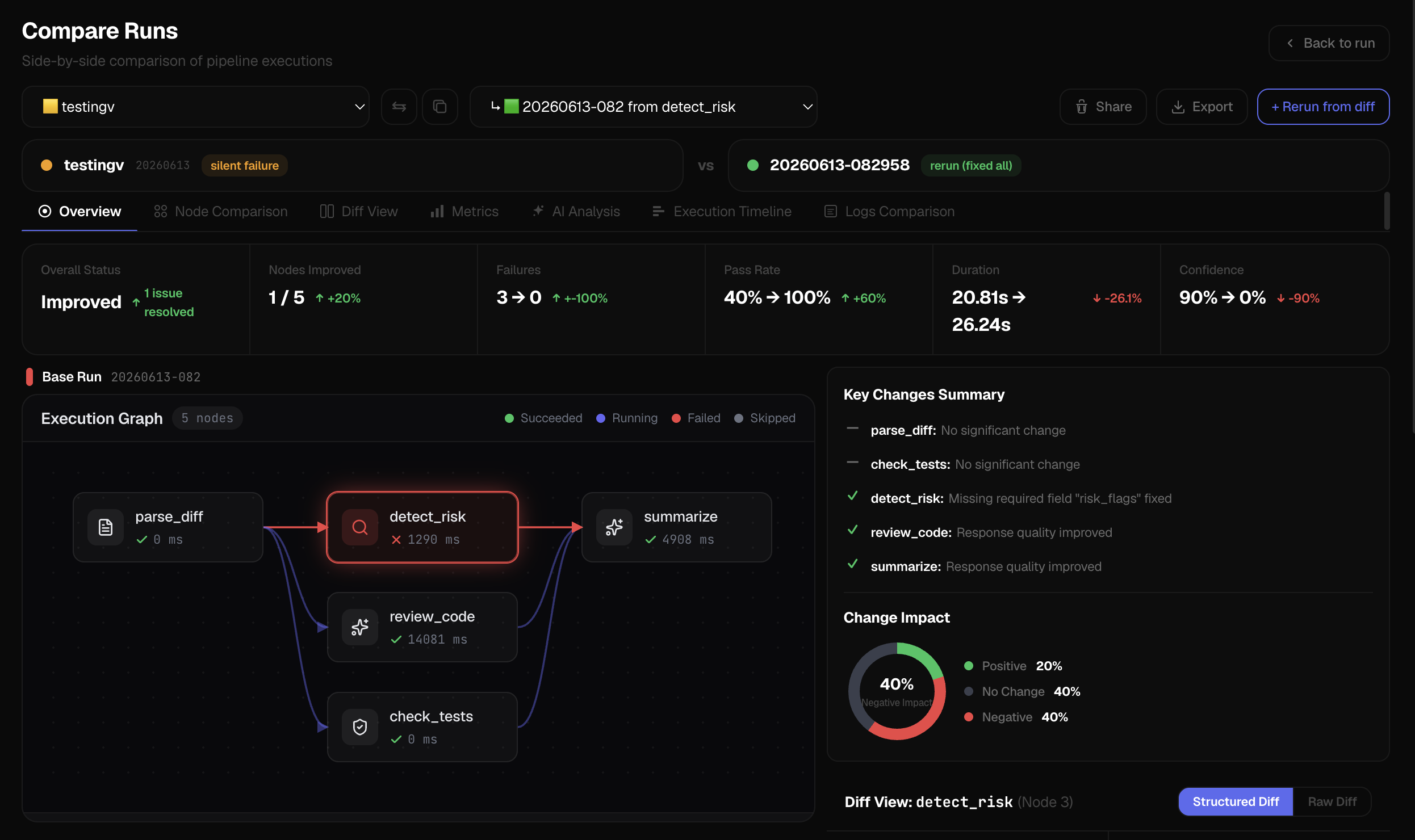
From the web UI — hover any step, click ↺ Rerun From Here. After rerun, the diff view opens automatically.
argus diff <rerun-id> # compare rerun vs original
External API calls
All external HTTP calls (OpenAI, search tools, databases) are recorded by default. Every API response is saved to disk alongside the run. During rerun, the recorded responses are served back — same data, zero extra cost, fully reproducible.
To disable recording (e.g. for lightweight monitoring without replay):
watcher = ArgusWatcher(graph, record_http=False)
Semantic Judge (LLM-powered)
Deterministic checks catch ~80% of production failures (missing fields, empty results, type mismatches, placeholder outputs). For the remaining 20% — subtle quality issues like wrong tone, unhelpful responses, or outdated information — enable the semantic judge:
watcher = ArgusWatcher(graph, semantic_judge=True)
The LLM judge runs after deterministic checks on every node. It evaluates output quality, generates causal hypotheses, and suggests debugging steps.
# With a specific model
watcher = ArgusWatcher(graph, semantic_judge=True, judge_model="gpt-4o")

# HTTP recording is on by default — deterministic + intelligent monitoring
watcher = ArgusWatcher(graph, semantic_judge=True)
Requires OPENAI_API_KEY in your environment. Uses GPT-4o by default.
When to use: complex multi-agent pipelines, customer-facing outputs, LLM-generated content where quality matters.
When to skip: simple pipelines, CI/CD speed runs, zero-cost monitoring.
Adaptive Learning (v0.6)
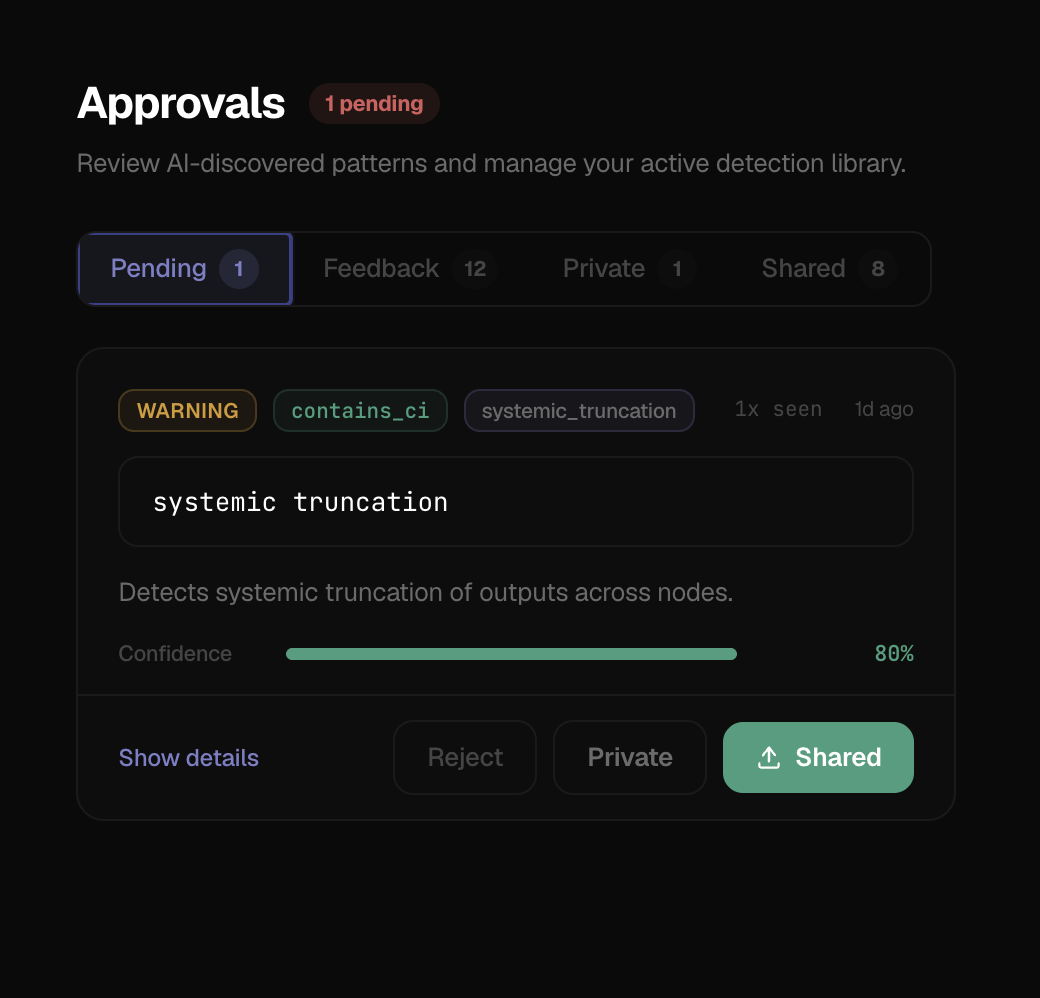
ARGUS learns from your runs. When the semantic judge discovers a new failure pattern, it proposes a candidate signature. You review it in the Approvals page (argus ui) and choose:
- Private — adds to your local heuristic engine only
- Shared — pushes to the cloud so every ARGUS user benefits
The heuristic engine loads from three tiers: bundled (ships with ARGUS) → private (your local patterns) → shared (community-contributed, synced from cloud). All three are merged and deduplicated at startup.
argus ui          # open Approvals page to review candidates
argus login       # required for cloud sync
The semantic judge also overrides heuristic false positives. If a node failed only due to a heuristic pattern match (no structural issues, no validator failures), the LLM reviews context and can clear the flag.
Diagnose setup issues
argus doctor
✓  python           Python 3.9.6
✓  langgraph        langgraph 0.6.11
✓  storage          312 runs stored, all healthy
✓  replay           all 7 node functions importable for rerun
✓  optional deps    openai (key set), dotenv
5 seconds to know if something is wrong — Python version, LangGraph compatibility, storage health, rerun readiness.
CLI
argus list                          # all runs
argus show last                     # most recent run
argus show run <id>                 # by full id or 8-char prefix
argus replay <id> <node>            # re-run from a node
argus replay <id> <node> --only     # re-run just that one node
argus inspect <id> --step <node>    # raw input/output for a node
argus diff <id>                     # rerun vs original
argus diff <id-a> <id-b>            # any two runs
argus ui                            # open web dashboard
argus doctor                        # check your setup
argus login                         # sync runs to cloud
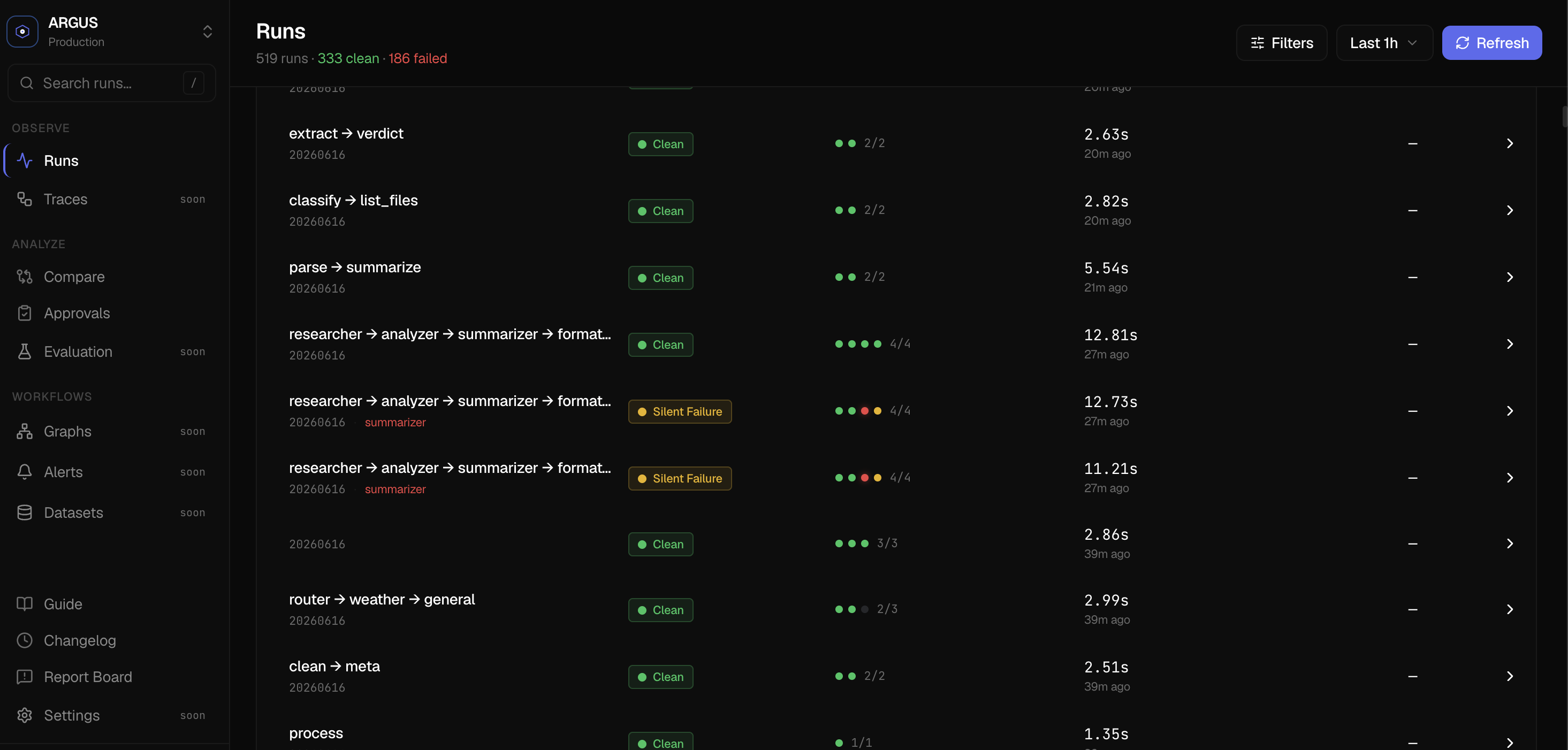
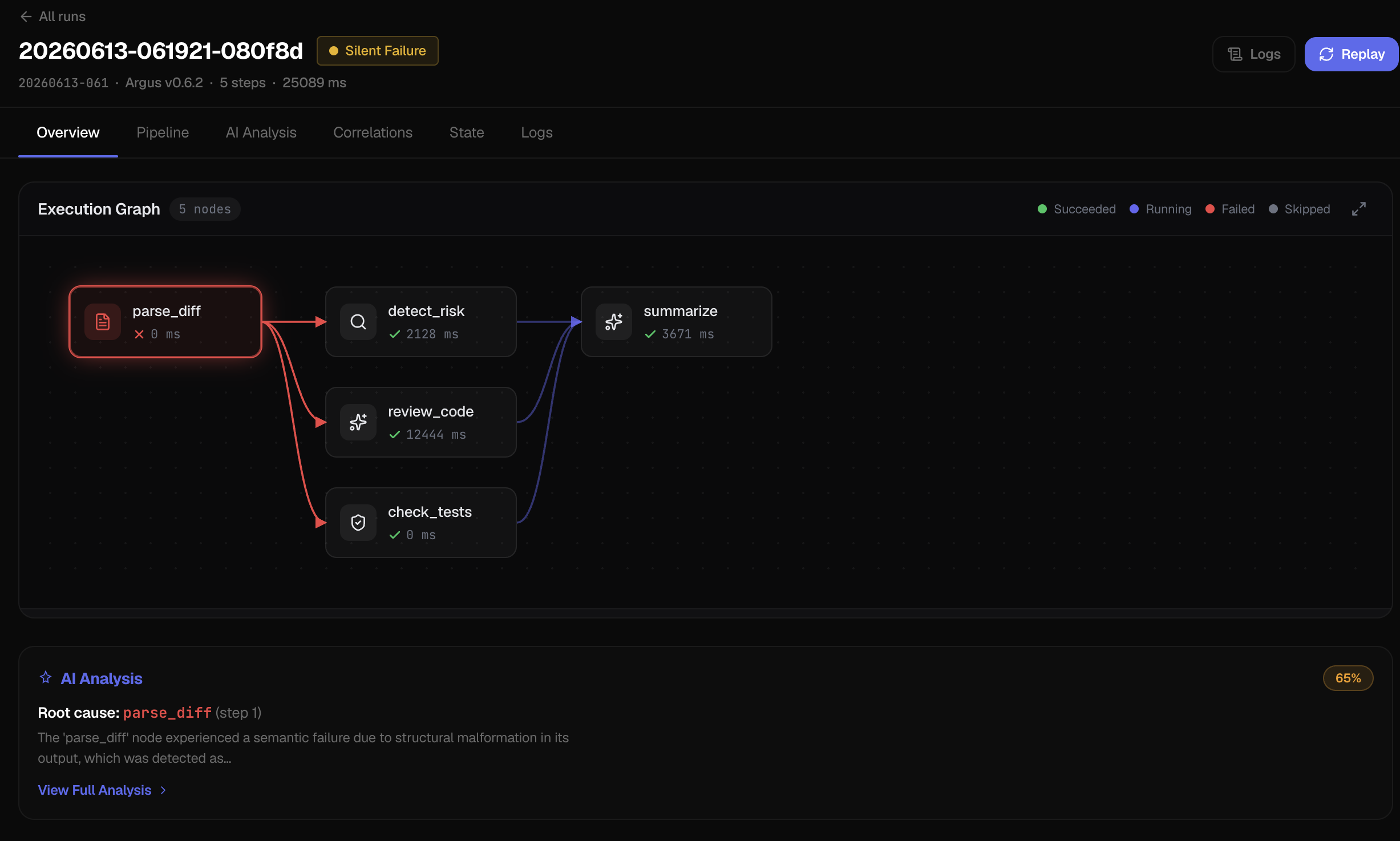
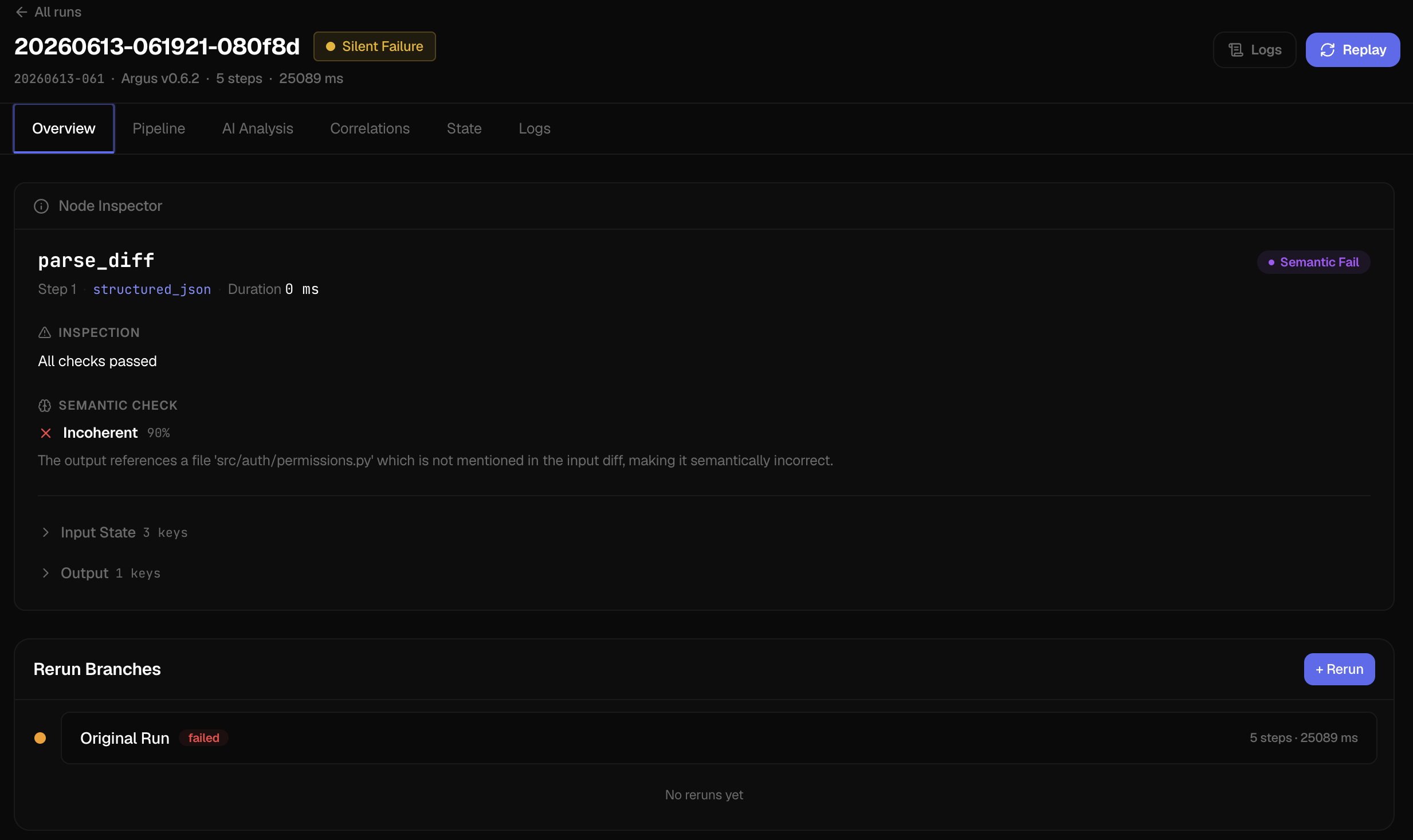
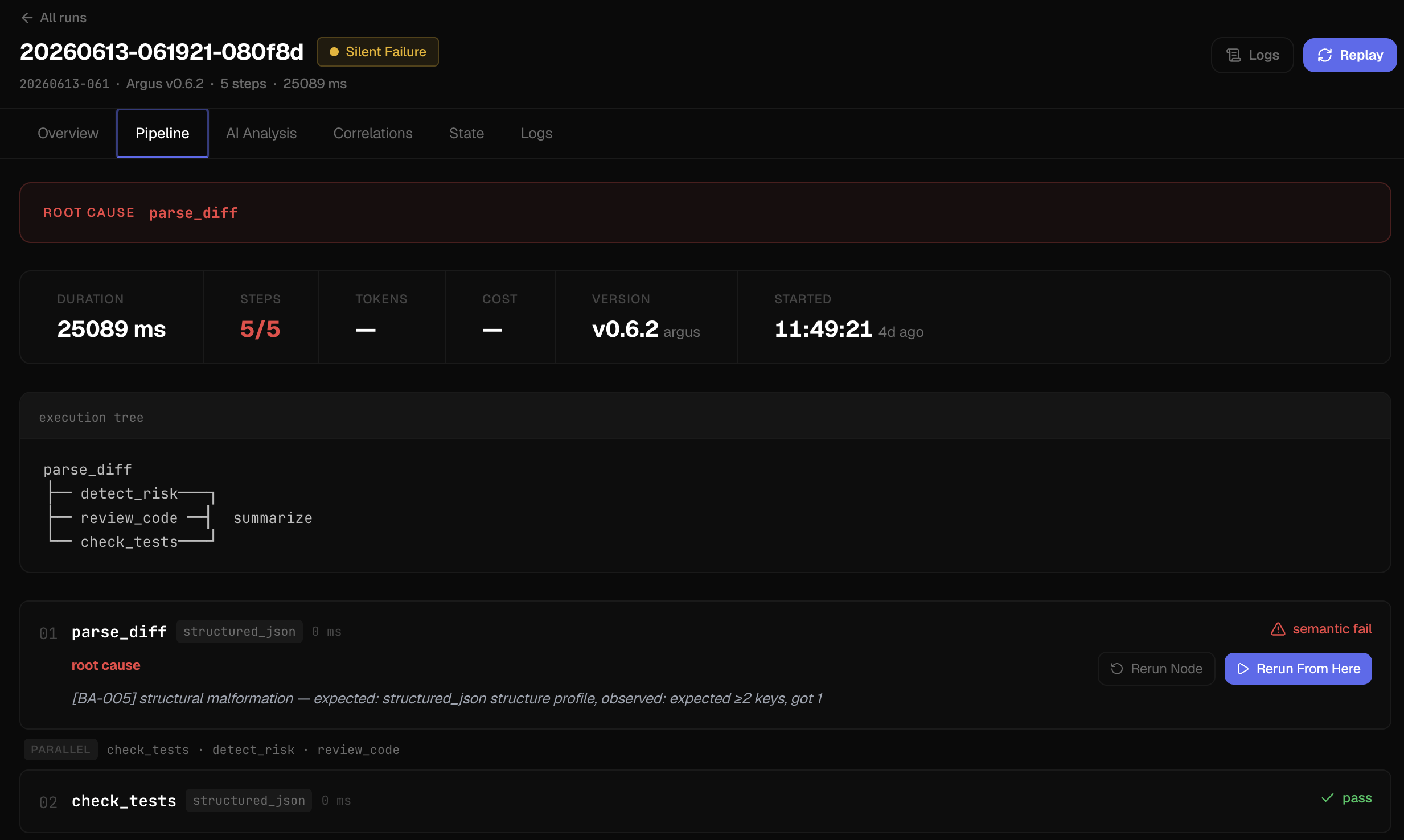
Web UI
argus ui
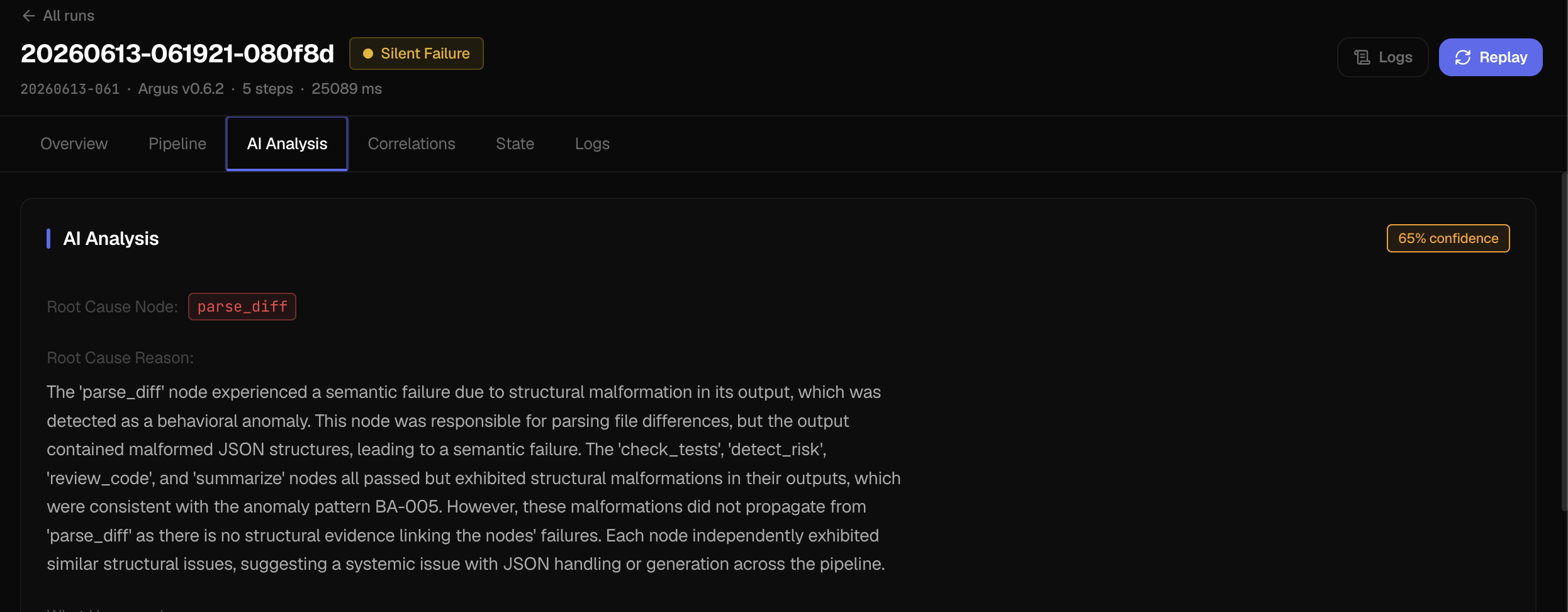
Opens at http://localhost:7842. Serves runs from .argus/runs/ in your current directory — no account needed.
Runs List
Run Detail
 |
 |
 |
 |
Compare Runs
 |
 |
Approvals
Node statuses
✓ |
pass |
~ |
pass with warnings (empty optional fields) |
⚠ |
silent failure (missing required fields) |
⊗ |
semantic fail (validator returned False) |
⏸ |
interrupted (human-in-the-loop pause) |
✗ |
crashed |
Without LangGraph
from argus import ArgusSession

session = ArgusSession()
session.set_edges({"fetch": ["classify"], "classify": ["process"]})

fetch    = session.wrap("fetch",    fetch_fn)
classify = session.wrap("classify", classify_fn)
process  = session.wrap("process",  process_fn)

state = fetch(initial_state)
state = classify(state)
state = process(state)
session.finalize()
Works with Prefect, Temporal, or plain Python functions.
Requires Python 3.9+. LangGraph 0.2+ only needed for ArgusWatcher.
v0.6.6 — changelog
Project details
Verified details
These details have been verified by PyPIProject links
GitHub Statistics
Maintainers
Release history Release notifications | RSS feed


Download files
Download the file for your platform. If you're not sure which to choose, learn more about installing packages.
Source Distribution
Built Distribution
Filter files by name, interpreter, ABI, and platform.
If you're not sure about the file name format, learn more about wheel file names.
Copy a direct link to the current filters
File details
Details for the file argus_agents-0.6.10.tar.gz.
File metadata
- Download URL: argus_agents-0.6.10.tar.gz
- Upload date:
- Size: 2.0 MB
- Tags: Source
- Uploaded using Trusted Publishing? Yes
- Uploaded via: twine/6.1.0 CPython/3.13.12
File hashes
| Algorithm | Hash digest | |
|---|---|---|
| SHA256 |
be65834e101aa95eef9818c8da6090ede9a4d17622731152f05eeb9a6312bfb5
|
|
| MD5 |
2618a5ec93dd87000e96a1c200dbeea3
|
|
| BLAKE2b-256 |
353d7f676ce0c60f2041be15799b09b0b470743a0385cb81181af883eaa6e5ef
|
Provenance
The following attestation bundles were made for argus_agents-0.6.10.tar.gz:
Publisher:
publish.yml on VaradDurge/ARGUS
-
Statement:
-
Statement type:
https://in-toto.io/Statement/v1 -
Predicate type:
https://docs.pypi.org/attestations/publish/v1 -
Subject name:
argus_agents-0.6.10.tar.gz -
Subject digest:
be65834e101aa95eef9818c8da6090ede9a4d17622731152f05eeb9a6312bfb5 - Sigstore transparency entry: 1872808193
- Sigstore integration time:
-
Permalink:
VaradDurge/ARGUS@7adb7577a4bd312c69c1ab649da753349e9aed96 -
Branch / Tag:
refs/tags/v0.6.10 - Owner: https://github.com/VaradDurge
-
Access:
public
-
Token Issuer:
https://token.actions.githubusercontent.com -
Runner Environment:
github-hosted -
Publication workflow:
publish.yml@7adb7577a4bd312c69c1ab649da753349e9aed96 -
Trigger Event:
release
-
Statement type:
File details
Details for the file argus_agents-0.6.10-py3-none-any.whl.
File metadata
- Download URL: argus_agents-0.6.10-py3-none-any.whl
- Upload date:
- Size: 2.0 MB
- Tags: Python 3
- Uploaded using Trusted Publishing? No
- Uploaded via: twine/6.2.0 CPython/3.9.6
File hashes
| Algorithm | Hash digest | |
|---|---|---|
| SHA256 |
37836660a6e5aa17c885b7687f5d85bea51405bf804979e9f8915b507faebace
|
|
| MD5 |
14882809745d15f1a62e20a769394738
|
|
| BLAKE2b-256 |
141b37c2d76f4d7f2459f69d567f14c7608b01390e3e1fa880d3512332e41bc3
|






