
artifact-gateway




Secure API gateway for AI-generated artifact apps — external HTTPS proxy, internal API forwarding, and user-isolated database access with JWT-scoped auth tokens.
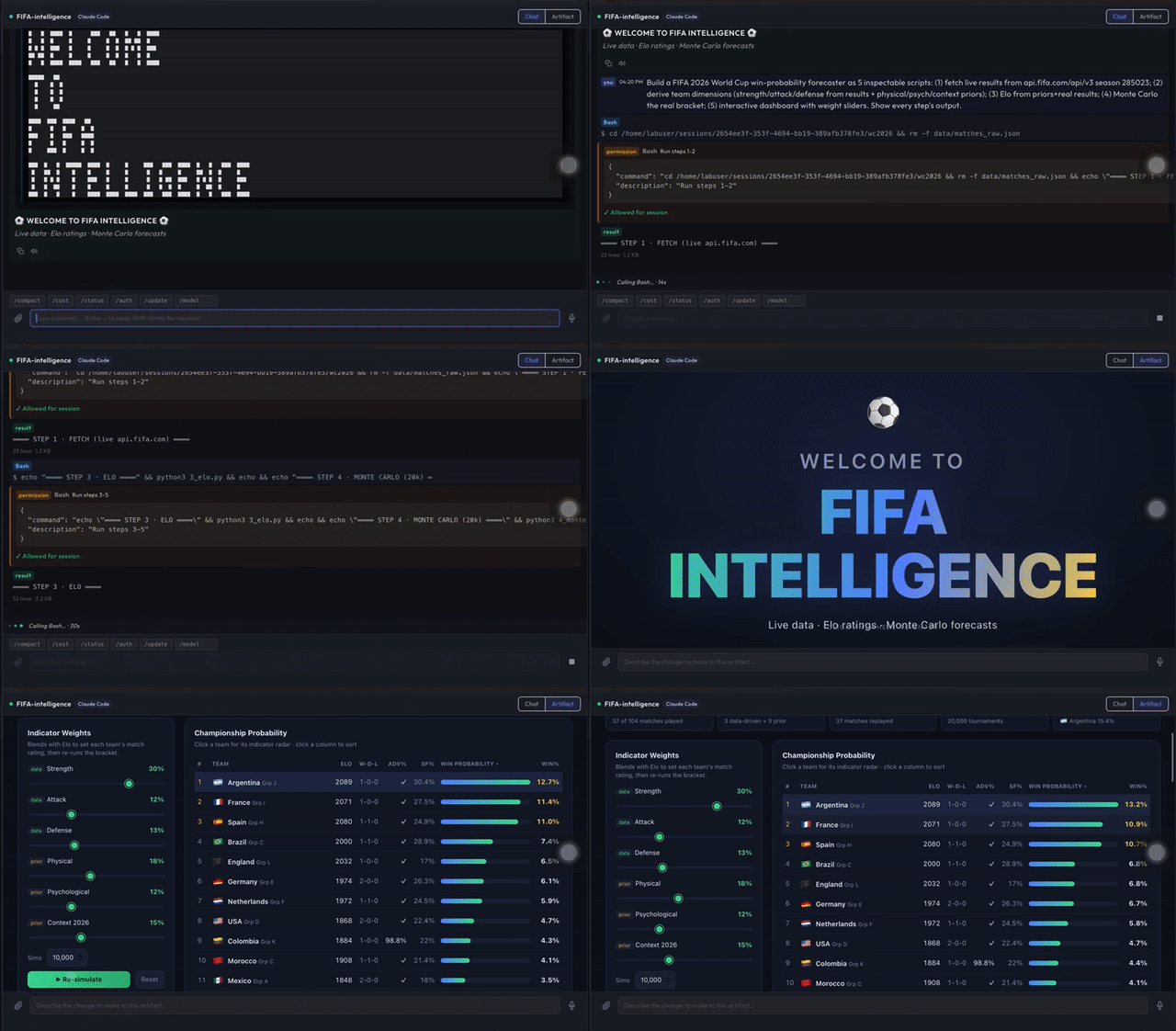
Above: an AI-generated artifact (a live FIFA forecast dashboard) calls external APIs and isolated data through artifact-gateway — no secrets in the page, no raw network access.
What it is
AI agents (Claude Code, Codex, Gemini CLI) can produce interactive web apps — artifacts — that need to call external APIs, read internal data, and persist state. These apps run inside iframes and cannot authenticate directly.
artifact-gateway provides:
- App tokens — short-lived JWTs scoped to a user+context, derived from the user's RBAC role.
- External proxy — forward calls from artifact apps to any external HTTPS API without exposing the user's credentials.
- Internal proxy — forward calls to internal OhWise APIs with allowlist enforcement; the user's JWT is forwarded so RBAC is handled by the target service.
- DuckDB handler — per-user and per-session isolated DuckDB files on the local filesystem.
- MongoDB handler — per-user and per-session isolated MongoDB collections via Motor.
Browser client SDK: the matching client that artifact apps load in the iframe lives in
sdk/js/and is published to npm asartifact-sdk(npm i artifact-sdk, or via CDN). This Python package is the server half; the JS SDK is the client half.
Installation
Base install (token + proxy only, no database drivers):
pip install artifact-gateway
With DuckDB support:
pip install "artifact-gateway[duckdb]"
With MongoDB (Motor) support:
pip install "artifact-gateway[mongo]"
Full install:
pip install "artifact-gateway[all]"
Quick start
1. Issue an app token
from artifact_gateway import issue_app_token, scope_from_role

token = issue_app_token(
    secret_key="your-service-secret-key",
    user_id="user-abc123",
    account_id="account-xyz789",
    context="lab_session:sess-001",
    scope=scope_from_role("member"),  # derives scopes from RBAC role
    ttl=14400,  # 4 hours (default)
)
2. Validate a token on incoming requests
from artifact_gateway import validate_app_token

try:
    claims = validate_app_token(secret_key="your-service-secret-key", token=token)
    user_id = claims["user_id"]
    scope = claims["scope"]
except ValueError as exc:
    # expired or tampered token
    raise
3. Proxy an external API call
from artifact_gateway import ExternalProxy

proxy = ExternalProxy()

result = await proxy.call(
    scope=claims["scope"],
    method="GET",
    url="https://api.example.com/v1/data",
    headers={"X-Api-Key": "..."},
)
# result = {"status": 200, "headers": {...}, "body": {...}}
4. Proxy an internal OhWise API call
from artifact_gateway import InternalProxy

proxy = InternalProxy(base_url="http://localhost:8000")

result = await proxy.call(
    scope=claims["scope"],
    user_jwt="<user's original OhWise JWT>",
    path="/api/agent",
    method="GET",
)
# result = {"status": 200, "body": {...}}
5. DuckDB — user-isolated database
from artifact_gateway.db.duckdb import DuckDBHandler

handler = DuckDBHandler(workspace="/var/ohwise/workspaces")

# Create and populate a table.
await handler.exec("user", user_id, "analytics", "CREATE TABLE events (ts TEXT, val INT)")
await handler.exec("user", user_id, "analytics", "INSERT INTO events VALUES (?, ?)", params=["2026-01-01", 42])

# Query it.
result = await handler.query("user", user_id, "analytics", "SELECT * FROM events")
# {"columns": ["ts", "val"], "rows": [["2026-01-01", 42]], "rowcount": 1}
Session-scoped database (isolated to one Lab session):
await handler.exec("session", user_id, "scratch", "CREATE TABLE t (n INT)", session_id="sess-001")
6. MongoDB — user-isolated collections
import motor.motor_asyncio
from artifact_gateway.db.mongo import MongoHandler

client = motor.motor_asyncio.AsyncIOMotorClient("mongodb://localhost:27017")
db = client["ohwise"]
handler = MongoHandler(db=db)

# Find documents.
docs = await handler.find("user", user_id, "notes", filter={"status": "active"})

# Upsert.
await handler.upsert("user", user_id, "notes",
    filter={"key": "my-note"},
    update={"$set": {"content": "updated content"}},
)

# Delete.
await handler.delete("user", user_id, "notes", filter={"archived": True})
7. Credential vault — reference secrets by name
Artifact apps should never embed plaintext API keys. Store the secret encrypted, then have the app reference it by name; the gateway resolves and injects it on the outbound request.
from artifact_gateway import CredentialVault, apply_credential, PLACEMENT_BEARER

vault = CredentialVault(master_key="your-encryption-key")

# At save time (store ciphertext in your DB):
ciphertext = vault.encrypt("sk-live-abc123")

# At request time, resolve and inject:
secret = vault.decrypt(ciphertext)
headers, query = apply_credential(secret=secret, placement=PLACEMENT_BEARER)
# headers = {"Authorization": "Bearer sk-live-abc123"}
placement can be "bearer", "header" (with name="X-Api-Key"), or "query" (with name="api_key").
8. Files — user/session-isolated read & write
from artifact_gateway import FilesHandler

files = FilesHandler(root="/var/ohwise/workspaces")

await files.write("user", user_id, "exports/report.csv", "a,b\n1,2\n")
out = await files.read("user", user_id, "exports/report.csv")
await files.list("user", user_id, "exports")
await files.delete("user", user_id, "exports/report.csv")
Paths are confined to the user's (or session's) directory; traversal outside it raises ValueError.
9. Streaming external proxy
proxy = ExternalProxy()
async for chunk in proxy.stream(
    scope=claims["scope"], method="POST",
    url="https://api.anthropic.com/v1/messages",
    headers={"x-api-key": "..."}, body={...},
):
    relay_to_client(chunk)  # e.g. as SSE
10. Refresh a token
from artifact_gateway import refresh_app_token

fresh = refresh_app_token(secret_key, old_token)  # same claims, new exp
Concepts
App token
A short-lived JWT (HS256) signed with the service's SECRET_KEY. Claims include user_id, account_id, context (e.g. lab_session:<id>), and a scope list derived from the user's RBAC role.
The token is injected into artifact app iframes via postMessage by the parent frame. It is stored in memory only — never in localStorage or cookies.
Scope claims
| Scope | Meaning |
|---|---|
external:* |
Call any external HTTPS API |
internal:read |
Read from internal OhWise APIs (GET) |
internal:write |
Mutate internal OhWise APIs (POST/PUT/DELETE) |
db:user:read |
Read from user-scoped databases |
db:user:rw |
Read and write user-scoped databases |
db:session:read |
Read from session-scoped databases |
db:session:rw |
Read and write session-scoped databases |
db:shared:read |
Read from shared databases (admin+ only) |
Role → scope mapping
| Role | External | Internal write | DB user rw | DB shared read |
|---|---|---|---|---|
| viewer | No | No | No | No |
| member | Yes | Yes | Yes | No |
| admin | Yes | Yes | Yes | Yes |
| system_admin | Yes | Yes | Yes | Yes |
| platform_owner | Yes | Yes | Yes | Yes |
Data isolation
- DuckDB: each user's files live under
{workspace}/{user_id}/db/. Session-scoped files live under{workspace}/{user_id}/sessions/{session_id}/db/. The proxy never allows path traversal beyond the user's directory. - MongoDB: collection names are prefixed automatically —
app_user_{user_id}_{collection}orapp_session_{session_id}_{collection}. User code never sees the real collection name.
Integrating with FastAPI
Wire the proxy handlers into a FastAPI router alongside token validation middleware:
from fastapi import APIRouter, Depends, HTTPException, Header
from artifact_gateway import (
    validate_app_token,
    ExternalProxy,
    InternalProxy,
    ExternalCallRequest,
    InternalCallRequest,
)

SECRET_KEY = "your-secret-key"
router = APIRouter(prefix="/api/lab/app")
external_proxy = ExternalProxy()
internal_proxy = InternalProxy(base_url="http://ohwise-backend:8000")


async def get_claims(authorization: str = Header(...)) -> dict:
    token = authorization.removeprefix("Bearer ")
    try:
        return validate_app_token(SECRET_KEY, token)
    except ValueError as exc:
        raise HTTPException(status_code=401, detail=str(exc))


@router.post("/external")
async def proxy_external(req: ExternalCallRequest, claims: dict = Depends(get_claims)):
    try:
        return await external_proxy.call(
            scope=claims["scope"],
            method=req.method,
            url=req.url,
            headers=req.headers,
            body=req.body,
        )
    except PermissionError as exc:
        raise HTTPException(status_code=403, detail=str(exc))


@router.post("/internal")
async def proxy_internal(req: InternalCallRequest, claims: dict = Depends(get_claims)):
    try:
        return await internal_proxy.call(
            scope=claims["scope"],
            user_jwt=claims["_user_jwt"],  # store at token issuance
            path=req.path,
            method=req.method,
            body=req.body,
            query=req.query,
        )
    except PermissionError as exc:
        raise HTTPException(status_code=403, detail=str(exc))
Contributing
- Fork the repository.
- Create a feature branch.
- Run tests:
pip install -e ".[dev]" && pytest. - Submit a pull request.
License
Apache 2.0 — see LICENSE.
1 maintainer

Metadata
1 maintainer
Release files for artifact-gateway 0.3.1
For a detailed explanation of source distributions (sdists) and built distributions (wheels), please see the package formats documentation.
Source distribution (sdist)
| File | Size | Uploaded | |
|---|---|---|---|
| artifact_gateway-0.3.1.tar.gz | 3.8 MB | Details |
Built distribution (wheel)
| File | Interpreter | ABI | Platform | Reset |
|---|---|---|---|---|
| artifact_gateway-0.3.1-py3-none-any.whl | Python 3 | none | any | Details |
Total release size: 3.9 MB
Release files / artifact_gateway-0.3.1.tar.gz
| Download URL | artifact_gateway-0.3.1.tar.gz |
|---|---|
| Size | 3.8 MB |
| Tags | Source |
|
SHA-256 checksum How to use checksums |
dc06b6c0e383c875c906dd4aec9cd43801d1fabe4f4a4a0cfae35049062c3e0c
|
|
BLAKE2b-256 checksum How to use checksums |
1981e08460d456df5cc52bf1cae7889a8ffb5cf21da67e8ffc897b3f4ad4c004
|
| Upload date | |
|
Uploaded using Trusted Publishing? What is trusted publishing? |
No |
| Uploaded via |
twine/6.2.0 CPython/3.14.0
|
Release files / artifact_gateway-0.3.1-py3-none-any.whl
| Download URL | artifact_gateway-0.3.1-py3-none-any.whl |
|---|---|
| Size | 30.6 kB |
| Tags | Python 3 |
|
SHA-256 checksum How to use checksums |
45e7ef5060589a8986993db6f89133032bccad5f15258f4bdeb2a75dfd1697e6
|
|
BLAKE2b-256 checksum How to use checksums |
a2d0d8d0aa400a341ec392b6383f40ebe89573727eccb9d9bd02a6cc479388f8
|
| Upload date | |
|
Uploaded using Trusted Publishing? What is trusted publishing? |
No |
| Uploaded via |
twine/6.2.0 CPython/3.14.0
|














