
askwol
Check OWL ontologies during modelling and before publication. Get a report on namespaces, terms, metadata, documentation, and selected logical issues, plus an interactive class diagram in the web app.



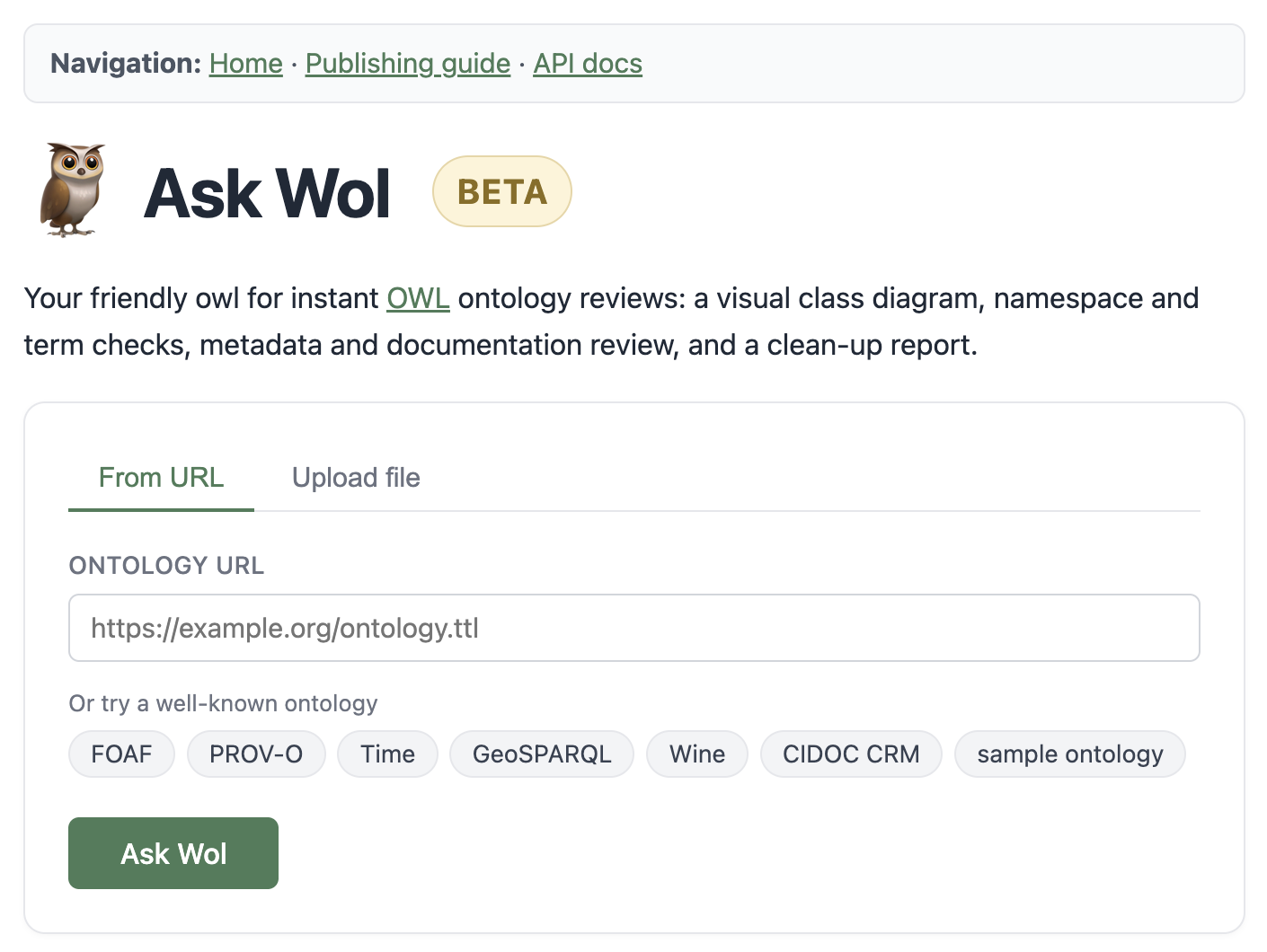
Supported formats: Turtle (.ttl), RDF/XML (.rdf, .owl), JSON-LD (.jsonld), N-Triples (.nt), and N3 (.n3). See the full list of checks; each report section links to the matching guide entry.
Findings count individual issues, not checks:
| Severity | Meaning |
|---|---|
| Error | A detected logical issue or violation of selected OWL restrictions. |
| Warning | A likely mistake or interoperability problem. |
| Recommendation | A publishing convention, such as metadata, licensing, or documentation. |
Reasoning uses the submitted document without imports. Passing these checks does not establish overall consistency or complete OWL conformance.
Install
Python 3.10+ is required. For the CLI only, install with pipx:
pipx install askwol
For local development, the web app, and the Python API (macOS/Linux):
git clone https://github.com/TDCC-NES/askwol.git
cd askwol
python3 -m venv .venv
.venv/bin/python -m pip install -e ".[dev]"
Run locally
Run from the repository folder containing pyproject.toml, using the virtual environment above:
ASKWOL_ROOT_PATH= PYTHONPATH=src .venv/bin/python -m uvicorn \
  askwol.web:app --reload --reload-dir src --port 8000
Open the checker, guide, or API docs. Python changes reload automatically; refresh the browser to see them. Stop with Ctrl+C.
CLI
askwol check ontology.ttl
askwol check ontology.ttl --format json
askwol check ontology.ttl --format markdown -o report.md
askwol check ontology.ttl --skip-resolution
For a source install, use .venv/bin/askwol instead of askwol.
--timeout 60sets the HTTP timeout in seconds (default:30).--skip-resolutionskips namespace and import HTTP requests; local checks and reasoning still run.- Exit code
0means no errors;1means errors were found. Warnings and recommendations do not change the exit code.
API
Upload a file to the running app for a JSON report:
curl -F "file=@ontology.ttl" http://127.0.0.1:8000/api/validate
JSON includes severity_summary with finding counts and has_errors. Per-check status values (ok, warn, fail, skip) describe outcomes, not severity. /health reports service availability.
To run the same checks from Python:
import asyncio
from askwol.pipeline import run_full_validation

report, _ = asyncio.run(run_full_validation("ontology.ttl", include_mermaid=False))
print(report.model_dump_json(indent=2))
Docker
From the repository root, build and start the app, or rebuild after changes:
docker compose up -d --build --force-recreate
The app is available at http://127.0.0.1:8000/. Logs: docker compose logs -f askwol. Stop: docker compose down.
For automatic reloading during development:
cp docker-compose.override.yml.example docker-compose.override.yml
docker compose up --build
Keep that development override off production servers. The supplied production configuration uses one web worker, binds to 127.0.0.1:8000, and persists usage data in ./data/.
On a server, clone the repository, run the start command above, and put an HTTPS reverse proxy in front of it. For example, with Caddy:
askwol.example.com {
    encode zstd gzip
    request_body { max_size 25MB }
    reverse_proxy 127.0.0.1:8000
}
For updates, run git pull, then repeat the build/start command.
Serving under a sub-path
For a deployment at /askwol/, put this in the repository's .env file:
ASKWOL_ROOT_PATH=/askwol
The reverse proxy must strip the prefix before forwarding. With Caddy:
server.example.com {
    handle_path /askwol/* {
        reverse_proxy 127.0.0.1:8000
    }
}
Configuration
Native Python runs read environment variables, not .env files. Docker Compose forwards ASKWOL_ROOT_PATH and ASKWOL_STATS_TOKEN from .env; add other overrides under the service's environment in a Compose override file. Restart native runs or recreate Compose containers after changing settings.
| Variable | Default | Purpose |
|---|---|---|
ASKWOL_RATE_LIMIT |
20 |
Validation requests per client IP per minute, per worker; 0 disables. |
ASKWOL_VALIDATION_TIMEOUT |
300 |
Maximum seconds per web job. |
ASKWOL_MAX_CONCURRENT_VALIDATIONS |
2 |
Concurrent web jobs per worker. |
ASKWOL_MAX_TRIPLES |
500000 |
Maximum triples per ontology. |
ASKWOL_MAX_NAMESPACES |
500 |
Maximum declared prefixes per ontology. |
ASKWOL_MAX_IMPORTS |
200 |
Maximum declared imports per ontology. |
ASKWOL_USAGE_DB |
data/usage.db |
Usage database path; Docker uses /data/usage.db. |
ASKWOL_USAGE_DISABLED |
unset | Set to 1 to disable usage tracking. |
ASKWOL_STATS_TOKEN |
unset | Enables access to usage statistics. |
Web uploads are capped at 20 MB. Requests to private/internal network addresses are blocked. Web jobs run in isolated subprocesses: timeouts return 504, and excess concurrent requests return 503. Set the proxy timeout above the job timeout and enforce a proxy upload limit. The CLI shares the ontology size caps, but runs without the web job timeout or concurrency limit.
A client disconnect cancels its job when the reverse proxy forwards the disconnect. Cancelled requests do not count as usage.
Usage tracking
A local SQLite database records timestamps, source URLs or filenames, HTTP statuses, durations, and IP hashes salted with a per-database secret. No cookies or third-party tracking services are used.
Set ASKWOL_STATS_TOKEN to a long random value (generate one with openssl rand -hex 32) and apply it as described above. /stats is the HTML dashboard; /api/stats returns JSON. Authenticate with ?token=YOUR_TOKEN, including on localhost. Totals and daily counts cover all recorded activity; average duration uses the last 30 days.
Tests
After the source installation above, run from the repository root:
.venv/bin/python -m pytest tests/ -q
For manual checks, upload sample.ttl or broken.ttl through the local app. Contribution guidelines: CONTRIBUTING.md.
Why askwol?
The name plays on OWL and “Wol,” Owl's misspelled name in Winnie-the-Pooh: ask Owl for a second opinion on your ontology. Wollie, to friends.
Licence
MIT.
1 maintainer

Metadata
1 maintainer
Release files for askwol 0.2.0
For a detailed explanation of source distributions (sdists) and built distributions (wheels), please see the package formats documentation.
Source distribution (sdist)
| File | Size | Uploaded | |
|---|---|---|---|
| askwol-0.2.0.tar.gz | 961.2 kB | Details |
Built distribution (wheel)
| File | Interpreter | ABI | Platform | Reset |
|---|---|---|---|---|
| askwol-0.2.0-py3-none-any.whl | Python 3 | none | any | Details |
Total release size: 1.2 MB
Release files / askwol-0.2.0.tar.gz
| Download URL | askwol-0.2.0.tar.gz |
|---|---|
| Size | 961.2 kB |
| Tags | Source |
|
SHA-256 checksum How to use checksums |
64ee2e0a0e01883f9f3ebdeac979660d877be625c526aed49b8fdb562ff91467
|
|
BLAKE2b-256 checksum How to use checksums |
aa3c50fa99b9726a797549017254447e9ad71a05af56354c10d699b0b0bce3f9
|
| Upload date | |
|
Uploaded using Trusted Publishing? What is trusted publishing? |
Yes |
| Uploaded via |
twine/7.0.0 CPython/3.13.14
|
Provenance
Provenance describes where a file came from. On PyPI, provenance is shared via attestations, which provide a verifiable record of the build or publishing details. View details, limitations and caveats.


PyPI Publish Attestation
PyPI verified that this artifact, at this checksum, originated from the publisher listed below.
Signed by GitHub Actions, verified by PyPI on Oct 15, 2026.
Transparency logRelease files / askwol-0.2.0-py3-none-any.whl
| Download URL | askwol-0.2.0-py3-none-any.whl |
|---|---|
| Size | 223.9 kB |
| Tags | Python 3 |
|
SHA-256 checksum How to use checksums |
7449c77047d732c88e3079eafbc3cae2722890273e4334cba8010f276fed829d
|
|
BLAKE2b-256 checksum How to use checksums |
870885f9b3238a2d7d66895ef413cee58e78c026de5b30936e2d8fd079f98d7f
|
| Upload date | |
|
Uploaded using Trusted Publishing? What is trusted publishing? |
Yes |
| Uploaded via |
twine/7.0.0 CPython/3.13.14
|
Provenance
Provenance describes where a file came from. On PyPI, provenance is shared via attestations, which provide a verifiable record of the build or publishing details. View details, limitations and caveats.
PyPI Publish Attestation
PyPI verified that this artifact, at this checksum, originated from the publisher listed below.
Signed by GitHub Actions, verified by PyPI on Oct 15, 2026.
Transparency log













