
Self-hostable, AI-native knowledge base engine — an external brain you share with your AI.

Project description
Atlas Mind





It's your mind, not someone else's.
Notion, and every hosted notes app, ask you to pour your thinking into their structure, on their servers, in their format. You rent the space; they hold the keys. Atlas Mind inverts that: your knowledge is plain files in your own git repository, served by an engine you can read line by line and throw away without losing a single note. Your AI comes to your library through an open protocol — it never pulls your brain into its own.
Own the data. Own the engine. Own the mind.
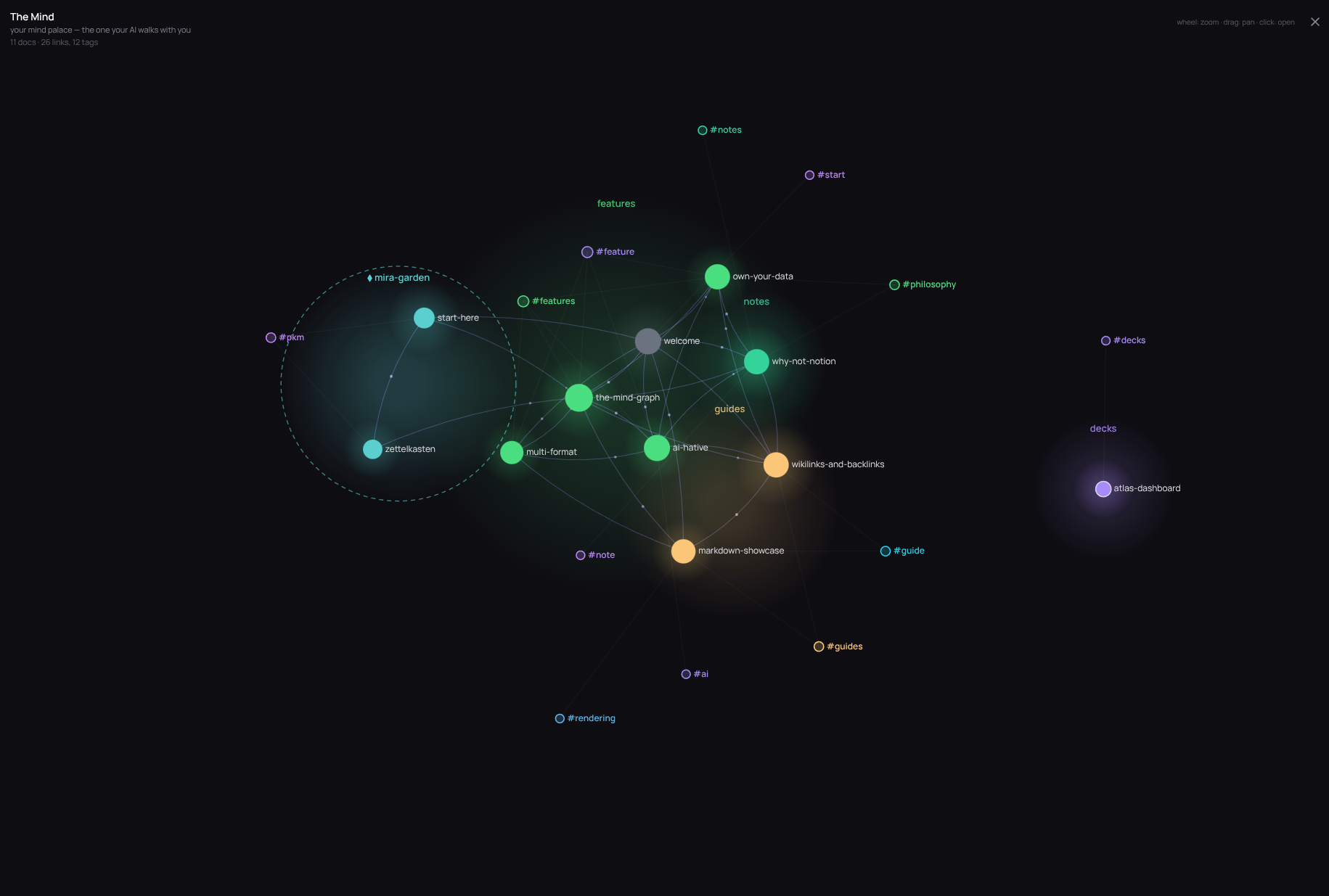
🔗 Try the live demo → — this is the offline build, some features are missing. (What is Atlas Mind? — the landing page.)
Atlas Mind is a self-hostable wiki / knowledge base engine — and an external brain you share with your AI. It serves a single-page viewer from a folder of documents (a mind), and keeps the engine (the code) cleanly decoupled from your content (your notes, in their own git repository).
It is built on three ideas:
- Multi-format, not just Markdown. Markdown is first-class (rendered, linked,
searched), but Atlas Mind also previews standalone HTML documents (decks,
dashboards), PDFs, and Word
.docxfiles inline — converted to readable HTML in your browser, nothing uploaded anywhere. Your knowledge lives in one place whatever its shape. - AI-native. Atlas Mind is meant to be the memory your AI assistant reads and
enriches: it exposes an MCP endpoint (nineteen tools — read, write, map and
rewind your mind) and
atlas initscaffolds the conventions (AGENTS.md,agents/,ai-sessions/) so an assistant knows how to use your mind. See Use it with your AI. - Lightweight & self-contained. A single Python HTTP server plus a build step, written entirely on the standard library — no database required, accounts and share links live in plain JSON files on disk. Frontend libraries and fonts are vendored, so a running instance makes no third-party network calls — your mind never leaves your disk, and nothing you write trains anyone's model.
Who it is for
- Anyone who wants a personal or small-team knowledge base they fully own.
- People who already keep notes as Markdown in git and want a viewer, search, linking and an AI integration on top — without a database or a hosted service.
- Self-hosters who want one process behind a reverse proxy, or a small container on a PaaS such as Fly.io.
It is not a multi-tenant SaaS, a real-time collaborative editor, or a plugin marketplace. It is a focused engine for one mind per instance.
Contents
How it works · Features · Requirements · Install · Quick start · Use it with your AI · Atlas nodes · Collaboration · Configuration · Updating · Deployment · Building from source · Extensions · Security model · Licence
How it works
Atlas Mind is two things kept deliberately apart:
- The engine — this repository: the Python server, the build step, and the single-page viewer.
- A mind — your content, in its own git repository: a
content/folder of documents plus a smallatlas.toml. Accounts, tokens and share links live in a local.atlas/directory (plain JSON, gitignored), so a mind carries its own state and no database is involved.
You point the engine at a mind and it serves a fast single-page app: a build step
turns content/ into a search/backlink index and a viewer shell, the server
serves it, and edits made in the viewer are written back to the files (and, in
cloud mode, committed and pushed). Upgrading the engine never touches your
content; syncing content never touches the engine.
That separation is the whole point: if Atlas Mind disappeared tomorrow, your mind would still open in any text editor — it is just a folder of files in your own git repository. You are never holding someone else's format hostage.
Features
Everything below ships in the box.
Reading & multi-format viewer
- Markdown is first-class: rendered with GitHub-flavoured Markdown, syntax highlighting, a table of contents, reading time, and a per-document tag bar.
- Standalone HTML documents (slide decks, dashboards) are previewed inline in a sandboxed iframe — their own CSS/JS runs, isolated from the viewer.
- PDF is previewed inline in the browser's native viewer.
- Word
.docxis converted to readable HTML in the browser (via a lazily-loaded library) and shown with the same prose styling as Markdown — read-only, and nothing ever leaves your machine. (.pptxand other binaries are offered as a direct download.) - Every file type can be downloaded as its original from the toolbar.
Navigation & discovery
- Tree sidebar over
content/, collapsible, with rename / share-as-node actions on hover. - Full-text search — server-side when online (transfers only the results), or MiniSearch (fuzzy, prefix) over embedded content when offline.
- Wikilinks
[[...]], backlinks, and "same subject" suggestions from shared tags, surfaced in a side panel; a wikilink/backlink index is built at build time. - Tags derived from parent folders and YAML frontmatter, each with its own per-tag view.
- Task rollup — every
- [ ]/- [x]across the whole mind gathered in one view, grouped by document, "show done" toggle, and a click that jumps straight to the task in its document (the per-document todo widget stays separate). - The Mind — a force-directed "mind palace": every document and tag is a node on a navigable map (drag, pan, zoom), colour-grouped into regions by folder, with recently-edited nodes glowing and orphans dimmed. Subscribed remote nodes appear as their own distinct, teal regions (see Atlas nodes).
- Command palette (Ctrl-K), pinned and recently-modified documents, and a quick-capture button.
Editing
- Create, edit, rename, move and delete documents straight from the viewer; moving a document rewrites the wikilinks that point at it.
- Document templates — new documents can start from a base skeleton (note,
meeting, project, decision/ADR, literature note, how-to, contact, retro, spec);
drop a
.mdintemplates/to add or override your own. - Interactive task checkboxes — tick a
- [ ]item in a rendered document and the change is written straight back to the file, no full re-render flicker. (Live engine only — the offline build / demo can't write, so its checkboxes are read-only.) - Todos — a small categorised CRUD widget backed by a Markdown file, with a count badge on the favicon.
- All edits in cloud mode are committed and pushed by the instance itself.
History (git time-travel)
- Every document is git-versioned, so the viewer surfaces its history: a
side panel lists each revision (date, author, message), shows a clean diff
between versions, lets you view a past version, and restore one — the
restore is a new commit on top, nothing is rewritten. Renames and moves are
followed, so a document keeps its full, loadable history even after a
move_doc.
Notes (annotations)
- Attach a note to a text selection in any Markdown document; the highlight persists and re-anchors on later visits (orphaned notes are flagged if the text changed). A tree badge shows each document's note count, live.
- Copy all notes of a document as Markdown (quote + note) in one click — handy for sharing your annotations, including on a read-only remote node.
Sharing & collaboration
- Per-document access (cloud mode) — share any document with specific people or groups at a level (view / comment / edit, optionally time-limited), à la Notion: documents are private by default, opened to chosen people, or made common to the whole team. See Collaboration.
- Public share links — an HMAC-signed token that serves a single document with no login, with optional expiry and one-click revocation. Useful to hand a page to someone outside your instance.
Hive Mind (Atlas nodes)
Share a folder or document with another Atlas Mind instance, read-only, kept in sync. See the dedicated section: Atlas nodes.
Multi-user & collaboration (cloud mode)
- Cloud mode turns on accounts and login. Two roles: admin (full access +
the Settings panel: users, tokens, shares, nodes, groups) and member (the
viewerrole — read access to the common space plus their own private space, and whatever others share with them). - Per-document access control — every document is private, shared with chosen people or groups (view / comment / edit, optionally time-limited), or common to the whole team. The owner controls a document's sharing; an admin curates the common space but never sees a member's private notes, and a document you can't read returns a clean 404 (no existence oracle). New members join by a one-time invite link and set their own password. See Collaboration.
Security & authentication
Cloud mode brings cookie sessions, optional TOTP 2FA with single-use recovery codes, per-account lockout with backoff and per-IP login rate limiting, and full CSRF defence. See the Security model for the honest details.
AI integration
- An MCP endpoint exposing nineteen tools so an assistant reads, writes,
navigates and rewinds your mind directly, in four groups:
- read —
search_docs(with an optionaltagfilter),read_doc,list_tree,recent_docs; - write —
create_doc,edit_doc,move_doc(fixes incoming[[backlinks]]),delete_doc(soft-delete to.trash/, reversible); - graph —
get_links,get_backlinks,list_by_tag,get_mind_topology(a bird's-eye summary: hubs, orphans, density, top tags); - time-travel (your mind is a git repo) —
doc_history,doc_at(a past version by revision or date),doc_diff,search_history(pickaxe — find when a string entered or left history, even if since deleted),changelog,doc_blame,doc_revert.
- read —
- A REST API v1 (Bearer tokens, create-only writes) with a published OpenAPI 3.1 spec.
atlas initscaffolds the conventions (AGENTS.md,agents/,ai-sessions/). See Use it with your AI.
Offline, PWA & sync
- Offline build — a single self-contained
index-offline.htmlthat works fromfile://, plus a service worker for an installable, offline-capable PWA. The file carries no runtime access control, so the build embeds only the common socle (documents nobody made private); pass--as <email>to export one account's full view instead. Either way it is a static snapshot — sharing the file shares exactly what was baked in, with no login. - Live reload over server-sent events; in cloud mode, content syncs via a
periodic
git pulland an optional GitHub webhook (see Updating).
Look & feel
- i18n: French and English. A single, carefully-built dark theme, re-skinnable via a CSS extension.
Requirements
- Python >= 3.11 (standard library only; uses
tomllib, added in 3.11; developed on 3.12+). - A git repository for your content (the mind). For cloud mode with content sync, a GitHub repository.
- Somewhere to run it — your machine for local use, or any host that can run a Python process or a container for self-hosting.
- No database. Accounts, tokens and share links are stored as plain JSON under
.atlas/. (bcryptis an optional dependency, used only to verify legacy$2…password hashes; the native scheme is scrypt, from the standard library.)
Install
Installing puts a self-contained atlas command on your PATH (the viewer assets
ship inside the package — no separate download).
The easy way — uv or pipx.
Both install the command into its own isolated environment (no virtualenv to
manage), and uv will even fetch a suitable Python for you:
uv tool install atlas-mind     # or: pipx install atlas-mind
atlas serve ~/my-mind

# Or run it once without installing, straight from PyPI:
uvx atlas-mind serve ~/my-mind   # or: pipx run atlas-mind serve ~/my-mind
With pip (a virtualenv is recommended):
pip install atlas-mind
# or, straight from the repository:
pip install "git+https://github.com/Anakior/atlas-mind.git"
# or, for development (editable, from a clone):
git clone https://github.com/Anakior/atlas-mind.git && cd atlas-mind && pip install -e .
Without installing, the engine also runs straight from the source tree as
python3 src/cli.py <command>. All examples below use the atlas command;
substitute python3 src/cli.py if you did not install. (atlas-mind is a
built-in alias of atlas, so the uvx/pipx run one-liners above resolve a
command without --from.)
Quick start
Scaffold a new mind and serve it locally:
atlas init ~/my-mind
atlas serve ~/my-mind
init creates atlas.toml, a .gitignore, example documents under content/,
the AI-native scaffolding (AGENTS.md, content/agents/, content/ai-sessions/),
an empty .atlas/extensions/ hook directory, and runs git init -b main. On a
terminal it asks a few questions (interface language, brand prefix, tagline) —
pass --lang, --prefix, --tagline, or --yes to skip the prompts. It never
overwrites existing files: it refuses a non-empty directory unless you pass
--force, and keeps any file already present.
serve builds the viewer once if it is missing, then becomes the HTTP server.
By default it listens on 127.0.0.1:8765 with authentication disabled — open
http://127.0.0.1:8765 and your notes are there. Stop it with Ctrl+C.
To produce the static viewer without serving:
atlas build ~/my-mind            # dist/index.html (online shell)
atlas build ~/my-mind --offline  # dist/index-offline.html (monolith)
CLI commands
Every command takes the mind directory as a positional argument; it defaults to the current directory, so you can omit it from inside the mind.
| Command | Purpose |
|---|---|
init <dir> [--force] [--lang en|fr] [--prefix P] [--tagline T] [--yes] |
Scaffold a new mind (never destructive; prompts for personalization on a TTY). |
serve <dir> [--port N] |
Build if needed, then run the HTTP server. |
build <dir> [--offline] |
Build the static viewer (--offline for the monolith). |
deploy <dir> [--target compose|systemd|fly] [--app NAME] [--wizard] |
Scaffold deployment files + guide; fly --wizard deploys end-to-end. |
user add <dir> --email <e> [--role admin|viewer] [--password ...] |
Create an account in the file store. |
user list <dir> |
List accounts (and token state for API accounts). |
user remove <dir> --email <e> |
Remove an account. |
token create <dir> [--label claude] |
Mint a 256-bit API/MCP token (shown once). |
token list <dir> |
List API tokens (label, email, active/revoked, date). |
token revoke <dir> [--label claude] |
Revoke a token (idempotent). |
share list <dir> |
List all share links (active / expired / revoked). |
share revoke <dir> --id <id> |
Revoke a share link. |
The user, token and share commands operate on the local file store
(.atlas/ by default). token create derives the account email from the label
(claude → claude@api.local) and prints the token once, with both the REST
(Authorization: Bearer) and MCP (/mcp/<token>) usage.
Use it with your AI (MCP)
Atlas Mind is designed to be the external memory your AI assistant reads and
writes. atlas init scaffolds an AGENTS.md at the mind root (read by Claude
Code and AGENTS.md-aware tools) that tells the assistant how to use your mind —
adapt it to your conventions. Two folders come scaffolded: content/agents/
(reusable AI agent definitions) and content/ai-sessions/ (session saves, with a
TEMPLATE.md template).
The engine exposes an MCP endpoint with nineteen tools — your assistant can
read (search_docs, read_doc, list_tree, recent_docs), write
(create_doc, edit_doc, move_doc, delete_doc), map the graph
(get_links, get_backlinks, list_by_tag, get_mind_topology) and
travel through time (doc_history, doc_at, doc_diff, search_history,
changelog, doc_blame, doc_revert). Mint a token and point your assistant at it:
atlas token create ~/my-mind --label claude
# → prints the MCP URL: https://<your-atlas>/mcp/<token>
Your AI can then search, read, write and rewind documents directly in your mind — the Mind view is, quite literally, the map it walks.
Hive Mind (Atlas nodes)
Two Atlas Mind instances can share a slice of their content becoming an Hive Mind. The model is a personal memory with sharing, not a real-time collaborative editor: a node is published by one side and mirrored read-only by the other, kept in sync.
It is pull-asymmetric — only the publisher needs to be reachable over the network; the subscriber just pulls. From the admin Settings → Nodes panel (or the share-as-node button on any folder/file in the tree):
- Publish a node. Pick a folder or a single document and publish it. You get a
one-time, copyable link (
atlas-node:…) that carries the origin URL and a read-only token (stored hashed; the link is shown only once, re-issue to rotate). - Subscribe. On the other instance, paste the link. Atlas Mind fetches a
manifest, downloads the documents, and keeps a read-only mirror under
remotes/<node>/. It re-syncs automatically (manifest diff by SHA-256) on the regular pull cadence, plus an on-demand Sync button. The publisher being offline just leaves the last copy in place. - Browse it like your own. Mirrored documents appear in the tree under a distinct “Mental nodes” umbrella (with the source instance shown), and as their own teal, dashed regions in The Mind. They are read-only: editing, renaming, moving or deleting them is refused (it would be overwritten on the next sync anyway).
- Make it yours. “Appropriate” copies a node (or, from a multi-file node, just the current document) into your own documents at a destination you choose — a detached, fully editable copy.
- Your AI sees everything. Mirrored content lives under your
content/, so the MCP/REST tools read it like any other document.
Nodes are managed by admins; tokens are scoped to the published path and can be revoked at any time (which removes the subscriber's access at the next sync).
Collaboration (one mind, many people)
Atlas Mind has two distinct kinds of sharing, and they solve different problems:
- The Hive links your mind to another instance — a read-only mirror, peer-to-peer. Minds that follow minds.
- Collaboration (this section) is the other direction: several people inside
one instance, each document with its own access. Notion-style sharing, on
files you own — access lives in a plain
acl.jsonnext to your accounts and share links, no database.
Turn it on with cloud mode (KB_AUTH_ENABLED), add accounts, and every
document carries one of three states:
- Private — only its owner; a member's new document starts here.
- Shared — the owner has granted specific people or groups access, at a level (view, comment or edit), optionally set to expire.
- Common — no owner: visible to the whole team, the shared socle.
The viewer keeps it legible without a dialog: a coloured dot in the tree (private / shared / shared-with-you), a “Shared with you” sidebar section, a “shared by …” line under a shared document, and margin notes that carry their author. The model is deliberate:
- The owner controls a document's sharing — not the admin. An admin curates the common space and manages accounts, but never sees another member's private notes.
- No existence oracle — a document you can't read is a clean 404, never a “forbidden” that would confirm it exists.
- Members join by invitation — an admin issues a one-time link; the person
opens it and sets their own password (the admin never sees it). Or create an
account directly with
atlas user add <mind> --email … --role viewer. - Groups (
group:<name>) grant a whole team at once, managed by admins in Settings.
It is still not a real-time collaborative editor: underneath it is a git repository, not a live co-editing surface. And it composes with the Hive — run one mind per person and let a few people share an instance, whatever fits the group.
Configuration
Configuration lives in atlas.toml at the root of the mind; every key is
optional. Precedence is environment variable > atlas.toml > built-in
default. Configuration is read once at startup. Unknown keys produce a
non-fatal warning on stderr (with a difflib suggestion); a wrong-typed value is
a fatal, readable error.
A minimal atlas.toml (roughly what init scaffolds):
# prefix = "Acme"          # "Acme" -> "Acme Atlas Mind"; empty/absent -> "Atlas Mind"
tagline = "Personal knowledge base."
lang = "en"                # "fr" or "en"

[server]
# port = 8765
# auth_enabled = false     # true = cloud mode (login required); needs session_secret
# session_secret = ""      # long random secret, REQUIRED if auth_enabled
# trusted_ip_header = "X-Forwarded-For"

[store]
kind = "file"              # local JSON under .atlas/ (no database)
# dir = ".atlas"

[todo]
# file = "notes/quick.md"
# categories = ["work", "personal"]

[build]
# excluded_names = ["drafts", "quick.md"]
Key reference
The prefix key only changes the displayed name; the Atlas Mind wordmark
itself is fixed (see Licence). Env semantics: keys marked presence
take effect when the variable is set (even empty); keys marked or fall back to
atlas.toml when the variable is empty.
atlas.toml key |
Env var | Env semantics | Default | Notes |
|---|---|---|---|---|
prefix (root) |
— | — | "" |
Prefix before the fixed Atlas Mind wordmark. |
tagline (root) |
— | — | Personal knowledge base. |
Home page tagline. |
lang (root) |
— | — | en |
en or fr only. |
[server] port |
PORT |
presence | 8765 |
Validated 0–65535. |
[server] auth_enabled |
KB_AUTH_ENABLED |
presence | false |
Any non-empty value enables; empty disables. |
[server] session_secret |
SESSION_SECRET |
presence | dev-secret-change-me |
Cloud mode refuses to boot on the default. |
[server] session_max_age |
SESSION_MAX_AGE |
presence | 2592000 (30 d) |
Must be > 0. |
[server] git_pull_interval |
GIT_PULL_INTERVAL |
presence | 300 |
Seconds between content pulls; must be ≥ 0. |
[server] github_webhook_secret |
GITHUB_WEBHOOK_SECRET |
presence | "" |
HMAC secret for the GitHub webhook. |
[server] trusted_ip_header |
ATLAS_TRUSTED_IP_HEADER |
or | "" (→ none) |
Client-IP header behind a proxy. |
[store] kind |
ATLAS_STORE |
or | file |
Storage backend (local JSON). |
[store] dir |
ATLAS_STORE_DIR |
or | <mind>/.atlas |
Cannot be the mind root or under content/. |
[git] author_name |
— | — | Atlas Bot |
Commit author for the bot. |
[git] author_email |
— | — | atlas-bot@example.com |
Commit author email for the bot. |
[git] repo_url |
GITHUB_REPO_URL |
or | none | Content repo URL with the push token embedded (used for the boot clone AND the content push-back) — see below. |
[todo] file |
— | — | notes/quick.md |
Todo file, relative to content/. |
[todo] categories |
— | — | ["work", "personal"] |
First is the default category. |
[build] excluded_names |
— | — | {"quick.md"} |
Names hidden from the viewer (dotfiles always excluded). |
ATLAS_MIND (and, in cloud mode only, KB_REPO_PATH, default /app/repo) select
the mind root. Resolution order: explicit --dir, then ATLAS_MIND, then
KB_REPO_PATH if KB_AUTH_ENABLED is set, otherwise the parent of src/.
Updating
Engine and content are decoupled, so there are two independent update channels.
Updating content (everyday)
Edit your documents and push to your mind's git repository. In cloud mode the
running instance picks the change up by two means: a periodic git pull
every GIT_PULL_INTERVAL seconds (default 300 s = 5 min), and an instant
GitHub webhook (POST /webhook/github, HMAC-verified with
GITHUB_WEBHOOK_SECRET) for push-to-update. On each sync the instance rebuilds
the viewer and the open page live-reloads over SSE.
So a freshly-pushed note appears within five minutes by default, or immediately
if the webhook is configured. Lower GIT_PULL_INTERVAL for snappier polling, or
rely on the webhook and raise it. (Edits made through the viewer are committed
and pushed by the instance itself, so they need no manual sync.)
The GitHub push token
In cloud mode the instance both clones your private mind repo at boot and
pushes content writes back to it. Both use a single setting: the repo URL
with the token embedded, named GITHUB_REPO_URL:
GITHUB_REPO_URL="https://x-access-token:<TOKEN>@github.com/<you>/<your-mind>.git"
<TOKEN> is a GitHub fine-grained personal access token with Contents:
Read and write on that one repo. Create it at GitHub → your avatar →
Settings → Developer settings → Personal access tokens → Fine-grained tokens →
Generate new token (direct link:
https://github.com/settings/personal-access-tokens/new): under Repository
access pick Only select repositories → your mind repo, then under
Permissions → Repository permissions set Contents → Read and write. The
token (github_pat_…) is shown once — copy it.
Where to set GITHUB_REPO_URL depends on the host: Fly →
fly secrets set GITHUB_REPO_URL="…"; Docker Compose → a line in .env;
systemd → Environment=GITHUB_REPO_URL="…". It is a secret (it carries the
token) — never commit it. The registry under .atlas/ is gitignored, so the
token is never pushed with your content.
Updating the engine
Engine updates are not automatic — only your content syncs on its own (the
git pull + webhook above). When a new engine version ships (the admin Settings
update banner flags it), update by hand. Content and the .atlas
store/volume are preserved; only the code changes.
The simplest way is the atlas update command — the mirror of atlas deploy.
It prints the right command for your target (and runs it with --run):
atlas update --target fly --app <your-app>   # or --target compose / --target systemd
atlas update --target compose --run          # build (no-cache) + up -d, in one go
Under the hood: the generated images install atlas-mind from PyPI, and Docker
caches the pip install layer, so a plain redeploy can silently reuse the old
version — atlas update forces a fresh fetch (--no-cache) for you. The manual
equivalents:
fly deploy -c deploy/fly.toml --no-cache              # Fly.io
docker compose build --no-cache && docker compose up -d   # Docker Compose
Cleaner and reproducible: pin the version in the Dockerfile
(pip install "atlas-mind[bcrypt]==X.Y.Z") and bump it — a normal fly deploy
then rebuilds that layer because the Dockerfile changed. For a local install,
update in place — uv tool upgrade atlas-mind, pipx upgrade atlas-mind, or
pip install -U atlas-mind — and restart the service.
Deployment
atlas deploy <mind> --target <compose|systemd|fly> scaffolds ready-to-use
deployment files into <mind>/deploy/ and prints a step-by-step guide. The
local/cloud split is driven by KB_AUTH_ENABLED: any non-empty value enables
authentication (the cloud-mode default), empty disables it. When auth is on a
real SESSION_SECRET is mandatory — the server refuses to boot on the default.
- Local (CLI) —
atlas serve <mind>: binds127.0.0.1, auth off, no secret required. The everyday local mode — nothing to deploy. - Fly.io — one command —
atlas deploy <mind> --target fly --wizardruns the whole thing interactively: creates the app + volume, generates and setsSESSION_SECRET, asks for your private content repo + token (GITHUB_REPO_URL), deploys, and creates the admin account — no setup token, no manual juggling. Drop--wizardto only scaffolddeploy/fly.toml+deploy/Dockerfile.flyand follow the printed steps;--app <name>overrides the auto-derived app name. The mind is cloned from your private GitHub repo at boot and the account registry lives on a persistent volume. - Docker Compose —
atlas deploy <mind> --target composescaffolds aDockerfile+docker-compose.yml+Caddyfile+.env.example(engine installed from PyPI, your mind mounted, Caddy for automatic HTTPS): thencd <mind>/deploy && cp .env.example .env, setSESSION_SECRET, point theCaddyfileat your domain, anddocker compose up -d. - systemd (no Docker) —
atlas deploy <mind> --target systemdscaffoldsdeploy/atlas.service, which runsatlas servefrom a venv as a dedicated non-root user. Front it with a TLS reverse proxy.
Behind a reverse proxy, set trusted_ip_header = "X-Forwarded-For" (or the header
your proxy sets) so the login rate limiter sees the real client IP — the bundled
Caddyfile already sets it. The registry under .atlas/ is gitignored and (on Fly)
lives on the volume, so it is never committed with your content.
Building from source
Running and deploying Atlas needs no build step — the package ships ready to run.
The one exception is the viewer's stylesheet: src/web/vendor/tailwind.css is a
precompiled Tailwind bundle containing only the classes the viewer uses. If you
edit src/web/viewer.html and add a Tailwind class that was not already on the page,
it will not exist in the compiled CSS (a silent no-op) until you regenerate it:
cd src/web/tailwind
npm install      # once — dev-only toolchain, into a gitignored node_modules
npm run build    # after every change to classes in viewer.html
Commit the regenerated CSS with your HTML change. See CONTRIBUTING.md for details; the toolchain is never bundled into the published package.
Extensions
Atlas Mind has two minimal hooks rather than a plugin system, both anchored on a
fixed per-mind directory: <mind>/.atlas/extensions/. A missing or empty
directory means no extensions, and the viewer and server are byte-for-byte
unchanged.
- Viewer assets — at build time,
*.cssand*.jsthere are concatenated (alphabetical) and inlined into the viewer, in both online and offline builds, and re-injected into public share pages. Closing tags are neutralised so an extension cannot escape its container. - Server routes — at boot,
*.pymodules are imported; each exposesregister(context)and registers routes viacontext.add_route(method, pattern, handler, role=...)(role∈public/auth/admin).
A broken extension is logged and skipped — it never crashes the boot or fails a
build. The viewer exposes a small window.Atlas API and emits
atlas:doc-rendered / atlas:edit-enter DOM events. Two worked examples live in
examples/extensions/: custom-theme (re-skin the design via CSS) and
pob (a server route + viewer template + styles). Installing an extension
means copying the files in, rebuilding, and restarting the server.
Security model
Authentication is implemented from scratch on the standard library. A brief, honest summary:
- Passwords: native scrypt (N=2¹⁴, r=8, p=1, 16-byte salt, 64-byte output).
bcrypt is an optional fallback only for legacy
$2…hashes. - Sessions: HMAC-SHA256–signed (not encrypted) cookies (email/role/epoch/ts),
revocable server-side via a
session_epochbumped on logout-all, password reset and TOTP changes.HttpOnly,SameSite=Lax,Securewhen auth is on. - CSRF defence in depth: JSON content type required when there is a body,
same-origin
Origin/Referercheck when present, and a synchronizer token (HMAC(secret, "email|epoch")) in anX-CSRF-Tokenheader. - 2FA: TOTP (RFC 6238, ±1 step) with ten single-use recovery codes.
- Brute-force: per-account lockout with exponential backoff (60 s → 1 h) plus a per-IP login rate limit (10/min); timing equalised to avoid enumeration.
- API / MCP tokens: SHA-256 of a 256-bit secret, role
api; REST writes are create-only; per-token rate limit 120/min. - Share links: HMAC-signed and fail-closed when auth is on — an unreachable registry returns 503 rather than serving a possibly-revoked doc.
Known limitations, stated plainly: the TOTP secret is stored in cleartext in
the registry; the session cookie payload is readable (signed, not encrypted);
share-link revocation is only re-checked when auth_enabled; account lockout
state is per-instance; and SESSION_SECRET is used for sessions, CSRF, share
links and the webhook alike (cloud mode refuses the default secret).
Licence
Atlas Mind is licensed under the GNU Affero General Public License v3.0
(AGPL-3.0). Because the AGPL covers use over a network, if you run a modified
version as a network service you must make the corresponding source available to
its users. See LICENSE for the full terms and NOTICE for the brand notice.
Brand notice. The name Atlas Mind and its visual wordmark (the styled
"Atlas" + "Mind" badge in the viewer and login page) are a fixed part of the
engine and are not granted to you by the software licence. The configurable
prefix key lets you display your own name in front (e.g. "Acme" → "Acme Atlas
Mind"); the Atlas Mind wordmark itself stays. You may fork and modify under the
AGPL, but please do not present a modified version as the official Atlas Mind, and
keep the brand notice intact.
Bundled third-party frontend libraries and fonts are vendored under their own
licences (MIT, Apache-2.0, BSD-3-Clause, OFL, …); see src/web/vendor/LICENSES.md.
Release history Release notifications | RSS feed


Download files
Download the file for your platform. If you're not sure which to choose, learn more about installing packages.
Source Distribution
Built Distribution
Filter files by name, interpreter, ABI, and platform.
If you're not sure about the file name format, learn more about wheel file names.
Copy a direct link to the current filters
File details
Details for the file atlas_mind-0.6.2.tar.gz.
File metadata
- Download URL: atlas_mind-0.6.2.tar.gz
- Upload date:
- Size: 1.2 MB
- Tags: Source
- Uploaded using Trusted Publishing? No
- Uploaded via: twine/6.2.0 CPython/3.14.6
File hashes
| Algorithm | Hash digest | |
|---|---|---|
| SHA256 |
0d23a1a393a74259f87cee9e30a18b2e3118d8f9d7b44a5028e3d91829882596
|
|
| MD5 |
6135a0a38099c944566c905d4c06cfe8
|
|
| BLAKE2b-256 |
0cf01de9696a66f414d3811acbfb91d6e4806b487824899f1b757a421f7ef5fb
|
File details
Details for the file atlas_mind-0.6.2-py3-none-any.whl.
File metadata
- Download URL: atlas_mind-0.6.2-py3-none-any.whl
- Upload date:
- Size: 1.1 MB
- Tags: Python 3
- Uploaded using Trusted Publishing? No
- Uploaded via: twine/6.2.0 CPython/3.14.6
File hashes
| Algorithm | Hash digest | |
|---|---|---|
| SHA256 |
921cef859601d9775f7a88868a08c22d484d1651dbc2113d770774a9152b22c1
|
|
| MD5 |
9b90fab5f54edfe6f904228855a36a0c
|
|
| BLAKE2b-256 |
4dd518400ce89bf98addd8136d1d8f549f874b382f23eaa00c8155abb28c4fb7
|






