
Standalone EoMT (Encoder-only Mask Transformer) for instance segmentation, with DINOv2 init, COCO training/validation and inference.
Verified details
These details have been verified by PyPIProject links
GitHub Statistics
Maintainers

Project description




Abstract
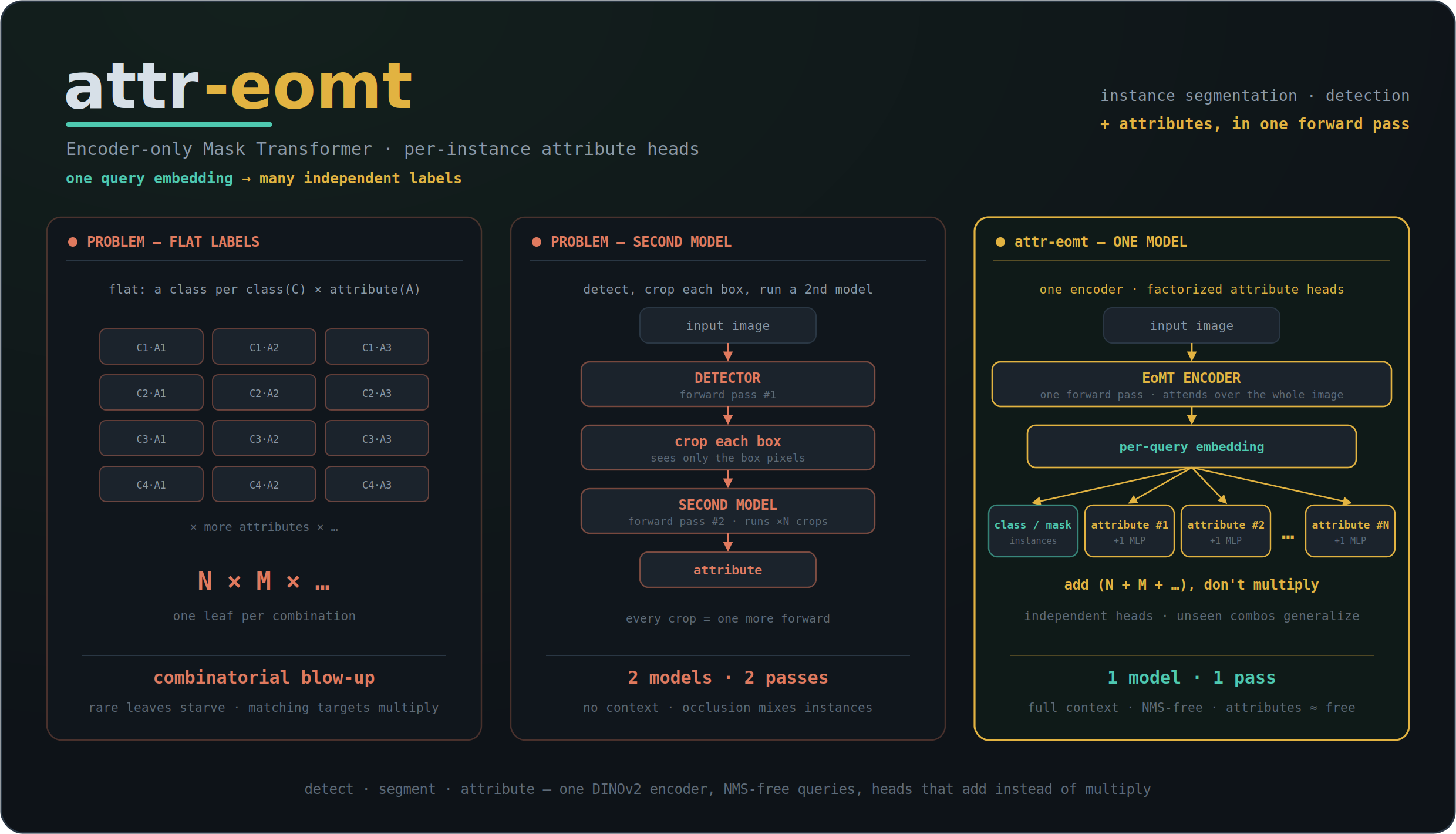
attr-eomt is a standalone EoMT (Encoder-only Mask Transformer) for instance
segmentation and object detection, extended with one feature that sets it apart:
independent per-instance attribute heads. Alongside the usual mask/box + class
output, the model predicts one or several orthogonal attributes for every detected
instance — colour, state, grade, laterality, anything — read straight off the same
per-query embedding the detector already computes. Instead of folding every distinction
into one combinatorial class list, attr-eomt factorizes the label space: a small,
well-populated primary taxonomy plus thin attribute heads that add rather than
multiply. Each head reuses the detector's own Hungarian match, so attributes train
and infer for near-zero extra compute — no second model, no second pass, and the
primary detection metric is left exactly as it was. The result is composable,
generalizing per-instance labels that can even predict attribute × class combinations
never seen during training.
It is a clean-room, Apache-2.0-compatible reimplementation: weights you train are yours to release.
from eomt import EoMT

model = EoMT("l")                            # fresh large model (DINOv2 backbone)
model.train(data="coco", epochs=50)          # COCO 2017 auto-downloads if missing

model = EoMT("runs/train/eomt-l")            # reload a run — size/classes/heads auto-detected
model.predict("images/", plot=True)          # render masks/boxes + per-instance attributes
Architecture
EoMT is a DINOv2-with-registers ViT whose last few transformer blocks are augmented
with a fixed set of learnable queries (the Mask2Former idea) — each query is one
"slot" that latches onto one object instance. After the encoder runs, every query emits
a single vector, the per-query embedding of shape [B, Q, hidden]. The whole model
is then just "turn that embedding into predictions": a class head for the primary
label and a mask/box head for geometry. It is NMS-free, so two overlapping
garments stay two distinct queries instead of being merged — the property that lets
attributes stay attached to the right instance.
The attribute heads add nothing to this picture except themselves: they tap the exact same embedding (captured non-invasively with a forward hook), each a small classifier on top.

Two model families: segmentation & detection
Both families share the same DINOv2 encoder, query mechanism, NMS-free matching and auxiliary heads — they differ only in the head on top and what they output:
| family | --task |
output | metric driving best.pt |
|---|---|---|---|
| instance (default) | instance |
per-instance masks + boxes + class | segm/mAP |
| detect | detect |
per-instance boxes + class (DETR-style box head, no masks) | bbox/mAP |
EoMT("l").train(data="coco", family="instance")   # masks (default)
EoMT("l").train(data="coco", family="detect")     # boxes only
The family is recorded in the checkpoint, so val / predict pick the right
post-processing automatically. Everything below applies identically to both.
Models & sizes
| size | backbone | hidden | layers | heads | queries |
|---|---|---|---|---|---|
s |
DINOv2-small | 384 | 12 | 6 | 100 |
b |
DINOv2-base | 768 | 12 | 12 | 200 |
l |
DINOv2-large | 1024 | 24 | 16 | 200 |
Default input is a patch-14-aligned square (644 = 14 × 46) so DINOv2 weights load 1:1.
Compute & inference speed
Measured on a single NVIDIA GeForce RTX 5090, 644 × 644 input, batch size 1.
GFLOPs are multiply-accumulates at that resolution (attention included); latency /
throughput are the median over 50 runs after warm-up, under torch.amp.autocast
(fp16) — the package's own inference path.
instance family (masks + boxes + class):
| size | params | GFLOPs | latency (fp16) | throughput (fp16) | throughput (fp32) |
|---|---|---|---|---|---|
s |
24.0 M | 128 | 8.4 ms | 119 img/s | 70 img/s |
b |
93.9 M | 430 | 17.4 ms | 58 img/s | 32 img/s |
l |
317 M | 1144 | 30.2 ms | 33 img/s | 15 img/s |
detect family (boxes + class, no mask head):
| size | params | GFLOPs | latency (fp16) | throughput (fp16) | throughput (fp32) |
|---|---|---|---|---|---|
s |
22.7 M | 89 | 2.9 ms | 348 img/s | 120 img/s |
b |
88.6 M | 276 | 5.3 ms | 190 img/s | 60 img/s |
l |
308 M | 881 | 13.6 ms | 74 img/s | 21 img/s |
Dropping the mask-upsampling head makes detect substantially lighter and ~1.3–3×
faster. Figures are for the detector itself (backbone + queries + heads); the
attribute heads add a thin linear/MLP per head and are negligible by design.
⭐ Method — factorizing the label space
This is the contribution. Conventional detectors fold every distinction into a single
flat label space. When an object has both a type and several attributes — a garment's
class and its viewpoint and whether it's occluded — the only way to express that is
the Cartesian product type × viewpoint × occlusion × …. That space explodes combinatorially,
starves each leaf class of training examples, and breaks Hungarian matching by
multiplying the query targets.
attr-eomt factorizes instead. The primary head stays small and general; orthogonal attributes are predicted by independent secondary heads, each reading the same per-instance query embedding the detector already computes — they add, not multiply.

Because the heads are independent:
- Categories stay collapsed and general. Keep a compact, well-populated primary
taxonomy (
short_sleeve_top,dress,trousers) and push fine-grained or orthogonal distinctions into attributes — every primary class keeps its full sample count instead of being shattered into rare leaves. - Unseen combinations generalize. A
viewpointhead trained across many garment types predictssideon a class it never co-occurred with sideways, because viewpoint is learned independently of type. The model composesattribute × classcombinations that never appear in the training data — combinations a flat label space cannot even represent. - Instances stay separate. EoMT is NMS-free, so two overlapping same-class objects remain two distinct queries; each carries its own attribute predictions rather than being merged.
- It rides along for free. Attributes reuse the backbone and the detector's own matched queries — they add only a thin linear/MLP head and a cross-entropy term, not a second model or a second pass.
Example: clothing with per-instance attributes
One model segments each garment (primary classes like vest_dress / short_sleeve_top
/ long_sleeve_dress / skirt / trousers …) and, for every detection, reads off
four independent attribute heads — scale (small / modest / large),
occlusion (no / slight / medium), zoom_in (no / medium / large) and
viewpoint (frontal / side / back). The renderer prints the primary class + score
on the first row and each attribute + its confidence on the rows beneath it.
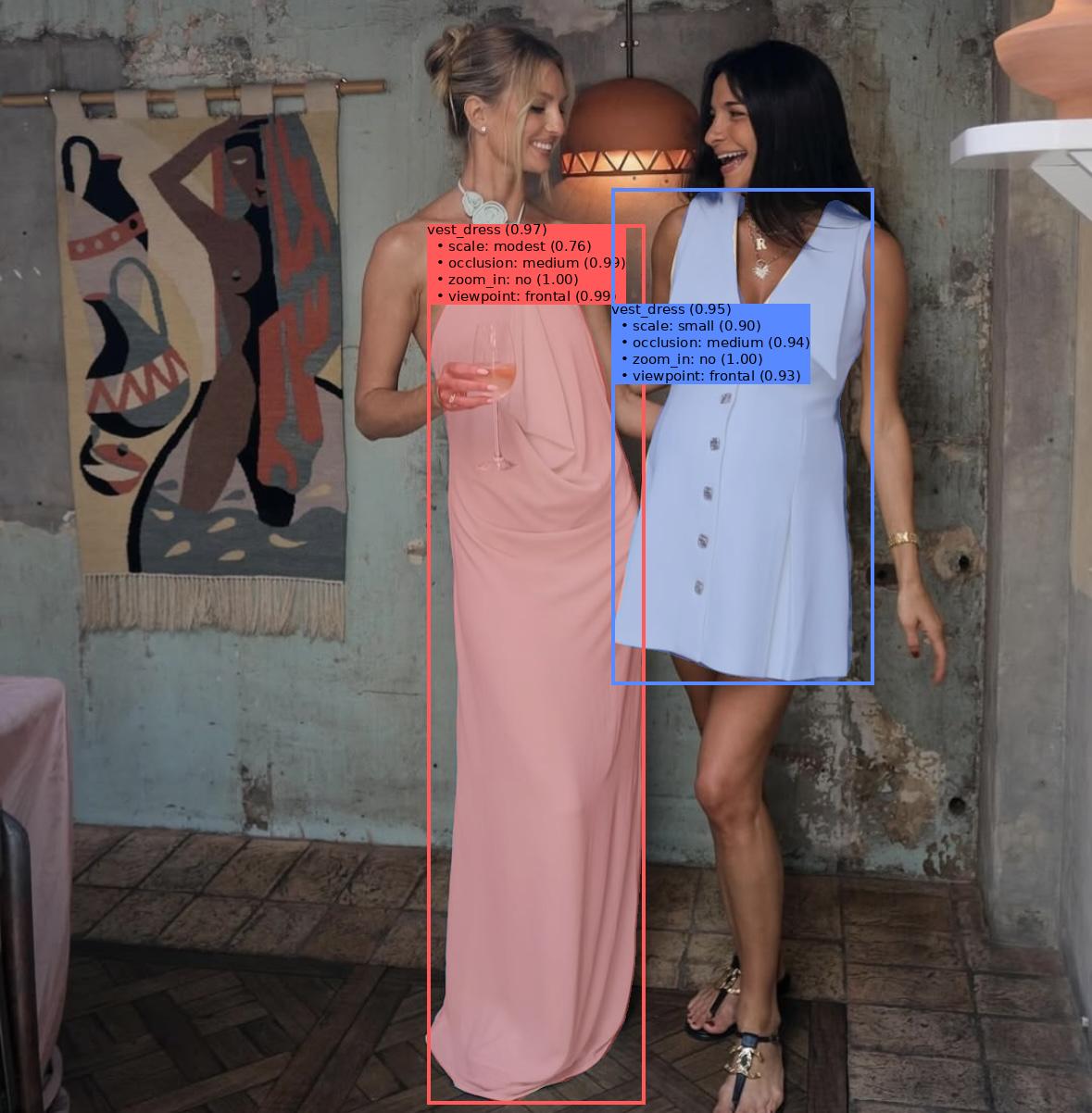
The four attributes are orthogonal to the garment class — they vary independently — which is exactly the case that's awkward to fold into the primary class space. The same pattern fits any "class plus per-instance sub-labels" task: retail shelves → product + facing, documents → element + role, cells → type + health.
Trained on the public DeepFashion2 dataset (13 garment classes + 4 attribute heads) and rendered with the package's own renderer (
eomt.visualize.draw_instances).
Training — it rides on the detector's own match
Attributes never run their own matcher. Detection already solves "which query is responsible for which ground-truth object" via the Hungarian matcher; attributes simply reuse that same query→GT assignment and read the answer off the matched queries.
![Training flow: query_embed → Hungarian matcher (reused) → IoU gate → matched queries [N, hidden] → per-head cross-entropy → × aux_w → added to detector loss](https://pypi-camo.freetls.fastly.net/691faefdaf194477d62c48fa4d67f55323b34b5d/68747470733a2f2f7261772e67697468756275736572636f6e74656e742e636f6d2f696d6167726139332f617474722d656f6d742f6d61696e2f646f63732f6173736574732f30332d747261696e696e672d666c6f772e706e67)
- Embedding source. Each head reads the per-query embedding — the input to EoMT's
class_predictor, captured with a forward hook ([B, Q, hidden]). - Matching. Supervision reuses EoMT's own Hungarian matcher
(
model.eomt.criterion.matcher), so every attribute is trained on the same query→GT assignment the detection loss used; the attribute is read after matching. - Gate. An optional IoU gate drops barely-overlapping matched pairs (common early in training) so attributes only learn from queries that actually localize the object.
- Loss. Cross-entropy per head over matched queries, summed across heads and scaled
by
aux_w(default1.0), added to the detector loss. Empty-match batches contribute a graph-preserving zero, and missing labels useignore_indexand contribute nothing. - Checkpoint selection is unchanged. The attribute "rides along": its per-head
matched-query accuracy is shown live and written to
metrics.csv, but never drivesbest.pt(stillsegm/mAPorbbox/mAP). - Inference. Each result attaches
aux = {head: {"ids", "probs"}}for the kept detections, andpredict(plot=True)renders each attribute next to the class label using names stored in the checkpoint.
Data format (auto-discovered from the COCO JSON)
Attributes live inside the COCO annotations — each annotation is already a
per-instance object, so alignment is automatic and pycocotools still parses it. Just
two additions to a standard COCO file; no YAML changes — heads (count, classes,
names) are discovered from the JSON, the same as nc.
1. A top-level attributes list — one entry per head, defining its vocabulary:
"attributes": [
  {
    "name": "scale",
    "categories": [
      {"id": 1, "name": "small"},
      {"id": 2, "name": "modest"},
      {"id": 3, "name": "large"}
    ]
  },
  {
    "name": "viewpoint",
    "categories": [
      {"id": 0, "name": "frontal"},
      {"id": 1, "name": "side"},
      {"id": 2, "name": "back"}
    ]
  }
]
2. A per-annotation attributes map — {head: raw_id} on each instance:
{
  "id": 1, "image_id": 42, "category_id": 1,
  "segmentation": [...], "bbox": [...], "area": 1234, "iscrowd": 0,
  "attributes": {"scale": 3, "viewpoint": 0}
}
Notes:
- Raw ids are remapped to a contiguous
0..n-1per head (soscale's1/2/3become0/1/2);categoriesmay be omitted, in which case the id set is inferred. - A missing per-annotation value defaults to
0; a JSON with noattributes⇒ detection-only, exactly as before.
A tiny, self-contained example (two heads, including a non-contiguous id set) lives in sample_data/.
Install
pip install attr-eomt                  # from PyPI
pip install "attr-eomt[logging]"       # + tensorboard/wandb
pip install -e ".[dev]"                # from source (editable; [dev] adds pytest/build/twine)
Usage
Everything goes through one class. Initialize from a size (fresh model, pretrained
DINOv2 backbone) or from a checkpoint / run folder (family, size, classes, image
size, normalization and any auxiliary heads are auto-detected from the .pt):
from eomt import EoMT

# Train on COCO 2017 (auto-downloaded on first run):
EoMT("l").train(data="coco", epochs=50, batch=4)

# ...or any COCO-format dataset (point at its data.yaml):
EoMT("s").train(data="sample_data/data.yaml", epochs=1, batch=1)

# Validate and predict from a trained run:
EoMT("runs/train/eomt-l").val(data="coco")
EoMT("runs/train/eomt-l").predict("images/", plot=True)   # writes annotated images
Compress to int8
compress() applies int8 weight-only quantization (via torchao)
to the ViT transformer blocks — the bulk of the parameters — while keeping the
prediction heads in full precision. It's data-free (no calibration) and shrinks the
checkpoint ≈3.4× on l with no measurable mAP loss.
m = EoMT("runs/train/eomt-l")
m.compress("int8", data="coco", save="runs/train/eomt-int8/weights/best.pt")  # quantize, validate, save
# size/mAP/latency deltas are returned (and written to compression_metrics.json in the
# run folder); omit `data` to skip the before/after validation

# Reload like any run — the recipe is recorded in the checkpoint, so the int8 layout
# is rebuilt automatically:
EoMT("runs/train/eomt-int8").predict("images/")
The compressed model is GPU-only (torchao's int8 kernels have no CPU path), and
best.pt exported from an EMA run quantizes exactly those EMA weights.
Useful train() options
Passed as keyword arguments to model.train(...):
| arg | default | effect |
|---|---|---|
family |
"instance" |
"instance" (masks) or "detect" (boxes only) |
nominal_batch / accum |
16 / 0 |
gradient accumulation to an effective batch of nominal_batch; accum=N sets the step count explicitly |
ema / ema_decay / ema_tau |
True / 0.9999 / 2000 |
validate & export best.pt from an EMA of the weights |
llrd |
0.85 |
layer-wise LR decay on the DINOv2 backbone (1.0 = flat backbone_lr_mult) |
min_scale / max_scale |
0.1 / 2.0 |
Large-Scale Jitter range |
letterbox |
True |
aspect-preserving letterbox eval (vs legacy square stretch); recorded in the checkpoint |
flip_prob |
0.5 |
horizontal-flip probability. Set 0 for datasets with a left/right attribute — hflip mirrors pixels without swapping the laterality label |
mask_anneal |
True |
anneal masked attention 1→0 over training (EoMT recipe) |
aux_w |
1.0 |
weight on the summed secondary-head loss |
Training recipe (defaults)
Defaults follow the EoMT/Mask2Former fine-tuning recipe; each piece is a keyword argument, so legacy behaviour is one override away.
- Effective batch via gradient accumulation — LR/WD/clip are tuned for an effective batch of 16; EoMT is a ViT (LayerNorm, no BatchNorm) so accumulation ≈ a true large batch at a fraction of the memory.
- EMA weights validated and saved as
best.pt;last.ptholds live weights + optimizer + EMA state for exact resume. - Large-Scale Jitter for training, letterbox for eval/inference (mode stored
per-checkpoint so
val/predictmatch training automatically). - AdamW with no weight decay on norms/biases/embeddings and layer-wise LR decay on the backbone.
- Masked-attention annealing
1 → 0so the final stretch trains mask-free and matches efficient (mask-less) inference.
Roadmap / future work
- Model export. ONNX / TensorRT (and friends) for deployment — currently out of scope; the inference path is being kept export-friendly.
- Keypoints. A keypoint/pose head family alongside
instanceanddetect(the code already carries afamilyparameter so new heads slot in without API churn). - Pretrained COCO checkpoints. None are published yet. COCO-trained
s/b/lweights will be released on the Hugging Face Hub (thefrom_pretrained/hf://loading plumbing is already in place and waiting for them). - Multi-image re-ID via contrastive learning. Train the auxiliary head with a contrastive objective so each instance's query embedding becomes a re-identification vector — matching the same object across images, frames and cameras for tracking and retrieval. The aux head already produces a per-instance embedding from the detector's own matched queries; re-ID reuses that signal instead of bolting on a separate model.
Project details
Verified details
These details have been verified by PyPIProject links
GitHub Statistics
Maintainers


Download files
Download the file for your platform. If you're not sure which to choose, learn more about installing packages.
Source Distribution
Built Distribution
Filter files by name, interpreter, ABI, and platform.
If you're not sure about the file name format, learn more about wheel file names.
Copy a direct link to the current filters
File details
Details for the file attr_eomt-0.1.3.tar.gz.
File metadata
- Download URL: attr_eomt-0.1.3.tar.gz
- Upload date:
- Size: 1.6 MB
- Tags: Source
- Uploaded using Trusted Publishing? Yes
- Uploaded via: twine/6.1.0 CPython/3.13.12
File hashes
| Algorithm | Hash digest | |
|---|---|---|
| SHA256 |
42cf1a61676e689c2cac31d2e76ab10b3c7f60118bb79c3874ca0f9ae4da1bd6
|
|
| MD5 |
ce0cf50778b83f04ffc057271aeb1c03
|
|
| BLAKE2b-256 |
9ed65da52146e6d1b5e4330de6695ff180dd970481dfb396d6a1a6f3906dba65
|
File details
Details for the file attr_eomt-0.1.3-py3-none-any.whl.
File metadata
- Download URL: attr_eomt-0.1.3-py3-none-any.whl
- Upload date:
- Size: 91.0 kB
- Tags: Python 3
- Uploaded using Trusted Publishing? Yes
- Uploaded via: twine/6.1.0 CPython/3.13.12
File hashes
| Algorithm | Hash digest | |
|---|---|---|
| SHA256 |
a4b0eb9769e0e0328a542824a669475f572cee99e2354cdec4f878289e4ebee7
|
|
| MD5 |
3843888604e81037f4989cfb1305f986
|
|
| BLAKE2b-256 |
f5fdf2438b2b2c539e36d768f99a8c9443bc4fad150d917210176a3f14e5f60b
|






