




What it is
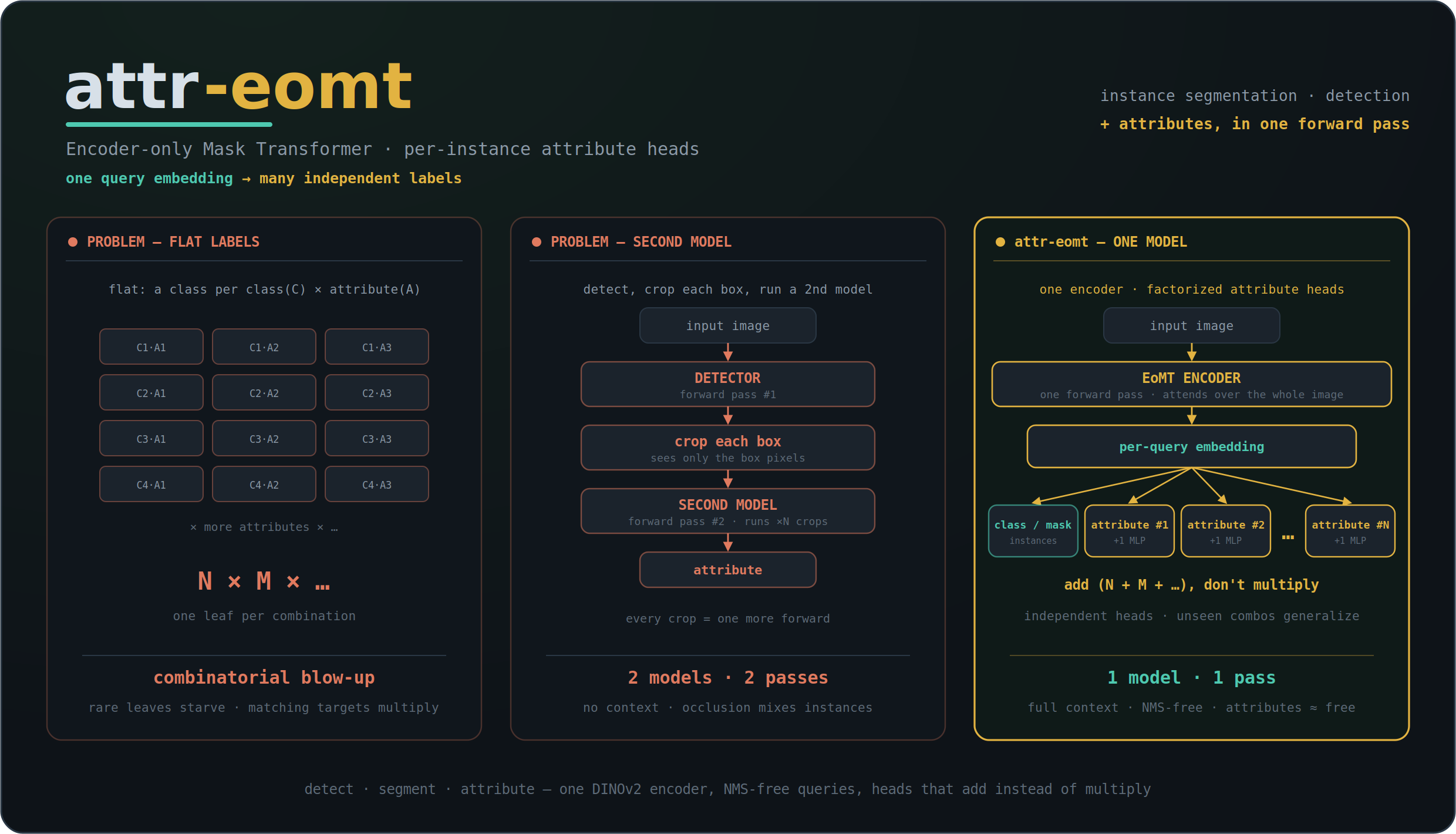
attr-eomt is a standalone EoMT (Encoder-only Mask Transformer, CVPR 2025) for instance segmentation and object detection on a DINOv2 backbone, built around three things:
- Instances with attributes. Every detected instance gets its class and any number of independent attributes — categorical (classify) or real-valued (regress) — read off the same per-query embedding the detector computes. No second model, no crops, no combinatorial label space.
- Several photos of one subject, predicted together (if you have them labelled): cross-view attention lets each photo's queries and features take what the other photos show, so an instance that is tiny or ambiguous in one photo is found and classified with the help of another.
- Instance matching across photos (if you have it labelled): a set matcher decides, in the context of all the
instances of the photos, which ones are the same;
match()turns a folder of photos into one identity per instance.
It is a clean-room, Apache-2.0 reimplementation: the weights you train are yours to release.
from eomt import EoMT

model = EoMT("l")                                  # a new large model (DINOv2 backbone)
model.train(data="run.yaml")                       # the run config: data, attribute heads, settings
model = EoMT("runs/train/my-run")                  # a trained run: everything is read from its checkpoint
model.val()                                        # on its own validation data
results = model.predict("images/", plot=True)      # masks, boxes, classes and attributes per instance
identities = model.match("photos/subject_42/")     # one identity per physical instance across the photos
Install
pip install attr-eomt                  # from PyPI
pip install -e ".[dev]"                # from source (editable; [dev] adds pytest)
Python 3.10+, PyTorch 2.4+. Training and inference run in bf16 on GPUs that support it.
Architecture
EoMT is a DINOv2-with-registers ViT whose last four transformer blocks also process a fixed set of learnable
queries (the Mask2Former idea): each query latches onto one object instance, and after the encoder every query emits
one vector, the per-query embedding [B, Q, hidden]. A class head and a mask head (or a box head for the
detect family) turn it into predictions. It is NMS-free, so two overlapping objects stay two queries — which is
what keeps attributes attached to the right instance.
The attribute heads tap the same embedding: each is a small MLP, trained on the queries the detector's Hungarian matcher assigned to an instance. The optional set matcher reads it too, and the optional cross-view sublayers let the queries and features of several photos of one subject attend to each other's tokens.
| size | backbone | hidden | layers | queries | params |
|---|---|---|---|---|---|
s |
DINOv2-small | 384 | 12 | 100 | 24 M |
b |
DINOv2-base | 768 | 12 | 200 | 94 M |
l |
DINOv2-large | 1024 | 24 | 200 | 317 M |
The default input is 644 px (patch-14 aligned, so DINOv2's weights load 1:1). Two families: instance (masks, the
default) and detect (boxes only, a DETR-style box head).
What differs from the reference EoMT, all on by default and measured on real data:
- Small objects stay visible. Masked attention max-pools the mask logits onto the patch grid (a query whose mask touches no patch attends to all of them, as in Mask2Former), matching scores every query on every cell of the mask grid, and dice is computed on every GT pixel — so instances of a few pixels are matched and supervised.
- A multi-scale pyramid (ViTDet-style FPN) that the queries cross-attend to.
- Scores that rank masks by quality: IoU-aware class targets and a mask-quality head (Mask Scoring R-CNN).
Factorizing the label space
This is the contribution. Conventional detectors fold every distinction into one flat
label space: an object's type × viewpoint × occlusion × … becomes a Cartesian product of
leaf classes that explodes combinatorially, starves each leaf of examples, and multiplies
the Hungarian matcher's targets. attr-eomt factorizes instead — a small, general primary
head plus independent attribute heads that add, not multiply.
Because the heads are independent, the primary taxonomy stays compact and every class keeps
its full sample count; attributes ride along for near-zero compute; and the model composes
attribute × class combinations that never appear in the training data — combinations a
flat label space cannot even represent.
Example: clothing with per-instance attributes
One model segments each garment (primary classes like vest_dress / short_sleeve_top
/ long_sleeve_dress / skirt / trousers …) and, for every detection, reads off
four independent attribute heads — scale (small / modest / large),
occlusion (no / slight / medium), zoom_in (no / medium / large) and
viewpoint (frontal / side / back). The renderer prints the primary class + score
on the first row and each attribute + its confidence on the rows beneath it.
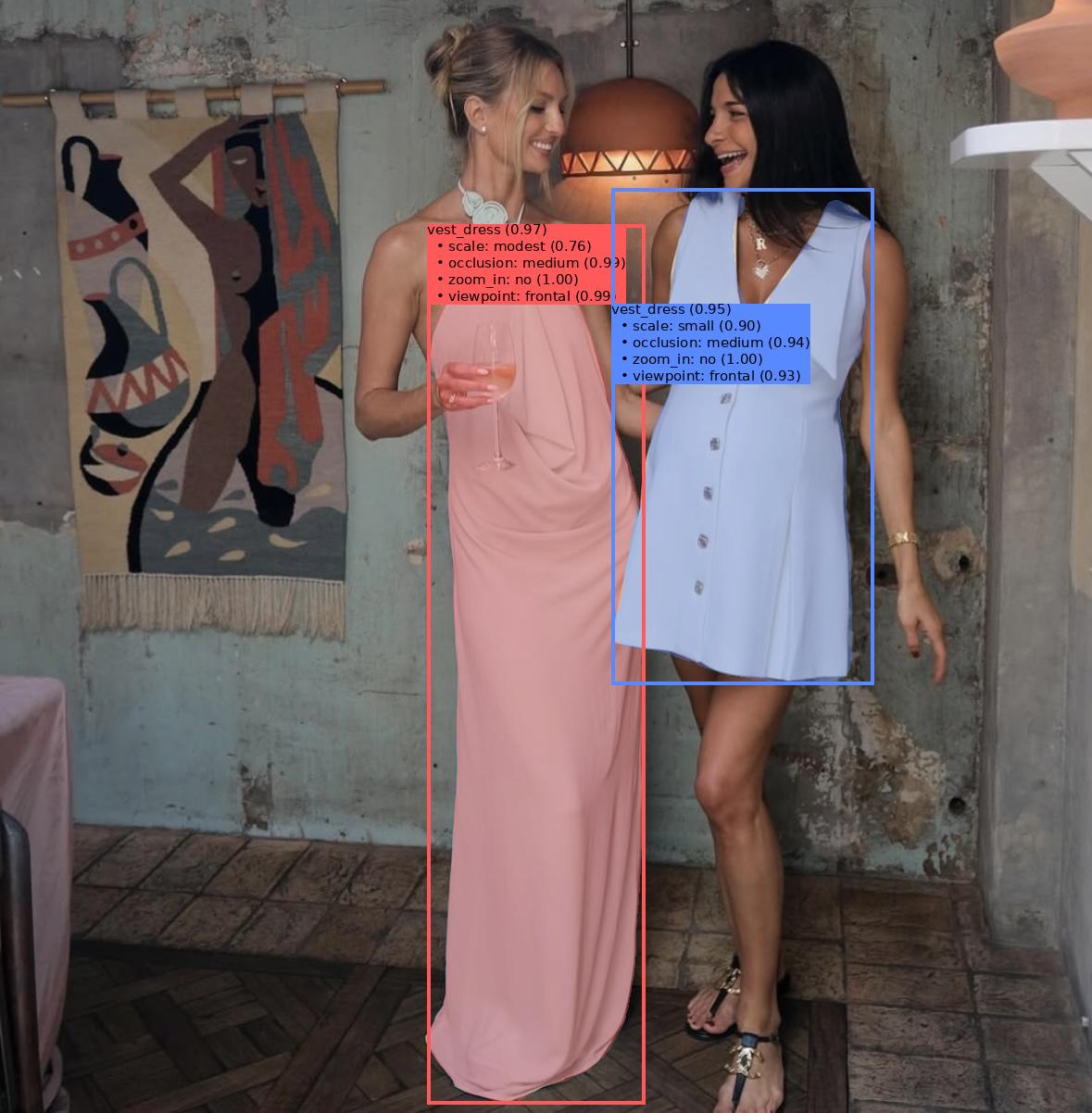
The four attributes are orthogonal to the garment class — they vary independently — which is exactly the case that's awkward to fold into the primary class space. The same pattern fits any "class plus per-instance sub-labels" task: retail shelves → product + facing, documents → element + role, cells → type + health.
Trained on the public DeepFashion2 dataset (13 garment classes + 4 attribute heads) and rendered with the package's own renderer (
eomt.visualize.draw_instances).
Data
A COCO instance-segmentation (or detection) JSON. Everything the model needs is read from it: the classes from
categories, the attribute heads from two additions.
1. A top-level attributes list, one entry per attribute, with its categories, or "type": "regression":
"attributes": [
  {"name": "scale", "categories": [{"id": 1, "name": "small"}, {"id": 2, "name": "modest"}, {"id": 3, "name": "large"}]},
  {"name": "price", "type": "regression", "unit": "EUR"}
]
2. A per-annotation attributes map, {attribute: value}:
{"id": 1, "image_id": 42, "category_id": 1, "segmentation": [...], "bbox": [...], "attributes": {"scale": 3, "price": 812.5}}
Raw ids are remapped to 0..n-1 per attribute. A missing or unknown value is ignored by that attribute's loss, never
trained as class 0, so a partly tagged dataset is fine; a JSON without attributes is plain instance segmentation.
The attributes can also live beside a plain COCO file: an attributes.yaml schema in the dataset root plus
attributes/<split>.json values keyed by annotation id. sample_data/ holds a tiny example.
Photos of one subject (for multiview) add to the same file:
| key | meaning |
|---|---|
image subject_id |
photos with the same id show the same subject; photos without one take no part in the sets |
annotation instance_id |
the same physical instance in every photo of the subject that shows it (a number or a string); the set matcher learns these links |
image supervision |
full (default): every instance is annotated. positives: only some are, so nothing unannotated is taught as background. none: the photo is only input for the others |
annotation iscrowd: 1 |
a region left out of the loss: detections there are neither right nor wrong |
eomt.data.subjects_from_file_names sets subject_id from file names that start with the subject (<subject>_...).
The run config
The dataset holds the data; one YAML holds the run. Its sections are the settings of train(), each with the
reference recipe as its default, so a run config only says what differs. Start from the commented template
sample_data/run.yaml:
path: datasets/garments                  # data: paths relative to this file
train_images: images/train
train_json: annotations/train.json
val_images: images/val
val_json: annotations/val.json

attributes:                              # which attributes get a head, and how each learns
  scale:
  side: {flip_aware: {left: right}}      # swapped when the augmentation mirrors the photo
  price: {log: true, range: [0, 20000], applies_to: [sofa]}

train: {epochs: 12, batch: 4, imgsz: 644}
aug: {min_scale: 0.4, max_scale: 1.6}
inference: {conf_thres: 0.3}             # saved with the model: the defaults of predict() / match()
| section | what it holds (eomt.engine.train) |
|---|---|
train |
the keywords of train(): epochs, batch (per GPU), nominal_batch (16: the rest is accumulated), imgsz, workers, seed, init_weights, project / name, stop_after_epochs |
model |
the architecture and loss weights of a new model (ModelConfig): fpn_scales, num_upscale_blocks, iou_aware_cls, quality_weight, the attribute heads' shape |
optim |
OptimConfig: lr0, llrd, warmup_steps, poly_power, clip_norm, ema_decay, mask_anneal |
aux |
how the attribute heads train (AuxConfig): w, per_head, class_weights, iou_gate, class_gate |
aug |
the augmentation (AugConfig) |
val |
ValConfig: interval, imgsz, group_by (metrics per value of an image field), best_key |
multiview |
a post-training on photos of one subject (MultiviewConfig, below) |
attributes, inference |
the heads and how each learns; the predict defaults saved in the checkpoint |
Arguments beat the file: a keyword of EoMT.train() replaces a train value, and a section given as a mapping is merged
over the YAML's key by key (model.train(data="run.yaml", optim={"lr0": 5e-5})). An unknown key stops the run before it
starts. The resolved run is written to args.yaml in the run folder and into every checkpoint.
python scripts/train.py --data run.yaml --size l --device 0,1                    # the run as its YAML says, two GPUs
python scripts/train.py --data run.yaml --epochs 1 --set optim.lr0=5e-5          # any setting: --set SECTION.KEY=VALUE
python scripts/train.py --data run.yaml --weights best.pt --set optim.mask_anneal=false   # warm start
python scripts/train.py --data run.yaml --resume runs/train/my-run                # continue a run exactly
Attributes
- Categorical heads train with cross-entropy, regression heads with a Huber loss on the standardized value
(
log1pfirst withlog: true, for heavy-tailed positives); predictions come back in real units (aux_values), clipped torange. applies_to(class names) scopes a head to some classes: it trains only on them and reportsids = -1("not applicable") for the others. Different attributes can attach to different classes in one model.flip_aware({left: right}) swaps an attribute that encodes a side when the augmentation mirrors the photo, and test-time augmentation swaps it back. Keepvflip_prob/rot90_proboff for such an attribute.crop(regression):scalemakes the value follow the share of the instance the augmentation keeps in view (an extensive quantity such as a surface),ignoredrops it belowmin_visible(a property of the whole instance).bins(regression) reports the errors per GT-value bucket too.
Validation reports aux_acc/<head> (accuracy) and aux_mae/<head> (mean absolute error in real units; a log head
also aux_logmae and aux_ratio, the median of prediction / GT).
Several photos of one subject
A multi-view post-training adds to a trained single-photo model what you have labelled:
xview— cross-view attention after each query block: the queries of each photo of a set, and its patch tokens pooled 2x2, attend to the tokens of the other photos. Each row's update is gated per head bytanhof a learned function of the row, starting at 0: the sublayer starts as the identity, a photo alone is predicted exactly as before, and each query learns when to use the other photos.attn_w > 0adds a loss pointing a query's cross-view attention at the same instance in the other photos (its mask and its query there).matching— a set matcher (SuperGlue / LightGlue style): the detected instances of the photos (their per-query embedding and mask box) attend to each other within a photo and across photos, and every two instances of two photos get a probability of being the same (a dual softmax, with a "no partner in that photo" bin), trained on theinstance_idlinks. One threshold on that probability links them. It trains with or withoutxview.lora—{rank, blocks}: LoRA on the attention of the frozen ViT blocks below the query blocks, so the features can adapt to the sets; merged into the exported weights (no cost at inference).
train: {init_weights: runs/train/my-run/weights/best.pt, epochs: 4, batch: 1}   # batch counts sets of photos
val: {interval: 1}
multiview:
  xview: true
  matching: true
  gate: [class]                       # links only between instances of the same class (and listed attributes)
  trainable: new                      # only the added modules; "query_blocks" also trains the query blocks, slower
  sets: {max_views: 4, sizes: {2: 0.2, 3: 0.2, 4: 0.6}, p_single: 0.3, p_shared: 0.5, p_hard: 0.25}
Every photo of a subject is the anchor of one set per epoch, with companions from the same subject (p_shared of the
sets first take those that show one of its linked instances). The horizontal flip is drawn once per set, so left and
right never mix within a subject. p_hard makes the anchor hard to read alone (shrunk, degraded, a close-up or
occluded) while its companions stay as they are, so the evidence has to come from them. trainable also takes
{group or parameter-name prefix: LR multiplier} (groups xview, matcher, lora, query_blocks, heads; e.g.
{xview: 1.0, aux_heads.price: 0.0}).
When your application predicts fixed groups of photos (decided before the model sees them), train on those groups:
sets: {groups: <image field>, p_random: 0.25} makes the photos of a subject sharing that field's value one set (split
into sets of max_views), each once per epoch, plus a p_random share of sets drawn at random as above, as
augmentation. The model is told nothing about the photos of a set: which photos go together is the data's decision.
Validation then scores the groups.
Validation scores fixed sets of the validation photos of each subject, unaugmented and placed exactly as inference
places them: sets/segm/mAP_{alone,set} (each photo predicted alone and with its set; _linked_ restricted to the
instances another photo shows, where the others can help), the attributes alone and with the set, and the links:
sets/match/{f1,precision,recall,thres} (what inference links with: the set matcher, else the embedding),
sets/reid/* (the baseline: re-identification of the photos predicted alone), _gated within the gate,
*_oracle/* (the same links between the annotated instances themselves: linking with perfect detection),
match/f1_stored at the threshold stored before the validation, and */cluster_f1 (B-cubed F1 of the identities over
each whole subject). The best threshold is stored in the checkpoint: inference links with it. val.final_epochs
validates every epoch at the end of a run validated every interval epochs.
EoMT("runs/train/mv").val(multiview=True)                                  # the run's own validation, standalone
EoMT("other.pt").val(multiview=True, run="runs/train/mv",                  # another model, scored as that run did,
                     sets_file="runs/train/mv/val_sets.json")              # on the same fixed sets
Inference. predict(source, subject=True) predicts the photos of each subject together (source holds one
subject's photos, or a subfolder per subject), max_views at a time. match(folder) links the detections of every
photo of a subject — any number of photos — into identities, with the stored threshold and gate:
out = EoMT("runs/train/mv").match("photos/subject_42/", groups=[[0, 3, 4], [1, 2]])   # groups: optional
out["images"][0]["identity_ids"]         # an identity per detection of photo 0
out["identities"][0]["attributes"]       # the identity's attributes, voted over its photos (regression: fused)
The set matcher matches the photos predicted together as one set, and any other two photos as a pair. A model without one links by the per-query embedding (re-identification, nothing trained for it), at 0.7 within the same class unless it was calibrated.
Groups may share photos: a photo in several groups is predicted in the first and shown to the others in the rest.
fill=True tops the default last group up with the photos before it (5 photos at 4 a time: two groups of 4, not
4 + 1), and similar_groups groups the photos by what they show, so that metadata saying where a photo was taken is
not needed. It compares one or several descriptions of each photo, averaged with weights: e.g. how much of each class
a first model finds in it, and its appearance, the mean final patch token over the photo (the letterbox padding left
out) that every forward returns (photo_embed). Two close-ups of one part stay together even when the first model
reads one of them on the wrong side:
import torch
from eomt import EoMT
from eomt.config import INFERENCE_DEFAULTS
from eomt.engine import predict_batch, predict_subject, similar_groups

model = EoMT("runs/train/mv").model
kw = {k: model.inference.get(k, d) for k, d in INFERENCE_DEFAULTS.items()}   # the checkpoint's thresholds, as
kw.update(device="cuda", imgsz=model.image_size)                             # EoMT.predict / match use them
looks = torch.stack([r["photo_embed"] for r in predict_batch(model, photos, photo_embed=True, **kw)])
# class_areas: (n_photos, n_classes), e.g. how much of each class a first model finds in each photo
groups = similar_groups([class_areas, looks], max_views=4, weights=[1, 1], center=[False, True])  # every group full
out = predict_subject(model, photos, groups=groups, identities=True, **kw)
predict_set / predict_subject / predict_batch also take photos already preprocessed (prepared: one
(chw, meta) per photo from preprocess_numpy or preprocess_torch, e.g. on the GPU) and return the masks at a
given size per photo (sizes). The model may be a wrapper of the network that passes set_ids on.
Training recipe
train() follows the reference EoMT recipe, checked numerically against the official code: AdamW at lr0=1e-4 with
layer-wise LR decay 0.8 (the top ViT block at the full LR: the last blocks process the queries), a two-stage warmup
(the head first, the ViT held at 0) and polynomial decay to 0, masked attention annealed block by block so the last
sixth of training is mask-free, and an EMA of the weights. epochs=12 is the official COCO instance recipe.
Validation runs in the regime the model is trained in (masked attention at the epoch's annealing), so best.pt — the
EMA weights, mask-free — is only chosen once the annealing is over. last.pt (the trainer state) is written before
each validation, so a crash there costs only the validation. Every checkpoint records its epoch, metrics row and the
resolved run, with the warm-start weights and the data files and their SHA-256.
A short fine-tune wants its own recipe: a lower optim.lr0, a shorter optim.warmup_steps, a lower
optim.ema_decay, and optim.mask_anneal: false for a model deployed mask-free.
Several GPUs: device="0,1" trains with one process per GPU; batch is per GPU and nominal_batch stays the global
batch, so the optimizer steps are those of one GPU. Write the training call under if __name__ == "__main__": (the
processes are spawned).
Inference
m = EoMT("runs/train/my-run")
for r in m.predict("folder/", batch=16, stream=True):     # a generator: a large folder is never held in memory
    r["boxes"], r["scores"], r["classes"], r["masks"], r.get("aux"), r.get("aux_values")
m.predict("big_photo.jpg", tiles=True)                     # native-resolution tiles + the whole image, merged
m.predict("photo.jpg", augment={"flip": True})             # test-time augmentation (flip-aware heads swapped back)
m.save("best_bf16.pt", dtype="bf16")                       # half the file, the same scores
conf_thres, max_det and mask_thresh default to the checkpoint's inference settings. Masks come back at the
photo's resolution; the network runs in bf16 on a GPU (amp=False: fp32). What the library reports goes to the
standard eomt logger (stdout): logging.getLogger("eomt").setLevel(logging.WARNING) silences it.
Checkpoints
A checkpoint is a self-describing torch.save dict: the weights plus everything needed to rebuild and run the model
(size, classes, attribute heads, input size and preprocessing, link calibration, inference settings, the run). It loads
with weights_only=True, so loading one never runs code. Checkpoints of earlier versions are upgraded on load
(eomt.migrate_checkpoint). scripts/info.py <ckpt> prints one.
Command line
| script | does |
|---|---|
scripts/train.py |
train from a run config (--set SECTION.KEY=VALUE for any setting) |
scripts/val.py |
validate (--augment, --tiles, --flip, --multiview, --run, --sets-file) |
scripts/predict.py |
predict and render images (--subject, --tiles, --batch) |
scripts/match.py |
link the instances of a subject's photos (--each-subdir) |
scripts/export.py |
a bf16 copy of a checkpoint |
scripts/info.py |
a checkpoint's metadata |
Roadmap
- Pretrained COCO weights on the Hugging Face Hub (
EoMT.from_pretrainedis in place), a runnable sample dataset, and a public multi-photo dataset formultiviewand matching. - ONNX / TensorRT export.
License
Apache-2.0. EoMT and DINOv2-with-registers are Apache-2.0 too.
1 maintainer

Metadata
1 maintainer
Release files for attr-eomt 3.1.0
For a detailed explanation of source distributions (sdists) and built distributions (wheels), please see the package formats documentation.
Source distribution (sdist)
| File | Size | Uploaded | Provenance | Actions |
|---|---|---|---|---|
| attr_eomt-3.1.0.tar.gz | 863.6 kB | Without provenance | Details for attr_eomt-3.1.0.tar.gz |
Built distribution (wheel)
| File | Interpreter | ABI | Platform | Actions Reset |
|---|---|---|---|---|
| attr_eomt-3.1.0-py3-none-any.whl | Python 3 | none | any | Details for attr_eomt-3.1.0-py3-none-any.whl |
Total release size: 1.1 MB
Release files / attr_eomt-3.1.0.tar.gz
| Download URL | attr_eomt-3.1.0.tar.gz |
|---|---|
| Size | 863.6 kB |
| Tags | Source |
|
SHA-256 checksum How to use checksums |
bea331f6807de9af3cf183018736bbebfdae4d10a3d21164f2b8dc18d2e8c168
|
|
BLAKE2b-256 checksum How to use checksums |
448152d4d5085fcd4df3c4804ac8baf2955cc52fee126112e71753b8ed0b515e
|
| Upload date | |
|
Uploaded using Trusted Publishing? What is trusted publishing? |
Yes |
| Uploaded via |
twine/7.0.0 CPython/3.13.16
|
Release files / attr_eomt-3.1.0-py3-none-any.whl
| Download URL | attr_eomt-3.1.0-py3-none-any.whl |
|---|---|
| Size | 207.8 kB |
| Tags | Python 3 |
|
SHA-256 checksum How to use checksums |
d4834ea73622bab78f457a64416dd3eb2983240c86cce2bfaf6a6a9f96c539b1
|
|
BLAKE2b-256 checksum How to use checksums |
20242092e38bb230fa597861f76365fcc7a201312fab441b8ac378a6d137b57f
|
| Upload date | |
|
Uploaded using Trusted Publishing? What is trusted publishing? |
Yes |
| Uploaded via |
twine/7.0.0 CPython/3.13.16
|
Security for attr-eomt 3.1.0
Provenance
Provenance describes where a file came from. On PyPI, provenance is shared via attestations, which provide a verifiable record of the build or publishing details. View details, limitations and caveats.
No provenance found
None of the files in this release were uploaded with provenance metadata.
A note on package security
PyPI is a repository for distributing packages, not a service for auditing them. While third-party security researchers and our staff do their best to detect and remove malicious packages, PyPI cannot guarantee the quality, security or suitability of any given package.
To learn more about protecting yourself from malicious actors, visit our package security documentation.














