




What it is
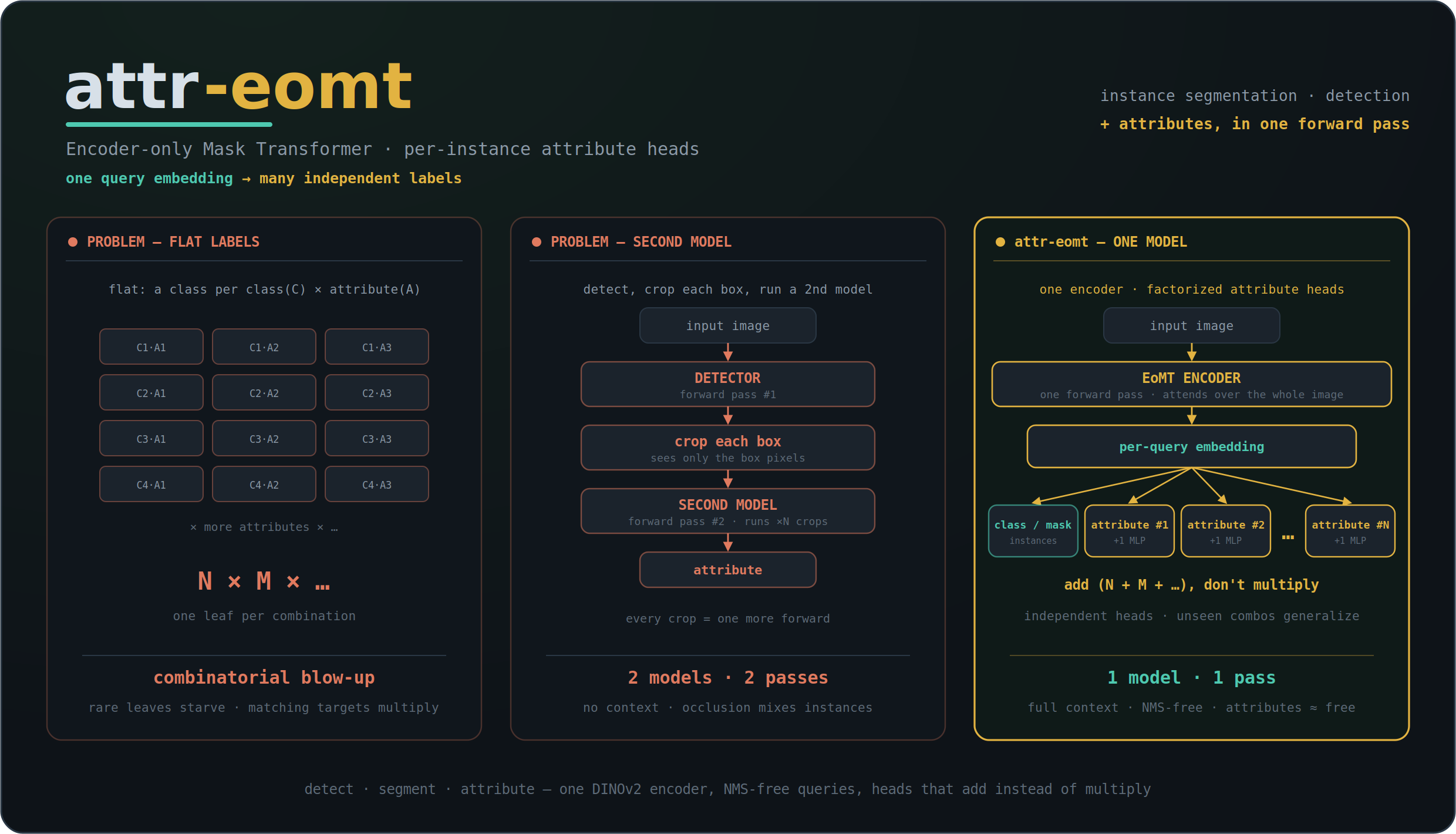
attr-eomt is a standalone EoMT (Encoder-only Mask Transformer) for instance segmentation and object detection, with one feature that sets it apart: independent per-instance attribute heads. Alongside the mask/box + class output, it predicts one or several orthogonal attributes for every detected instance — read straight off the same per-query embedding the detector already computes. No second model, no second pass, and the primary detection metric is untouched (the figure above tells the whole story).
It's a clean-room, Apache-2.0 reimplementation: the weights you train are yours to release.
from eomt import EoMT

model = EoMT("l")                            # fresh large model (DINOv2 backbone)
model.train(data="coco")                     # COCO 2017 auto-downloads if missing; 12 epochs, the official recipe

model = EoMT("runs/train/eomt-l")            # reload a run — size/classes/heads auto-detected
model.predict("images/", plot=True)          # render masks/boxes + per-instance attributes
Architecture
EoMT is a DINOv2-with-registers ViT whose last few transformer blocks are augmented
with a fixed set of learnable queries (the Mask2Former idea) — each query is one
"slot" that latches onto one object instance. After the encoder runs, every query emits
a single vector, the per-query embedding of shape [B, Q, hidden]. The whole model
is then just "turn that embedding into predictions": a class head for the primary
label and a mask/box head for geometry. It is NMS-free, so two overlapping
garments stay two distinct queries instead of being merged — the property that lets
attributes stay attached to the right instance.
The attribute heads add nothing to this picture except themselves: they tap the exact same embedding (captured non-invasively with a forward hook), each a small classifier on top.
This collapses what is classically a two-stage pipeline — detect, crop each box, run a second classifier per crop — into a single pass. Attributes therefore cost only a thin head each, see full-image context (not just a cropped box), and never inherit a second model's cropping errors — the modern, single-stage formulation of the DETR / Mask2Former lineage (see the figure at the top).
Two model families: segmentation & detection
Both families share the same DINOv2 encoder, query mechanism, NMS-free matching and auxiliary heads — they differ only in the head on top and what they output:
| family | --task |
output | metric driving best.pt |
|---|---|---|---|
| instance (default) | instance |
per-instance masks + boxes + class | segm/mAP |
| detect | detect |
per-instance boxes + class (DETR-style box head, no masks) | bbox/mAP |
EoMT("l").train(data="coco", family="instance")   # masks (default)
EoMT("l").train(data="coco", family="detect")     # boxes only
The family is recorded in the checkpoint, so val / predict pick the right
post-processing automatically. Everything below applies identically to both.
Models & sizes
| size | backbone | hidden | layers | heads | queries |
|---|---|---|---|---|---|
s |
DINOv2-small | 384 | 12 | 6 | 100 |
b |
DINOv2-base | 768 | 12 | 12 | 200 |
l |
DINOv2-large | 1024 | 24 | 16 | 200 |
Default input is a patch-14-aligned square (644 = 14 × 46) so DINOv2 weights load 1:1.
Compute & inference speed
Measured on a single NVIDIA GeForce RTX 5090, 644 × 644 input, batch size 1.
GFLOPs are multiply-accumulates at that resolution (attention included); latency /
throughput are the median over 50 runs after warm-up, under torch.amp.autocast
(fp16) — the package's own inference path.
instance family (masks + boxes + class):
| size | params | GFLOPs | latency (fp16) | throughput (fp16) | throughput (fp32) |
|---|---|---|---|---|---|
s |
24.0 M | 128 | 8.4 ms | 119 img/s | 70 img/s |
b |
93.9 M | 430 | 17.4 ms | 58 img/s | 32 img/s |
l |
317 M | 1144 | 30.2 ms | 33 img/s | 15 img/s |
detect family (boxes + class, no mask head):
| size | params | GFLOPs | latency (fp16) | throughput (fp16) | throughput (fp32) |
|---|---|---|---|---|---|
s |
22.7 M | 89 | 2.9 ms | 348 img/s | 120 img/s |
b |
88.6 M | 276 | 5.3 ms | 190 img/s | 60 img/s |
l |
308 M | 881 | 13.6 ms | 74 img/s | 21 img/s |
Dropping the mask-upsampling head makes detect substantially lighter and ~1.3–3×
faster. Figures are for the detector itself (backbone + queries + heads); the
attribute heads add a thin linear/MLP per head and are negligible by design.
Factorizing the label space
This is the contribution. Conventional detectors fold every distinction into one flat
label space: an object's type × viewpoint × occlusion × … becomes a Cartesian product of
leaf classes that explodes combinatorially, starves each leaf of examples, and multiplies
the Hungarian matcher's targets. attr-eomt factorizes instead — a small, general primary
head plus independent attribute heads that add, not multiply.
Because the heads are independent, the primary taxonomy stays compact and every class keeps
its full sample count; attributes ride along for near-zero compute; and the model composes
attribute × class combinations that never appear in the training data — combinations a
flat label space cannot even represent.
Example: clothing with per-instance attributes
One model segments each garment (primary classes like vest_dress / short_sleeve_top
/ long_sleeve_dress / skirt / trousers …) and, for every detection, reads off
four independent attribute heads — scale (small / modest / large),
occlusion (no / slight / medium), zoom_in (no / medium / large) and
viewpoint (frontal / side / back). The renderer prints the primary class + score
on the first row and each attribute + its confidence on the rows beneath it.
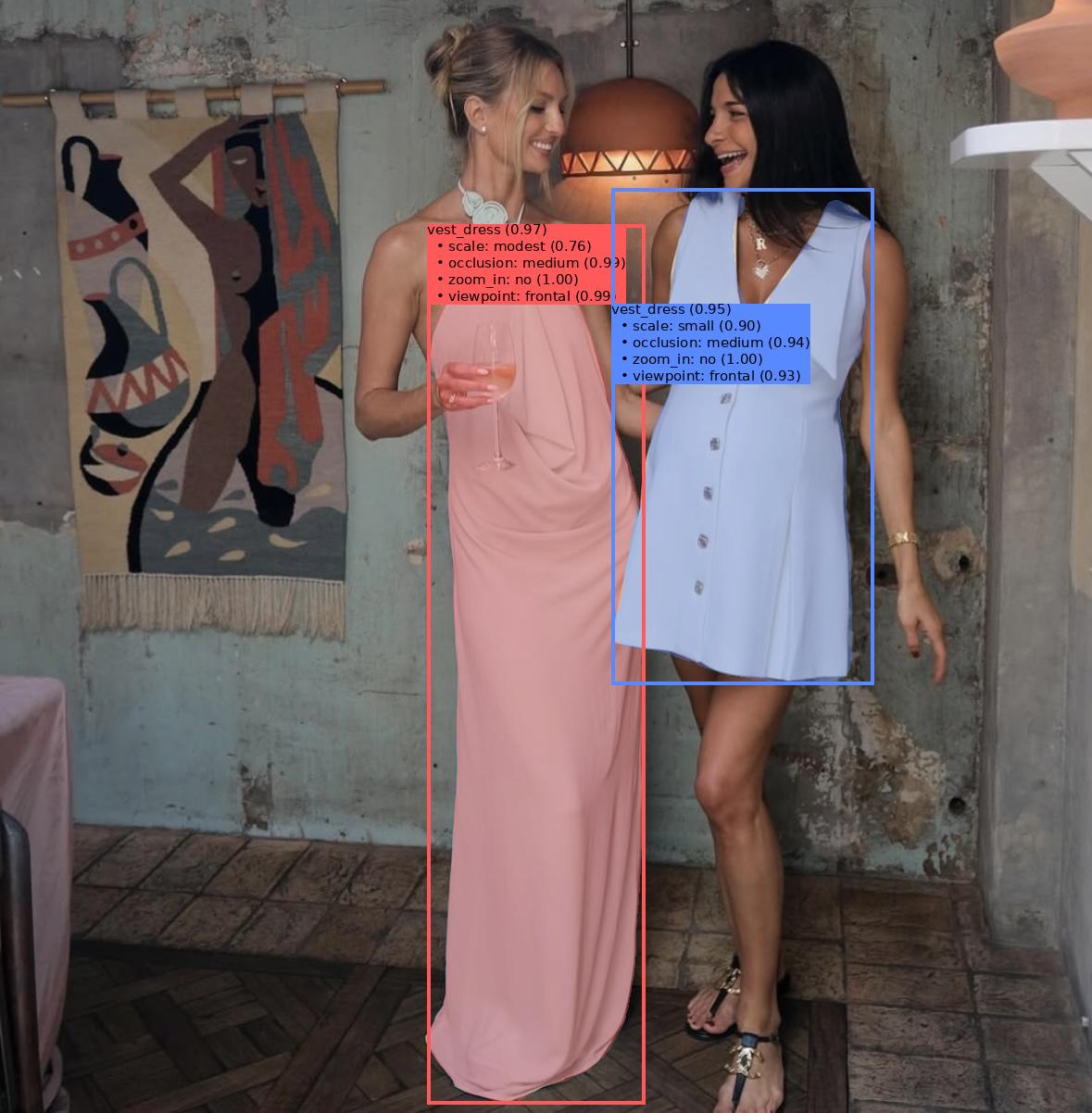
The four attributes are orthogonal to the garment class — they vary independently — which is exactly the case that's awkward to fold into the primary class space. The same pattern fits any "class plus per-instance sub-labels" task: retail shelves → product + facing, documents → element + role, cells → type + health.
Trained on the public DeepFashion2 dataset (13 garment classes + 4 attribute heads) and rendered with the package's own renderer (
eomt.visualize.draw_instances).
Training — it rides on the detector's own match
Attributes never run their own matcher. Detection already solves "which query is responsible for which ground-truth object" via the Hungarian matcher; attributes simply reuse that same query→GT assignment and read the answer off the matched queries.
- Embedding source. Each head reads the per-query embedding — the input to EoMT's
class_predictor, captured with a forward hook ([B, Q, hidden]). - Matching. Supervision reuses EoMT's own Hungarian matcher
(
model.eomt.criterion.matcher), so every attribute is trained on the same query→GT assignment the detection loss used; the attribute is read after matching. - Gate. An optional IoU gate drops barely-overlapping matched pairs (common early in training) so attributes only learn from queries that actually localize the object.
- Loss. Cross-entropy per head over matched queries (a regression head: Huber on its
standardized value, see below), summed across heads and scaled
by
aux_w(default1.0), added to the detector loss. Empty-match batches contribute a graph-preserving zero, and missing labels useignore_indexand contribute nothing. - Balancing. Both losses are O(1), so equal weights are a sane start.
aux_w_per_headweights each head,aux_class_weights=Truere-weights rare classes (rare values of a regression head, by smoothed density), andaux_balance="uncertainty"learns one weight per head (Kendall et al. 2018) with the detector loss as the fixed anchor. Each epoch prints every head's pull on the shared queries (its gradient norm over the detector's,train/aux_grad/<head>): well above 1 a head steers the encoder, far below it only reads it. - Checkpoint selection is unchanged. The attribute "rides along": its per-head
matched-query accuracy is shown live and written to
metrics.csv, but never drivesbest.pt(stillsegm/mAPorbbox/mAP). - Inference. Each result attaches
aux = {head: {"ids", "probs"}}for the kept detections (andaux_values = {head: values}in real units for the regression heads), andpredict(plot=True)renders each attribute next to the class label using names stored in the checkpoint.
Data format (auto-discovered from the COCO JSON)
Attributes live inside the COCO annotations — each annotation is already a
per-instance object, so alignment is automatic and pycocotools still parses it. Just
two additions to a standard COCO file; no YAML changes — heads (count, classes,
names) are discovered from the JSON, the same as nc.
1. A top-level attributes list — one entry per head, defining its vocabulary:
"attributes": [
  {
    "name": "scale",
    "categories": [
      {"id": 1, "name": "small"},
      {"id": 2, "name": "modest"},
      {"id": 3, "name": "large"}
    ]
  },
  {
    "name": "viewpoint",
    "categories": [
      {"id": 0, "name": "frontal"},
      {"id": 1, "name": "side"},
      {"id": 2, "name": "back"}
    ]
  }
]
2. A per-annotation attributes map — {head: raw_id} on each instance:
{
  "id": 1, "image_id": 42, "category_id": 1,
  "segmentation": [...], "bbox": [...], "area": 1234, "iscrowd": 0,
  "attributes": {"scale": 3, "viewpoint": 0}
}
Notes:
- Raw ids are remapped to a contiguous
0..n-1per head (soscale's1/2/3become0/1/2);categoriesmay be omitted, in which case the id set is inferred. - A missing or out-of-vocab per-annotation value is ignored (
-100), not trained as class0— so a partially tagged dataset is valid: each head learns only from the instances that actually carry its value. A JSON with noattributes⇒ detection-only, exactly as before.
Class-conditional heads. Give an attribute definition an optional applies_to list of
primary-class names or ids, and that head is only trained on — and only emitted for —
instances of those classes (hard routing on the primary class). Omit it and the head applies
to every class. So different attributes can attach to different classes, each with its own
label set, in one model:
"attributes": [
  {"name": "posture", "categories": [...], "applies_to": ["cat", "dog"]}
]
At inference a scoped head reports ids = -1 ("not applicable") for detections whose class it
does not cover. The scope is stored in the checkpoint, so it survives reload.
Flip-aware attributes. A horizontal flip mirrors the photo but not the labels, so an attribute
that encodes a side (a left door shows up as a right one) is corrupted by flip_prob > 0. Give
its definition flip_aware, a map of category names to the ones they become on a horizontal
flip, and the training augmentation swaps them for every instance it flips (each pair swaps both
ways, so {"left": "right"} is enough; unlisted categories stay as they are):
{"name": "laterality", "categories": [{"id": 0, "name": "left"}, {"id": 1, "name": "center"}, {"id": 2, "name": "right"}],
 "flip_aware": {"left": "right"}}
Mosaic, mixup and copy-paste flip each source image independently, and the swap follows each
instance. Only the horizontal flip is handled: keep vflip_prob and rot90_prob off for such an
attribute. It is categorical only. The mapping is stored in the checkpoint, and test-time augmentation with
flip swaps it back in each mirrored view's prediction before the views are merged (a checkpoint saved before the
mapping was stored takes it from the val JSON, with a warning). The training banner lists each head's swapped pairs. A
regression head needs no mapping: its value must not change under a flip (see below).
Regression attributes. "type": "regression" makes a head regress one real number per
instance instead of choosing a category; categorical and regression heads mix freely in one
dataset. log (regress log1p of the value, for heavy-tailed positives such as costs) and
range (valid values; predictions are clipped to it) are optional, and applies_to works as above:
"attributes": [
  {"name": "severity", "categories": [...]},
  {"name": "repair_cost", "type": "regression", "log": true, "range": [0, 20000], "applies_to": ["bumper"]}
]
// per annotation:
"attributes": {"severity": 3, "repair_cost": 812.5}
A missing, non-numeric or out-of-range value is ignored. The head is trained on the value
standardized by the train split's mean and std (stored in the checkpoint), validated as the
mean absolute error in real units (val/aux_mae/<head>; metrics.png gives each regression
head its own MAE panel, aux_per_class.png its MAE per primary class), and predicted in real units
(aux_values). The value must not change under the augmentations (scale, crop, flip,
rotation): a cost or a score is fine, a pixel area or an angle is not. Tracking votes on the
categorical heads only, and re-identification cannot gate on a regression head.
A value that depends on how much of the instance is in view can say so with crop: the
training augmentation measures, per instance, the fraction it keeps in view (mask mass, or box
area, inside the crop window, after copy-paste occlusion), and the value follows it.
"crop": "scale" multiplies the value by that fraction — for an extensive quantity such as the
object's area in cm² (half the damage cropped away ⇒ half the area). "crop": "ignore" drops the
value when less than min_visible (default 0.9) is kept — for a property of the whole object
that a cut view no longer shows. Validation and inference see whole images, so the head predicts
the full value there:
{"name": "damage_area", "type": "regression", "log": true, "crop": "scale"},
{"name": "part_length", "type": "regression", "crop": "ignore", "min_visible": 0.95}
How the fraction is measured: for masks, the share of the instance's mask mass whose source pixels
the crop (and rotation / shear / perspective warp) lands inside the window: exact, so an instance
the window does not cut keeps exactly 1 (a warp alone is not a cut); copy-paste occlusion counts as
hidden, and instances brought in by mosaic, mixup or copy-paste are measured against their own crops. For boxes (detect family), the ratio of
the box areas: exact for a crop, approximate under rotation. Each call of the built-in
augmentation exposes it as TrainAugment.last_info["visible"].
Limits: the head's mean / std and its aux_class_weights density come from the unscaled values,
so with "scale" the values trained on sit somewhat lower than those statistics. Only the visible
fraction is tracked, not the scale jitter, so a pixel area is still not supported. A custom
transform= gets no adjustment. crop is rejected on a categorical attribute, and it is a
training-only setting (not stored in the checkpoint). The training banner prints each head's crop
mode.
Sidecar format (optional). You can keep the COCO JSON as plain, standard COCO and put the
attributes beside it instead of inside it: an attributes.yaml schema (same keys, regression heads included) in the dataset root plus
attributes/<split>.json values keyed by annotation id ({ann_id: {head: value}}). If present
(and the JSON has no embedded attributes), it is merged in memory at load — so a plain COCO
dataset always works and the sidecar is picked up automatically when you add it. Embedded
attributes in the JSON take precedence.
A tiny, self-contained example (two heads, including a non-contiguous id set) lives in sample_data/.
Cross-photo re-identification
Several photos of the same scene from different viewpoints, and some instance appears
in three of them — is that one instance seen three times, or three separate ones?
infer_match() answers that at inference time, with no second model and nothing
retrained: every detected instance already carries a fingerprint, the per-query
embedding that feeds the class head, and two detections are the same physical instance
when those embeddings agree.
from eomt import EoMT

model = EoMT("runs/train/eomt-l/weights/best.pt")
result = model.infer_match("photos/subject_42/", group_by=("class",))

for rec in result["identities"]:
    print(rec["identity_id"], rec["class_name"], rec["attributes"], rec["num_photos"])
One call handles one folder = one subject. Each detection is stamped with an
identity_ids entry, identities summarizes each identity (dominant class, smoothed
attributes, how many photos it appears in), and matches records every candidate pair
— accepted or not, with the reason — so a threshold can be retuned from the JSON
without re-running inference. With plot you get a grid image: every photo, instances
colored by identity, plain lines linking the matched pairs (thickness = similarity, on
an absolute scale that does not vary with panel size), and a legend.
python scripts/match.py weights/best.pt photos/subject_42/
python scripts/match.py weights/best.pt photos/ --each-subdir   # a folder per subject
How it works
It is the DeepSORT recipe — detect, describe, associate — applied between photos
instead of between video frames, which is also what track()
does for video. Three EoMT properties make the fingerprint free:
- the model is NMS-free, so two overlapping instances stay two distinct queries;
- each query owns one instance, so its embedding describes that instance alone;
- the embedding is already computed on the way to the class head.
Matching runs the Hungarian matcher per pair of photos, then links the accepted pairs into identities with union-find. Two constraints keep that honest: one physical instance appears at most once per photo (union-find would otherwise chain two instances of the same photo together through a third), and a merge guard rejects a merge whose cross-cut similarity falls below the threshold — without it, A↔B and B↔C chain into one identity even when A and C are nothing alike.
Gating and thresholds
group_by decides which pairs may match at all. The default ("class",) means only
same-class instances compete. Adding attribute heads tightens it, which matters
whenever the primary class is coarser than the distinction you care about: if one class
covers instances that sit at different places on the subject, an attribute head that
separates them — ("class", "position"), say — stops an instance in one location from
ever matching one in another, however alike they look. Any head in the checkpoint can
be named; unknown names raise before the first forward pass. group_by=None disables
gating entirely and needs a much higher sim_thres, since far more pairs then compete
with no structural prior ruling any of them out.
sim_thres (default 0.7) is the cosine floor for "same instance". Hungarian always
returns a full assignment, so the threshold is what turns best available partner into
no partner — this is a new instance. Measured on one checkpoint across four real
photo sets, with the gate on:
| non-candidate pairs | true-match pairs | |
|---|---|---|
| mean | 0.11 – 0.16 | 0.85 – 0.98 (the true-match mode) |
| p99 / max | 0.40 – 0.67 / 0.49 – 0.79 | — |
The default was raised from 0.6 to 0.7 after a 30-case run showed non-candidate
pairs reaching 0.73 and the two distributions overlapping in over half the cases —
0.6 was admitting matches with no margin at all. Every run
writes its own diagnostics (within-identity vs across-identity percentiles) into
<subject>_identities.json; if those two distributions overlap, no threshold will
save the run.
Limitations
- A gate group with one instance per photo gets no benefit from the embedding.
Hungarian has no choice to make, and only
sim_threscan veto the pairing. The fingerprint earns its keep where several instances of one group compete in the same photo. - Small-instance recall caps what can be matched. An instance that is never detected in a view cannot be linked to it.
- One folder must be one subject. A folder holding photos of more than one subject will happily link generic-looking instances across them; that is a data problem, not a matching one.
- Letterboxing shifts scale with orientation, so a landscape and a portrait shot of the same subject are not on quite equal footing.
Install
pip install attr-eomt                  # from PyPI
pip install "attr-eomt[logging]"       # + tensorboard/wandb
pip install -e ".[dev]"                # from source (editable; [dev] adds pytest/build/twine)
Usage
Everything goes through one class. Initialize from a size (fresh model, pretrained
DINOv2 backbone) or from a checkpoint / run folder (family, size, classes, image
size, normalization and any auxiliary heads are auto-detected from the .pt):
from eomt import EoMT

# Train on COCO 2017 (auto-downloaded on first run):
EoMT("l").train(data="coco", batch=4)   # 12 epochs, validated every 2: the official recipe

# ...or any COCO-format dataset (point at its data.yaml):
EoMT("s").train(data="sample_data/data.yaml", epochs=1, batch=1)

# Validate and predict from a trained run:
EoMT("runs/train/eomt-l").val(data="coco")
EoMT("runs/train/eomt-l").predict("images/", plot=True)   # writes annotated images
Several GPUs. device="0,1" trains on both GPUs, one process each (DistributedDataParallel); "auto" is GPU 0.
batch is per GPU and nominal_batch (16) stays the global effective batch, so the optimizer steps, LR schedule and
masked-attention annealing are exactly those of one GPU, with an epoch 1.9× faster on two RTX 5090s (1.8× end to end with
validation and checkpoints). Validation splits the val images between the
GPUs; the main process scores them and alone logs and writes checkpoints. The processes are spawned, so every train()
argument must be picklable.
EoMT("l", device="0,1").train(data="coco", batch=2) # 2 per GPU x accum 4 x 2 GPUs = effective 16
Test-time augmentation and tiled inference (instance family). predict() and val() take augment=True (the
image at imgsz and zoomed to 1.5x imgsz) and tiles=True (overlapping tiles of imgsz px of the original image, i.e. native resolution,
25 % overlap, plus the whole image: small objects in large images). The views' instances are merged: same class and
mask IoU >= 0.5 measured where both views can see, so an object cut by a tile border is put back together; the mask
logits are averaged and the score is the mean over the views that could see the object (one that missed it votes 0).
Each takes a dict of overrides; see
eomt/tta.py. augment={"flip": True} also merges mirrored views. Attributes marked flip_aware are swapped
back in a mirrored view; left / right primary classes are not (a mirrored view predicts them swapped), so keep flip off
for those, and for attributes that encode a side without being flip-aware.
m = EoMT("runs/train/eomt-l")
m.predict("images/", augment=True)                                  # + the image at 1.5x imgsz
m.val(data="data.yaml", tiles=True)                                 # native tiles + the whole image
m.predict("images/", augment={"flip": True}, tiles=1024)            # 1x / 1.5x and mirrored; 1024 px tiles
scripts/val.py and scripts/predict.py take --augment and --tiles [SIZE] (scripts/val.py also --flip; its arguments are
in Command-line scripts). Each view is a forward pass: augment
costs ~3.5x one prediction (the 1.5x view has 2.25x the pixels); a 1280 x 960 photo at imgsz 644 makes 6 tiles + the
whole image.
For the full training recipe, every train() knob, and int8 compression, see the
annotated explainer → — it's the deep dive.
Optimisation recipe
train() follows the reference EoMT recipe (checked numerically against the official code: every parameter group's
LR, every step of the LR schedule, and the masked-attention annealing agree exactly):
| default | |
|---|---|
| optimizer | AdamW, lr0=1e-4, weight_decay=0.05 (not applied to norms, biases and embeddings) |
| head LR | lr0 |
| encoder LR | layer-wise decay llrd=0.8, backbone_lr_mult=1.0: the top ViT block is at the full lr0 and each block below is 0.8× the one above; embeddings follow the first block, the final norm is at lr0 |
| schedule | polynomial decay (poly_power=0.9) to 0 after a two-stage warmup in optimizer steps warmup_steps=(500, 1000): the head warms up while the ViT LR is held at 0, then the ViT ramps up |
| masked attention | annealed block by block (mask_anneal_start/end, fractions of training: 1/6–2/6, 2/6–3/6, 3/6–4/6, 4/6–5/6, polynomial); the last sixth of training is mask-free |
| length | epochs=12, validated every val_interval=2 epochs and after the last (official COCO instance recipe, about 89k optimizer steps at batch 16) |
In EoMT the last four transformer blocks are the ones that process the queries and predict the masks, so they must learn at
close to the head's speed: scaling the whole encoder by 0.1 (as detector-style recipes do for a backbone) starves them. The
LR decay and the annealing span epochs.
Validation follows the training regime, as in the official EoMT: masked attention at the annealing probabilities of
the epoch's end. A model that still masks is far worse without its masks (part damage, ViT-L at epoch 11 of 50: 0.034
segm mAP mask-free against 0.114 masked), so a mask-free curve before the last sixth follows the annealing and jumps as each
block finishes it, not the model. best.pt is deployed mask-free, so it is only chosen once every block's annealing is
over (a run stopped earlier, e.g. with stop_after_epochs, has last.pt alone), and every checkpoint is saved mask-free.
Training prints the windows in epochs when it starts.
Command-line scripts: arguments and things to take into account
scripts/train.py. Every flag is a keyword of train(); a flag left out keeps train()'s default.
| flag | train() keyword |
what it does |
|---|---|---|
--data |
data |
dataset YAML, or coco (auto-downloads) |
--size / --task |
model size s b l; head family instance (masks) or detect (boxes) |
|
--epochs |
epochs |
total epochs: the LR schedule and the masked-attention annealing span them |
--batch / --nominal-batch |
batch / nominal_batch |
micro-batch per GPU / global effective batch (16); the difference is gradient accumulation |
--device |
device |
auto, cpu, cuda:N, or 0,1 for several GPUs (one process each) |
--weights / --resume |
init_weights / resume |
warm-start a fresh run from a checkpoint / continue a run. One of the two, not both |
--lr, --warmup HEAD,VIT |
lr0, warmup_steps |
peak head LR (the encoder follows with layer-wise decay) and the two-stage warmup in optimizer steps |
--ema-decay, --ema-tau |
ema_decay, ema_tau |
EMA of the weights (what is validated and exported as best.pt) |
--mask-free |
mask_anneal_start/end |
no masked attention from step 0 (annealing windows 0 -> 0) |
--aux-dropout |
aux_head_dropout |
dropout in the attribute heads |
--val-interval, --workers, --seed |
same | validate every N epochs (and after the last); data-loader workers per GPU; seed |
--aug KEY=VALUE, --aug-preset |
aug |
augmentation overrides (see Augmentation) |
--fpn-scales, --box-head, --no-deep-supervision, --upscale-blocks, --iou-aware-cls, --quality-weight, --val-imgsz |
same | architecture options |
Things to take into account when training:
- Resume or warm start.
--resumecontinues a run exactly (epoch, optimizer, schedule, EMA, best metric) and re-reads the architecture from the checkpoint: keep the other flags as they were, and the seed is ignored so the shuffle is not replayed.--weightsloads the weights only and starts a new run at epoch 0. Start from abest.pt(the EMA, saved mask-free); alast.ptholds the live weights. - A short fine-tune needs its own recipe. Lower
--lr, shorten--warmup, and lower--ema-decay(at 0.9999 the EMA averages over ~10k steps and barely leaves its starting point in a few epochs). If the model is deployed mask-free, pass--mask-free: with the default annealing a warm-started model is trained masked for the first sixth of the run, a regime it no longer runs in. best.ptis only chosen mask-free. With the default annealing that means from 5/6 of the schedule on; with--mask-freeevery validation is eligible.- Validated epochs only. With
--val-interval Nthe other epochs have empty validation cells inmetrics.csv; the curves inmetrics.pngjoin the validated points. - Attribute heads follow the dataset's definitions. Categories,
applies_to,flip_awareandcrop/ zoom settings come from the dataset (the training banner lists them). The flip mapping, scope and regression statistics are stored in the checkpoint;cropand the zoom settings are training-only.
scripts/val.py.
| flag | what it does |
|---|---|
weights |
checkpoint .pt or a run / weights folder (best.pt preferred) |
--data, --batch, --workers, --device |
dataset YAML (coco), batch, data-loader workers, device |
--imgsz |
evaluation input size (default: the trained one; the positional embeddings are interpolated) |
--augment |
add the image at 1.5x imgsz |
--tiles [SIZE] |
overlapping tiles (default imgsz px, native resolution) plus the whole image |
--flip |
also run every view mirrored (alone: --augment with mirrored views) |
--no-attributes |
mAP only |
--ema, --mask annealed|free |
validate the EMA weights of a last.pt (see below) |
Things to take into account when validating:
- What is reported.
segm/*andbbox/*mAP and, for a model with secondary heads,aux_acc/<head>(accuracy) andaux_mae/<head>(regression heads, mean absolute error in real units). They are scored on the same predictions as the mAP, so they also work with--augment,--tilesand--flip. - The attribute population is the deployed one. Each GT instance is matched to the kept detection of its class with the
highest mask IoU (one to one, IoU >= 0.5). The trainer's
val/aux_*columns score matched queries instead, so the two differ slightly: compare TTA against plain within the script's numbers, not againstmetrics.csv. A regression head's MAE is dominated by its large values, so also look at a relative error before concluding. - Regime. A model that is still annealing is only meaningful with its masks:
--ema --mask annealedreproduces the trainer's validation of alast.pt(EMA weights, the masked-attention probabilities of that epoch, read from the run'sargs.yaml),--ema --mask freeis the deployed regime, andbest.ptis already the EMA, mask-free. - TTA is not free and not uniform. It costs one forward pass per view and mostly helps small objects and strict-IoU mAP; the classification heads often do not move. A regression head's prediction is averaged over views at different zoom, so a value that depends on the object's apparent size can drift under TTA: check it against the plain run before relying on it.
--flipand the heads. Heads the checkpoint stores as flip-aware are swapped back in mirrored views; an older checkpoint takes the mapping from the dataset's JSON, with a warning. Left / right primary classes are not handled: keep--flipoff for them. The val categories of every head must match the model's, or the run stops instead of scoring against the wrong ids.- One process.
scripts/val.pyruns on one device; the trainer's own validation uses all the GPUs.
Architecture options
All are keyword arguments of train() (and flags of scripts/train.py); checkpoints record them, so EoMT(path) rebuilds
the model with the same modules, and checkpoints without them load as before.
| option | what it does | cost, ViT-L at 644 px, batch 2, bf16 (measured, relative to the default) |
|---|---|---|
fpn_scales=None |
drop the multi-scale FPN (default (2, 1, 0.5)) |
+12 % throughput, −0.5 GB |
box_head=True |
auxiliary box head: L1 + GIoU loss on the matched queries, and the same terms in the matching cost (a localisation signal that does not depend on the mask grid). Predicted boxes are returned as aux_boxes / head_boxes |
−7 % |
deep_supervision=False |
stop supervising a query block's prediction once that block's masked attention is annealed away (while it masks, the prediction builds its attention mask and stays supervised: unsupervised, it made noise masks). Blocks drop out at 2/6, 3/6, 4/6, 5/6 of training | none while blocks mask; +26 % per step once all are annealed (last sixth) |
num_upscale_blocks=3 |
368² mask logits at 644 px (small masks); the block predictions stay at 184² (they only build 46² attention masks), only the output is 368²; cannot warm-start a 2-block checkpoint | −17 % (10.1 vs 12.1 img/s), 22.2 GB |
iou_aware_cls=True |
train a matched query's class probability towards (1 + mask IoU) / 2 instead of 1 (IoU-aware targets, as in VarifocalNet / Stable-DINO), so the score ranks loose masks below tight ones; above 0.5, so matched queries keep their class for the attribute gate. Hard targets reduce exactly to the weighted CE. Windscreen damage, 12 epochs at 644 px, against the same recipe: segm AP 0.0296 -> 0.0758, AP small 0.0033 -> 0.0106, AP large 0.128 -> 0.210, bbox AP 0.177 -> 0.217, attribute accuracy unchanged |
one upsample of the matched masks |
quality_weight=2 |
mask-quality head: a small MLP on the query embedding predicts each matched query's mask IoU (BCE against the measured IoU, final prediction only; Mask Scoring R-CNN), and postprocess scores class probability x predicted IoU instead of the mean mask probability. Windscreen damage, with iou_aware_cls, two seeds against the same recipe without the head: segm AP +7 / +13 %, AP small +19 % / 3.6x, AP medium +21 / +22 %, AR100 +2 / +5 %, bbox AP and attribute accuracy unchanged |
one MLP on the queries |
val_imgsz=N |
validate (and pick best.pt) at another input size than imgsz. Scale jitter shows the objects larger, on average, than a val image resized to imgsz: validate at imgsz × the mean training scale. Windscreens (training scale 0.4-1.0 of the photo, val 0.5), same checkpoint: segm AP 0.0113 at 644, 0.0173 at 896 |
val time grows with the pixels |
stop_after_epochs=N |
stop after N epochs while the LR schedule and mask annealing still span epochs (truncated A/B runs) |
Always on (training-side; inference of existing checkpoints is unchanged):
- Masked attention keeps small objects in view. A query may attend to every patch its predicted mask touches (max-pool of
the mask logits onto the patch grid), and a query whose mask touches no patch attends to all of them, as in Mask2Former. The
reference EoMT downsamples bilinearly (only the centre of each patch counts) and leaves an empty-mask query blind, which in
practice blinded the queries of most objects smaller than a patch during the masked phase. The mask is a boolean
[B, 1, N, N]and is not built in a block whose annealing probability has reached 0. - Mask terms that see small objects. Matching scores every query on every cell of the mask-logit grid against the GT
area-averaged onto it, instead of on 12,544 random points (one per ~33 px² at 644 px, so an object of a few dozen pixels often
got no point and its assigned query changed from step to step). The mask loss keeps the reference's BCE on 12,544 points
concentrated where the prediction is uncertain (the boundaries), and computes dice on every GT pixel against the upsampled
logits, so every instance is supervised however small. A fully dense loss gave coarser masks (AP75 down) on thin objects;
dropping the points altogether lost the boundaries. The
train_num_points/oversample_ratio/importance_sample_ratiosettings are gone (fixed at the reference values; checkpoints that carry them still load). - Attribute IoU gate at full resolution. The gate that decides which matched queries train the attribute heads compares the upsampled prediction with the GT, instead of shrinking the GT to the logit grid with "nearest" (which erased many objects of a few pixels, so they never trained the attribute heads).
Inference: predict_image(..., amp=True) (and predict(..., amp=True)) runs the network under bf16 autocast, ~2.5x faster at 644 px
on an RTX 5090 with the same accuracy on a trained ViT-L model (AP within 0.002 in every size bucket). Off by default.
What is not established: the accuracy effect of box_head, deep_supervision=False,
iou_aware_cls and quality_weight (beyond the windscreen data), dropping the FPN and the always-on changes above depends on the data. Measure it with truncated runs (stop_after_epochs), which follow the schedule of a full run, against a reference run at equal
epochs.
Augmentation
Training augmentation is one config, AugConfig, run by one pipeline
(TrainAugment) for both model families. The defaults are a strong general recipe: the original
EoMT/Mask2Former one (horizontal flip, Large-Scale Jitter 0.1–2.0, random crop, colour jitter) plus small
rotation / shear / perspective, gamma, grayscale, Gaussian blur, sensor noise, JPEG recompression, glare and
"safe" random erasing (a rectangle that never overlaps an instance). Masks are resized by area averaging (soft,
mass-preserving), so thin objects are not shredded into dots by nearest-neighbour resampling.
| group | knobs (default probability) |
|---|---|
| geometry | flip_prob 0.5 · vflip_prob 0 · rot90_prob 0 · LSJ min_scale/max_scale 0.1–2.0 · rotate_prob 0.3 (±10°) · shear_prob 0.2 (±5°) · perspective_prob 0.15 |
| optics / sensor | colour jitter 1.0 · gamma_prob 0.3 · grayscale_prob 0.05 · blur_prob 0.2 · noise_prob 0.2 · jpeg_prob 0.3 · glare_prob 0.15 · erasing_prob 0.2 |
| multi-image (instance family) | mosaic_prob 0 · mixup_prob 0 · copy_paste_prob 0 |
| crop | instance_crop_prob 0 (instance-aware crop) · instance_crop_empty_prob 0 · zoom_prob 0 (close-ups, zoom_scale 4–5x) |
| masks | mask_resize="area" (or "nearest") |
Override per run, per dataset, or from the CLI — precedence is explicit keywords (flip_prob, min_scale,
max_scale) > aug= > the dataset YAML's train_aug block > defaults:
model.train(data="coco", aug={"rotate_prob": 0.5, "blur_prob": 0})   # in code
model.train(data="coco", aug={"preset": "legacy"})                    # the original recipe (hard masks, no extras)
model.train(data="coco", train_transform=my_callable)                 # bring your own (image, masks) -> (image, masks)
# data.yaml — settings for THIS dataset
train_aug:
  min_scale: 0.6                  # thin / tiny objects: keep the effective scale r = imgsz/long_side * s in ~[0.4, 1.0]
  max_scale: 1.6
  instance_crop_prob: 0.8         # optional instance-aware crop: window placed around a (rarity-weighted) instance
  instance_crop_rarity_attr: material
python scripts/train.py --data my/data.yaml --aug min_scale=0.6 --aug instance_crop_prob=0.8 --aug-preset default
Things worth knowing:
- Orientation. Flips, 90° turns and rotations change the pixels but not the label. If an attribute encodes
orientation (e.g. a
viewpointhead) setflip_prob=0androtate_prob=0, or, for a left / right attribute, mark itflip_aware(see Flip-aware attributes) and keep the horizontal flip;vflip_prob/rot90_probstay off unless your scenes have no canonical "up". - Thin or tiny objects. Large-Scale Jitter at 0.1 shrinks a 5 px crack to under a pixel; keep the effective
scale within ~[0.4, 1.0] (
min_scale = 0.4·long_side/imgsz,max_scale = 1.0·long_side/imgsz). The instance-aware crop pays off when the crop is much smaller than the image (high zoom, smallimgsz), andinstance_crop_rarity_attrmakes rare attribute values the crop's focus more often. - Close-ups.
zoom_probmakes an occasional sample a close-up: scaled bys ~ U(zoom_scale)(default 4–5x the whole-image view, past the photo's own resolution) instead of the LSJ range, with the window on one instance (whole when it fits, else a window inside it).zoom_attrrestricts it to instances with a value of that attribute and to the samples that have one, e.g.{"zoom_prob": 0.1, "zoom_attr": "area"}so a crop-scaled area head also learns that a part filling the frame keeps its real area, and that a cut part keeps the share in view. It resizes the whole photo first (~1.5x the time of a normal sample at 5x), so keep it occasional. - Multi-image ops (
mosaic,mixup,copy_paste) add instances from other samples and are off: they splice or blend long thin structures, so try them deliberately and look at the result. - Negatives. Images with no annotations are dropped from the train set by default.
train(keep_empty=True)keeps them as zero-target samples (masks(0, imgsz, imgsz), every query is trained as "no object"); validation already includes them. Instance family only. args.yamlof a run records the resolvedaugdict; the log prints the active ops at start.build_train_transform(imgsz, aug=...)returns the same pipeline for use in your own loaders (tf(image_uint8, masks) -> (image, masks)).
Roadmap / future work
- Model export. ONNX / TensorRT (and friends) for deployment — currently out of scope; the inference path is being kept export-friendly.
- Keypoints. A keypoint/pose head family alongside
instanceanddetect(the code already carries afamilyparameter so new heads slot in without API churn). - Pretrained COCO checkpoints. None are published yet. COCO-trained
s/b/lweights will be released on the Hugging Face Hub (thefrom_pretrained/hf://loading plumbing is already in place and waiting for them). - Contrastive re-ID training. Cross-photo re-identification already works at
inference time (see above) on the embedding the
detector computes anyway. What remains is training that embedding for the job: a
contrastive objective on the matched queries would make each one a purpose-built
re-identification vector rather than a by-product of the class head, which should
widen the margin between matches and non-matches and make
sim_threstransferable across datasets. Feeding those embeddings into the video tracker to re-associate objects across occlusions is the same lever.
1 maintainer

Metadata
1 maintainer
Release files for attr-eomt 1.2.0
For a detailed explanation of source distributions (sdists) and built distributions (wheels), please see the package formats documentation.
Source distribution (sdist)
| File | Size | Uploaded | Provenance | Actions |
|---|---|---|---|---|
| attr_eomt-1.2.0.tar.gz | 1.6 MB | Without provenance | Details for attr_eomt-1.2.0.tar.gz |
Built distribution (wheel)
| File | Interpreter | ABI | Platform | Actions Reset |
|---|---|---|---|---|
| attr_eomt-1.2.0-py3-none-any.whl | Python 3 | none | any | Details for attr_eomt-1.2.0-py3-none-any.whl |
Total release size: 1.8 MB
Release files / attr_eomt-1.2.0.tar.gz
| Download URL | attr_eomt-1.2.0.tar.gz |
|---|---|
| Size | 1.6 MB |
| Tags | Source |
|
SHA-256 checksum How to use checksums |
fb0dc8333ed0b775063ffe06af0f028f70e85745345931aa17e50c4ca095ab5e
|
|
BLAKE2b-256 checksum How to use checksums |
8e442aef5eabb30702315d9836d3befd112fc8cc23b236f3a7d03198d58ebc91
|
| Upload date | |
|
Uploaded using Trusted Publishing? What is trusted publishing? |
Yes |
| Uploaded via |
twine/7.0.0 CPython/3.13.16
|
Release files / attr_eomt-1.2.0-py3-none-any.whl
| Download URL | attr_eomt-1.2.0-py3-none-any.whl |
|---|---|
| Size | 183.0 kB |
| Tags | Python 3 |
|
SHA-256 checksum How to use checksums |
102e13700ece1a9e9e5fcf5177386864a5252697cfc01f8b267d56358c8e6dc9
|
|
BLAKE2b-256 checksum How to use checksums |
42dff21fe791f6510397f902256fed5833f08e81d4a18daa9d4e6d8668b7b945
|
| Upload date | |
|
Uploaded using Trusted Publishing? What is trusted publishing? |
Yes |
| Uploaded via |
twine/7.0.0 CPython/3.13.16
|
Security for attr-eomt 1.2.0
Provenance
Provenance describes where a file came from. On PyPI, provenance is shared via attestations, which provide a verifiable record of the build or publishing details. View details, limitations and caveats.
No provenance found
None of the files in this release were uploaded with provenance metadata.
A note on package security
PyPI is a repository for distributing packages, not a service for auditing them. While third-party security researchers and our staff do their best to detect and remove malicious packages, PyPI cannot guarantee the quality, security or suitability of any given package.
To learn more about protecting yourself from malicious actors, visit our package security documentation.














