
A high-performance lossy audio compression engine inspired by LLM weight quantization

Project description
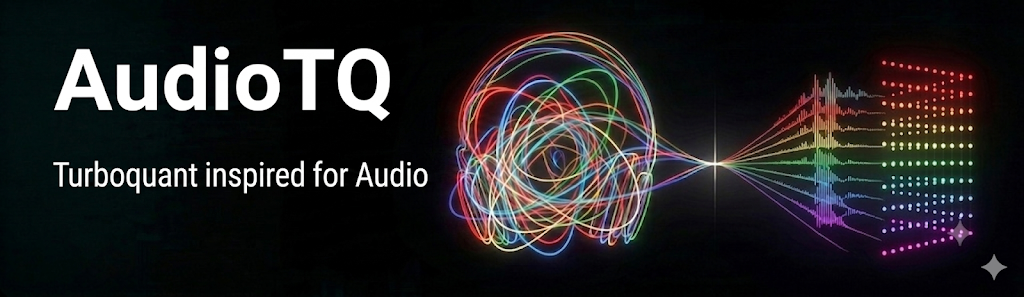



A minimal, high-performance lossy audio compression engine built in Python and NumPy.
TQA adapts the mathematical principles of TurboQuant (originally designed for data-oblivious weight quantization of LLMs on GPU clusters) into a localized, cache-aligned CPU audio codec. By mapping high-dimensional audio amplitudes into zero-centered symmetrical Gaussian distributions via Hadamard rotations, it achieves a ~3.9x memory reduction while preserving transient fidelity.
Features
- Data-Oblivious Energy Flattening: Spreads transient spike energy uniformly across audio blocks using Fast Walsh-Hadamard Transform (FWHT) rotations.
- Optimal Centroid Clustering: Employs an iterative Lloyd-Max solver to converge on the Mean-Squared-Error (MSE) optimal 6-bit codebook.
- 1-Bit QJL Residual Layer: Uses a Quantized Joint Least-Squares error sign layer to track quantization rounding errors and suppress distortion.
- Zero-Dependency: Built purely on standard Python, NumPy, and SciPy.
Installation
Install the package directly from PyPI:
pip install audiotq
Quick Start (Python Library Usage)
You can easily integrate audiotq into your own Python audio processing pipelines:
import numpy as np
from audiotq import TurboAudioEngine

# 1. Initialize the codec engine
engine = TurboAudioEngine(block_size=512)

# 2. Prepare your floating-point audio signal (normalized between -1.0 and 1.0)
raw_signal = np.random.normal(0, 0.2, 8000).astype(np.float32)

# 3. Compress the signal
compressed_blocks, meta_scales = engine.compress_signal(raw_signal)

# 4. Decompress back to audio amplitudes
reconstructed_signal = engine.decompress_signal(compressed_blocks, meta_scales)
Command Line Interface (CLI)
The package installs global command-line entry points:
1. Compress and Decompress Audio
Process any standard .wav audio track end-to-end:
tqa-cli run -i input.wav -o output_reconstructed.wav
2. Compare Reconstructed Audio
Extract mathematical fidelity metrics (MSE, SQNR, correlation, and envelope preservation) between raw and processed signals:
tqa-cli compare -f1 input.wav -f2 output_reconstructed.wav
3. Run Synthetic Simulations
Generate custom synthetic signals (e.g., sine waves, square waves, noise, transients) with custom parameters:
tqa-sim --type square --frequency 440 --duration 2.0 --spikes 5
Performance Benchmarks
Below is the telemetry report captured using a standard high-sample dataset (44.1 kHz):
| Metric | Performance Profile |
|---|---|
| Original Dataset Size | 2.52 MB (15.0 seconds) |
| Compressed On-Disk Footprint | 0.65 MB |
| Compression Ratio | ~3.91x smaller footprint (74.4% reduction) |
| Fidelity (SQNR) | 30.24 dB |
| Compression Throughput | ~1.32 MB/s |
| Decompression Throughput | ~1.35 MB/s |
Known Limitations & Failure Modes
1. WHT Basis Alignment (Extreme Sparsity Failure)
- Failure Scenario: If an input block perfectly aligns with one of the Walsh-Hadamard basis vectors (e.g.
signal = rotator.hadamardSigns), the rotated vector becomes a single extreme Kronecker delta spike. - Result: Because the Lloyd-Max codebook is optimized for normal distributions, it clips this extreme spike to the outermost centroid boundary ($\pm 2.41$ standard deviations). This clipping noise destroys reconstruction quality, dropping the SQNR to ~1.31 dB. (Proven in
tests/test_failures.py::test_failure_hadamard_basis_alignment).
2. Silent Block Edge Case
- Edge Case: Silent blocks have a standard deviation of
0.0. Dividing by this value during block standardization would lead toNaNorInferrors. - Resolution: The engine implements a safety threshold guard (
std_dev > 1e-6). Silent blocks bypass normalization and are reconstructed as perfect silence. (Proven intests/test_failures.py::test_boundary_silent_signal).
License
This project is licensed under the GNU General Public License v3.0. See the LICENSE file for details.
Release history Release notifications | RSS feed


Download files
Download the file for your platform. If you're not sure which to choose, learn more about installing packages.
Source Distribution
Built Distribution
Filter files by name, interpreter, ABI, and platform.
If you're not sure about the file name format, learn more about wheel file names.
Copy a direct link to the current filters
File details
Details for the file audiotq-0.1.1.tar.gz.
File metadata
- Download URL: audiotq-0.1.1.tar.gz
- Upload date:
- Size: 494.8 kB
- Tags: Source
- Uploaded using Trusted Publishing? No
- Uploaded via: uv/0.11.3 {"installer":{"name":"uv","version":"0.11.3","subcommand":["publish"]},"python":null,"implementation":{"name":null,"version":null},"distro":{"name":"macOS","version":null,"id":null,"libc":null},"system":{"name":null,"release":null},"cpu":null,"openssl_version":null,"setuptools_version":null,"rustc_version":null,"ci":null}
File hashes
| Algorithm | Hash digest | |
|---|---|---|
| SHA256 |
c15713ecd1b4cd2cec9b1cb637d88fc938608b989c06cd13440305cada51b2be
|
|
| MD5 |
63fa703bbdf53cbed18375327dcdc28f
|
|
| BLAKE2b-256 |
1b410d5e4f5336c95dad7887e087466a1ca1e93b8ac26cc9316f3e11bd850e11
|
File details
Details for the file audiotq-0.1.1-py3-none-any.whl.
File metadata
- Download URL: audiotq-0.1.1-py3-none-any.whl
- Upload date:
- Size: 23.2 kB
- Tags: Python 3
- Uploaded using Trusted Publishing? No
- Uploaded via: uv/0.11.3 {"installer":{"name":"uv","version":"0.11.3","subcommand":["publish"]},"python":null,"implementation":{"name":null,"version":null},"distro":{"name":"macOS","version":null,"id":null,"libc":null},"system":{"name":null,"release":null},"cpu":null,"openssl_version":null,"setuptools_version":null,"rustc_version":null,"ci":null}
File hashes
| Algorithm | Hash digest | |
|---|---|---|
| SHA256 |
e8b3b773d4df799a47d570089fde755a726b11cf45d5077d0fa1850a0f891702
|
|
| MD5 |
299c58785319a9d255c426e58d65af97
|
|
| BLAKE2b-256 |
2bef48829dc656b461564f3ba6d1f1d51a39f40f7f3cc1e165d4cd933d3d9986
|






