
AVLite - Modular Autonomous Vehicle Stack for rapid prototyping, research, and education

Project description
AVLite
Modular Autonomous Vehicle Stack for rapid prototyping, research, and education.

















Install · Quick Start · Architecture · Documentation · Plugins · Community
AVLite is a lightweight, extensible autonomous vehicle software stack designed for rapid prototyping, research, and education. It provides clean abstractions for perception, planning, and control while maintaining flexibility through a plugin-based architecture.
ROS2 & Autoware Ready — Optional ROS2 executer plugin with native Autoware message support (
Trajectory,ControlCommand, etc.).
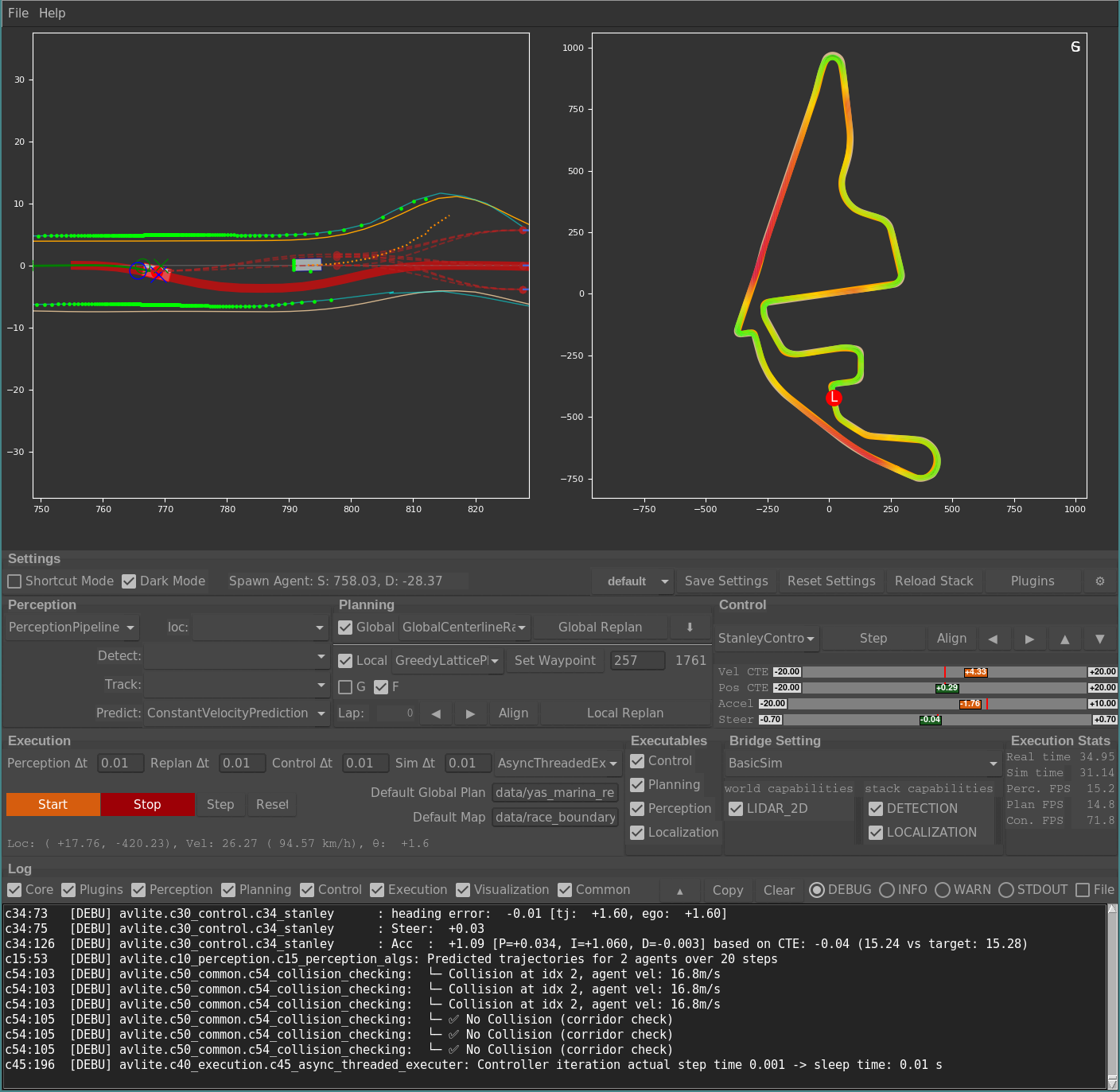
Architecture Overview
AVLite follows a modular architecture with clear separation of concerns:
flowchart TB
    subgraph ENTRY[" "]
        direction LR
        VIZ["🖥️ Visualization · c50\nReal-time Tkinter GUI"]
        HL["⌨️ Headless Mode\nTerminal dashboard · rich"]
        VIZ ~~~ HL
    end

    EXEC["⚙️ Execution Layer · c40\nSyncExecuter · AsyncThreadedExecuter · Factory"]

    subgraph COMPONENTS[" "]
        direction LR
        PERC["Perception · c10 (optional)\nLocalization · Mapping\nDetection · Tracking · Prediction"]
        PLAN["Planning · c20\nGlobal · Local · Lattice"]
        CTRL["Control · c30\nStanley · PID"]
        WB["World Bridge · c40\nBasicSim · Carla · Gazebo · ROS2"]
        PERC ~~~ PLAN ~~~ CTRL ~~~ WB
    end

    COMMON["🔧 Common · c60\nSettings · Capabilities · TrajectoryTracker · CollisionChecker"]

    ENTRY --> EXEC
    EXEC --> COMPONENTS
    COMPONENTS --> COMMON
Core Components
- c10_perception: Interfaces and built-in algorithms for detection (
FastBEVLidarDetection), tracking (KalmanTracker), prediction, and localization (LidarLocalization);Map/RaceMapin c11; OpenDRIVEHDMapparser in c18 - c20_planning: Global planning (
GlobalCenterlineRacePlanner,HDMapGlobalPlanner) and local planning (VelocityLocalPlanner, lattice-basedGreedyLatticePlanner) - c30_control: Vehicle control algorithms (Stanley, PID)
- c40_execution: Execution orchestration with sync/async modes, simulator bridges, and
replan_global() - c60_apps: App infrastructure (
c61_app_strategy,c62_factory,c63_plugins,c64_settings_schema,c65_setting_utils,c68_paths); no tkinter - c50_common: Algorithm utilities only (
c51–c55: capabilities, sensor data, trajectory, collision, FPS) - plugins (
avlite/plugins/): Built-in Tk visualizer package (p60_visualizer_tk), headless mode, config CLI; world bridges and alternative executers are available as optional plugins
Key Features
Strategy Pattern Architecture: All major components (perception, localization, planning, control) use the strategy pattern with automatic registration, allowing runtime selection and hot-reloading without code changes.
Capability-Based System: Components declare their requirements and capabilities, enabling automatic compatibility checking between perception/localization strategies and world bridges.
Optional Perception & Localization: Both perception and localization are optional in the execution pipeline. Run with ground truth data or plug in your own strategies as needed.
YAML-Based Configuration: Profile-based configuration system allows quick switching between different algorithm combinations and parameters.
Hot Reloading: Modify code and configuration files while the system is running without restarting.
Multiple Simulator Support: Works with BasicSim (built-in), CARLA, Gazebo, and ROS2/Autoware through abstract world bridge interface.
Extensible Plugin System: Add custom perception, planning, or control algorithms as plugins without modifying core code.
Why AVLite?
- Lightweight: Small codebase focused on clarity over production complexity
- No middleware lock-in: Works standalone; ROS2/Autoware integration is optional via a world-bridge/executer plugin
- Multi-simulator: Same code runs on BasicSim, Carla, or Gazebo
- Rapid iteration: Hot-reload code and tune parameters without restarting
- Minimal dependencies: Core needs only NumPy, Matplotlib, Tkinter
- Educational: Numbered modules and clean abstractions for learning
Installation
From PyPI (recommended):
pip install avlite
From source (development):
git clone https://github.com/AV-Lab/avlite.git
cd avlite
pip install -e ".[dev]"
Requires Python 3.10+.
Optional integrations (install separately as needed):
- CARLA: CARLA releases + the CARLA world-bridge plugin
- Gazebo: ROS 2 + the Gazebo world-bridge plugin
- ROS2 + Autoware: ROS 2 (Humble+) and optionally
autoware_auto_msgs, plus the ROS2 world-bridge or executer plugin - Joystick: the joystick controller plugin
Run from source:
python -m avlite
Install system-wide:
pip install .
Quick Start
- Launch the visualizer:
python -m avlite - Select a profile from the Config tab (e.g., "default")
- Click "Start/Stop Stack" to begin execution
- Right-click on the plot to spawn NPC vehicles
- Adjust parameters in real-time through the GUI
Headless Mode
For long-running deployments (robots, servers, CI) AVLite ships a minimal terminal dashboard that runs the executer without a GUI.
# Run with the 'default' profile
python -m avlite headless

# Pick a profile (saved from the visualizer)
python -m avlite headless -p my_robot_profile
python -m avlite headless my_robot_profile          # positional shortcut

# Useful options
python -m avlite headless -p my_robot_profile \
    --log-level WARNING \
    --control-dt 0.01 --replan-dt 0.5 --perceive
The dashboard shows live FPS, ego state, lap counter, and recent log lines. Press Ctrl+C to stop.
Requires the optional rich package:
pip install rich
Recommended workflow
- Configure with the visualizer (
python -m avlite): pick the bridge, strategies, and tune parameters until it behaves the way you want. - Save the result as a named profile from the Config tab.
- Transfer (optional): export the profile as a single
.yamlfrom the settings window (T) or withpython -m avlite setting-cli export-profile <name>, then import on the target machine with Import profile orsetting-cli import-profile. - Deploy that profile on your robot/server with
python -m avlite headless -p <profile>.
The same YAML profiles drive both the GUI and headless mode, so what you see in the visualizer is what the robot will run.
Configuration files
Each profile is a single configs/<profile>.yaml file with sections for the core layers (c10_perception, c20_planning, c30_control, c40_execution), app bootstrap (c69_apps), and plugins (plugins:). Shipped defaults are in the repository configs/ directory. Saving from the GUI or settings window writes to ~/.config/avlite/ with the same filename; load prefers the user copy when present. User maps and trajectories live under ~/.config/avlite/data/; the Planning panel Save Global Plan button (⬇) opens a file picker there. Set AVLITE_CONFIG_DIR or AVLITE_DATA_DIR to use different directories.
python -m avlite setting              # settings GUI (no visualizer)
python -m avlite setting-cli help
python -m avlite setting-cli validate --profile default
python -m avlite setting-cli export-profile myprofile -o myprofile.yaml
python -m avlite setting-cli import-profile myprofile.yaml --force
See Configuration in the docs for paths, CLI, and resetting to repo defaults.
Community Plugins
AVLite has a community plugin system that lets anyone publish perception, planning, control, executer, or world-bridge strategies as a small Git repository. Community and member plugins are third-party or unverified code; AV-Lab does not guarantee their safety. Use for research and development at your own risk.
Browse and install from the GUI:
python -m avlite plugins
The browser has Community (public registry) and Members (AV-Lab private
registry) tabs. It fetches the official community registry
(https://github.com/AV-Lab/avlite-community-plugins) and lets you
install, uninstall, and register plugins with the active profile.
Installed plugins live under $XDG_DATA_HOME/avlite/plugins
(or ~/.local/share/avlite/plugins); override with AVLITE_PLUGINS_DIR.
Member plugins (Members tab): sign in with GitHub (Device Flow) to browse plugins from the AV-Lab private registry. Your account must have access to that registry and each listed plugin repo. See docs/overview.md — Member plugins for details.
Publish your own plugin:
See the Plugin Development Guide — Publish via pull request for prerequisites, registry fields, and a PR checklist. Summary:
-
Build a plugin following the Plugin Development Guide.
-
Push it to a public Git repository.
-
Fork https://github.com/AV-Lab/avlite-community-plugins, add an entry to
plugins.yaml:plugins: - name: my_perception_plugin description: One-line summary of what the plugin does repository: https://github.com/your-org/your-plugin-repo version: latest # or a tag/commit SHA author: your-org category: - PerceptionStrategy
-
Open a pull request. Once merged it shows up in every user's
python -m avlite pluginsbrowser for install and register.
Project Structure
AVLite uses a numbered module system for easy navigation:
avlite/
├── c10_perception/         # Perception components (8 modules)
│   ├── c11_perception_model.py   # PerceptionModel, Map, RaceMap
│   ├── c12_perception_strategy.py
│   ├── c13_localization_strategy.py
│   ├── c14_mapping_strategy.py
│   ├── c15_perception_algs.py    # FastBEVLidarDetection, KalmanTracker, ConstantVelocityPrediction
│   ├── c16_localization_algs.py  # LidarLocalization (ICP)
│   ├── c18_hdmap_parser.py       # HDMap (OpenDRIVE parsing)
│   └── c19_settings.py
├── c20_planning/           # Planning components
│   ├── c21_planning_model.py
│   ├── c22_global_planning_strategy.py
│   ├── c23_local_planning_strategy.py
│   ├── c24_global_hdmap_planners.py  # HDMapGlobalPlanner
│   ├── c25_global_race_planners.py   # GlobalCenterlineRacePlanner
│   ├── c26_local_path_planners.py                    # ReferencePathPlanner
│   ├── c27_local_behavioral_and_velocity_planners.py # CruiseBehavioralPlanner, VelocityLocalPlanner
│   ├── c28_local_lattice_planners.py                 # Node/Edge/Lattice, GreedyLatticePlanner
│   └── c29_settings.py
├── c30_control/            # Control components
│   ├── c31_control_model.py
│   ├── c32_control_strategy.py
│   ├── c33_pid.py
│   ├── c34_stanley.py
│   └── c39_settings.py
├── c40_execution/          # Execution and simulation
│   ├── c41_world_bridge.py
│   ├── c42_execution_strategy.py
│   ├── c44_sync_executer.py
│   ├── c45_async_threaded_executer.py
│   ├── c46_basic_sim.py
│   └── c49_settings.py
├── c60_apps/               # App infrastructure (no tkinter)
│   ├── c61_app_strategy.py       # AppStrategy registry + bootstrap
│   ├── c62_factory.py            # executor_factory, load_stack_settings
│   ├── c63_plugins.py            # Plugin discovery, loading, log routing
│   ├── c64_settings_schema.py    # SettingsSchema, validation
│   ├── c65_setting_utils.py      # YAML profile load/save/export
│   └── c68_paths.py              # ConfigPaths, PluginPaths, DataPaths
├── c50_common/             # Algorithm utilities (c51–c55)
│   ├── c51_capabilities.py
│   ├── c52_sensor_datatypes.py
│   ├── c53_trajectory_tracker.py
│   ├── c54_collision_checking.py
│   └── c55_fps_tracker.py
└── plugins/               # Built-in plugins
    ├── p60_visualizer_tk/        # Tk visualizer + config + plugins apps (p61–p69)
    ├── p60_setting_cli/
    └── p60_headless_mode/
The numbering scheme allows quick navigation: search for "c23" to find local planning, "c34" for Stanley controller, etc.
Optional plugins
Additional world bridges (CARLA, Gazebo, ROS2), executers, and controllers are available as optional plugins. Register them in c62_community_plugins in the c69_apps section of configs/<profile>.yaml; each plugin's settings live under the profile's plugins: mapping, keyed by the plugin's dashed name.
Testing
Install dev dependencies and run the default fast suite (excludes slow and data-dependent tests):
pip install -e ".[dev]"
pytest
Run the full suite including slow timing tests and repo data/ regressions:
pytest -m ""
Run with coverage (advisory, no threshold enforced):
pytest --cov=avlite --cov-report=term-missing
Tests mirror the package layout under test/. Synthetic fixtures live in test/fixtures/ so CI does not depend on large map assets. Markers: slow for timing-sensitive tests, requires_data for Yas Marina and similar repo data checks.
Developing Custom Plugins
See the Plugin Development Guide for detailed instructions on creating custom perception, planning, and control components.
License
Distributed under the MIT License. See LICENSE for details.
Built with care by AV-Lab · Documentation · Report a bug · Request a feature
If you find AVLite useful, please consider giving it a ⭐ on GitHub.


Download files
Download the file for your platform. If you're not sure which to choose, learn more about installing packages.
Source Distribution
Built Distribution
Filter files by name, interpreter, ABI, and platform.
If you're not sure about the file name format, learn more about wheel file names.
Copy a direct link to the current filters
File details
Details for the file avlite-0.4.4.tar.gz.
File metadata
- Download URL: avlite-0.4.4.tar.gz
- Upload date:
- Size: 5.8 MB
- Tags: Source
- Uploaded using Trusted Publishing? Yes
- Uploaded via: twine/6.1.0 CPython/3.13.12
File hashes
| Algorithm | Hash digest | |
|---|---|---|
| SHA256 |
54ef84c4e8bf9ea2dd520af91fbca2c7089bcd9d0ee7877ed4b59ad052af8aea
|
|
| MD5 |
83e987183bfcdb10dedd81bf8a668447
|
|
| BLAKE2b-256 |
9f261b4575e5ab1a322b8df07d31165aba39d4fdc5bde6501ed5b56116496c6e
|
Provenance
The following attestation bundles were made for avlite-0.4.4.tar.gz:
Publisher:
publish.yml on AV-Lab/avlite
-
Statement:
-
Statement type:
https://in-toto.io/Statement/v1 -
Predicate type:
https://docs.pypi.org/attestations/publish/v1 -
Subject name:
avlite-0.4.4.tar.gz -
Subject digest:
54ef84c4e8bf9ea2dd520af91fbca2c7089bcd9d0ee7877ed4b59ad052af8aea - Sigstore transparency entry: 2083770589
- Sigstore integration time:
-
Permalink:
AV-Lab/avlite@91d6572890a6ea9843302446748e8d4bd3370fd0 -
Branch / Tag:
refs/tags/v0.4.4 - Owner: https://github.com/AV-Lab
-
Access:
public
-
Token Issuer:
https://token.actions.githubusercontent.com -
Runner Environment:
github-hosted -
Publication workflow:
publish.yml@91d6572890a6ea9843302446748e8d4bd3370fd0 -
Trigger Event:
release
-
Statement type:
File details
Details for the file avlite-0.4.4-py3-none-any.whl.
File metadata
- Download URL: avlite-0.4.4-py3-none-any.whl
- Upload date:
- Size: 5.9 MB
- Tags: Python 3
- Uploaded using Trusted Publishing? Yes
- Uploaded via: twine/6.1.0 CPython/3.13.12
File hashes
| Algorithm | Hash digest | |
|---|---|---|
| SHA256 |
6abd68dccfe288c707acab0a0be772c10b1607c961ea3b984748c533af4129ae
|
|
| MD5 |
fbfcb1ba5f8b76306e2ee79a224bf4d2
|
|
| BLAKE2b-256 |
c19ab33a31a01733eb9b56be75a82cbbb9e816ad0c83d20d2e6dcd38c588bb64
|
Provenance
The following attestation bundles were made for avlite-0.4.4-py3-none-any.whl:
Publisher:
publish.yml on AV-Lab/avlite
-
Statement:
-
Statement type:
https://in-toto.io/Statement/v1 -
Predicate type:
https://docs.pypi.org/attestations/publish/v1 -
Subject name:
avlite-0.4.4-py3-none-any.whl -
Subject digest:
6abd68dccfe288c707acab0a0be772c10b1607c961ea3b984748c533af4129ae - Sigstore transparency entry: 2083770621
- Sigstore integration time:
-
Permalink:
AV-Lab/avlite@91d6572890a6ea9843302446748e8d4bd3370fd0 -
Branch / Tag:
refs/tags/v0.4.4 - Owner: https://github.com/AV-Lab
-
Access:
public
-
Token Issuer:
https://token.actions.githubusercontent.com -
Runner Environment:
github-hosted -
Publication workflow:
publish.yml@91d6572890a6ea9843302446748e8d4bd3370fd0 -
Trigger Event:
release
-
Statement type:






