
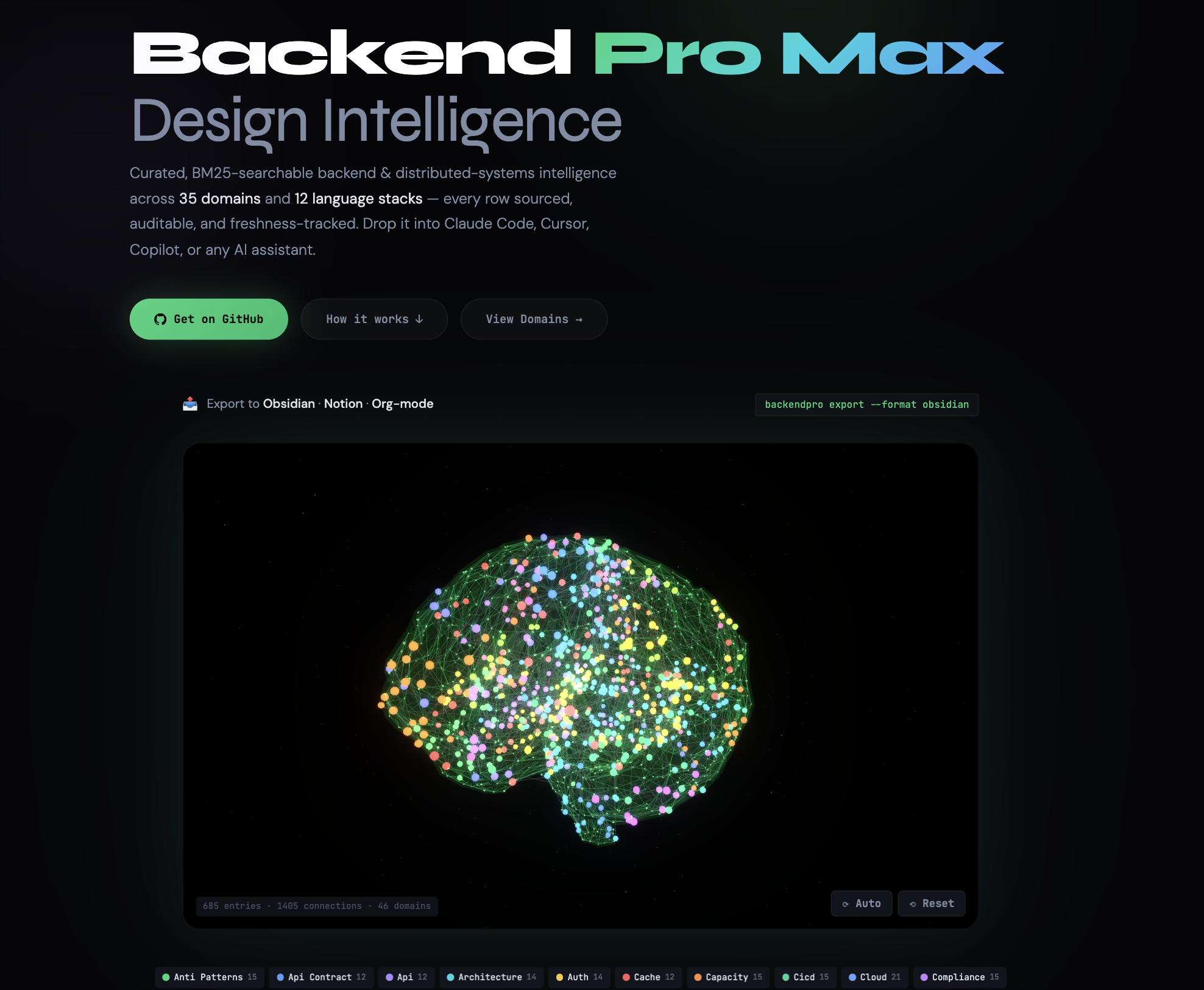
🚀 Backend Pro Max
A staff-engineer-in-a-box for your AI coding assistant
Curated, BM25-searchable backend & distributed-systems intelligence across 34 domains and 12 language stacks — every row sourced, auditable, and freshness-tracked. Drop it into Claude Code, Cursor, Windsurf, GitHub Copilot, Gemini, Continue, or any AI assistant.









Quick Start · Domains · Stacks · Install as a Skill · Examples · Contributing
✨ What is this?
Backend Pro Max grounds your AI coding assistant in opinionated, source-citable, senior-engineer-grade knowledge for backend & distributed-systems work — and forces it to search before answering.
LLMs know surface-level facts about backend tech, but they:
- 🎯 Recommend the trendy pattern instead of the right one for your team / scale.
- ⏱️ Forget timeouts, retries, idempotency, backpressure, and graceful shutdown.
- 🧩 Don't know your stack's idioms — Spring lazy-init pitfalls, FastAPI sync-in-async, Express vs Fastify, sqlx compile-time queries, EF Core change tracking, …
- 🔀 Mix up consistency models, replication modes, and partition strategies.
- 🛡️ Skip the boring-but-critical stuff: SLOs, error budgets, runbooks, PII in logs.
This skill fixes that with a structured, searchable knowledge base that the model is instructed to consult — so its advice cites a row, not a vibe.
🎁 What you get
| 📚 34 domain knowledge bases | Languages · Patterns · Databases · Messaging · Cache · Cloud · IaC · Containers · Observability · API · Auth · Security · CI/CD · Testing · Architecture · Scaling · Consistency · Performance · Reliability · Data · Anti-patterns · Cost · Migration · Incident · Capacity · Compliance · Multi-tenant · Release · ML Platform · Edge · Mobile Backend · API Contract · Interview · Latency Numbers |
| 🛠️ 12 stack guidelines | Go · Java/Spring · Python/FastAPI · Node/Express · Rust/Axum · C#/ASP.NET · Kotlin/Spring · Scala/Akka · Elixir/Phoenix · Ruby/Rails · PHP/Laravel · C++ |
| 🔎 Pure-Python BM25 + synonyms | No installs, no models, no network — partial failure → finds Saga / Circuit Breaker automatically |
⚖️ compare mode |
backendpro compare "Kafka" "RabbitMQ" --domain messaging → side-by-side markdown table for ADRs |
| 💬 Interactive REPL | backendpro --interactive for design sessions: /d, /s, /all, /cmp, /stale |
| 📅 Freshness tracking | Last Updated column + --max-age-months filter + --stale audit mode |
| 🎯 Confidence scores | Every result carries a BM25 score + high/medium/low label so the agent knows when to trust |
| ⚡ mtime-cached index | Sub-millisecond repeat queries — agent loops stay snappy |
| 🧠 Intent classifier | Auto-detects query intent (comparison, troubleshoot, migration, incident, definition, best-practice, checklist) and applies a structured template to the output |
| 🔀 Hybrid retrieval | pip install backendpro[semantic] adds embedding-based search via sentence-transformers + RRF fusion with BM25 — graceful fallback to pure BM25 when not installed |
| 🏆 Cross-encoder re-ranking | pip install backendpro[rerank] adds cross-encoder re-ranking for precision-critical queries — optional, graceful fallback |
| ⚠️ Anti-patterns domain | 15 common distributed-systems anti-patterns (Distributed Monolith, God Service, Dual Writes, …) with symptoms, root causes, and fixes |
| 🤖 Drop-in skill files | SKILL.md for Claude Code · skill-content.md for Cursor / Windsurf / Copilot / Gemini / Continue |
| 📐 Do / Don't + Code examples | Each row contains good vs bad code, severity, and a docs URL |
| 🧠 Auto domain detection | Skip --domain and the engine picks the right CSV from your query |
| ⚙️ JSON output mode | First-class integration with tool-calling agents and MCP servers |
| 🔌 MCP server | pip install backendpro[mcp] → 8 tools on stdio, works with Claude Desktop, Cline, Cursor, Zed |
| 📎 Citation tokens | Every result carries [BPM:domain.slug] — greppable provenance for PR review |
| 📡 JSONL streaming | --jsonl for agent loops that consume results incrementally |
| ✅ CI-enforced | backendpro-validate schema-checks every CSV; 652 pytest cases run on Py 3.9 / 3.11 / 3.12 |
| 🔗 100% source citations | Every row carries Source URL, Source Type, Last Updated — official docs, RFCs, papers, OWASP. --strict mode fails on gaps |
| ⚠️ Conflict detector | backendpro conflicts surfaces 12 architectural tensions (retry vs latency, cache vs consistency, etc.) with citation tokens |
| 🕐 Auto-freshness audit | Weekly GitHub Action flags stale rows (>18mo) and broken URLs. --check-urls for local runs |
| 📜 Provenance tracking | Git-blame-based Added By + Version columns. --show-provenance flag in search output |
🔍 backendpro lint |
Scans source files for 18 backend anti-patterns (missing timeouts, sync-in-async, secrets in .env, SQL injection, etc.). Human, JSON, and SARIF output. Pre-commit hook + GitHub Action included |
📤 backendpro export |
Export the entire KB to Obsidian (wikilinks + MOC), Notion CSV, or Org-mode. --domain filter |
🧠 backendpro learn |
Spaced-repetition flashcards (SM-2 algorithm) from the KB. --domain, --daily N, --stats, --reset |
| 💻 VS Code extension | Search, Explain Selection (right-click), CodeLens stack guidelines. CLI or MCP mode. extensions/vscode/ |
| 🌐 Web playground | backendpro.cc — search-as-you-type, domain filter, permalinks, compare view. Zero backend |
| 🧪 Golden query suite | 239 retrieval assertions across all domains, stacks, cross-domain, and compare — guards ranking quality on every PR |
🔎 backendpro dedup |
BM25 pairwise near-duplicate detection within and across domains. --threshold, --cross-domain, --json. Allowlist for intentional overlaps |
📊 backendpro coverage |
Per-domain coverage report with gap/thin detection against coverage-targets.yml. --json, --badge for shields.io |
⚡ Quick start
Option A — install once, type backendpro
# Install from PyPI — pure stdlib, zero dependencies
pip install backendpro

backendpro --list
backendpro "kafka exactly once delivery"
backendpro "circuit breaker" --domain pattern
backendpro "virtual threads" --stack java-spring
backendpro "idempotency" --all

# v0.2 power tools
backendpro compare "Kafka" "RabbitMQ" --domain messaging   # ADR-style table
backendpro --interactive                                    # REPL for design sessions
backendpro --stale --domain pattern --max-age-months 18     # freshness audit
backendpro "redis cluster" --json                           # MCP / agent-friendly
backendpro-validate                                         # schema-check every CSV
💡
pipx install backendproworks too if you prefer an isolated venv. You can also install from source:pip install git+https://github.com/shashankswe2020-ux/backend-pro-max-skill
Option B — run the script directly (no install)
# 0. No install needed — pure Python 3.8+ stdlib
python3 src/backend-pro-max/scripts/search.py --list

# 1. Auto-detect the domain from the query
python3 src/backend-pro-max/scripts/search.py "kafka exactly once delivery"

# 2. Constrain to a specific domain
python3 src/backend-pro-max/scripts/search.py "circuit breaker" --domain pattern

# 3. Stack-specific guidance
python3 src/backend-pro-max/scripts/search.py "virtual threads" --stack java-spring

# 4. Cross-domain search
python3 src/backend-pro-max/scripts/search.py "idempotency" --all

# 5. JSON output (great for agents / MCP)
python3 src/backend-pro-max/scripts/search.py "redis cluster" --json
💡 Tip: the search engine ranks results with BM25 over the search columns of each CSV, with light keyword-based domain auto-detection when
--domainis omitted.
🧭 Example queries
A taste of what to ask — these all return ranked, citable rows:
| Domain | Try this |
|---|---|
🧬 pattern |
"saga vs 2pc for distributed transactions" |
🗄️ database |
"postgres index on jsonb" · "dynamodb single table design" |
📨 messaging |
"kafka exactly once" · "sqs vs sns vs eventbridge" |
⚡ cache |
"thundering herd" · "negative caching with redis" |
☁️ cloud |
"aws gcp azure equivalent of pubsub" |
🛰️ observability |
"slo error budget alerting" · "otel trace context propagation" |
🔐 security |
"ssrf prevention" · "sigstore supply chain" |
🧪 testing |
"contract testing pact" · "testcontainers postgres" |
🏗️ architecture |
"modular monolith vs microservices" |
📈 scaling |
"hedged requests" · "backpressure" |
⚖️ consistency |
"linearizability vs sequential" · "PACELC" |
🛡️ reliability |
"graceful shutdown" · "circuit breaker timeouts" |
🧠 Decision Intelligence (v0.3)
Three new commands — decide, adr, design — turn the search engine into
a decision advisor. Instead of returning raw rows, they extract
constraints from your query, score candidates, and produce structured output
an LLM can cite directly.
# Quick decision with trade-off analysis
backendpro decide "Kafka vs Pulsar vs Pub/Sub for high-throughput event streaming on GCP"

# Architecture Decision Record (Markdown)
backendpro adr "Redis vs Memcached for session cache on AWS"

# Capacity-aware design document
backendpro design "Postgres vs DynamoDB for 50M DAU e-commerce with strong consistency"
Why does this matter?
| Dimension | Plain LLM | Backend Pro Max + LLM |
|---|---|---|
| Candidates | Mentions 2–3 obvious options | Returns 5 ranked candidates from the knowledge base, including less-obvious picks |
| Constraints | Ignores or hallucinates requirements | Extracts facets (throughput:high, cloud:gcp, consistency:strong) and scores every candidate against them |
| Trade-offs | Vague "it depends" | Structured pro/con per candidate with severity ratings |
| Citations | None | Every recommendation cites domain:key rows the reviewer can verify |
| Reproducibility | Different answer each time | Deterministic BM25 ranking — same query, same results |
5 hard demos
These are real outputs from the decide command — the kind of nuanced
comparisons that catch LLMs off-guard:
1. Kafka vs Pulsar vs Pub/Sub — decide "Kafka vs Pulsar vs Pub/Sub for high-throughput event streaming on GCP with ordering guarantees"
graph LR
    Q["🔍 Query: Kafka vs Pulsar vs Pub/Sub<br/>high-throughput · GCP · ordering"] --> E["⚙️ Constraint Extraction"]
    E --> C1["throughput: high"]
    E --> C2["cloud: gcp"]
    E --> C3["ordering: true"]
    C1 & C2 & C3 --> S["📊 Score & Rank"]
    S --> R1["🥇 Apache Pulsar<br/>2/2 constraints ✅"]
    S --> R2["🥈 Apache Kafka<br/>2/2 constraints ✅"]
    S --> R3["🥉 Google Pub/Sub<br/>2/2 constraints ✅"]
    S --> R4["4. Redpanda"]
    S --> R5["5. NATS JetStream"]

    style R1 fill:#22d67a,color:#000,stroke:#16a34a
    style R2 fill:#5b9cf6,color:#000,stroke:#3b82f6
    style R3 fill:#f5c842,color:#000,stroke:#d97706
- Recommendation: Apache Pulsar (highest combined score)
- 5 candidates returned across messaging domain
- Constraints extracted:
throughput:high,cloud:gcp,ordering:true - Top 3 all score 2/2 on constraint match — decision comes down to BM25 relevance to the specific query
- 🔑 Plain LLM would say "use Pub/Sub because you're on GCP" — misses that Pulsar and Kafka score equally well on constraints and may be better fits for ordering guarantees
2. Redis vs Memcached — decide "Redis vs Memcached for low-latency session cache on AWS"
graph LR
    Q["🔍 Query: Redis vs Memcached<br/>low-latency · session cache · AWS"] --> E["⚙️ Constraint Extraction"]
    E --> C1["cloud: aws"]
    E --> C2["throughput: high"]
    E --> C3["latency: low-ms"]
    C1 & C2 & C3 --> S["📊 Score & Rank"]
    S --> R1["🥇 Redis<br/>3/3 constraints ✅"]
    S --> R2["🥈 Redis Cluster<br/>3/3 constraints ✅"]
    S --> R3["🥉 Memcached<br/>3/3 constraints ✅"]
    S --> R4["4. In-process LRU"]
    S --> R5["5. L1+L2 Hybrid"]

    style R1 fill:#22d67a,color:#000,stroke:#16a34a
    style R2 fill:#5b9cf6,color:#000,stroke:#3b82f6
    style R3 fill:#f5c842,color:#000,stroke:#d97706
- Recommendation: Redis (highest score)
- 5 candidates across cache + database domains
- Constraints extracted:
cloud:aws,throughput:high,latency:low-ms - Redis scores 3/3 on all constraint columns
- 🔑 Plain LLM gives a generic feature comparison. Backend Pro Max surfaces that Redis wins on every extracted constraint axis, and also pulls in database-domain rows for Redis Cluster that an LLM wouldn't think to include.
3. Monolith vs Microservices — decide "monolith vs microservices for a 10-person startup"
graph LR
    Q["🔍 Query: monolith vs microservices<br/>10-person startup"] --> E["⚙️ Constraint Extraction"]
    E --> C0["No constraint columns<br/>on architecture domain"]
    C0 --> S["📊 Pure BM25 Ranking"]
    S --> R1["🥇 Monolith<br/>Best relevance match"]
    S --> R2["🥈 Modular Monolith<br/>Strong #2"]
    S --> R3["🥉 Microservices"]
    S --> R4["4. Serverless/FaaS"]
    S --> R5["5. Hexagonal Architecture"]

    style R1 fill:#22d67a,color:#000,stroke:#16a34a
    style R2 fill:#5b9cf6,color:#000,stroke:#3b82f6
    style R3 fill:#f5c842,color:#000,stroke:#d97706
- Recommendation: Monolith (highest BM25 score)
- 5 candidates across architecture + patterns domains
- No constraint columns on architecture domain — pure relevance ranking
- 🔑 Plain LLM hedges with "it depends on your team." Backend Pro Max commits to monolith as #1, returns modular monolith at #2, and includes the specific trade-off rows (coupling, deployment, team autonomy) that justify the ranking.
4. Postgres vs DynamoDB — decide "Postgres vs DynamoDB for 50M DAU e-commerce with strong consistency on multi-cloud"
graph LR
    Q["🔍 Query: Postgres vs DynamoDB<br/>50M DAU · strong consistency · multi-cloud"] --> E["⚙️ Constraint Extraction"]
    E --> C1["throughput: high"]
    E --> C2["cloud: multi-cloud"]
    E --> C3["consistency: strong"]
    C1 & C2 & C3 --> S["📊 Score & Rank"]
    S --> R1["🥇 Spanner / TiDB<br/>3/3 constraints ✅"]
    S --> R2["🥈 CockroachDB<br/>3/3 constraints ✅"]
    S --> R3["🥉 Postgres<br/>2/3 constraints ⚠️"]
    S --> R4["4. DynamoDB<br/>1/3 constraints"]
    S --> R5["5. Cassandra"]

    style R1 fill:#22d67a,color:#000,stroke:#16a34a
    style R2 fill:#5b9cf6,color:#000,stroke:#3b82f6
    style R3 fill:#f5c842,color:#000,stroke:#d97706
    style R4 fill:#f56060,color:#000,stroke:#dc2626
- Recommendation: Spanner / TiDB (surprise — neither of the two named!)
- 5 candidates across database + consistency + scaling domains
- Constraints extracted:
throughput:high,cloud:multi-cloud,consistency:strong - Spanner scores 3/3; Postgres lands at #3 with 2/3 (not cloud-native multi-cloud)
- 🔑 This is the killer demo. A plain LLM would compare only Postgres and DynamoDB. Backend Pro Max widens the search and surfaces Spanner/TiDB as a better fit for the actual constraints — exactly what a staff engineer would do in a design review.
5. REST vs GraphQL — decide "REST vs GraphQL for a public API with low latency"
graph LR
    Q["🔍 Query: REST vs GraphQL<br/>public API · low latency"] --> E["⚙️ Constraint Extraction"]
    E --> C1["latency: low-ms"]
    C1 --> S["📊 Score & Rank"]
    S --> R1["🥇 REST<br/>api domain"]
    S --> R2["🥈 GraphQL<br/>api domain"]
    S --> R3["🥉 Tail Latency<br/>⚡ performance domain"]
    S --> R4["4. gRPC"]
    S --> R5["5. Cold Starts<br/>⚡ performance domain"]

    S -.->|"cross-domain"| PD["⚡ performance"]
    S -.->|"primary"| AD["🔌 api"]

    style R1 fill:#22d67a,color:#000,stroke:#16a34a
    style R2 fill:#5b9cf6,color:#000,stroke:#3b82f6
    style R3 fill:#f5c842,color:#000,stroke:#d97706
    style PD fill:#fb8c3e,color:#000,stroke:#d97706
    style AD fill:#a78bfa,color:#000,stroke:#7c3aed
- Recommendation: Based on API-domain BM25 ranking
- 5 candidates across api + performance domains
- Constraints extracted:
latency:low-ms - Pulls in tail-latency and performance rows that a pure API comparison would miss
- 🔑 Plain LLM gives a feature matrix. Backend Pro Max crosses into the performance domain and flags tail-latency concerns for GraphQL that most comparisons overlook.
Note: Constraint scoring works best on domains with constraint columns (
databases,messaging,cache). Other domains use pure BM25 relevance. More constraint columns are planned for future tiers.
🧬 How is this different from RAG + LLM?
At first glance Backend Pro Max looks like a RAG system — it retrieves knowledge and feeds it to a model. But the architecture is fundamentally different, and the difference matters.
The standard RAG pipeline
User query ──▶ Embed ──▶ Vector DB ──▶ Top-K chunks ──▶ LLM ──▶ Answer
RAG embeds your docs into a vector store, retrieves the nearest chunks, and stuffs them into the prompt. The LLM then generates an answer from those chunks. This works, but has well-known failure modes:
| Problem | What happens |
|---|---|
| Chunk boundary corruption | A CSV row about "Saga pattern" gets split mid-sentence; the LLM sees half a trade-off |
| Semantic drift | "connection pool exhausted" embeds near "swimming pool" — wrong chunks retrieved |
| No structure in, no structure out | Chunks are flat text; the LLM has to infer which part is "when to use" vs "when not to" |
| Hallucination laundering | The LLM cites a retrieved chunk but subtly changes the recommendation |
| Non-determinism | Same query, different embedding model version → different chunks → different answer |
| Cold start cost | Embedding 21 CSVs requires a model download, GPU/CPU time, and a vector DB |
| Dependency weight | sentence-transformers + faiss + chromadb = 500 MB+ before you write a line of code |
The Backend Pro Max approach
User query ──▶ BM25 (stdlib) ──▶ Structured rows ──▶ Agent context
                                  (not chunks)        (not generation)
| Design choice | Why |
|---|---|
| BM25 over structured CSV rows | Each row is a complete, self-contained knowledge unit with named columns (Name, When to Use, When NOT to Use, Trade-offs, Severity). No chunk splitting, no boundary corruption. |
| Deterministic ranking | Same query → same BM25 scores → same results. Every time. Reviewable, testable, reproducible. |
| Zero dependencies by default | Pure Python stdlib. No embedding model, no vector DB, no GPU. pip install backendpro and you're done in 2 seconds. |
| Intent classification, not generation | The classifier routes your query to a structured template (troubleshoot → Symptom/Root Cause/Fix). The model fills in from retrieved rows — it doesn't hallucinate a structure. |
| Constraint columns, not vibes | Throughput Tier: very-high, Latency Tier: sub-ms, Cloud Native: aws,gcp — structured metadata that the decide command scores programmatically. No embedding similarity guesswork. |
| The model is the consumer, not the generator | Retrieved rows go into the agent's context as facts to cite. The model's job is to explain and compare them — not to generate knowledge from noisy chunks. |
| Optional semantic upgrade | pip install backendpro[semantic] adds embedding-based hybrid search for conceptual queries. But it's an addition to BM25, not a replacement — and BM25 alone covers 95% of queries. |
Side by side
| RAG + LLM | Backend Pro Max | |
|---|---|---|
| Retrieval | Embedding similarity (approximate) | BM25 keyword match (exact) + optional hybrid |
| Unit of retrieval | Text chunk (arbitrary boundary) | Structured row (complete knowledge unit) |
| Ranking | Cosine similarity (non-deterministic across model versions) | BM25 score (deterministic, testable) |
| Output structure | LLM-generated (variable) | Template-driven by intent (consistent) |
| Constraint matching | None (hope the LLM reads the chunk correctly) | Programmatic column-level scoring |
| Cold start | Download model + build index (minutes) | Zero (pure stdlib, sub-ms first query) |
| Dependencies | 500 MB+ (transformers, vector DB, numpy) | 0 (stdlib only) |
| Reproducibility | Low (embedding drift, LLM temperature) | High (same query = same rows = same scores) |
| Auditability | "The LLM said so" | "Row pattern:Saga scored 8.42 on BM25" |
What actually breaks vs what this fixes
| Problem in RAG + LLM | What Backend Pro Max does |
|---|---|
| Different answers every run | Same input → same decisions |
| Loses architectural context | Persists system decisions |
| Retrieves noisy chunks | Retrieves complete decision units |
| LLM hallucinates tradeoffs | Explicit scoring + constraints |
| No explainability | Every decision is traceable |
When you'd still want RAG
- You have unstructured documents (PDFs, wikis, Confluence) that can't be easily tabulated into CSV rows with named columns.
- Your knowledge base is huge (100K+ documents) and keyword matching produces too many false negatives for conceptual queries.
- You need cross-document reasoning where the answer spans multiple sources.
Backend Pro Max is designed for curated, structured, expert-reviewed knowledge — the kind a staff engineer would put in a decision matrix, not in a wiki page. For that use case, structured retrieval beats RAG on every dimension that matters: precision, reproducibility, auditability, and speed.
📚 Domains
| Domain | What's in it |
|---|---|
🧠 language |
Go, Java, Kotlin, Python, Rust, Node.js/TS, C#, Scala, Elixir, Ruby, PHP, C++ |
🧩 pattern |
Saga, CQRS, Event Sourcing, Outbox, CDC, Circuit Breaker, Bulkhead, Retry, Idempotency, Leader Election, Sidecar, Strangler Fig, ACL, BFF, API Gateway, Rate Limiting, Sharding, Read Replica, Materialized View, Process Manager, Outbox+Inbox, Fan-out / Scatter-Gather |
🗄️ database |
Postgres, MySQL/Vitess, CockroachDB, Spanner/TiDB, MongoDB, Cassandra/Scylla, DynamoDB, Redis, Memcached, Elastic/OpenSearch, ClickHouse, DuckDB, Snowflake/BigQuery/Redshift, Neo4j/Memgraph, Influx/Timescale/VictoriaMetrics, vector DBs, S3/GCS/Blob, etcd/ZK/Consul, SQLite |
📨 messaging |
Kafka, Redpanda, Pulsar, RabbitMQ, NATS/JetStream, MQTT, SQS, SNS/EventBridge, Kinesis, Pub/Sub, Service Bus / Event Grid / Event Hubs, ZeroMQ |
⚡ cache |
In-process LRU, Redis (single + cluster), Memcached, CDN, HTTP cache, read/write/write-back, materialized views, negative caching, Bloom filters, L1+L2 hybrid |
☁️ cloud |
AWS / GCP / Azure / Cloudflare service mapping & equivalents |
🏗️ iac |
Terraform/OpenTofu, Pulumi, AWS CDK, CloudFormation, Bicep, Ansible, Crossplane, Helm, Kustomize, Packer |
📦 container |
Docker/OCI, Podman, containerd, Kubernetes, EKS/GKE/AKS, Helm, Kustomize, ArgoCD/Flux, Istio/Linkerd/Cilium, Envoy, Karpenter, Nomad, Compose, Testcontainers |
📊 observability |
Prometheus, Mimir/Cortex/Thanos/VM, Grafana, Loki, ELK/OpenSearch, Tempo/Jaeger/Zipkin, OpenTelemetry, Pyroscope/Parca, Datadog, New Relic / Honeycomb / Dynatrace, Sentry, Fluent Bit / Vector, PagerDuty / Opsgenie, SLO frameworks |
🔌 api |
REST, GraphQL, gRPC, gRPC-Web/Connect, WebSocket, SSE, HTTP/2, HTTP/3, Webhooks, WebSub/ActivityPub, JSON-RPC, SOAP |
🔑 auth |
OAuth 2.0 + PKCE, OIDC, JWT, SAML, mTLS, API keys, HMAC signing, sessions, passkeys/WebAuthn, magic links, RBAC/ABAC/ReBAC, SCIM, workload identity (IRSA / WIF) |
🛡️ security |
OWASP Top 10, CSRF, XSS, SSRF, deserialisation, secrets, supply chain (SLSA, Sigstore), zero-trust, TLS hardening, PII/logging, rate limiting, CORS, SBOM, SAST, DAST/fuzz |
🔁 cicd |
GitHub Actions, GitLab CI, Jenkins, CircleCI, Buildkite, Drone, Tekton, Argo Workflows, ArgoCD, Flux, Spinnaker, Argo Rollouts, Renovate/Dependabot, SonarQube, GHAS |
🧪 testing |
Unit, component/slice, integration (Testcontainers), contract (Pact), E2E, property-based, fuzz, snapshot, mutation, load, stress/soak, chaos, smoke / synthetic monitoring |
🏛️ architecture |
Monolith, modular monolith, microservices, serverless/FaaS, event-driven, hexagonal/ports-and-adapters, clean/onion, DDD, CQRS+ES, service mesh, BFF, lambda/kappa, actor model, cell-based |
📈 scaling |
Vertical, horizontal, autoscaling (HPA/KEDA/Karpenter), sharding, read replicas, multi-tier caching, connection pooling, backpressure, bulkhead, hedged requests, load balancing, CDN, geo-distribution, async/queue load levelling, indexing, materialized views, partitioning |
⚖️ consistency |
Linearizability, sequential, causal, read-your-writes, eventual, SEC/CRDTs, CAP, PACELC, Raft, Paxos, 2PC, snapshot isolation/SSI, quorum, Lamport/vector/HLC clocks |
🚀 performance |
N+1, missing indexes, plan regressions, pool exhaustion, GC pauses, hot keys, tail latency, thundering herd, async-blocking, cold starts, leaks, hot-path allocations, JSON serialisation, chatty interfaces, TLS overhead |
🛟 reliability |
SLO/SLI/error budget, timeouts, retries+backoff, circuit breaker, bulkhead, idempotency, graceful shutdown, liveness/readiness, capacity & headroom, RPO/RTO, multi-AZ/region, backups + PITR, chaos engineering, runbooks, blue/green & canary, feature flags, per-tenant quotas, postmortems |
🧮 data |
Spark, Flink, Kafka Streams/ksqlDB, Airbyte/Fivetran/Stitch/Meltano, dbt, Airflow, Dagster, Prefect, Iceberg/Delta/Hudi, ClickHouse/Druid/Pinot, Spark Streaming + Delta, Debezium, Kafka Connect, LakeFS/Nessie, vector DBs, feature stores |
⚠️ antipattern |
Distributed Monolith, Shared Database Integration, God Service, Sync-over-Async, Dual Writes, Chatty Microservices, Unbounded Retry, Missing Idempotency Key, Premature Microservices, Log-and-Throw, Generic Error Swallowing, N+1 Query, Secrets in Env Vars, Time-Based Cache Invalidation Only, Polling Instead of Events |
🛠️ Stacks
Each stack file contains tight, opinionated, "what would a staff engineer say in code review" guidelines — categorised by Concurrency, HTTP, Errors, Persistence, Tooling, Observability, Performance, Testing, Build, … — with ✅ Do / ❌ Don't plus good vs bad code examples.
| Stack | Highlights |
|---|---|
🐹 go |
context.Context, errgroup, http.Client reuse, pgx/sqlc, table-driven tests |
☕ java-spring |
Virtual threads (Loom), constructor DI, OSIV off, Flyway, Testcontainers, native image |
🐍 python-fastapi |
async-all-the-way, Pydantic v2, httpx, uv, ruff/mypy, structlog, Testcontainers |
🟢 nodejs-express |
Fastify > Express, zod at boundaries, Undici pool, pino, OTel, Vitest |
🦀 rust-axum |
Tokio + Axum + Tower, sqlx compile-time queries, thiserror/anyhow, tracing, tokio-console |
🟪 csharp-aspnet |
Minimal APIs, async-all-the-way, HttpClientFactory, Polly v8, EF Core AsNoTracking, Native AOT |
🟧 kotlin-spring |
Coroutines + structured concurrency, Spring Boot Kotlin DSL, Exposed/jOOQ, kotest |
🔺 scala-akka |
Pekko (Akka fork), Typed actors, Pekko Streams, Cats Effect / ZIO |
💧 elixir-phoenix |
OTP supervision, GenServer, Task.async_stream, Phoenix LiveView, Broadway, libcluster |
💎 ruby-rails |
Modular Rails (Packwerk), Sidekiq, Puma tuning, Bullet, Rails 7+ defaults, Solid Queue/Cache |
🐘 php-laravel |
Octane (Swoole/RoadRunner/FrankenPHP), OPcache+JIT, Horizon, eager loading, PHPStan |
➕ cpp |
C++20+, RAII, jthread/stop_token, coroutines, sanitizers, CMake presets, Conan/vcpkg, GoogleTest, clang-tidy |
🤖 How AI agents use this
A typical interaction inside Claude Code, Cursor, Copilot, etc.:
👤  "Add retries to our outbound HTTP client without melting the dependency."

🤖  → search.py "retry backoff jitter circuit breaker" --domain reliability
    → search.py "http client retries" --stack <your stack>
    → answers with: exponential backoff + jitter, max attempts, idempotency
      key requirement, circuit breaker around it, budgeted timeout, plus
      a code snippet using the right library for your stack — and cites
      the row(s) it pulled from.
The skill files (SKILL.md / skill-content.md) instruct the agent to:
- Search first — never guess when a row exists.
- Cite the row (domain + key) so reviewers can verify.
- Prefer stack guidelines for code-shaped answers.
- Combine multiple domains for cross-cutting concerns (e.g. a "saga"
answer pulls from
pattern+messaging+consistency+reliability).
📁 Repository structure
See CLAUDE.md for the full layout. TL;DR:
src/backend-pro-max/
├── data/                       # 34 domain CSVs + stacks/ (12 stack CSVs)
│   ├── languages.csv  patterns.csv  databases.csv  messaging.csv …
│   └── stacks/
│       └── go.csv  java-spring.csv  python-fastapi.csv  …
├── scripts/
│   ├── core.py                 # BM25 engine + domain auto-detection
│   ├── search.py               # CLI entry point
│   ├── lint.py                 # Anti-pattern linter (18 rules)
│   ├── export.py               # Obsidian / Notion / Org-mode export
│   ├── learn.py                # SM-2 spaced-repetition flashcards
│   ├── dedup.py                # Near-duplicate detection (BM25 self-similarity)
│   ├── coverage.py             # KB coverage gap/thin analysis
│   ├── calc.py                 # Back-of-envelope calculators
│   ├── conflicts.py            # Architectural tension detector
│   ├── freshness.py            # Stale-row & URL-health checker
│   └── provenance.py           # Git-blame provenance populator
└── templates/base/
    ├── skill-content.md        # Drop-in rules for any AI assistant
    └── quick-reference.md      # Cheatsheet

extensions/
├── vscode/                     # VS Code extension (TypeScript)
│   ├── src/extension.ts        # Commands, CodeLens, MCP client
│   └── package.json            # Marketplace metadata + settings
└── jetbrains/                  # JetBrains plugin stub (Java)
    └── src/main/resources/META-INF/plugin.xml

lint-rules.yml                  # 18 lint rules with BPM citations
coverage-targets.yml            # Expected categories per domain (gap detection)
dedup-allowlist.yml             # Intentional overlaps (suppressed in dedup)
.pre-commit-hooks.yaml          # Pre-commit framework integration
.github/actions/lint/action.yml # GitHub Action for SARIF upload
.claude/skills/backend-pro-max/ # Claude Code skill (SKILL.md)
docs/                           # ARCHITECTURE.md & USAGE.md
Visual architecture
flowchart TD
    U["👤 User Query\n"Design a URL shortener with caching""]:::user
    S["📜 SKILL.md / skill-content.md\nInstructs model to search before answering"]:::skill
    C["🔎 backendpro CLI\nBM25 search engine · pure Python stdlib"]:::cli
    D["📚 21 Domain CSVs\napi · cache · database\nscaling · reliability …"]:::data
    K["🛠️ 12 Stack CSVs\ngo · java-spring\npython-fastapi …"]:::data
    A["🌐 Auto-detect / --all\nCross-domain search"]:::data
    R["📋 Ranked Results\nCited rows · do/don't · code\nseverity · docs URL"]:::result
    G["✅ Grounded, Citable Answer"]:::answer

    U --> S --> C
    C --> D & K & A
    D & K & A --> R --> G

    classDef user     fill:#6366f1,color:#fff,stroke:#4f46e5,stroke-width:2px
    classDef skill    fill:#8b5cf6,color:#fff,stroke:#7c3aed,stroke-width:2px
    classDef cli      fill:#0ea5e9,color:#fff,stroke:#0284c7,stroke-width:2px
    classDef data     fill:#f59e0b,color:#fff,stroke:#d97706,stroke-width:2px
    classDef result   fill:#10b981,color:#fff,stroke:#059669,stroke-width:2px
    classDef answer   fill:#22c55e,color:#fff,stroke:#16a34a,stroke-width:2px
🔌 Installation as an AI skill
� Step 1 — Install from PyPI
pip install backendpro
🟣 Claude Code
backendpro --load claude
Creates .claude/skills/backend-pro-max/SKILL.md in the current directory.
🟦 Cursor / Windsurf / Continue / GitHub Copilot / Gemini
backendpro --load cursor     # → .cursor/rules/backend.mdc
backendpro --load windsurf   # → .windsurfrules
backendpro --load continue   # → AGENTS.md
backendpro --load copilot    # → .github/copilot-instructions.md
For Gemini Code Assist, copy the skill file manually:
cp "$(python3 -c "import backendpro as b; print(b.__path__[0])")/templates/base/skill-content.md" GEMINI.md
⚙️ CLI / MCP
Ready to use after pip install:
backendpro --list
backendpro "redis cluster" --json
backendpro-mcp                     # start MCP server
✅ Prerequisites
- Python 3.8+ — that's it. No
pip install, no virtualenv, no models. - Works on Linux, macOS, Windows (WSL/native), and inside containers.
🧪 Smoke test
# Installed CLI
backendpro --list
backendpro "circuit breaker"
backendpro "virtual threads" --stack java-spring
backendpro "idempotency" --all
backendpro compare "Postgres" "DynamoDB" --domain database
backendpro decide "Kafka vs Pulsar" --constraints throughput=high
backendpro adr "Redis vs Memcached for session cache on AWS"
backendpro design "Postgres vs DynamoDB for 50M DAU e-commerce"
backendpro-validate                       # ✅ All CSVs valid (21 domains + 12 stacks).

# v0.6 DX tools
backendpro lint src/                                        # scan for anti-patterns
backendpro lint src/ --format sarif                         # SARIF for GitHub Code Scanning
backendpro export --format obsidian --out /tmp/bpm-vault    # export to Obsidian vault
backendpro export --format notion --out /tmp/notion         # export to Notion CSV
backendpro learn --domain consistency --daily 5             # spaced-repetition flashcards
backendpro learn --stats                                    # learning progress

# v0.7 quality engineering
backendpro dedup                                            # find near-duplicate rows
backendpro dedup --domain messaging --threshold 0.7         # per-domain with custom threshold
backendpro dedup --cross-domain --json                      # cross-domain, JSON output
backendpro coverage                                         # KB coverage report
backendpro coverage --domain database --json                # per-domain, JSON output
backendpro coverage --badge                                 # shields.io badge URL

# Or, without installing
python3 src/backend-pro-max/scripts/search.py --list
python3 src/backend-pro-max/scripts/search.py "circuit breaker"
Run the test suite (contributors)
pip install -e ".[dev]"
pytest                                    # 652 tests
ruff check src tests                      # lint
backendpro-validate                       # schema validation
� MCP / Agent Integration (v0.3.1)
Backend Pro Max ships as a Model Context Protocol (MCP) server — any MCP-aware IDE or agent framework can consume all 8 tools natively.
Install
pip install 'backendpro[mcp]' # quotes required in zsh; adds the mcp SDK as an optional extra
Core
pip install backendprostill works with zero dependencies — MCP is fully optional.
Run the MCP server
backendpro-mcp # starts on stdio transport
Claude Desktop config
Add to ~/Library/Application Support/Claude/claude_desktop_config.json:
{
  "mcpServers": {
    "backendpro": {
      "command": "backendpro-mcp"
    }
  }
}
⚠️ Troubleshooting: "No such file or directory" If the MCP client can't find
backendpro-mcp, use the full path instead:which backendpro-mcp # find the full pathThen use it in the config:
{
  "mcpServers": {
    "backendpro": {
      "command": "/opt/anaconda3/bin/backendpro-mcp"
    }
  }
}
This is common when using conda, pyenv, or virtualenvs where the binary isn't on the system PATH that the MCP client inherits.
Available MCP tools
| Tool | Description |
|---|---|
backendpro_search |
BM25 search in a domain (query, domain?, max_results?, min_score?) |
backendpro_search_all |
Cross-domain search (query, max_results?) |
backendpro_search_stack |
Stack-specific guidelines (query, stack, max_results?) |
backendpro_compare |
Side-by-side comparison (names[], domain?) |
backendpro_decide |
Opinionated recommendation (requirement) |
backendpro_adr |
Architecture Decision Record (title, context_domains[]) |
backendpro_design |
System design scaffold (description) |
backendpro_find_stale |
Freshness audit (domain, months) |
Every tool returns structured JSON with [BPM:…] citation tokens — stable,
greppable keys that let reviewers verify grounding in PRs:
grep -r '\[BPM:' . # find all citations in generated code / docs
JSONL streaming
For agent loops that consume results incrementally:
backendpro "kafka" --domain messaging --jsonl     # one JSON object per line
backendpro "idempotency" --all --jsonl             # cross-domain, streamed
backendpro compare "Kafka" "RabbitMQ" --jsonl      # per-field lines
Function-calling manifest (tools.json)
A pre-generated tools.json at repo root provides dual-format
schemas (OpenAI functions + Anthropic tool_use) for LangGraph, CrewAI,
AutoGen, and other agent frameworks:
import json
tools = json.load(open("tools.json"))["openai"]    # or ["anthropic"]
MCP Inspector validation
npx @modelcontextprotocol/inspector backendpro-mcp
# All 8 tools tested ✅ — see docs/mcp-inspector-report.md
🛡️ DX & Distribution (v0.6)
Five features that turn the knowledge base into an active developer tool:
Linter (backendpro lint)
Scan source files for backend anti-patterns — 18 rules across Go, Python, Java, TypeScript, and .env files. Each finding links to a BPM citation.
backendpro lint src/                             # human-readable output
backendpro lint src/ --format json               # machine-readable
backendpro lint src/ --format sarif              # GitHub Code Scanning
backendpro lint src/ --severity error            # errors only
Pre-commit: Add to .pre-commit-config.yaml:
repos:
  - repo: https://github.com/shashankswe2020-ux/backend-pro-max-skill
    rev: v0.6.0
    hooks:
      - id: backendpro-lint
GitHub Action: Use .github/actions/lint/action.yml to upload SARIF inline annotations.
Export (backendpro export)
Export the KB to your preferred knowledge management tool:
backendpro export --format obsidian --out ./vault     # Obsidian vault with wikilinks + _Index.md
backendpro export --format notion --out ./notion       # Notion-importable CSVs
backendpro export --format org --out ./org             # Org-mode files
backendpro export --format obsidian --domain cache --out ./vault  # single domain
Learn Mode (backendpro learn)
Spaced-repetition flashcards (SM-2 algorithm) generated from the KB:
backendpro learn --domain consistency --daily 5   # 5 flashcards from consistency domain
backendpro learn --stats                          # learning progress
backendpro learn --reset                          # start over
VS Code Extension
Install from extensions/vscode/:
cd extensions/vscode && npm install && npm run compile
npx @vscode/vsce package    # produces .vsix
code --install-extension backendpro-*.vsix
- Cmd+Shift+P → "Backend Pro Max: Search" — query the KB from VS Code
- Right-click → "Explain with Backend Pro Max" — explain selected text
- CodeLens — stack guidelines shown at top of Go, Python, Java, TS, Rust files
- MCP mode — set
backendpro.useMcp: trueto usebackendpro-mcpinstead of CLI
Web Playground
Live at backendpro.cc — search-as-you-type, domain filter, shareable permalinks, compare view. Zero backend.
🧱 Extending
Adding a new row, a new domain, or a new stack takes ~2 minutes.
| Want to add… | Steps |
|---|---|
| 📝 A new row | Append to the relevant data/<domain>.csv (keep column order; quote any field with commas). Set Last Updated to today (YYYY-MM-DD) where the column exists. |
| 🆕 A new domain | Add data/<domain>.csv, register in CSV_CONFIG + _DOMAIN_KEYWORDS in core.py. |
| 🧱 A new stack | Add data/stacks/<stack>.csv, register in STACK_CONFIG in core.py. |
| 🔁 A search synonym | Add a token → expansions entry in _SYNONYMS in core.py (keep it conservative). |
Always run before pushing:
pytest                  # ranking-quality + unit tests
backendpro-validate     # CSV schema check
ruff check src tests    # lint
Full details in CONTRIBUTING.md, CLAUDE.md, and
docs/ARCHITECTURE.md.
🤝 Contributing
PRs welcome — especially for:
- 🆕 New stacks: Swift on the server, Erlang/OTP, Zig, Crystal, Gleam, Deno, Bun, …
- 🌐 New domains: FinOps, ML platform, edge / WASM, blockchain infra, mobile-backend, …
- 🧠 More rows in existing CSVs (with
Do,Don't, code, severity, and a docs URL). - 🐛 Corrections — if a recommendation is dated or wrong, open a PR with the source.
Please follow the Git workflow in CLAUDE.md:
- Branch from
main(feat/...orfix/...). - Commit with a clear message.
- Open a PR — never push directly to
main.
❓ FAQ
Does this need an internet connection?
No. The CLI is offline-first, pure Python stdlib. The only network calls are whatever the AI assistant itself makes.
Why CSV instead of YAML / JSON / SQLite?
CSV diffs cleanly in PRs, opens in any editor / spreadsheet, and is trivial to parse with stdlib. Search is BM25 over the configured columns.
How is this different from a generic "rules" file?
A flat rules file forces the model to keep everything in context. This skill makes the model search a structured KB on demand — so it scales to hundreds of rows across 20+ domains without bloating the prompt.
Can I use it from an MCP server / tool-calling agent?
Yes — pip install backendpro[mcp] and run backendpro-mcp. It exposes 8
tools via stdio transport, compatible with Claude Desktop, Cline, Cursor, Zed,
and any MCP-aware client. See the MCP section
for details. For non-MCP agents, use --json or --jsonl, or import tools.json
for OpenAI / Anthropic function-calling schemas.
📜 License
MIT © 2025 contributors
Built for the engineers who actually ship distributed systems. If this saves you one outage, ⭐ the repo.
1 maintainer

Metadata
1 maintainer
Release files for backendpro 0.8.1
For a detailed explanation of source distributions (sdists) and built distributions (wheels), please see the package formats documentation.
Source distribution (sdist)
| File | Size | Uploaded | |
|---|---|---|---|
| backendpro-0.8.1.tar.gz | 263.9 kB | Details |
Built distribution (wheel)
| File | Interpreter | ABI | Platform | Reset |
|---|---|---|---|---|
| backendpro-0.8.1-py3-none-any.whl | Python 3 | none | any | Details |
Total release size: 503.6 kB
Release files / backendpro-0.8.1.tar.gz
| Download URL | backendpro-0.8.1.tar.gz |
|---|---|
| Size | 263.9 kB |
| Tags | Source |
|
SHA-256 checksum How to use checksums |
f640d04714007f225ccbe0ab16e6ffad4d1518fff4b8b53ff8247e4df1a280ef
|
|
BLAKE2b-256 checksum How to use checksums |
c612f6cae42c8b6a2292ac00f9d17d0af674ada57ebb9c227e71dcbd837789dd
|
| Upload date | |
|
Uploaded using Trusted Publishing? What is trusted publishing? |
No |
| Uploaded via |
twine/6.2.0 CPython/3.13.9
|
Release files / backendpro-0.8.1-py3-none-any.whl
| Download URL | backendpro-0.8.1-py3-none-any.whl |
|---|---|
| Size | 239.6 kB |
| Tags | Python 3 |
|
SHA-256 checksum How to use checksums |
a8fdef775c0ed427524791767942de3c3d24dcb356eba7f7f939810248c1448a
|
|
BLAKE2b-256 checksum How to use checksums |
5e7691755b7129222e54f4559e0111c2e1ad8ec91d645d6fb2c6f8e48b128fb2
|
| Upload date | |
|
Uploaded using Trusted Publishing? What is trusted publishing? |
No |
| Uploaded via |
twine/6.2.0 CPython/3.13.9
|














