
Backend Pro Max — BM25-searchable backend & distributed-systems engineering intelligence as an AI skill / CLI.

Project description
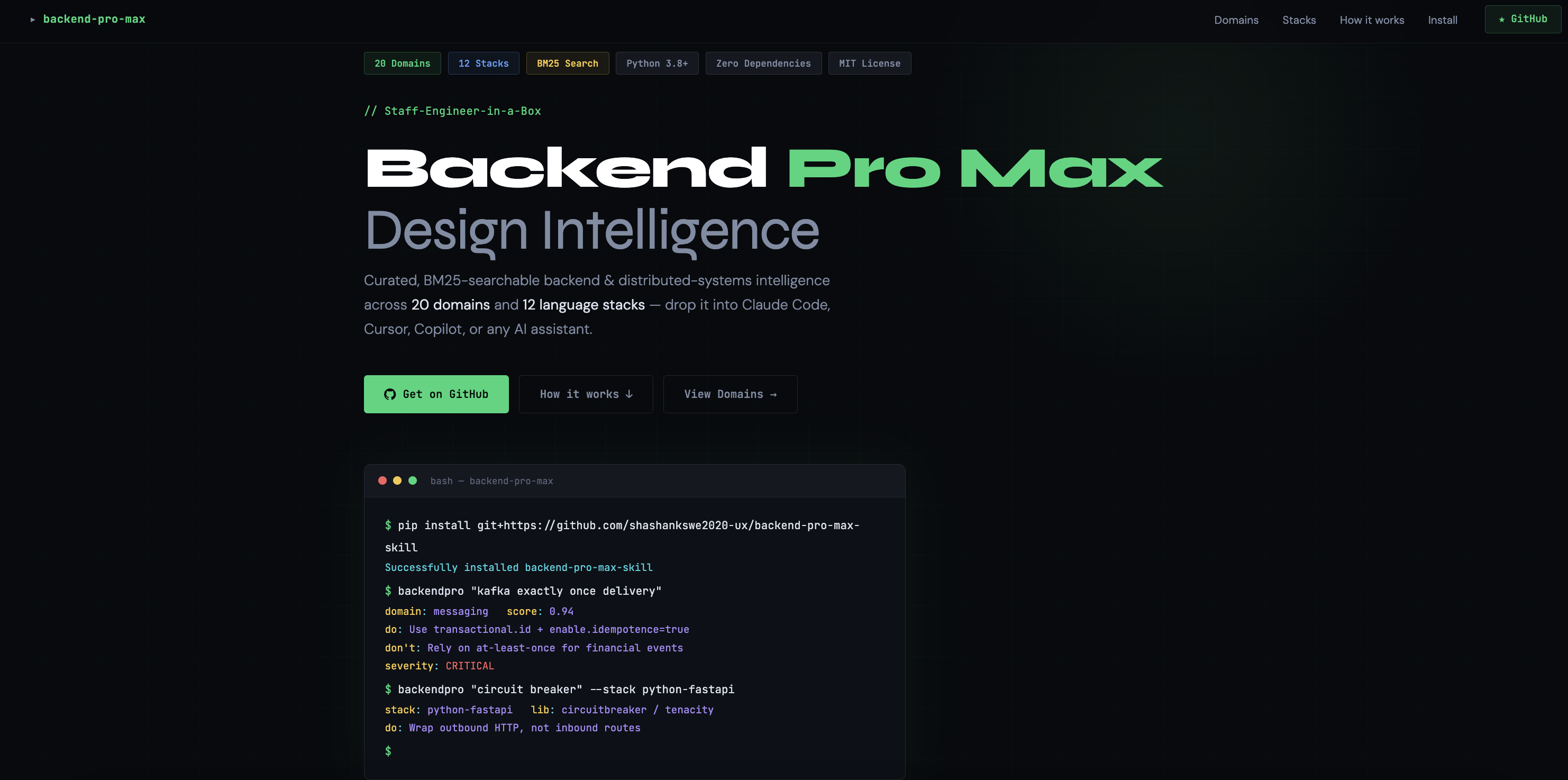
🚀 Backend Pro Max
A staff-engineer-in-a-box for your AI coding assistant
Curated, BM25-searchable backend & distributed-systems intelligence across 20 domains and 12 language stacks — drop it into Claude Code, Cursor, Windsurf, GitHub Copilot, Gemini, Continue, or any AI assistant.









Quick Start · Domains · Stacks · Install as a Skill · Examples · Contributing
✨ What is this?
Backend Pro Max grounds your AI coding assistant in opinionated, source-citable, senior-engineer-grade knowledge for backend & distributed-systems work — and forces it to search before answering.
LLMs know surface-level facts about backend tech, but they:
- 🎯 Recommend the trendy pattern instead of the right one for your team / scale.
- ⏱️ Forget timeouts, retries, idempotency, backpressure, and graceful shutdown.
- 🧩 Don't know your stack's idioms — Spring lazy-init pitfalls, FastAPI sync-in-async, Express vs Fastify, sqlx compile-time queries, EF Core change tracking, …
- 🔀 Mix up consistency models, replication modes, and partition strategies.
- 🛡️ Skip the boring-but-critical stuff: SLOs, error budgets, runbooks, PII in logs.
This skill fixes that with a structured, searchable knowledge base that the model is instructed to consult — so its advice cites a row, not a vibe.
🎁 What you get
| 📚 20 domain knowledge bases | Languages · Patterns · Databases · Messaging · Cache · Cloud · IaC · Containers · Observability · API · Auth · Security · CI/CD · Testing · Architecture · Scaling · Consistency · Performance · Reliability · Data |
| 🛠️ 12 stack guidelines | Go · Java/Spring · Python/FastAPI · Node/Express · Rust/Axum · C#/ASP.NET · Kotlin/Spring · Scala/Akka · Elixir/Phoenix · Ruby/Rails · PHP/Laravel · C++ |
| 🔎 Pure-Python BM25 + synonyms | No installs, no models, no network — partial failure → finds Saga / Circuit Breaker automatically |
⚖️ compare mode |
backendpro compare "Kafka" "RabbitMQ" --domain messaging → side-by-side markdown table for ADRs |
| 💬 Interactive REPL | backendpro --interactive for design sessions: /d, /s, /all, /cmp, /stale |
| 📅 Freshness tracking | Last Updated column + --max-age-months filter + --stale audit mode |
| 🎯 Confidence scores | Every result carries a BM25 score + high/medium/low label so the agent knows when to trust |
| ⚡ mtime-cached index | Sub-millisecond repeat queries — agent loops stay snappy |
| 🤖 Drop-in skill files | SKILL.md for Claude Code · skill-content.md for Cursor / Windsurf / Copilot / Gemini / Continue |
| 📐 Do / Don't + Code examples | Each row contains good vs bad code, severity, and a docs URL |
| 🧠 Auto domain detection | Skip --domain and the engine picks the right CSV from your query |
| ⚙️ JSON output mode | First-class integration with tool-calling agents and MCP servers |
| ✅ CI-enforced | backendpro-validate schema-checks every CSV; 37 pytest cases run on Py 3.9 / 3.11 / 3.12 |
⚡ Quick start
Option A — install once, type backendpro
# Install from PyPI — pure stdlib, zero dependencies
pip install backendpro

backendpro --list
backendpro "kafka exactly once delivery"
backendpro "circuit breaker" --domain pattern
backendpro "virtual threads" --stack java-spring
backendpro "idempotency" --all

# v0.2 power tools
backendpro compare "Kafka" "RabbitMQ" --domain messaging   # ADR-style table
backendpro --interactive                                    # REPL for design sessions
backendpro --stale --domain pattern --max-age-months 18     # freshness audit
backendpro "redis cluster" --json                           # MCP / agent-friendly
backendpro-validate                                         # schema-check every CSV
💡
pipx install backendproworks too if you prefer an isolated venv. You can also install from source:pip install git+https://github.com/shashankswe2020-ux/backend-pro-max-skill
Option B — run the script directly (no install)
# 0. No install needed — pure Python 3.8+ stdlib
python3 src/backend-pro-max/scripts/search.py --list

# 1. Auto-detect the domain from the query
python3 src/backend-pro-max/scripts/search.py "kafka exactly once delivery"

# 2. Constrain to a specific domain
python3 src/backend-pro-max/scripts/search.py "circuit breaker" --domain pattern

# 3. Stack-specific guidance
python3 src/backend-pro-max/scripts/search.py "virtual threads" --stack java-spring

# 4. Cross-domain search
python3 src/backend-pro-max/scripts/search.py "idempotency" --all

# 5. JSON output (great for agents / MCP)
python3 src/backend-pro-max/scripts/search.py "redis cluster" --json
💡 Tip: the search engine ranks results with BM25 over the search columns of each CSV, with light keyword-based domain auto-detection when
--domainis omitted.
🧭 Example queries
A taste of what to ask — these all return ranked, citable rows:
| Domain | Try this |
|---|---|
🧬 pattern |
"saga vs 2pc for distributed transactions" |
🗄️ database |
"postgres index on jsonb" · "dynamodb single table design" |
📨 messaging |
"kafka exactly once" · "sqs vs sns vs eventbridge" |
⚡ cache |
"thundering herd" · "negative caching with redis" |
☁️ cloud |
"aws gcp azure equivalent of pubsub" |
🛰️ observability |
"slo error budget alerting" · "otel trace context propagation" |
🔐 security |
"ssrf prevention" · "sigstore supply chain" |
🧪 testing |
"contract testing pact" · "testcontainers postgres" |
🏗️ architecture |
"modular monolith vs microservices" |
📈 scaling |
"hedged requests" · "backpressure" |
⚖️ consistency |
"linearizability vs sequential" · "PACELC" |
🛡️ reliability |
"graceful shutdown" · "circuit breaker timeouts" |
🧠 Decision Intelligence (v0.3)
Three new commands — decide, adr, design — turn the search engine into
a decision advisor. Instead of returning raw rows, they extract
constraints from your query, score candidates, and produce structured output
an LLM can cite directly.
# Quick decision with trade-off analysis
backendpro decide "Kafka vs Pulsar vs Pub/Sub for high-throughput event streaming on GCP"

# Architecture Decision Record (Markdown)
backendpro adr "Redis vs Memcached for session cache on AWS"

# Capacity-aware design document
backendpro design "Postgres vs DynamoDB for 50M DAU e-commerce with strong consistency"
Why does this matter?
| Dimension | Plain LLM | Backend Pro Max + LLM |
|---|---|---|
| Candidates | Mentions 2–3 obvious options | Returns 5 ranked candidates from the knowledge base, including less-obvious picks |
| Constraints | Ignores or hallucinates requirements | Extracts facets (throughput:high, cloud:gcp, consistency:strong) and scores every candidate against them |
| Trade-offs | Vague "it depends" | Structured pro/con per candidate with severity ratings |
| Citations | None | Every recommendation cites domain:key rows the reviewer can verify |
| Reproducibility | Different answer each time | Deterministic BM25 ranking — same query, same results |
5 hard demos
These are real outputs from the decide command — the kind of nuanced
comparisons that catch LLMs off-guard:
1. Kafka vs Pulsar vs Pub/Sub — decide "Kafka vs Pulsar vs Pub/Sub for high-throughput event streaming on GCP with ordering guarantees"
- Recommendation: Apache Pulsar (highest combined score)
- 5 candidates returned across messaging domain
- Constraints extracted:
throughput:high,cloud:gcp,ordering:true - Top 3 all score 2/2 on constraint match — decision comes down to BM25 relevance to the specific query
- 🔑 Plain LLM would say "use Pub/Sub because you're on GCP" — misses that Pulsar and Kafka score equally well on constraints and may be better fits for ordering guarantees
2. Redis vs Memcached — decide "Redis vs Memcached for low-latency session cache on AWS"
- Recommendation: Redis (highest score)
- 5 candidates across cache + database domains
- Constraints extracted:
cloud:aws,throughput:high,latency:low-ms - Redis scores 3/3 on all constraint columns
- 🔑 Plain LLM gives a generic feature comparison. Backend Pro Max surfaces that Redis wins on every extracted constraint axis, and also pulls in database-domain rows for Redis Cluster that an LLM wouldn't think to include.
3. Monolith vs Microservices — decide "monolith vs microservices for a 10-person startup"
- Recommendation: Monolith (highest BM25 score)
- 5 candidates across architecture + patterns domains
- No constraint columns on architecture domain — pure relevance ranking
- 🔑 Plain LLM hedges with "it depends on your team." Backend Pro Max commits to monolith as #1, returns modular monolith at #2, and includes the specific trade-off rows (coupling, deployment, team autonomy) that justify the ranking.
4. Postgres vs DynamoDB — decide "Postgres vs DynamoDB for 50M DAU e-commerce with strong consistency on multi-cloud"
- Recommendation: Spanner / TiDB (surprise — neither of the two named!)
- 5 candidates across database + consistency + scaling domains
- Constraints extracted:
throughput:high,cloud:multi-cloud,consistency:strong - Spanner scores 3/3; Postgres lands at #3 with 2/3 (not cloud-native multi-cloud)
- 🔑 This is the killer demo. A plain LLM would compare only Postgres and DynamoDB. Backend Pro Max widens the search and surfaces Spanner/TiDB as a better fit for the actual constraints — exactly what a staff engineer would do in a design review.
5. REST vs GraphQL — decide "REST vs GraphQL for a public API with low latency"
- Recommendation: Based on API-domain BM25 ranking
- 5 candidates across api + performance domains
- Constraints extracted:
latency:low-ms - Pulls in tail-latency and performance rows that a pure API comparison would miss
- 🔑 Plain LLM gives a feature matrix. Backend Pro Max crosses into the performance domain and flags tail-latency concerns for GraphQL that most comparisons overlook.
Note: Constraint scoring works best on domains with constraint columns (
databases,messaging,cache). Other domains use pure BM25 relevance. More constraint columns are planned for future tiers.
📚 Domains
| Domain | What's in it |
|---|---|
🧠 language |
Go, Java, Kotlin, Python, Rust, Node.js/TS, C#, Scala, Elixir, Ruby, PHP, C++ |
🧩 pattern |
Saga, CQRS, Event Sourcing, Outbox, CDC, Circuit Breaker, Bulkhead, Retry, Idempotency, Leader Election, Sidecar, Strangler Fig, ACL, BFF, API Gateway, Rate Limiting, Sharding, Read Replica, Materialized View, Process Manager, Outbox+Inbox, Fan-out / Scatter-Gather |
🗄️ database |
Postgres, MySQL/Vitess, CockroachDB, Spanner/TiDB, MongoDB, Cassandra/Scylla, DynamoDB, Redis, Memcached, Elastic/OpenSearch, ClickHouse, DuckDB, Snowflake/BigQuery/Redshift, Neo4j/Memgraph, Influx/Timescale/VictoriaMetrics, vector DBs, S3/GCS/Blob, etcd/ZK/Consul, SQLite |
📨 messaging |
Kafka, Redpanda, Pulsar, RabbitMQ, NATS/JetStream, MQTT, SQS, SNS/EventBridge, Kinesis, Pub/Sub, Service Bus / Event Grid / Event Hubs, ZeroMQ |
⚡ cache |
In-process LRU, Redis (single + cluster), Memcached, CDN, HTTP cache, read/write/write-back, materialized views, negative caching, Bloom filters, L1+L2 hybrid |
☁️ cloud |
AWS / GCP / Azure / Cloudflare service mapping & equivalents |
🏗️ iac |
Terraform/OpenTofu, Pulumi, AWS CDK, CloudFormation, Bicep, Ansible, Crossplane, Helm, Kustomize, Packer |
📦 container |
Docker/OCI, Podman, containerd, Kubernetes, EKS/GKE/AKS, Helm, Kustomize, ArgoCD/Flux, Istio/Linkerd/Cilium, Envoy, Karpenter, Nomad, Compose, Testcontainers |
📊 observability |
Prometheus, Mimir/Cortex/Thanos/VM, Grafana, Loki, ELK/OpenSearch, Tempo/Jaeger/Zipkin, OpenTelemetry, Pyroscope/Parca, Datadog, New Relic / Honeycomb / Dynatrace, Sentry, Fluent Bit / Vector, PagerDuty / Opsgenie, SLO frameworks |
🔌 api |
REST, GraphQL, gRPC, gRPC-Web/Connect, WebSocket, SSE, HTTP/2, HTTP/3, Webhooks, WebSub/ActivityPub, JSON-RPC, SOAP |
🔑 auth |
OAuth 2.0 + PKCE, OIDC, JWT, SAML, mTLS, API keys, HMAC signing, sessions, passkeys/WebAuthn, magic links, RBAC/ABAC/ReBAC, SCIM, workload identity (IRSA / WIF) |
🛡️ security |
OWASP Top 10, CSRF, XSS, SSRF, deserialisation, secrets, supply chain (SLSA, Sigstore), zero-trust, TLS hardening, PII/logging, rate limiting, CORS, SBOM, SAST, DAST/fuzz |
🔁 cicd |
GitHub Actions, GitLab CI, Jenkins, CircleCI, Buildkite, Drone, Tekton, Argo Workflows, ArgoCD, Flux, Spinnaker, Argo Rollouts, Renovate/Dependabot, SonarQube, GHAS |
🧪 testing |
Unit, component/slice, integration (Testcontainers), contract (Pact), E2E, property-based, fuzz, snapshot, mutation, load, stress/soak, chaos, smoke / synthetic monitoring |
🏛️ architecture |
Monolith, modular monolith, microservices, serverless/FaaS, event-driven, hexagonal/ports-and-adapters, clean/onion, DDD, CQRS+ES, service mesh, BFF, lambda/kappa, actor model, cell-based |
📈 scaling |
Vertical, horizontal, autoscaling (HPA/KEDA/Karpenter), sharding, read replicas, multi-tier caching, connection pooling, backpressure, bulkhead, hedged requests, load balancing, CDN, geo-distribution, async/queue load levelling, indexing, materialized views, partitioning |
⚖️ consistency |
Linearizability, sequential, causal, read-your-writes, eventual, SEC/CRDTs, CAP, PACELC, Raft, Paxos, 2PC, snapshot isolation/SSI, quorum, Lamport/vector/HLC clocks |
🚀 performance |
N+1, missing indexes, plan regressions, pool exhaustion, GC pauses, hot keys, tail latency, thundering herd, async-blocking, cold starts, leaks, hot-path allocations, JSON serialisation, chatty interfaces, TLS overhead |
🛟 reliability |
SLO/SLI/error budget, timeouts, retries+backoff, circuit breaker, bulkhead, idempotency, graceful shutdown, liveness/readiness, capacity & headroom, RPO/RTO, multi-AZ/region, backups + PITR, chaos engineering, runbooks, blue/green & canary, feature flags, per-tenant quotas, postmortems |
🧮 data |
Spark, Flink, Kafka Streams/ksqlDB, Airbyte/Fivetran/Stitch/Meltano, dbt, Airflow, Dagster, Prefect, Iceberg/Delta/Hudi, ClickHouse/Druid/Pinot, Spark Streaming + Delta, Debezium, Kafka Connect, LakeFS/Nessie, vector DBs, feature stores |
🛠️ Stacks
Each stack file contains tight, opinionated, "what would a staff engineer say in code review" guidelines — categorised by Concurrency, HTTP, Errors, Persistence, Tooling, Observability, Performance, Testing, Build, … — with ✅ Do / ❌ Don't plus good vs bad code examples.
| Stack | Highlights |
|---|---|
🐹 go |
context.Context, errgroup, http.Client reuse, pgx/sqlc, table-driven tests |
☕ java-spring |
Virtual threads (Loom), constructor DI, OSIV off, Flyway, Testcontainers, native image |
🐍 python-fastapi |
async-all-the-way, Pydantic v2, httpx, uv, ruff/mypy, structlog, Testcontainers |
🟢 nodejs-express |
Fastify > Express, zod at boundaries, Undici pool, pino, OTel, Vitest |
🦀 rust-axum |
Tokio + Axum + Tower, sqlx compile-time queries, thiserror/anyhow, tracing, tokio-console |
🟪 csharp-aspnet |
Minimal APIs, async-all-the-way, HttpClientFactory, Polly v8, EF Core AsNoTracking, Native AOT |
🟧 kotlin-spring |
Coroutines + structured concurrency, Spring Boot Kotlin DSL, Exposed/jOOQ, kotest |
🔺 scala-akka |
Pekko (Akka fork), Typed actors, Pekko Streams, Cats Effect / ZIO |
💧 elixir-phoenix |
OTP supervision, GenServer, Task.async_stream, Phoenix LiveView, Broadway, libcluster |
💎 ruby-rails |
Modular Rails (Packwerk), Sidekiq, Puma tuning, Bullet, Rails 7+ defaults, Solid Queue/Cache |
🐘 php-laravel |
Octane (Swoole/RoadRunner/FrankenPHP), OPcache+JIT, Horizon, eager loading, PHPStan |
➕ cpp |
C++20+, RAII, jthread/stop_token, coroutines, sanitizers, CMake presets, Conan/vcpkg, GoogleTest, clang-tidy |
🤖 How AI agents use this
A typical interaction inside Claude Code, Cursor, Copilot, etc.:
👤  "Add retries to our outbound HTTP client without melting the dependency."

🤖  → search.py "retry backoff jitter circuit breaker" --domain reliability
    → search.py "http client retries" --stack <your stack>
    → answers with: exponential backoff + jitter, max attempts, idempotency
      key requirement, circuit breaker around it, budgeted timeout, plus
      a code snippet using the right library for your stack — and cites
      the row(s) it pulled from.
The skill files (SKILL.md / skill-content.md) instruct the agent to:
- Search first — never guess when a row exists.
- Cite the row (domain + key) so reviewers can verify.
- Prefer stack guidelines for code-shaped answers.
- Combine multiple domains for cross-cutting concerns (e.g. a "saga"
answer pulls from
pattern+messaging+consistency+reliability).
📁 Repository structure
See CLAUDE.md for the full layout. TL;DR:
src/backend-pro-max/
├── data/                       # 20 domain CSVs + stacks/ (12 stack CSVs)
│   ├── languages.csv  patterns.csv  databases.csv  messaging.csv …
│   └── stacks/
│       └── go.csv  java-spring.csv  python-fastapi.csv  …
├── scripts/
│   ├── core.py                 # BM25 engine + domain auto-detection
│   └── search.py               # CLI entry point
└── templates/base/
    ├── skill-content.md        # Drop-in rules for any AI assistant
    └── quick-reference.md      # Cheatsheet

.claude/skills/backend-pro-max/  # Claude Code skill (SKILL.md)
.claude-plugin/plugin.json       # Claude marketplace manifest
docs/                            # ARCHITECTURE.md & USAGE.md
Visual architecture
flowchart TD
    U["👤 User Query\n"Design a URL shortener with caching""]:::user
    S["📜 SKILL.md / skill-content.md\nInstructs model to search before answering"]:::skill
    C["🔎 backendpro CLI\nBM25 search engine · pure Python stdlib"]:::cli
    D["📚 20 Domain CSVs\napi · cache · database\nscaling · reliability …"]:::data
    K["🛠️ 12 Stack CSVs\ngo · java-spring\npython-fastapi …"]:::data
    A["🌐 Auto-detect / --all\nCross-domain search"]:::data
    R["📋 Ranked Results\nCited rows · do/don't · code\nseverity · docs URL"]:::result
    G["✅ Grounded, Citable Answer"]:::answer

    U --> S --> C
    C --> D & K & A
    D & K & A --> R --> G

    classDef user     fill:#6366f1,color:#fff,stroke:#4f46e5,stroke-width:2px
    classDef skill    fill:#8b5cf6,color:#fff,stroke:#7c3aed,stroke-width:2px
    classDef cli      fill:#0ea5e9,color:#fff,stroke:#0284c7,stroke-width:2px
    classDef data     fill:#f59e0b,color:#fff,stroke:#d97706,stroke-width:2px
    classDef result   fill:#10b981,color:#fff,stroke:#059669,stroke-width:2px
    classDef answer   fill:#22c55e,color:#fff,stroke:#16a34a,stroke-width:2px
🔌 Installation as an AI skill
🟣 Claude Code
Symlink (or copy) the src/backend-pro-max directory into your repo at
.claude/skills/backend-pro-max/ — the SKILL.md already lives there. The
agent will discover it automatically.
mkdir -p .claude/skills
ln -s "$(pwd)/src/backend-pro-max" .claude/skills/backend-pro-max
🟦 Cursor / Windsurf / Continue / GitHub Copilot / Gemini
Copy src/backend-pro-max/templates/base/skill-content.md into your editor's
rules file:
| Tool | Rules file |
|---|---|
| Cursor | .cursor/rules/backend.mdc |
| Windsurf | .windsurfrules |
| Continue | AGENTS.md |
| GitHub Copilot | .github/copilot-instructions.md |
| Gemini Code Assist | GEMINI.md |
Make sure the assistant can run python3 src/backend-pro-max/scripts/search.py …
in your repo.
⚙️ Anywhere else (CLI / scripts / MCP)
The CLI is pure Python 3 standard library. Either install it:
pip install git+https://github.com/shashankswe2020-ux/backend-pro-max-skill
backendpro --list
backendpro "redis cluster" --json
…or just clone and run the script directly:
python3 src/backend-pro-max/scripts/search.py --list
python3 src/backend-pro-max/scripts/search.py "redis cluster" --json
The --json output makes it trivial to wire into an MCP tool, a custom
agent loop, or any CI step.
✅ Prerequisites
- Python 3.8+ — that's it. No
pip install, no virtualenv, no models. - Works on Linux, macOS, Windows (WSL/native), and inside containers.
🧪 Smoke test
# Installed CLI
backendpro --list
backendpro "circuit breaker"
backendpro "virtual threads" --stack java-spring
backendpro "idempotency" --all
backendpro compare "Postgres" "DynamoDB" --domain database
backendpro decide "Kafka vs Pulsar" --constraints throughput=high
backendpro adr "Redis vs Memcached for session cache on AWS"
backendpro design "Postgres vs DynamoDB for 50M DAU e-commerce"
backendpro-validate                       # ✅ All CSVs valid (20 domains + 12 stacks).

# Or, without installing
python3 src/backend-pro-max/scripts/search.py --list
python3 src/backend-pro-max/scripts/search.py "circuit breaker"
Run the test suite (contributors)
pip install -e ".[dev]"
pytest                                    # 80 tests
ruff check src tests                      # lint
backendpro-validate                       # schema validation
🧱 Extending
Adding a new row, a new domain, or a new stack takes ~2 minutes.
| Want to add… | Steps |
|---|---|
| 📝 A new row | Append to the relevant data/<domain>.csv (keep column order; quote any field with commas). Set Last Updated to today (YYYY-MM-DD) where the column exists. |
| 🆕 A new domain | Add data/<domain>.csv, register in CSV_CONFIG + _DOMAIN_KEYWORDS in core.py. |
| 🧱 A new stack | Add data/stacks/<stack>.csv, register in STACK_CONFIG in core.py. |
| 🔁 A search synonym | Add a token → expansions entry in _SYNONYMS in core.py (keep it conservative). |
Always run before pushing:
pytest                  # ranking-quality + unit tests
backendpro-validate     # CSV schema check
ruff check src tests    # lint
Full details in CONTRIBUTING.md, CLAUDE.md, and
docs/ARCHITECTURE.md.
🤝 Contributing
PRs welcome — especially for:
- 🆕 New stacks: Swift on the server, Erlang/OTP, Zig, Crystal, Gleam, Deno, Bun, …
- 🌐 New domains: FinOps, ML platform, edge / WASM, blockchain infra, mobile-backend, …
- 🧠 More rows in existing CSVs (with
Do,Don't, code, severity, and a docs URL). - 🐛 Corrections — if a recommendation is dated or wrong, open a PR with the source.
Please follow the Git workflow in CLAUDE.md:
- Branch from
main(feat/...orfix/...). - Commit with a clear message.
- Open a PR — never push directly to
main.
❓ FAQ
Does this need an internet connection?
No. The CLI is offline-first, pure Python stdlib. The only network calls are whatever the AI assistant itself makes.
Why CSV instead of YAML / JSON / SQLite?
CSV diffs cleanly in PRs, opens in any editor / spreadsheet, and is trivial to parse with stdlib. Search is BM25 over the configured columns.
How is this different from a generic "rules" file?
A flat rules file forces the model to keep everything in context. This skill makes the model search a structured KB on demand — so it scales to hundreds of rows across 20+ domains without bloating the prompt.
Can I use it from an MCP server / tool-calling agent?
Yes — use --json and parse the result. Each row includes the citation key,
domain, summary, do/don't, code samples, severity, and docs URL.
📜 License
MIT © 2025 contributors
Built for the engineers who actually ship distributed systems. If this saves you one outage, ⭐ the repo.
Release history Release notifications | RSS feed


Download files
Download the file for your platform. If you're not sure which to choose, learn more about installing packages.
Source Distribution
Built Distribution
Filter files by name, interpreter, ABI, and platform.
If you're not sure about the file name format, learn more about wheel file names.
Copy a direct link to the current filters
File details
Details for the file backendpro-0.3.0.tar.gz.
File metadata
- Download URL: backendpro-0.3.0.tar.gz
- Upload date:
- Size: 128.3 kB
- Tags: Source
- Uploaded using Trusted Publishing? No
- Uploaded via: twine/6.2.0 CPython/3.13.9
File hashes
| Algorithm | Hash digest | |
|---|---|---|
| SHA256 |
2f07547c7e7de3eada20d62fe1fd082cae26178c70a976f08f159bf946f98ee8
|
|
| MD5 |
c7bfcff5949f063e766169fac59366dc
|
|
| BLAKE2b-256 |
cc6946760759ba31bdc3a9c01bc0476d7db0033acd72e177eca2e982dc70305b
|
File details
Details for the file backendpro-0.3.0-py3-none-any.whl.
File metadata
- Download URL: backendpro-0.3.0-py3-none-any.whl
- Upload date:
- Size: 132.3 kB
- Tags: Python 3
- Uploaded using Trusted Publishing? No
- Uploaded via: twine/6.2.0 CPython/3.13.9
File hashes
| Algorithm | Hash digest | |
|---|---|---|
| SHA256 |
64e35de22f460502f956e1f9f1beed06bf9e9091d6cc239208f88b590e7b1a09
|
|
| MD5 |
b008badbcac3e8e3317a239ece34a432
|
|
| BLAKE2b-256 |
80dc774c5c7a7a5952d457503bcd38f8f03af2459d1981a197058b57fa87d653
|






