







EVOLvE is a framework for evaluating Large Language Models (LLMs) for In-Context Reinforcement Learning (ICRL). We provide a flexible framework for experimenting with different LLM Agent Context Layers and analyzing how they affect a model's ability to interact with RL environments (bandits). This repository contains the code to reproduce results from our EVOLvE paper.
📰 News
- [Jan 2025] 🎉 EVOLvE codebase is released and available on GitHub
- [Jan 2025] 📦 First version of
banditbenchpackage is published on PyPI - [Oct 2024] 📄 Our paper "EVOLvE: Evaluating and Optimizing LLMs For Exploration" is now available on arXiv
🚀 Features
- Flexible framework for evaluating LLMs for In-Context Reinforcement Learning (ICRL)
- Support for both multi-armed and contextual bandit scenarios
- Mixin-based design for LLM agents with customizable Context Layers
- Built-in support for few-shot learning and demonstration
- Includes popular benchmark environments (e.g., MovieLens)
🛠️ Installation
Option 1: Install from PyPI (Recommended for Users)
pip install banditbench
Option 2: Install from Source (Recommended for Developers)
git clone https://github.com/allenanie/EVOLvE.git
cd EVOLvE
pip install -e .  # Install in editable mode for development
🎯 Bandit Scenario
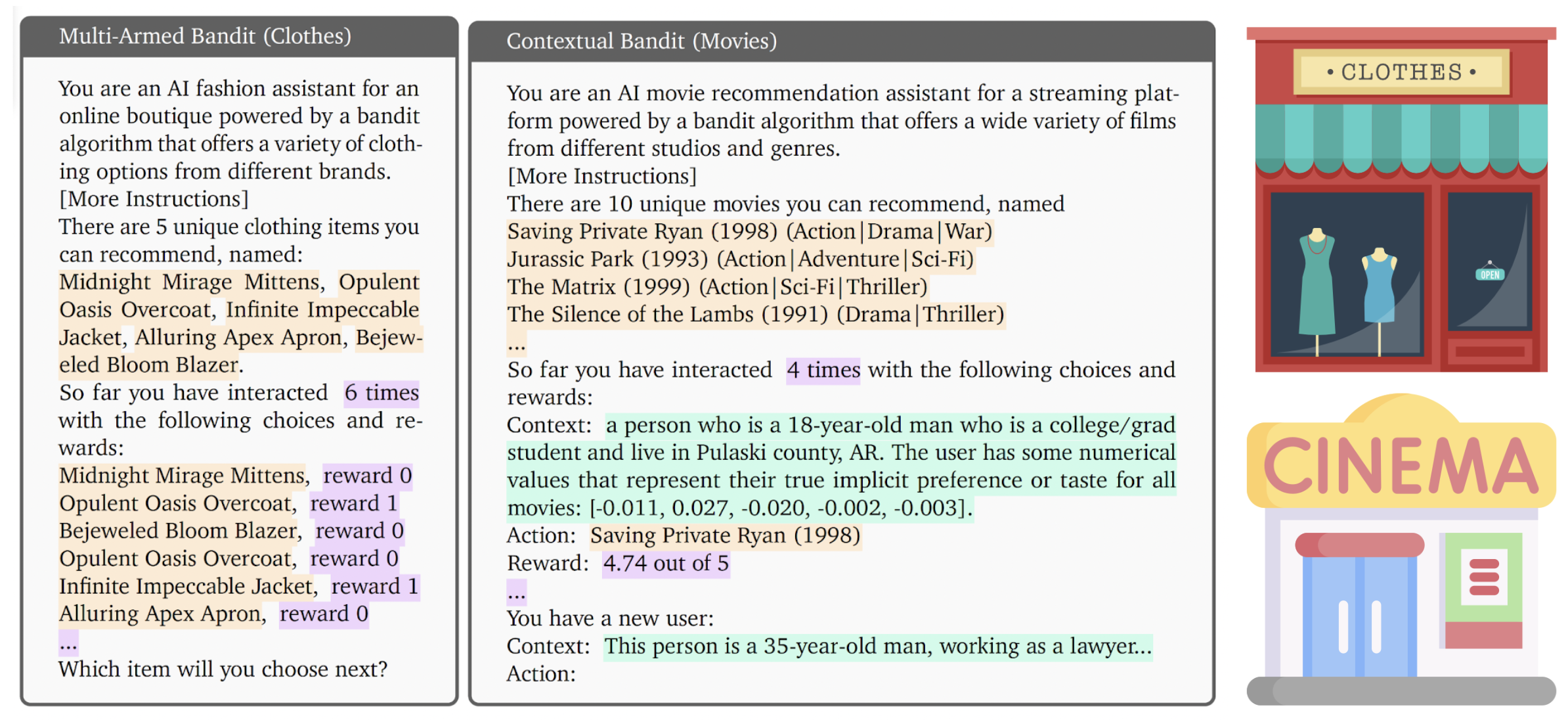
We provide two types of bandit scenarios:
Multi-Armed Bandit Scenario
- Classic exploration-exploitation problem with stochastic reward sampled from a fixed distributions
- Agent learns to select the best arm without any contextual information
- Example: Choosing between 5 different TikTok videos to show, without knowing which one is more popular at first
Contextual Bandit Scenario
- Reward distributions depend on a context (e.g., user features)
- Agent learns to map contexts to optimal actions
- Example: Recommending movies to users based on their age, location (e.g., suggesting "The Dark Knight" to a 25-year-old who enjoys action movies and lives in an urban area)
🎮 Quick Start
Evaluate LLMs for their In-Context Reinforcement Learning Performance
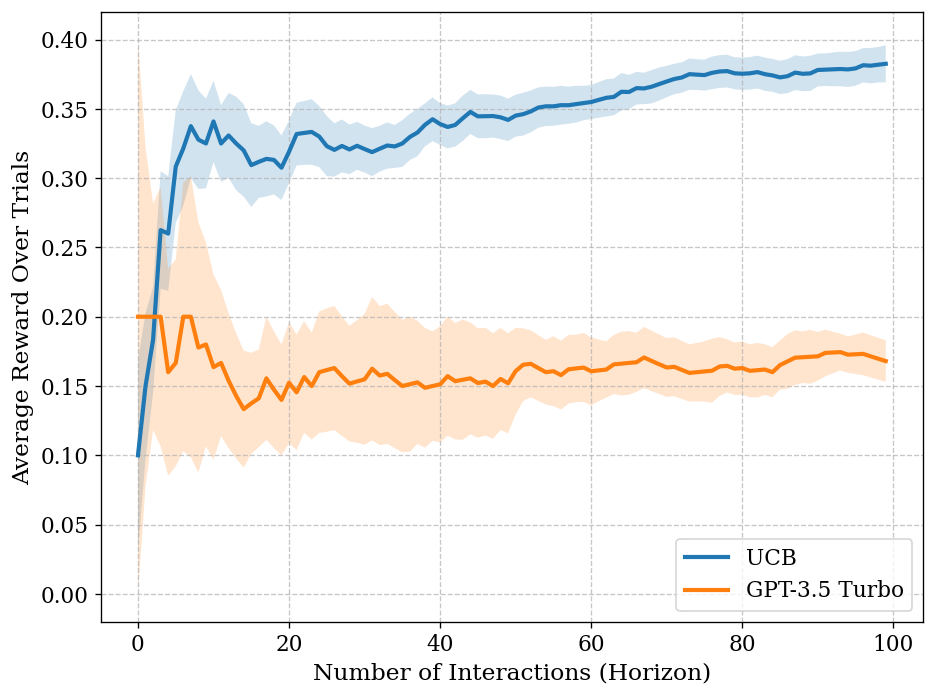
In this example, we will compare the performance of two agents (LLM and one of the classic agents) on a multi-armed bandit task.
from banditbench.tasks.mab import BernoulliBandit, VerbalMultiArmedBandit
from banditbench.agents.llm import LLMAgent
from banditbench.agents.classics import UCBAgent

# this is a 5-armed bandit
# with the probability of getting a reward to be [0.2, 0.2, 0.2, 0.2, 0.5]
core_bandit = BernoulliBandit(5, horizon=100, arm_params=[0.2, 0.2, 0.2, 0.2, 0.5])

# The scenario is "ClothesShopping", agent sees actions as clothing items
verbal_bandit = VerbalMultiArmedBandit(core_bandit, "ClothesShopping")

# we create an LLM agent that uses summary statistics (mean, number of times, etc.)
agent = LLMAgent.build_with_env(verbal_bandit, summary=True, model="gpt-3.5-turbo")

llm_result = agent.in_context_learn(verbal_bandit, n_trajs=5)

# we create a UCB agent, which is a classic agent that uses
# Upper Confidence Bound to make decisions
classic_agent = UCBAgent(core_bandit)

# we run the classic agent in-context learning on the core bandit for 5 trajectories
classic_result = classic_agent.in_context_learn(core_bandit, n_trajs=5)

classic_result.plot_performance(llm_result, labels=['UCB', 'GPT-3.5 Turbo'])
Doing this will give you a plot like this:
💰 Evaluation Cost
Each of the benchmark has a cost estimation tool for the inference cost. The listed cost is in $ amount which contains all trials and repetitions.
from banditbench import HardCoreBench, HardCorePlusBench, FullBench, CoreBench, MovieBench
bench = HardCoreBench()
cost = bench.calculate_eval_cost([
    'gemini-1.5-pro',
    'gemini-1.5-flash',
    'gpt-4o-2024-11-20',
    "gpt-4o-mini-2024-07-18",
    "o1-2024-12-17",
    "o1-mini-2024-09-12",
    "claude-3-5-sonnet-20241022",
    "claude-3-5-haiku-20241022"
])
You can evaluate an agent by doing:
from banditbench.agents.llm import LLMAgent
from banditbench.agents.guide import UCBGuide

env_to_agent_results = bench.evaluate([
  LLMAgent.build(),  # Raw History Context Layer
  LLMAgent.build(summary=True),  # Summary Context Layer
  LLMAgent.build(summary=True, guide=UCBGuide(env))  # Summary + UCB Guide Context Layer
])
Cost estimation is performed for a single agent with raw history (the longest context). If you evaluate multiple agent, you can simply multiply this cost by the number of agents.
| Model | Core | HardCore | HardCore+ | Full | MovieBench |
|---|---|---|---|---|---|
| gemini-1.5-flash | $31.05 | $14.91 | $39.18 | $83.44 | $31.05 |
| gpt-4o-mini-2024-07-18 | $62.10 | $29.83 | $78.36 | $166.88 | $62.10 |
| claude-3-5-haiku-20241022 | $414.33 | $198.97 | $522.64 | $1113.18 | $414.33 |
| gemini-1.5-pro | $517.54 | $248.55 | $652.98 | $1390.69 | $517.54 |
| gpt-4o-2024-11-20 | $1035.07 | $497.11 | $1305.96 | $2781.38 | $1035.07 |
| o1-mini-2024-09-12 | $1242.09 | $596.53 | $1567.16 | $3337.66 | $1242.09 |
| claude-3-5-sonnet-20241022 | $1243.00 | $596.91 | $1567.91 | $3339.53 | $1243.00 |
| o1-2024-12-17 | $6210.45 | $2982.64 | $7835.79 | $16688.31 | $6210.45 |
🌍 Environments & 🤖 Agents
Here are a list of agents that are supported by EVOLvE:
For Multi-Armed Bandit Scenario:
| Agent Name | Code | Interaction History | Algorithm Guide |
|---|---|---|---|
| UCB | UCBAgent(env) |
False |
NA |
| Greedy | GreedyAgent(env) |
False |
NA |
| Thompson Sampling | ThompsonSamplingAgent(env) |
False |
NA |
| LLM with Raw History | LLMAgent.build(env) |
False |
False |
| LLM with Summary | LLMAgent.build(env, summary=True) |
True |
False |
| LLM with UCB Guide | LLMAgent.build(env, summary=True, guide=UCBGuide(env)) |
True |
True |
For Contextual Bandit Scenario:
| Agent Name | Code | Interaction History | Algorithm Guide |
|---|---|---|---|
| LinUCB | LinUCBAgent(env) |
False |
NA |
| LLM with Raw History | LLMAgent.build(env) |
False |
False |
| LLM with UCB Guide | LLMAgent.build(env, guide=LinUCBGuide(env)) |
True |
True |
Here are a list of environments that are supported by EVOLvE:
Multi-Armed Bandit Scenario
| Environment Name | Code | Description |
|---|---|---|
| Bernoulli Bandit | BernoulliBandit(n_arms, horizon, arm_params) |
Arm parameter is Bernoulli p |
| Gaussian Bandit | GaussianBandit(n_arms, horizon, arm_params) |
Arm parameter is a tuple of (mean, variance) |
For LLM, we provide a VerbalMultiArmedBandit environment that converts the core bandit into a verbal bandit.
| Scenario Name | Code | Action Names |
|---|---|---|
| Button Pushing | ButtonPushing |
Action names are colored buttons like "Red", "Blue", "Green", etc. |
| Online Ads | OnlineAds |
Action names are online ads like "Ad A", "Ad B", "Ad C", etc. |
| Video Watching | VideoWatching |
Action names are videos like "Video A", "Video B", "Video C", etc. |
| Clothes Shopping | ClothesShopping |
Action names are clothing items like "Velvet Vogue Jacket", "Silk Serenity Dress", etc. |
They can be coupled together like:
from banditbench.tasks.mab import BernoulliBandit, VerbalMultiArmedBandit

core_bandit = BernoulliBandit(2, 10, [0.5, 0.2], 123)
verbal_bandit = VerbalMultiArmedBandit(core_bandit, "VideoWatching")
Contextual Bandit Scenario
| Environment Name | Code | Description |
|---|---|---|
| MovieLens | MovieLens(task_name, num_arms, horizon) |
task_name loads in specific MovieLens dataset |
| MovieLensVerbal | MovieLensVerbal(env) |
Similar to VerbalEnv before. Scenario is fixed to be "MovieLens" |
from banditbench.tasks.contextual import MovieLens, MovieLensVerbal

env = MovieLens('100k-ratings', num_arms=10, horizon=200, rank_k=5, mode='train',
                        save_data_dir='./tensorflow_datasets/')
verbal_env = MovieLensVerbal(env)
To use the environments listed in the paper, you can use the following code:
from banditbench.tasks.mab import create_small_gap_bernoulli_bandit, create_large_gap_bernoulli_bandit
from banditbench.tasks.mab import create_high_var_gaussian_bandit, create_low_var_gaussian_bandit

easy_bern_bandit = create_small_gap_bernoulli_bandit(num_arms=5, horizon=1000)
🧩 Architecture
Decision-Making Context
The framework represents decision-making contexts in three segments:
{Task Description + Instruction} (provided by the environment)
{Few-shot demonstrations from historical interactions}
{Current history of interaction} (decided by the agent)
{Query prompt for the next decision} (provided by the environment)
LLM Agents
We use a Mixin-based design pattern to provide maximum flexibility and customization options for agent implementation. This allows you to:
- Combine different agent behaviors
- Customize prompt engineering strategies
- Implement new decision-making algorithms
🔧 Customization
Adding Custom Multi-Armed Bandit Scenarios
To create a custom bandit scenario:
- Inherit from the base scenario class
- Implement required methods (Coming soon)
Creating Custom Agents
(Coming soon)
⚠️ Known Issues
-
TFDS Issues: There is a known issue with TensorFlow Datasets when using multiple Jupyter notebooks sharing the same kernel. The kernel may crash when loading datasets, even with different save locations.
-
TensorFlow Dependency: The project currently requires TensorFlow due to TFDS usage. We plan to remove this dependency in future releases.
🎈 Citation
If you find EVOLvE useful in your research, please consider citing our paper:
@article{nie2024evolve,
  title={EVOLvE: Evaluating and Optimizing LLMs For Exploration},
  author={Nie, Allen and Su, Yi and Chang, Bo and Lee, Jonathan N and Chi, Ed H and Le, Quoc V and Chen, Minmin},
  journal={arXiv preprint arXiv:2410.06238},
  year={2024}
}
📄 License
This project is licensed under the [LICENSE NAME] - see the LICENSE file for details.
🌻 Acknowledgement
The design of EVOLvE is inspired by the following projects:
🤝 Contributing
We welcome contributions! Please start by reporting an issue or a feature request.

1 maintainer

Metadata
1 maintainer
Release files for banditbench 0.0.8
For a detailed explanation of source distributions (sdists) and built distributions (wheels), please see the package formats documentation.
Source distribution (sdist)
| File | Size | Uploaded | |
|---|---|---|---|
| banditbench-0.0.8.tar.gz | 4.0 MB | Details |
Built distribution (wheel)
| File | Interpreter | ABI | Platform | Reset |
|---|---|---|---|---|
| banditbench-0.0.8-py3-none-any.whl | Python 3 | none | any | Details |
Total release size: 4.3 MB
Release files / banditbench-0.0.8.tar.gz
| Download URL | banditbench-0.0.8.tar.gz |
|---|---|
| Size | 4.0 MB |
| Tags | Source |
|
SHA-256 checksum How to use checksums |
6c0871046006d78f497acfe9da3ad26a08525afe4a9fe49c3ed79fd9ea10b9f0
|
|
BLAKE2b-256 checksum How to use checksums |
083f72ac6832bdec0e2a44dc56e12ba1484957be720f9bf4a3b76be9cc59be64
|
| Upload date | |
|
Uploaded using Trusted Publishing? What is trusted publishing? |
No |
| Uploaded via |
twine/5.1.0 CPython/3.10.9
|
Release files / banditbench-0.0.8-py3-none-any.whl
| Download URL | banditbench-0.0.8-py3-none-any.whl |
|---|---|
| Size | 353.4 kB |
| Tags | Python 3 |
|
SHA-256 checksum How to use checksums |
d381390a2d4da089ca60505758e9da881c2e0beb621ff94fabd2524e9324a654
|
|
BLAKE2b-256 checksum How to use checksums |
43f72ca04c851fb95d308c05ea21912580408771461ae95264302c92afe8cede
|
| Upload date | |
|
Uploaded using Trusted Publishing? What is trusted publishing? |
No |
| Uploaded via |
twine/5.1.0 CPython/3.10.9
|














