
Minimal agent framework. Explicit state, policy-first tools, honest uncertainty.

Project description
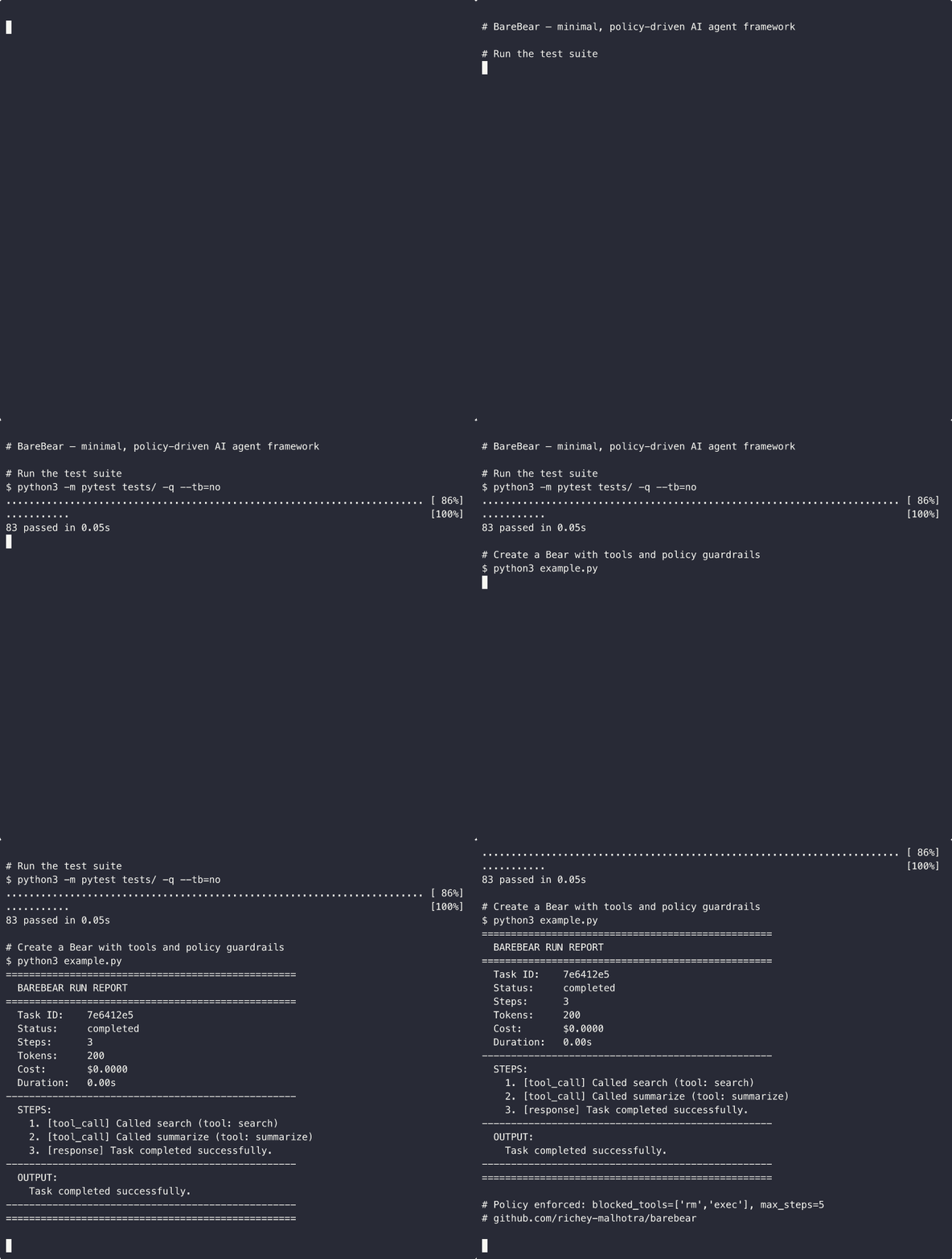
Every step leaves a print.
Minimal agent framework. Explicit state, policy-first tools, honest uncertainty.


What is BareBear?
BareBear is a Python framework for building LLM agents that you can actually trust in production. It gives you 7 primitives, a policy engine, and a run receipt — nothing else. Every tool call is checked against policy before execution. Every run produces a traceable report. The agent knows what it doesn't know, and tells you.
Why?
Most agent frameworks give you magic orchestration, invisible state, and tools that fire without guardrails. That works great in demos. It falls apart when a customer asks why the agent sent that email, or when your bill spikes because the loop ran 200 steps.
BareBear is built on different assumptions:
- Tools are dangerous. Every tool declares its risk level and side effects. Policy checks happen before execution, not after.
- State should be visible. No hidden memory, no magic context. State is a dict you can inspect, snapshot, and diff.
- Autonomy needs bounds. Step limits, cost caps, token budgets, approval gates — all declared upfront in policy.
- Runs should be receipts. Every run produces a
Reportwith steps, costs, assumptions, and uncertainties. You can audit it, log it, replay it. - Uncertainty is data, not a bug. If the agent isn't sure, it says so. Assumptions are tracked explicitly.
Quickstart
pip install barebear
from barebear import Bear, Task, Policy, Tool, MockModel

def greet(name: str) -> str:
    return f"Hello, {name}!"

bear = Bear(
    model=MockModel(),
    tools=[Tool("greet", fn=greet, description="Greet someone by name")],
    policy=Policy(max_steps=5, max_cost_usd=0.05),
)

result = bear.run(Task(goal="Greet the user Alice"))
print(result.summary())
==================================================
  BAREBEAR RUN REPORT
==================================================
  Task ID:    a1b2c3d4
  Status:     completed
  Steps:      2
  Tokens:     160
  Cost:       $0.0000
  Duration:   0.00s
--------------------------------------------------
  STEPS:
    1. [tool_call] Called greet (tool: greet)
    2. [response] Task completed successfully.
--------------------------------------------------
==================================================
No API key needed — MockModel auto-calls available tools and produces a final response. Swap in OpenAIModel("gpt-4o-mini") or OpenRouterModel("meta-llama/llama-4-scout") when you're ready for the real thing.
The 7 Primitives
| Primitive | What it does |
|---|---|
| Bear | The agent. Holds model, tools, policy, state. Runs tasks. |
| Task | A unit of work: a goal string, input dict, optional context. |
| State | Explicit key-value store with snapshot history and change tracking. |
| Tool | A callable with declared risk, side effects, and approval requirements. |
| Policy | Constraints: step limits, cost caps, blocked tools, approval lists. |
| Checkpoint | A saved pause-point for human approval before high-risk actions. |
| Report | The run receipt: every step, token count, cost, assumptions, uncertainties. |
That's it. No chains, no graphs, no planners, no routers. Just the bones.
Features
Policy-first tool execution
Every tool call passes through policy before it runs. Block tools, require approval, or reject external side effects — all in one declaration.
policy = Policy(
    max_steps=10,
    blocked_tools=["delete_account"],
    require_approval_for=["send_email"],
    allow_external_side_effects=False,
)
Budget tracking
Step counts, tool calls, token usage, and dollar cost — all tracked against limits you set. If a run hits its budget, it stops cleanly with a budget_exceeded status.
policy = Policy(max_steps=8, max_cost_usd=0.10, max_tokens=50000)
Checkpoint / approval gates
High-risk tools pause the run and create a Checkpoint. You approve or reject, then resume.
bear = Bear(
    model=model,
    tools=[
        Tool("send_email", fn=send_email, risk="high",
             side_effects="external", requires_approval=True),
    ],
    policy=Policy(require_approval_for=["send_email"]),
)

result = bear.run(task)

if result.status == "paused":
    checkpoint = bear.checkpoints.get(result.checkpoint_id)
    result = bear.resume(checkpoint, approved=True)
Side-effect staging
Tools declare side_effects="none", "internal", or "external". Policy can block external side effects entirely, so your agent can propose actions without executing them.
Tool("propose_patch", fn=propose, description="Suggest a code change",
     side_effects="none")
Tool("apply_patch", fn=apply, description="Apply the change",
     side_effects="external")
Run receipts
Every bear.run() returns a Report — a full trace you can print, serialise to JSON, or store for auditing.
result = bear.run(task)

print(result.summary())       # human-readable receipt
print(result.to_json())       # full JSON trace
print(result.total_cost_usd)  # what it cost
print(result.steps)            # list of every step taken
Honest uncertainty
Bears track what they don't know. Assumptions and missing information are first-class data in the report, not buried in log noise.
result = bear.run(task)
print(result.assumptions)     # ["Customer tier assumed from email domain"]
print(result.uncertainties)   # ["Could not verify account status"]
Examples
All examples run with MockModel by default — no API keys needed. Pass --live to use OpenAI.
export PYTHONPATH=src
| Example | What it shows | Run it |
|---|---|---|
| Research Assistant | Tool use, multi-step reasoning, report generation | python examples/research_assistant/run.py |
| Email Approval | requires_approval, checkpoint gates, side-effect policy |
python examples/email_approval/run.py |
| File Patcher | Side-effect staging (propose allowed, apply blocked) | python examples/file_patcher/run.py |
| Ticket Triage | Multi-step classification, budget tracking across calls | python examples/ticket_triage/run.py |
Architecture
┌─────────────────────────────────────────────────┐
│                   bear.run(task)                 │
├─────────────────────────────────────────────────┤
│                                                 │
│   Task ──► System Prompt + User Message         │
│                     │                           │
│                     ▼                           │
│              ┌─────────────┐                    │
│              │  Run Loop   │◄── Budget check    │
│              └──────┬──────┘    each step       │
│                     │                           │
│          ┌──────────┴──────────┐                │
│          ▼                     ▼                │
│     Text response         Tool calls            │
│     ──► Report            ──► Policy check      │
│                               │                 │
│                    ┌──────────┼──────────┐      │
│                    ▼          ▼          ▼      │
│                 Allowed    Blocked    Approval   │
│                 ──► Execute ──► Skip  ──► Pause  │
│                     │                    │      │
│                     ▼                    ▼      │
│                Tool result          Checkpoint   │
│                ──► Loop              (resume)    │
│                                                 │
├─────────────────────────────────────────────────┤
│  State (explicit, snapshotable, diffable)       │
│  Budget (steps, tokens, cost — all tracked)     │
│  Report (full receipt of everything that happened)│
└─────────────────────────────────────────────────┘
See docs/architecture.md for the full breakdown.
Philosophy
Most frameworks optimise for demos. BareBear optimises for reality.
Read the manifesto.
Contributing
See CONTRIBUTING.md. We welcome PRs, bug reports, and honest feedback.
License
MIT — Richey Malhotra, 2026.
Release history Release notifications | RSS feed


Download files
Download the file for your platform. If you're not sure which to choose, learn more about installing packages.
Source Distribution
Built Distribution
Filter files by name, interpreter, ABI, and platform.
If you're not sure about the file name format, learn more about wheel file names.
Copy a direct link to the current filters
File details
Details for the file barebear-0.1.1.tar.gz.
File metadata
- Download URL: barebear-0.1.1.tar.gz
- Upload date:
- Size: 899.7 kB
- Tags: Source
- Uploaded using Trusted Publishing? No
- Uploaded via: twine/6.2.0 CPython/3.9.6
File hashes
| Algorithm | Hash digest | |
|---|---|---|
| SHA256 |
c53403dfd43bb9ae1fc780797769b658b630e9a78a0eee098ec3b5775a220162
|
|
| MD5 |
06252a4a079eaac45e11b4303fd0b4ad
|
|
| BLAKE2b-256 |
5ed67ab0baa6e02e316d9266b203683229c0b2830f6b05f6df8b2096c955b694
|
File details
Details for the file barebear-0.1.1-py3-none-any.whl.
File metadata
- Download URL: barebear-0.1.1-py3-none-any.whl
- Upload date:
- Size: 23.3 kB
- Tags: Python 3
- Uploaded using Trusted Publishing? No
- Uploaded via: twine/6.2.0 CPython/3.9.6
File hashes
| Algorithm | Hash digest | |
|---|---|---|
| SHA256 |
36aa478afec6fb925e4ef7813e7e451076669805a782c85be9b5e3c9fdbdfa8d
|
|
| MD5 |
147eef3f61425435e9f03f7d80908d86
|
|
| BLAKE2b-256 |
e3af3bfeb5bb9a1d8d6ca2054a9c0121de871dc582df63460131032a476d0923
|






