
BatchLens Bio
Experimental-design and batch-confounding audits for single-cell and spatial metadata.
BatchLens checks declared experimental units, target-by-batch coverage and whether a specific contrast is estimable under an additive fixed-effects model. It produces an offline HTML report, JSON findings and auditable tables. It never fits or corrects expression data.
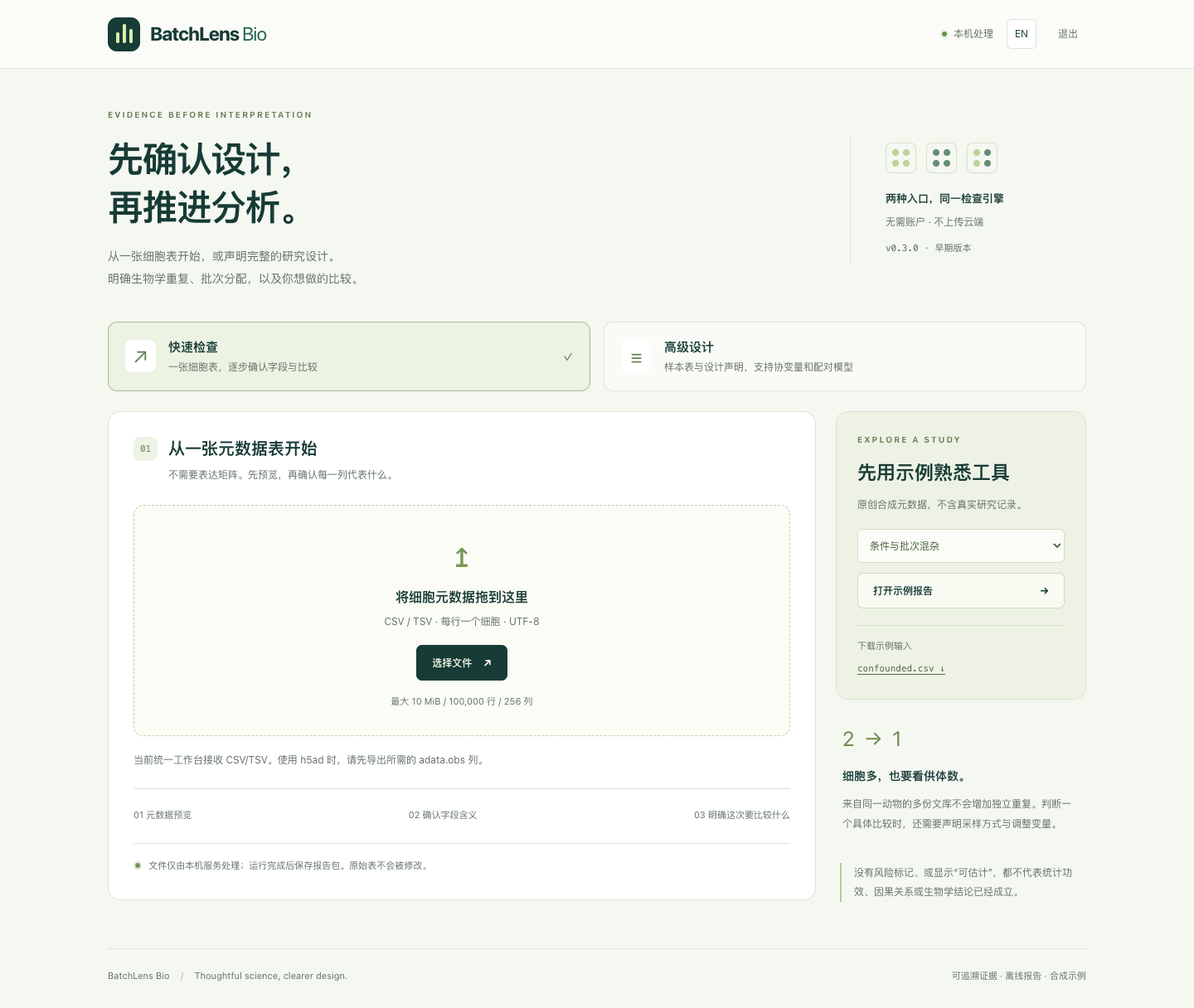
0.3.0 unified workbench: start with a cell metadata table or an explicit samples/YAML design. Both paths use the same audit engine, with Chinese/English interfaces and offline reports. Migration and scope.
GitHub Releases · PyPI · Browser / desktop guide
Why another tool?
Keep using scIB/kBET/LISI for integration evaluation. Good embedding mixing cannot recover information absent from an experimental design. If D0 samples were processed only in run A and D7 only in run B, time + run cannot distinguish the time effect from run.
BatchQC and ExploreModelMatrix already provide valuable confounding/design diagnostics. BatchLens offers a narrowly scoped CLI, local browser UI and desktop app that connects experimental-unit checks, explicit contrasts, machine-readable findings and offline delivery. It is a workflow tool using established linear algebra, not a new statistical method. See competitor research.
Open the unified workbench
With Python 3.12 or 3.13, install the release:
python -m pip install "batchlens-bio==0.3.0"
batchlens serve
For a source checkout or development branch, use python -m pip install . instead.
Choose a synthetic example to see a report immediately, with no private data. The interface starts in Chinese; EN switches to English without rerunning the audit.
| Entry | Start with | Confirm |
|---|---|---|
| Quick check | One cell-level CSV/TSV | Five column roles, comparison direction, sampling structure and coverage thresholds |
| Advanced design | Samples CSV/TSV + design YAML | Explicit contrasts, categorical/numeric covariates, independent or paired model; optional observations/assays |
Quick mode previews metadata and can convert it into standard advanced inputs. Both paths call the same contrast engine. Quick mode includes three original synthetic cell tables; advanced mode keeps all seven existing scenarios. Quick workflow and boundaries.
Files stay on your computer. Raw uploads remain in memory; completed reports are saved under ~/BatchLens Audits. Download either language's HTML, the canonical JSON or a ZIP containing both reports, tables and hashes. No account, cloud upload or expression matrix is needed.
Desktop: choose the Mac Apple Silicon, Intel Mac or Windows x64 installer from GitHub Releases. Python and dependencies are included. Version 0.3.0 uses this unified interface; v0.2.0 installers retain the earlier advanced interface. See platform evidence and alpha signing status.
CLI remains available:
batchlens demo --case balanced --out demo-balanced
batchlens demo --case confounded-time --out demo-confounded --language zh --fail-on none
The second example deliberately shows NON_ESTIMABLE; exit-policy selection does not hide findings. Each output path must be new and have an existing parent. Other advanced examples: partial-overlap, redundant-nuisance, paired, spatial-replicates, mixed-assays.
New Chinese quick report · English report · Public spatial example
Your metadata
Prepare a CSV/TSV with one row per sample and a YAML design declaration. IDs are strings; declare the true experimental unit rather than assuming every cell or spot is independent.
batchlens validate --samples samples.tsv --design design.yaml
batchlens audit --samples samples.tsv --design design.yaml --out audit-001
batchlens audit --samples samples.tsv --design design.yaml \
  --observations cells.tsv --assays assays.tsv --out audit-002
The input guide specifies columns and includes a complete configuration. Export only metadata from your analysis environment; h5ad, expression matrices and spatial images are not required or read.
Understand the result
| Contrast status | Meaning |
|---|---|
ESTIMABLE |
Algebraically estimable under the declared model; not a power, biological validity or causality pass |
NON_ESTIMABLE |
The requested contrast cannot be uniquely determined under that model |
NOT_ASSESSED |
Sampling structure is outside the supported independent/paired model; descriptive checks still run |
Rank deficiency does not necessarily invalidate every contrast. Partial target-by-batch overlap is not automatically complete confounding. More cells or technical sections do not create more experimental units. See methods and interpretation.
Output and automation
report.html: selected language, self-contained;report.en.htmlandreport.zh.htmlare always included. No network or JavaScript required.result.json: canonical English keys/rule IDs/text, output schema and ruleset 1.1; design YAML remains schema 1.0. Addscell_supportand optional quickinput_adapter.tables/*.tsv: sample/unit coverage, annotation summaries and optionalcell_support.tsv.manifest.json: input/output SHA256 hashes, environment and dependency versions.COMPLETE: written last; its absence indicates an incomplete bundle.
IDs are replaced with local aliases; labels/design values can still identify people. Review all outputs before sharing. No original ID map, absolute input paths or cell-level rows are exported. TSV formula-like labels are prefixed with an apostrophe for spreadsheet safety; JSON preserves original scientific labels.
Exit codes: 0 completed, 1 internal failure, 2 input/output error, 3 findings exceed policy. --fail-on critical is the default. Use --fail-on warning in strict CI so unsupported models do not pass silently; --fail-on none changes only exit behavior. A successful validate command does not test estimability.
Supported scope
Independent: one sample per declared experimental unit. Paired: one sample at each of two target levels per unit, with an explicit unit block. Categorical target; additive categorical/numeric adjustment. Multi-batch samples and more complex repeated sampling produce NOT_ASSESSED, never silent aggregation. No interaction terms, mixed-effects inference, power analysis, causal inference, spatial correlation test or batch correction.
Metadata-only audits cannot verify randomization, independence or unmeasured confounding. The study specification is supplied by the analyst. Near-singular designs require numerical review. Current resource guard: at most 100,000 samples and 256 encoded columns; this is a safety limit, not a performance guarantee.
Development and verification
uv sync --locked --no-editable
uv run --no-editable pytest
uv run --no-editable ruff check .
uv run --no-editable mypy
uv run --no-editable python -m build
uv run --no-editable twine check dist/*.whl dist/*.tar.gz
The validation record distinguishes executed tests from pending external evidence. R's model.matrix/QR supplies an independent oracle for selected scientific fixtures; see scripts/verify_r_oracle.R. The CI and release workflows validate tests, package installation outside the source directory, and demo output. Remote CI success is claimed only with a recorded run URL.
See CONTRIBUTING.md, CITATION.cff, release checklist and CHANGELOG.md. MIT-licensed code and synthetic examples; public datasets have their own provenance and terms.
Project status and feedback
BatchLens is an exploratory alpha project with completed automated tests and clean-install verification. It still needs evaluation in more real research settings; external user validation and independent scientific review are not yet completed. The validation record documents completed checks and outstanding evidence.
Maintainer: guatou904. Usage feedback, minimal reproducible examples and statistical-method suggestions are welcome via GitHub Issues. Use synthetic inputs and include the software version when reporting installation or scientific issues. The next iteration prioritizes fixes and actual user feedback.
1 maintainer

Metadata
1 maintainer
Release files for batchlens-bio 0.3.0
For a detailed explanation of source distributions (sdists) and built distributions (wheels), please see the package formats documentation.
Source distribution (sdist)
| File | Size | Uploaded | |
|---|---|---|---|
| batchlens_bio-0.3.0.tar.gz | 511.3 kB | Details |
Built distribution (wheel)
| File | Interpreter | ABI | Platform | Reset |
|---|---|---|---|---|
| batchlens_bio-0.3.0-py3-none-any.whl | Python 3 | none | any | Details |
Total release size: 593.1 kB
Release files / batchlens_bio-0.3.0.tar.gz
| Download URL | batchlens_bio-0.3.0.tar.gz |
|---|---|
| Size | 511.3 kB |
| Tags | Source |
|
SHA-256 checksum How to use checksums |
7faa6e79bbdc78b024347e1a90618655ee7d6fe1473cee4e60428b91fe941d31
|
|
BLAKE2b-256 checksum How to use checksums |
895dc073383d9664a0911b1f13d22b3f86ac2151bb2d102888e1c551e6de3ae2
|
| Upload date | |
|
Uploaded using Trusted Publishing? What is trusted publishing? |
Yes |
| Uploaded via |
twine/7.0.0 CPython/3.13.14
|
Provenance
Provenance describes where a file came from. On PyPI, provenance is shared via attestations, which provide a verifiable record of the build or publishing details. View details, limitations and caveats.


PyPI Publish Attestation
PyPI verified that this artifact, at this checksum, originated from the publisher listed below.
Signed by GitHub Actions, verified by PyPI on Sep 21, 2026.
Transparency logRelease files / batchlens_bio-0.3.0-py3-none-any.whl
| Download URL | batchlens_bio-0.3.0-py3-none-any.whl |
|---|---|
| Size | 81.8 kB |
| Tags | Python 3 |
|
SHA-256 checksum How to use checksums |
b128b19d4b6d593281befe0cd88b5786ecfc8f5132ef33c386f99a293af97c0a
|
|
BLAKE2b-256 checksum How to use checksums |
47aba9b5215d3f6d86b50c3023d9acf0adfea35e8715e082f18bf087b96a8eda
|
| Upload date | |
|
Uploaded using Trusted Publishing? What is trusted publishing? |
Yes |
| Uploaded via |
twine/7.0.0 CPython/3.13.14
|
Provenance
Provenance describes where a file came from. On PyPI, provenance is shared via attestations, which provide a verifiable record of the build or publishing details. View details, limitations and caveats.
PyPI Publish Attestation
PyPI verified that this artifact, at this checksum, originated from the publisher listed below.
Signed by GitHub Actions, verified by PyPI on Sep 21, 2026.
Transparency log













