
beamfeat






beamfeat builds readable formulas from the columns of a table, such as
(x0 / x2) * x1 or log(a) * log(b), tests each against the null
hypothesis that it is independent of the target, and keeps only those whose
null is rejected, with a stated false-discovery-rate guarantee. The result is
a short equation in your own column names, from a scikit-learn estimator you
can fit, inspect and predict with. The method is described in a
TMLR 2026 paper.
An example: fat content from a spectrum
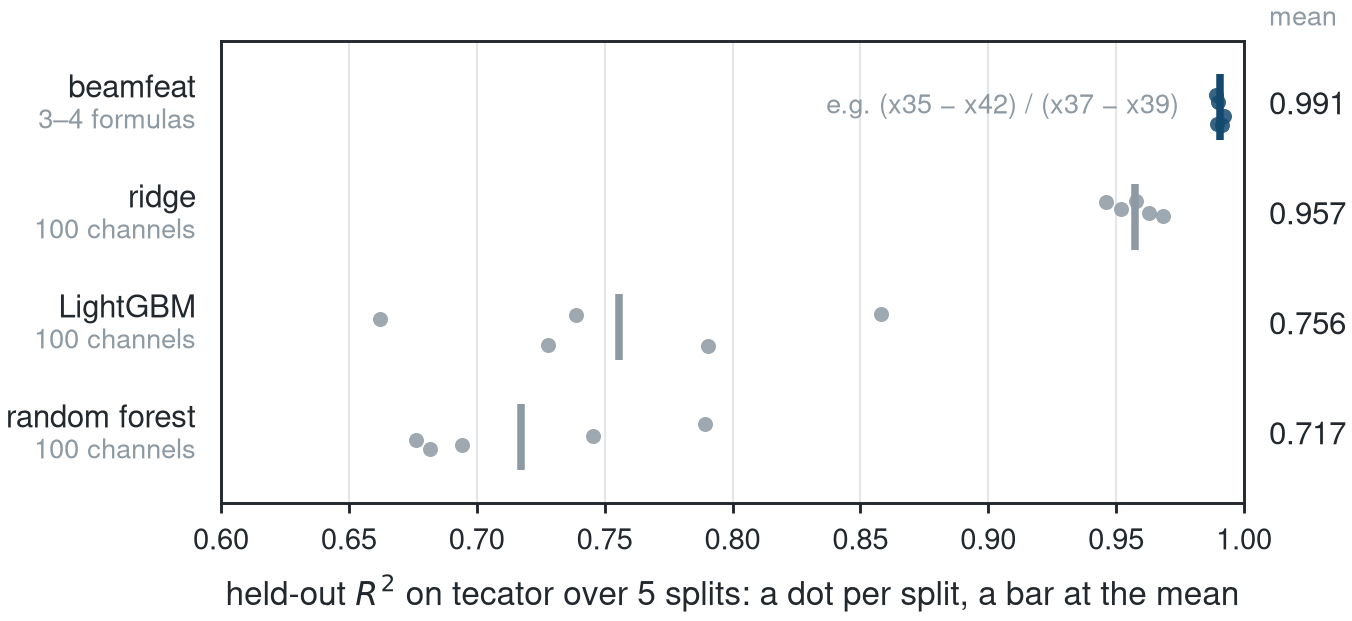
In the tecator data, the task is to predict the fat content of meat samples
from 100 near-infrared absorbance channels. Over five random 75/25 splits,
beamfeat's equation uses three or four formulas, mostly ratios of channel
differences such as ((x35 - x42) / (x37 - x39)), and reaches a mean
held-out R² of 0.991. On all 100 channels, ridge regression reaches 0.957, a
random forest 0.717 and LightGBM 0.756. A random forest given the formulas in
place of the raw channels goes from 0.739 to 0.992, on three of the five
splits.
The accuracy is stable from split to split; which ratios are picked is not.
Neighbouring channels correlate at 0.99988, so many ratios are nearly
interchangeable, and each split settles on its own. stability_report
measures this on any data: it refits on many random splits and counts the
distinct equations.
The numbers are the paper's (Table 6 and its appendices), from the archived
run in benchmarks/additional_experiments/;
benchmarks/figures/tecator.py
draws the plot. The Benchmarks
page has all nine datasets of that study, including those where beamfeat
trails.
Install
pip install beamfeat              # core: numpy, scikit-learn, joblib
pip install "beamfeat[units]"     # + pint, for units
pip install "beamfeat[display]"   # + sympy, for to_sympy() and latex()
pip install "beamfeat[all]"       # + both, pandas and the test dependencies
Python 3.10 or newer, with no upper version pins: the 965 tests pass on Python 3.10 to 3.15 with the newest releases each supports, and the suite runs on the oldest supported stack too. Installation lists the versions, and how to run the tests or reproduce the benchmarks.
It fits like any scikit-learn estimator:
from beamfeat import BeamFeatRegressor

model = BeamFeatRegressor().fit(X, y)

model.formulas()        # ['((x0 / x2) * x1)', ...]
model.equation()        # 'y = 0.9847*((x0 / x2) * x1) + ...'
model.fdr_controlled_   # True: the features carry the stated FDR guarantee
model.predict(X_new)
What you get
- Readable formulas.
formulas()lists the features, andequation()prints the fitted model in your column names. - The equation at every size.
equations()lists one equation per number of terms, with the R² each term adds. - LaTeX and SymPy.
latex()typesets the equation, andto_sympy()hands the features to SymPy, and from there to NumPy, JAX or PyTorch. - Units. Give the columns units, as strings such as
"kg"or as pint quantities, and dimensionally invalid expressions are never built. - A guarantee code can check.
fdr_controlled_says whether the features carry the guarantee, andfdr_scope_whether it covers the printed equation or the larger certified set the equation was drawn from. - Fitted constants. Expressions can carry one constant fitted inside
them, such as
exp(a*x)and1/(x + a), which recovers laws likeexp(-x^2/2)exactly. On by default;fitted_ops=()turns it off. - Hidden building blocks, opt in.
magnitude_slotskeeps a few beam places for parts whose size tracks the target's even when they do not correlate with it, such asx0andx1iny = x0*x1with centred inputs. - Every column in a formula tested, opt in.
input_test=Truetests each column inside each formula, and drops a formula when the test fails to reject the null for one of its columns, such asx6in(x0 * x1) / (x0 + x6). - Stability.
stability_reportrefits on many splits and shows whether the equation is the only good one or one of many.
The guarantee
The search runs on half of the training rows. On the other half, each formula
it returns is tested against the null hypothesis that it is independent of
the target, with a permutation test and the Benjamini–Yekutieli correction.
The formulas whose nulls are rejected are the certified set, and on average
at most 10% of them are false discoveries (target_fdr). That is an average
over repeated fits, not a promise about any one fit, and it covers the
certified set, of which the printed equation is by default a compact subset.
If no null is rejected, the model uses no formulas and warns.
Statistical guarantees
gives each procedure's assumptions and what was measured.
Documentation
- User guide: fitting, reading and exporting an equation.
- Tutorials: four notebooks, from a first fit to reading one in detail.
- Benchmarks: every measured result, with the scripts and archived runs behind it.
- Migrating from autofeat: the API mapping and the differences to expect.
- API reference.
Citing
If you use beamfeat, please cite the paper:
@article{
daramola2026symbolic,
title={Symbolic feature construction with false discovery rate control},
author={Olanrewaju M. Daramola},
journal={Transactions on Machine Learning Research},
issn={2835-8856},
year={2026},
url={https://openreview.net/forum?id=UibXoy4h3u},
note={}
}
The Zenodo DOIs archive the code, not the paper:
10.5281/zenodo.23417132 is 0.4.2,
the version the paper describes, with the run records behind its results, and
10.5281/zenodo.21619567 collects
every release. CITATION.cff
has the same details in machine-readable form.
Later releases correct two of the paper's results, detailed on the Benchmarks page: a harness bug understated featuretools, and fixing a search bug takes the datasets where beamfeat leads both tree ensembles from five to four.
If you use the selection procedures, please also cite the underlying statistics: Benjamini & Hochberg (1995), Benjamini & Yekutieli (2001), Barber & Candès (2015), Candès et al. (2018), and Phipson & Smyth (2010).
License
MIT.
1 maintainer

Metadata
1 maintainer
Release files for beamfeat 0.6.0
For a detailed explanation of source distributions (sdists) and built distributions (wheels), please see the package formats documentation.
Source distribution (sdist)
| File | Size | Uploaded | Provenance | |
|---|---|---|---|---|
| beamfeat-0.6.0.tar.gz | 568.0 kB | With provenance | Details |
Built distribution (wheel)
| File | Interpreter | ABI | Platform | Reset |
|---|---|---|---|---|
| beamfeat-0.6.0-py3-none-any.whl | Python 3 | none | any | Details |
Total release size: 702.5 kB
Release files / beamfeat-0.6.0.tar.gz
| Download URL | beamfeat-0.6.0.tar.gz |
|---|---|
| Size | 568.0 kB |
| Tags | Source |
|
SHA-256 checksum How to use checksums |
a284b8589fd3ce661a13dea4d0cd0b10d16a153cc30a33be22764f1dcddec3a5
|
|
BLAKE2b-256 checksum How to use checksums |
a6865c2057bb518426a052ec59d907677ecd74f80d4881b6e8ed3147d87fda61
|
| Upload date | |
|
Uploaded using Trusted Publishing? What is trusted publishing? |
Yes |
| Uploaded via |
twine/7.0.0 CPython/3.13.16
|
Provenance
Provenance describes where a file came from. On PyPI, provenance is shared via attestations, which provide a verifiable record of the build or publishing details. View details, limitations and caveats.


PyPI Publish Attestation
PyPI verified that this artifact, at this checksum, originated from the publisher listed below.
Signed by GitHub Actions, verified by PyPI on Oct 24, 2026.
Transparency logRelease files / beamfeat-0.6.0-py3-none-any.whl
| Download URL | beamfeat-0.6.0-py3-none-any.whl |
|---|---|
| Size | 134.5 kB |
| Tags | Python 3 |
|
SHA-256 checksum How to use checksums |
eecc0bdfe16ede8d095e1862e85b15902728bcfb99fd47786b9451a099a55b4c
|
|
BLAKE2b-256 checksum How to use checksums |
c6b9a6392184d82f7e26d519da5264563092daffc04d8b8713fa5bb09c21e2ba
|
| Upload date | |
|
Uploaded using Trusted Publishing? What is trusted publishing? |
Yes |
| Uploaded via |
twine/7.0.0 CPython/3.13.16
|
Provenance
Provenance describes where a file came from. On PyPI, provenance is shared via attestations, which provide a verifiable record of the build or publishing details. View details, limitations and caveats.
PyPI Publish Attestation
PyPI verified that this artifact, at this checksum, originated from the publisher listed below.
Signed by GitHub Actions, verified by PyPI on Oct 24, 2026.
Transparency logSecurity for beamfeat 0.6.0
Provenance
Provenance describes where a file came from. On PyPI, provenance is shared via attestations, which provide a verifiable record of the build or publishing details. View details, limitations and caveats.
Full provenance
All 2 files in this release have been uploaded with provenance metadata.
Attestation for beamfeat-0.6.0.tar.gz
PyPI Publish Attestation
PyPI verified that this artifact, at this checksum, originated from the publisher listed below.
Signed by GitHub Actions, verified by PyPI on Oct 24, 2026.
Transparency logA note on package security
PyPI is a repository for distributing packages, not a service for auditing them. While third-party security researchers and our staff do their best to detect and remove malicious packages, PyPI cannot guarantee the quality, security or suitability of any given package.
To learn more about protecting yourself from malicious actors, visit our package security documentation.














