
best-engine-ai-helper
Pick and pull the best local large language model (LLM) or vision-language model (VLM) for the hardware in the current machine.
The tool detects available memory (Apple Silicon unified pool, NVIDIA VRAM, or system RAM), consults a bundled model catalog, and selects the highest-scoring model that fits within a configurable safety headroom. After selection, it pulls the model via Ollama, runs two quality gates (the Ralph Loop for prose and the Ralph Eyeball Loop for vision), and writes an environment file that downstream projects source to find the chosen model.
The Promise
best-engine-ai-helper is designed to run entirely offline once the weights
are downloaded. Two honest cases:
- Guaranteed local. Hardware detection, model selection, the quality gates, and writing the environment file all run on your machine. No telemetry, no account, no dependency on a cloud service.
- The only caveat: the initial download. The
pullcommand downloads the model weights via Ollama (a normal download from Ollama's servers). After that, everything runs offline. Refreshing the catalog (catalog update) is also online, but optional: the bundled catalog is enough for everyday use.
A minimal browser GUI (best-engine-ai-helper gui) covers the read-only half
of this flow (the hardware snapshot and the task-to-engine recommendation)
without touching the terminal. The page is bilingual: French by default,
English via /gui?lang=en, with a header link to switch. See
GUI.md.
Documentation
Requirements
- Python 3.10 or later
- Ollama (needed for
pull,validate,env; not fordetect,recommend, orreport) - Everything else installs automatically: os-helper (hardware detection),
PyYAML, click, requests, langdetect, and the FastAPI/MCP surfaces
(
fastapi,uvicorn,fastapi-mcp). The CLI, GUI, HTTP API, and MCP server are all part of the default install, nothing extra to opt into. - Optional:
[cloud]for cloud-provider mode (retry, caching, pseudonymization, an OS-keychain fallback for API keys) and[filtered]for real NSFW classifiers (a DistilBERT text model; LAION's CLIP-based image detector, viatransformersfor the CLIP encoder and a bundledonnxruntimemodel for the classifier head). See EXAMPLES.md'sresolve/mode: cloudsection for the full story; both degrade gracefully (a keyword heuristic, or an "unavailable" verdict) when absent, never a hard failure.
Installation
The package is pure Python (Python 3.10+). The only platform-specific pieces
are Python itself and the optional Ollama runtime (needed only for
pull / validate / env, not for detect, recommend, report, the GUI,
or the MCP surface). Pick your OS below.
🍎 macOS
# 1. Python 3.10+ (skip if you already have it: python3 --version)
brew install python

# 2. Install into an isolated virtual environment (recommended)
python3 -m venv .venv
source .venv/bin/activate
pip install --upgrade pip
pip install best-engine-ai-helper

# 3. Optional: Ollama, only if you'll run `pull`
brew install ollama          # then: ollama serve
Hardware detection uses the built-in system_profiler (Apple Silicon unified
memory), so nothing extra is needed.
🐧 Ubuntu / Debian
# 1. Python 3.10+ with venv support
sudo apt update
sudo apt install -y python3 python3-venv python3-pip

# 2. Install into an isolated virtual environment (recommended)
python3 -m venv .venv
source .venv/bin/activate
pip install --upgrade pip
pip install best-engine-ai-helper

# 3. Optional: Ollama, only if you'll run `pull`
curl -fsSL https://ollama.com/install.sh | sh   # then: ollama serve
GPU detection is automatic when the vendor tools are on PATH: nvidia-smi
(ships with the NVIDIA driver) for NVIDIA VRAM, rocm-smi (ROCm stack) for
AMD. With no GPU it falls back to system RAM.
🪟 Windows (PowerShell)
# 1. Python 3.10+ (skip if you already have it: py --version)
winget install Python.Python.3.12

# 2. Install into an isolated virtual environment (recommended)
py -m venv .venv
.\.venv\Scripts\Activate.ps1
python -m pip install --upgrade pip
pip install best-engine-ai-helper

# 3. Optional: Ollama, only if you'll run `pull`
winget install Ollama.Ollama
NVIDIA VRAM is detected via nvidia-smi (installed with the driver).
From source (any OS)
git clone https://github.com/warith-harchaoui/best-engine-ai-helper
cd best-engine-ai-helper
pip install -e .
Verify the install
best-engine-ai-helper --version
best-engine-ai-helper detect     # prints this machine's hardware as JSON
Every command is also available through an argparse twin,
best-engine-ai-helper-argparse (same flags, same output): the suite's
zero-extra-runtime-dependency CLI surface (click is a core dependency here,
so best-engine-ai-helper stays the primary entry point; the argparse twin
is the added surface, not a replacement).
Quick start
# See what hardware this machine has
best-engine-ai-helper detect

# See which models would be selected (no download)
best-engine-ai-helper recommend

# Recommend the best engine(s) for a task, as a report (Markdown + JSON)
best-engine-ai-helper report --task "product descriptions and image-quality checks" --out engine

# Browse the full catalog
best-engine-ai-helper catalog show

# Browse the hardware chip table
best-engine-ai-helper hardware show

# Launch the browser GUI
best-engine-ai-helper gui

# Who's calling what, and at what cost (local SQLite ledger)
best-engine-ai-helper activity
The same /api/system, /api/recommend, and /api/activity endpoints are
also reachable as MCP tools for any MCP-aware agent host:
best-engine-ai-helper-mcp # -> http://127.0.0.1:8000 (MCP at /mcp)
See EXAMPLES.md for runnable recipes with expected output, and GUI.md for the browser GUI.
GUI
best-engine-ai-helper gui serves a single-page browser GUI (FastAPI +
vanilla JS, no build step) at http://127.0.0.1:8000/gui: the same hardware
snapshot as detect, and a task-description box that returns the same
recommendation as report, with no terminal needed. The page is bilingual
(French by default, English at /gui?lang=en), with a header link to switch.
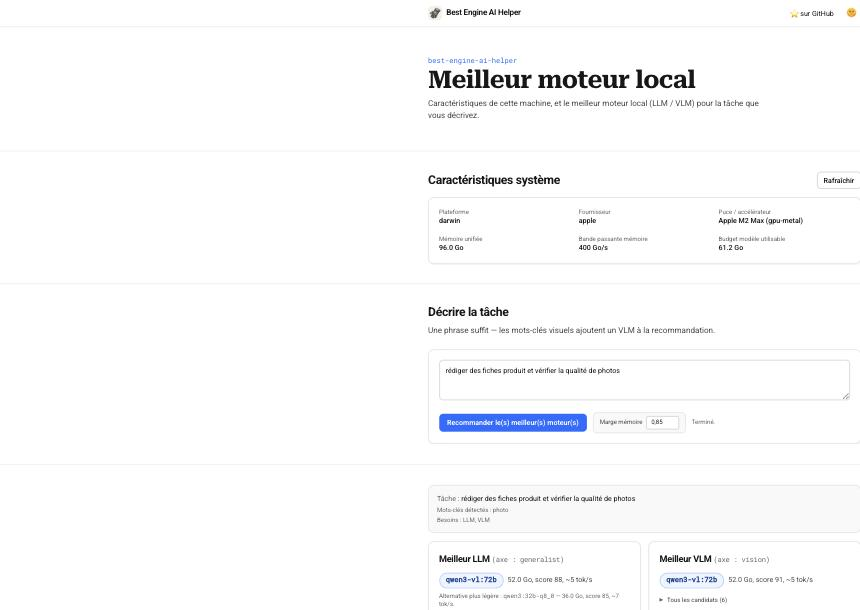
See GUI.md for the full write-up, the JSON API it's built on, and
how the favicon / touch-icon set is generated from assets/logo.png.
Activity ledger
Every llm.chat() call, whether from this tool's own pull/validate gates
or from any downstream project that imports best_engine_ai_helper.llm, can
be recorded to a local, append-only SQLite ledger
(~/.best-engine-ai-helper/usage.db): who called it (BEST_ENGINE_USER env
var, else the OS login name), which model and backend, latency,
success/failure, and an estimated cost for paid backends (always 0.0 for
local Ollama/vLLM). Built for the "one company, several users on a shared
machine" case: answer "who is calling what, how often, at what cost" without
a separate telemetry stack. Local only, no network call, no third-party
service.
best-engine-ai-helper activity              # table
best-engine-ai-helper activity --format json
The CLI, GUI, and MCP server all enable recording by default; opt out with
BEST_ENGINE_NO_LEDGER=1. The GUI's Activity section and GET /api/activity
read the same ledger. See best_engine_ai_helper.observe for the library API
(enable(), as_user(name), Ledger.summary()).
How selection works
Selection weighs four factors, each made explicit in the report output so the
recommendation is reproducible and can be argued with.
1. Structured-output capability (can it be driven by a schema?)
The AI-Helpers suite routes every task through a JSON schema (intent parsing,
edit proposals, visual critique). Some open-weight models cannot honour Ollama's
grammar-constrained structured output and return an empty response under it (the
Qwen3-VL family does this, verified on qwen3-vl:8b). A model marked
structured_output: false in the catalog is never auto-selected, however high
its raw benchmark, and it still appears lower in the ranked list so an explicit
non-schema task can find it. Entries with no such marker are assumed capable.
2. Memory fit (will it run on the accelerator?)
Available memory comes from the highest-priority probe that succeeds: Apple
Silicon unified memory (system_profiler), NVIDIA VRAM (nvidia-smi), AMD VRAM
(rocm-smi), else half of system RAM as a conservative CPU-only estimate.
The usable budget is not the whole pool. On Apple Silicon, Metal caps GPU
allocations at about 66% of unified memory at or below 36 GB and about
75% above it (recommendedMaxWorkingSetSize); past that, work spills to the
CPU and slows sharply. An extra safety headroom (default 0.85) is applied
on top, reserving room for the OS, your own application, and KV-cache growth as
context fills. A catalog entry's ram_gb is already a peak-inference estimate
(weights plus a moderate KV cache; roughly weights ÷ 0.7, since weights are only
about 70% of runtime memory and can approach 2× at long context). A model fits
when that ram_gb is at most the budget.
3. Task fit (is it good at the job?)
A task, even a vague phrase like "retail descriptions and image-quality
checks", maps to a benchmark axis (generalist, code, math, ocr,
vision) and to the model kinds it needs (text implies an LLM, anything visual
implies a VLM).
Among fitting models, the highest benchmark on that axis wins.
4. Throughput (how fast will it generate?)
Token generation is memory-bandwidth bound: each token reads the active
model from memory once, so the ceiling is bandwidth ÷ model-size, derated to
about 65% for KV-cache reads and overhead. report estimates tokens/s per
candidate from the chip's memory bandwidth, and offers a lighter, faster
alternative when one is nearly as strong. Bigger is not automatically better: a
72B model that technically fits may run at a few tokens/s, while an 8-14B model
leaves headroom and runs several times faster.
When nothing fits, the tool falls back to the smallest model and says so.
5. Live server load (optional, --live)
The four factors above describe the machine's theoretical capacity. Add
--live (recommend/report; live: true on POST /api/recommend) to also
weigh what else is happening on it right now: current free RAM, CPU/GPU/disk
usage, and how many engines (Ollama models, vLLM servers) are already running.
A busy or already-loaded machine gets a smaller, more realistic budget than an
idle one with identical hardware. Off by default: it adds a short live probe
(~0.1-0.5s: nvidia-smi/ioreg, a local Ollama ping, a psutil sample) and
makes the recommendation depend on this exact moment rather than being a
deterministic function of the hardware alone, which matters for reproducible
reports and CI.
Sources. Apple Metal working-set cap (Apple developer docs / apple-specs);
inference-memory breakdown weights + KV (15-20%) + overhead (5-10%) (local-LLM
sizing guides); bandwidth-bound decode tok/s ≈ bandwidth ÷ active-bytes × 0.5-0.8
(llama.cpp / MLX community benchmarks). The exact ratios live as documented
constants in score.py.
Available commands
| Command | Description |
|---|---|
detect |
Print the detected hardware as JSON |
recommend |
Rank candidates for this hardware (no download) |
report |
Recommend the best engine(s) for a task (Markdown + JSON) |
catalog show |
Print the merged model catalog |
catalog update |
Refresh the model cache from the ApXML open-weight directory (--limit N for a partial refresh) |
hardware show |
Print the known hardware chip table |
hardware update |
Record this machine's chip and memory in the hardware cache |
pull |
Download the best model and run the Ralph gates |
validate |
Run the Ralph gates on the currently configured model |
env |
Print the shell export block ready for ~/.zshrc |
gui |
Launch the browser GUI |
activity |
Summarize the local activity/cost ledger (calls, cost, by user/model, errors) |
usages list |
List usage profiles and families (needs only, never a model) |
usages show <profile> |
Show one profile's needs (task, structured output, floors) |
usages resolve <profile> |
Resolve a profile (or --family) to the model best-engine picks here |
Model catalog
The bundled seed catalog (models.yaml) covers the Qwen 3, Qwen 2.5, Qwen 2.5-Coder, and Gemma 3 families (from 3B to 72B parameters, across Q4_K_M and Q8_0), plus a small set of kind: embed text embedders for the retrieval index. The catalog tracks on-disk size, estimated peak RAM, and benchmark scores from the Open LLM Leaderboard v2, the OpenVLM Leaderboard, EvalPlus (code), and MTEB (embedding retrieval). This is the search space best-engine picks from: it is never a per-usage choice.
catalog update refreshes the cache from the ApXML LLM directory (open-weight models with their per-quant VRAM needs, consulted regularly). It fetches the specs, normalizes them to catalog entries, and merges them into ~/.best-engine-ai-helper/catalog_cache.yaml by id (the bundled seed is never modified). Use --limit N for a quick partial refresh. ApXML's static pages carry specs but no numeric leaderboard scores, so refreshed entries keep null benchmarks (and rank low) until a scored source, such as the Open LLM Leaderboard v2 or the OpenVLM Leaderboard, fills them.
Hardware table
hardware.yaml lists known GPU and Apple Silicon chip configurations with their usable memory (physical pool minus OS and driver overhead). There is no public specs API spanning every chip, so hardware update records ground truth for the machine it runs on instead: it detects this machine's chip, memory pool, and Ollama-usable share, and upserts that row into ~/.best-engine-ai-helper/hardware_cache.yaml (keyed on chip + memory tier).
Downstream integration
There are two ways to consume the selected model. Use the first when every tool on the machine should share one model. Use the second when a project has its own idea of the job and wants the pick that fits that job, not a generic one.
Pattern A: one shared model for the whole machine
After best-engine-ai-helper pull completes, it writes ~/.best-engine-ai-helper/env.sh. pull picks one model that clears both quality gates and points the text and vision slots at it, so both tags match (the exact tag depends on your hardware):
export BEST_LLM_TEXT=gemma3:12b
export BEST_LLM_VISION=gemma3:12b
export BEST_LLM_BACKEND=ollama
export BEST_LLM_BASE_URL=http://localhost:11434
Projects that consume the selected model source this file or read the companion config.json.
Pattern B: a per-project engine resolved from a tuned brief
A project usually knows its job more precisely than a machine-wide default can, and the quality of the pick depends on how well that job is described: the task text is what maps to a scoring axis and decides whether a VLM is needed (see How selection works). So the project keeps a committed brief describing the job and resolves it, per machine, into a gitignored engine file that names the backend and model to use. No DEFAULT_MODEL constant lives in the project: the model is always read from the resolved engine file.
-
Commit the brief:
llm.brief.yamlin the repo, hardware-independent:kind: both # llm | vlm | both headroom: 0.5 # max fraction of usable accelerator memory (clamped to 0.5) min_tps: 15 # comfort throughput floor (tokens/s) structured_output: true # the job needs schema-constrained output task: >- Name PCA axis poles as schema-constrained JSON, write a short analysis in the table's own language, and sanity-check the rendered chart image.
-
Resolve it, per machine: writes a gitignored
llm.engine.yaml:best-engine-ai-helper resolve --brief llm.brief.yaml --out llm.engine.yaml
The backend is chosen for the hardware: vLLM when a discrete GPU (NVIDIA/AMD) is present, Ollama otherwise (macOS, CPU-only Linux, Intel iGPU). The pick is deliberately conservative: the memory headroom is capped at 0.5, and among models within a few benchmark points of the best it takes the leanest and fastest, not the largest that merely fits. vLLM picks are sized against full FP16 weights (heavier than the Ollama Q4 estimate), so a vLLM pick is realistic on the real GPU. The output is hardware-specific; add it to
.gitignore:backend: ollama base_url: http://localhost:11434 llm: {model: gemma3:12b, ram_gb: 9.2, est_tokens_per_s: 28.3, structured_output: true} vlm: {model: gemma3:12b, ram_gb: 9.2, est_tokens_per_s: 28.3, structured_output: true} serve: [ollama pull gemma3:12b]
-
Consume it, no constant: read the engine at call time and let the transport route to the right backend:
from best_engine_ai_helper import ensure, llm

engine = ensure(".")            # loads llm.engine.yaml, or resolves it from
                                # llm.brief.yaml on first use
summary = llm.chat(prompt, engine=engine, kind="llm")
critique = llm.chat(prompt, engine=engine, kind="vlm",
                    images=[png], json_schema=SCHEMA)
chatreads the backend and model from the engine file and dispatches to Ollama (/api/generate) or vLLM (OpenAI-compatible/v1/chat/completions) transparently, with schema-constrained structured output on both.
Missing-file policy. The brief is committed, so its absence is a real bug and ensure raises loudly with the command to run. The engine file is gitignored and machine-specific, so its absence is normal: ensure resolves it from the brief on first use. This keeps the model out of any variable: the resolved engine file is the single source of truth.
The suite's consumers, Standpoint, vocal-helper, and md2star, follow this pattern; each ships an llm.brief.yaml describing its own job (Standpoint's, for instance, names schema-constrained JSON, so the structured-output gate rules out higher-scoring vision models that cannot honour a schema and picks the strongest one that can) and reads the model only from the resolved engine file.
Usages / task profiles
Where a brief is written per repo, the recurring eight workloads are named once in a bundled usage catalog (usages.yaml). Each profile, text2sql, rag-answer, embeddings, text2sql-figures, report-bluf, classification, pii-rgpd, persona, states only its needs: task type (text / code / vision / embeddings), whether it needs structured output, a throughput floor, a memory headroom, an advisory quality bar, and a context-length hint. A profile is, at heart, a named brief, so it is resolved by the same four-criteria picker as any brief.
A profile never names a model. best-engine is the sole decider: it reads the needs, probes the machine, and chooses the concrete local model, writing that choice only into a generated engine file (llm.engine*.yaml) that is gitignored and machine-specific, never a committed literal. That is the whole point of the tool.
Profiles are grouped into families: the usages that can share one model, so a machine need not hold eight:
| Family | What it needs | Profiles |
|---|---|---|
| F1: constrained generation | code + reliable structured output (SQL / JSON), deterministic | text2sql, text2sql-figures, classification, pii-rgpd |
| F2: prose generation | faithful FR/EN prose over long context | rag-answer, report-bluf, persona |
| F3: embeddings | multilingual, multi-granular retrieval vectors (never a chat model) | embeddings |
Resolving a family yields one model for the group; resolving a single profile yields the possibly-specialised model for that job when the hardware allows it. On a roomy machine best-engine may specialise; on a tight one a family collapses onto one model.
Discover and resolve through the existing CLI / library surface:
best-engine-ai-helper usages list                 # every profile + family (needs, no models)
best-engine-ai-helper usages show text2sql        # one profile's needs
best-engine-ai-helper usages resolve text2sql     # -> the model best-engine picks here
best-engine-ai-helper usages resolve --family F1 --out llm.engine.F1.yaml
from best_engine_ai_helper import resolve_usage, resolve_family, list_usages

for u in list_usages():
    print(u["name"], u["family"], u["status"])

engine = resolve_usage("text2sql")   # best-engine chooses the model for THIS machine
family = resolve_family("F1")        # one model for the whole constrained-generation group
best-engine writes the retained models into the gitignored llm.engine*.yaml for this machine (the extension of the env.sh it already emits); the app reads that file and re-resolution re-decides if the hardware changes. Adding a profile is a few lines in usages.yaml; a user overlay at ~/.best-engine-ai-helper/usages_cache.yaml overrides by name.
Author
Acknowledgements
Special thanks to Victor Favreau for fruitful discussions.
License
BSD-3-Clause. Copyright 2026 Warith Harchaoui.
1 maintainer

Download files
Download the file for your platform. If you're not sure which to choose, learn more about installing packages.
Source Distribution
Built Distribution
Filter files by name, interpreter, ABI, and platform.
If you're not sure about the file name format, learn more about wheel file names.
Copy a direct link to the current filters
File details
Details for the file best_engine_ai_helper-1.3.5.tar.gz.
File metadata
- Download URL: best_engine_ai_helper-1.3.5.tar.gz
- Upload date:
- Size: 1.5 MB
- Tags: Source
- Uploaded using Trusted Publishing? No
- Uploaded via: twine/6.2.0 CPython/3.13.13
File hashes
| Algorithm | Hash digest | |
|---|---|---|
| SHA256 |
55b6e4620542f4db297083db548c8c240919b25010646d4dfa9bb0c70da244f2
|
|
| MD5 |
f0d474837249bc6b1012f4867555787c
|
|
| BLAKE2b-256 |
05b7740f5b269fd371cbd481595c88e75c39c94f5c2e868bc8c8997f36ae0f68
|
File details
Details for the file best_engine_ai_helper-1.3.5-py3-none-any.whl.
File metadata
- Download URL: best_engine_ai_helper-1.3.5-py3-none-any.whl
- Upload date:
- Size: 1.4 MB
- Tags: Python 3
- Uploaded using Trusted Publishing? No
- Uploaded via: twine/6.2.0 CPython/3.13.13
File hashes
| Algorithm | Hash digest | |
|---|---|---|
| SHA256 |
b47ac1e790b1f2165723f6b8e7c00dbfc32916f232972455805eb8b47c0f31f3
|
|
| MD5 |
b2ca8c5ed2a1b00807865c724b2da00a
|
|
| BLAKE2b-256 |
e1487e1559d4a25b7f0dddc7f198abe8e52299592cd69b27f11aaf7aa6d819fa
|







