







Embedding Sentinel-2 and Sentinel-1 with a Little Help of AlphaEarth
📄 arXiv preprint coming soon. The full write-up (architecture, evaluation on 6,250 test tiles, modality attribution, multi-temporal aggregation) is currently under moderation at arXiv — this page will be updated with the link as soon as it's live.
What is BetaEarth?
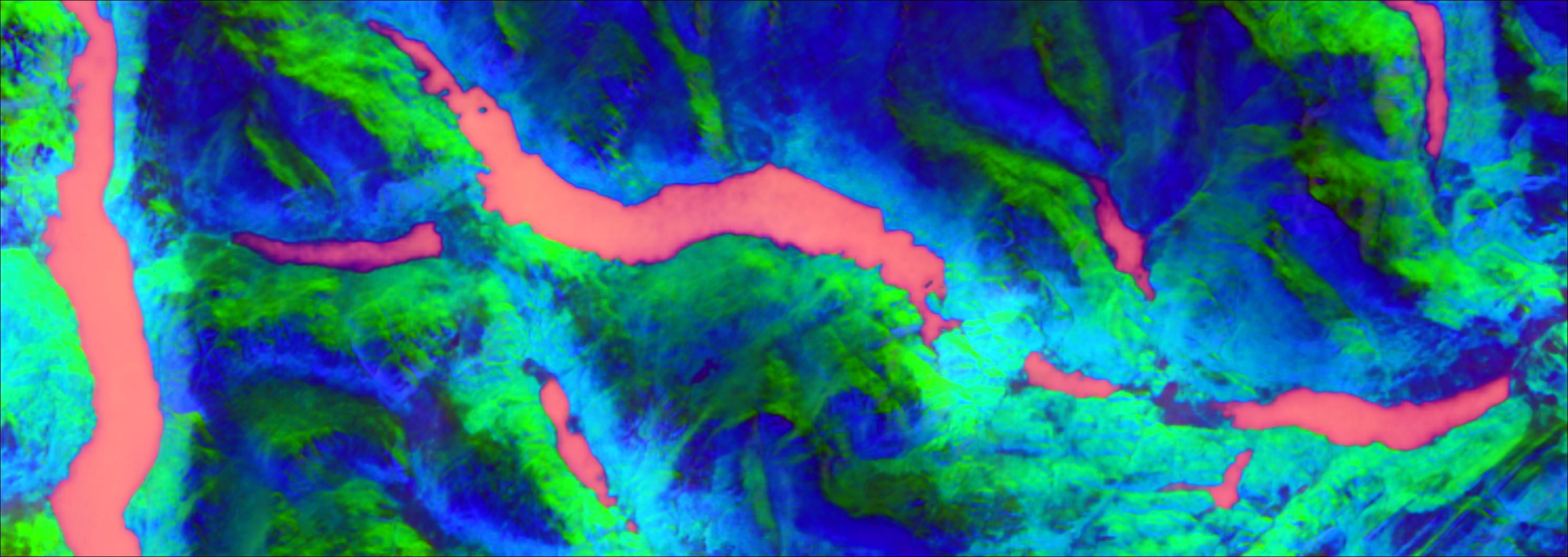
BetaEarth produces dense 10 m geospatial embedding fields from Sentinel-2 and Sentinel-1 imagery. It is trained to approximate the outputs of AlphaEarth Foundations (AEF) — the embedding product released by Google and Google DeepMind — using only AEF's public precomputed embeddings as supervision.
BetaEarth has no access to AEF's weights or architecture. It is an independent model, not a variant or extension of AEF. Emulation quality is below AEF's, but BetaEarth runs locally on any Sentinel scene and its full pipeline is open.

When to use BetaEarth
- Offline generation. AEF is distributed as annual global rasters generated inside Google Earth Engine. BetaEarth runs on any S2/S1 scene locally — useful for custom temporal windows or deployments without Earth Engine access.
- Open pipeline. Training data, weights, and inference code are all open, so BetaEarth can serve as an approximate reference for studying how multimodal Earth-observation embeddings behave under missing modalities, temporal averaging, or compression.
Quickstart
pip install betaearth
from betaearth import BetaEarth

model = BetaEarth.from_pretrained()  # default: robust curriculum variant

# Any modality can be omitted — the curriculum model handles missing inputs.
# predict() tiles internally (224 px tile, 112 px overlap, trapezoidal blend),
# so any (H, W) works — including full 1068x1068 Major TOM tiles or larger.
embedding = model.predict(
    s2_l2a=s2_l2a,   # (9, H, W) uint16 DN; bands [B02,B03,B04,B08,B05,B06,B07,B11,B12]
    s2_l1c=s2_l1c,   # (9, H, W) uint16 DN; same band order as L2A
    s1=s1,           # (2, H, W) float32 linear power (NOT dB); bands [VV, VH]
    dem=dem,         # (1, H, W) float32 elevation in metres (raw COP-DEM)
    doy=182,         # day-of-year of the S2 acquisition (1-366)
)
# embedding: (H, W, 64) float32, L2-normalised per pixel (unit vectors on S^63)
Input formats
All spatial arrays share the same (H, W) and are pixel-aligned. BetaEarth normalises internally — pass the raw source values described below, no custom scaling.
| Input | Shape | Dtype | Units / range | Band order | Typical source |
|---|---|---|---|---|---|
s2_l1c |
(9, H, W) |
uint16 | Digital numbers, 0–10 000+ (top-of-atmosphere reflectance × 10 000). Divided by 10 000 internally. | [B02, B03, B04, B08, B05, B06, B07, B11, B12] |
Copernicus Data Space Ecosystem, Sentinel Hub, AWS Open Data |
s2_l2a |
(9, H, W) |
uint16 | Digital numbers, 0–10 000+ (atmospherically-corrected surface reflectance × 10 000). Divided by 10 000 internally. | same as L1C | Planetary Computer, Sentinel Hub, AWS Earth Search |
s1 |
(2, H, W) |
float32 | Linear power (typical range ~0–200, not 0–1). Converted to dB and rescaled internally. | [VV, VH] |
Planetary Computer sentinel-1-rtc, ASF Radiometric Terrain Corrected |
dem |
(1, H, W) |
float32 | Raw elevation in metres (COP-DEM GLO-30 range ~−500 to 9000). Min-max rescaled internally. | – | Copernicus DEM GLO-30 (Planetary Computer cop-dem-glo-30) |
doy |
scalar int | 1–366 | Day-of-year of the S2 acquisition (not epoch, not ISO) | – | – |
Output is (H, W, 64) float32, L2-normalised per pixel. H and W can be anything ≥ 224; predict() tiles the input with a 224×224 window internally and stitches.
Input gotchas
- S2 band order matters. The 10 m bands come first, then 20 m:
[B02, B03, B04, B08, B05, B06, B07, B11, B12]. Any other order silently produces garbage embeddings. If you fetch from a STAC source that returns bands in their native order (B01, B02, …), you must reorder before passing in. - L1C and L2A are NOT interchangeable. They are handled by separate encoders and represent distinct processing levels (top-of-atmosphere vs surface reflectance). The default curriculum (flagship) model handles any subset (single L1C, single L2A, both, or neither) gracefully. The peak-quality variants (
segformer-film-reinit,segformer-film-hilr, etc.) were trained with L1C + L2A jointly and drop ~32 % cos sim if only one processing level is provided. - Raw DN values, not reflectance. S2 normalisation happens inside the model — pass the uint16 DN as-is.
- S1 must be linear power, not dB. Planetary Computer's
sentinel-1-rtccollection returns linear power by default. If you have GRD-dB data (e.g. from SNAP), convert first:linear = 10 ** (db / 10). Typical linear-power magnitudes are ~0.01–200;predict()handles the dB conversion and clipping internally. - DEM in metres, not pre-normalised. Pass the raw elevation array (COP-DEM GLO-30 output).
predict()applies per-input min-max rescaling internally. If you already have DEM rescaled to[0, 1], passnormalise=Falsetopredict(). - Shape convention. All spatial inputs are channel-first
(C, H, W)— consistent with torch conventions but opposite of common remote-sensing(H, W, C)rasters. - Tiling is automatic.
predict()uses a 224 px tile with 112 px overlap (trapezoidal blending) by default — matches the paper's eval pipeline and gives seam-free PCA-RGB previews on low-variance scenes (arid, water, snow). Override withtile_size=.../overlap=...if you want a different stitch;overlap=32is ~3× faster but can show visible seams on uniform surfaces. Anything below 224 px total will fail.
Try in 30 seconds on Colab — pick the notebook that matches your use case:
| Notebook | When to use | Inputs | Runtime |
|---|---|---|---|
⚡ demo.ipynb |
Fast mono-temporal quickstart. Understand the model in one minute. | 1 Major TOM tile (single parquet row, no STAC) | ~30 s on T4 |
🌍 generate_demo.ipynb |
Flexible multi-temporal — any bounding box, annual aggregated embedding. Same pipeline as the hosted app. | S2 + S1 + DEM from Planetary Computer (multi-scene) | few minutes on T4 |
Or skip the notebooks: examples/predict.py is the minimal local script.
Generate embeddings for any area
Four entry points, from zero-install to fully scripted.
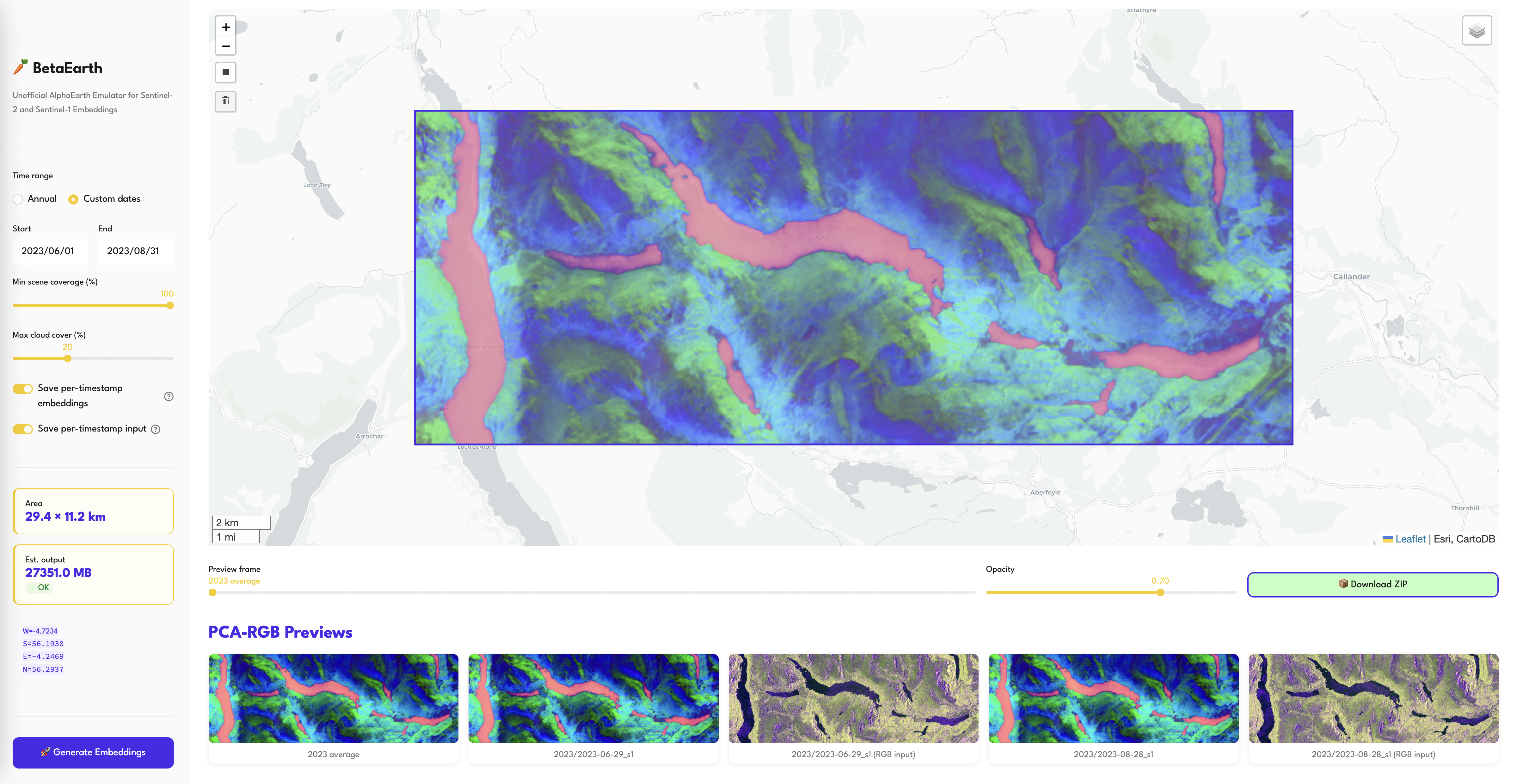
1. Hosted app (no install)
Pick a bounding box on a map, click run: huggingface.co/spaces/asterisk-labs/betaearth. Free tier is CPU-only and caps total output at 3 GB.
2. Colab notebooks
Two notebooks depending on how much acquisition plumbing you want:
- ⚡
examples/demo.ipynbpredict(), one PCA-RGB. No STAC, no credentials. Good for understanding the model. - 🌍
examples/generate_demo.ipynb
3. Command-line generation (the main path for real work)
betaearth-generate ships with the package and drives the same pipeline: download Sentinel-2 L2A + Sentinel-1 RTC + COP-DEM from Planetary Computer, run tiled inference, write an annual 64-band COG plus a full provenance manifest per year.
pip install 'betaearth[generate]'

# By bounding box (W S E N), one or more years
betaearth-generate --bbox 13.1 48.7 13.8 49.2 --years 2020 2021 2022 2023 2024 2025 \
    --output_dir outputs/bavarian_forest

# By OSM relation id (resolved to its bbox)
betaearth-generate --osm_relation 1864214 --years 2024 --output_dir outputs/bav
No API keys needed — Planetary Computer is publicly accessible. A CUDA GPU is used automatically if available; CPU works but is slower. Each run produces, per year:
| File | Description |
|---|---|
{year}.tif |
64-band annual average embedding (L2-normalised per pixel), COG |
{year}_preview_pca.png |
3-band PCA-RGB quick-look of the annual mosaic |
{year}_manifest.json |
Provenance: model repo + version, CRS/bounds/shape, acquisition params, full STAC id list of every scene used (cloud cover, coverage, S1 orbit/polarisation, ...) |
{year}_files/{date}_{sensor}/ |
Optional per-scene outputs, only with --save_per_timestamp_embedding / --save_scenes |
The manifest is deliberately verbose so any downstream user of the embedding can verify exactly which Sentinel products fed into it. Import betaearth.generate for the Python API that backs the CLI; a minimal scripted example is in examples/predict.py.
4. Streamlit app (local)
The same app as the hosted Space, run on your own compute:
git clone https://github.com/asterisk-labs/beta-earth
cd beta-earth
pip install 'betaearth[demo]'
streamlit run demo/app.py
Then open http://localhost:8501 in your browser. Raise the 3 GB cap via env var:
BETAEARTH_MAX_OUTPUT_MB=50000 streamlit run demo/app.py # 50 GB ceiling
Models
We release 8 model variants spanning different trade-offs between quality, parameter efficiency, and input requirements.
Main results (full 6,250-tile test set)
Preliminary results from the first preprint version (arXiv v1). Numbers match the preprint, Table II (full test set; own-probe LULC). Subject to revision in future preprint versions as evaluation is expanded.
| Model | Test Cos Sim | Std | LULC Acc | Model Size | Inputs |
|---|---|---|---|---|---|
| SF curriculum (flagship) | 0.873 | 0.109 | 0.833 | 104.8M | Any subset of S2/S1/DEM + DOY |
| SF frozen+FiLM (reinit) | 0.883 | 0.106 | 0.836 | 104.8M | S2 L1C+L2A, S1, DEM, DOY |
| SF frozen+FiLM (hilr) | 0.883 | 0.107 | 0.838 | 104.8M | S2 L1C+L2A, S1, DEM, DOY |
| SF from-scratch+FiLM | 0.883 | 0.105 | 0.835 | 104.8M | S2 L1C+L2A, S1, DEM, DOY |
| SF no FiLM (baseline) | 0.875 | 0.110 | 0.838 | 104.8M | S2 L1C+L2A, S1, DEM |
| DINOv3 ViT-L/16 | 0.873 | 0.109 | 0.840 | 304M | 6 primitives + DOY |
| DINOv3 ViT-S/16 | 0.862 | 0.112 | 0.836 | 24M | 6 primitives + DOY |
| SF RGB-only+FiLM | 0.834 | 0.128 | 0.823 | 26.3M | S2 RGB, DOY |
| Real AlphaEarth (reference) | --- | --- | 0.856 | --- | --- |
Single-modality performance (curriculum flagship, test set)
Preliminary — arXiv v1. Values match the preprint Table III (curriculum on the full 6,250-tile test set).
The curriculum model is the only variant that remains functional under severely reduced inputs:
| Input subset | Cosine sim |
|---|---|
| All modalities | 0.872 |
| No DEM (S2+S1 only) | 0.854 |
| No S1 (S2+DEM only) | 0.848 |
| S2 only | 0.817 |
| No time (DOY=0) | 0.773 |
| S1 only | 0.710 |
| DEM only | 0.541 |
For users with access to only one S2 processing level, separate validation-set measurements give L1C-only 0.806 and L2A-only 0.755 (the paper's test-set ablation groups both L1C and L2A together under "S2 only").
Which model should I use?
| Use case | Recommended model | Why |
|---|---|---|
| General use (default) | SF curriculum (flagship) | Works with any input subset; only variant that stays usable on single-modality inputs (S1-only 0.710, DEM-only 0.541) |
| Maximum quality | SF frozen+FiLM (reinit) | Highest test cos sim (0.883) — requires all 4 modalities |
| No timestamp needed | SF no FiLM (baseline) | Does not consume day-of-year input; reaches 0.875 |
| Lightweight / edge | DINOv3 ViT-S/16 | 24M params, 0.862 test cos sim |
| Minimal data requirements | SF RGB-only+FiLM | Only needs 3-band S2 RGB + DOY |
| Best downstream LULC | DINOv3 ViT-L/16 | 0.840 own-probe LULC (closest to AEF's 0.856 ceiling) |
| Research / ablation | SF frozen+FiLM (hilr), SF from-scratch+FiLM | Alternative training strategies for comparison against the reinit variant |
Architecture overview
DINOv3 models use a single shared frozen DINOv3 backbone applied to 3-band spectral primitives:
| Primitive | Bands | Captures |
|---|---|---|
| True-colour RGB | B04/B03/B02 | Visual texture, built environment |
| False-colour IR | B08/B04/B03 | Vegetation health (NIR) |
| SWIR composite | B12/B11/B04 | Moisture, bare soil, burn scars |
| Red-edge | B07/B06/B05 | Canopy structure, chlorophyll |
| SAR | VV/VH/ratio | Structure, moisture (from S1) |
| Topography | Elevation/Slope/Aspect | Terrain (from COP-DEM) |
Primitives are fused via permutation-invariant cross-attention (SetFusion).
SegFormer models use 4 separate MiT-B2 encoders processing each modality's raw bands natively (9ch S2-L1C, 9ch S2-L2A, 2ch S1, 1ch DEM), with channel concatenation fusion.
All models use FiLM temporal conditioning (day-of-year modulation) except the no-FiLM baseline.
Key findings
- Temporal conditioning as spectral compensation: FiLM importance scales inversely with spectral access — RGB-only (22pp) > DINOv3 (18pp) > SegFormer scratch (14pp) > frozen SegFormer (5pp).
- Multi-temporal averaging of 4+ observations improves emulation by up to +13pp over single timestamps, with the benefit biome-dependent (gap-fill wins in boreal regions; S2-only wins in arid/temperate).
- Predicted embeddings retain 97% of downstream LULC classification accuracy and are robust to 32x compression.
Model Properties
| Property | Value |
|---|---|
| Output | Dense embedding field — (H, W, 64) per tile at 10m resolution |
| Output normalisation | L2-normalised per pixel (unit vectors on S^63) |
| Quantisation | Original AEF: int8 on S^63; BetaEarth outputs float32 |
| Tile size | 10.68 x 10.68 km (1068 x 1068 px), Major TOM grid |
| Training data | 62,489 Major TOM grid cells (49,991 train / 6,248 val / 6,250 test) |
| Loss | Cosine similarity + 0.1 * MSE, masked to valid pixels |
Multi-temporal averaging
Build an annual mosaic by predicting each scene separately and averaging the L2-normalised outputs — saturates at ~4 observations per pixel:
import numpy as np

preds = []
for s2, s1, doy in zip(s2_timeseries, s1_timeseries, doys):
    pred = model.predict(s2_l2a=s2, s1=s1, dem=dem, doy=doy)
    preds.append(pred)

annual = np.mean(preds, axis=0)
annual /= np.linalg.norm(annual, axis=-1, keepdims=True)
(betaearth-generate and the Streamlit demo wrap this pattern with cloud masking, seasonal balancing, and a provenance manifest.)
Data Access
All training data is from the Major TOM community project and is freely available on HuggingFace:
| Dataset | Description |
|---|---|
| Major-TOM/Core-S2-L2A | Sentinel-2 L2A imagery |
| Major-TOM/Core-S2-L1C | Sentinel-2 L1C imagery |
| Major-TOM/Core-S1-RTC | Sentinel-1 RTC imagery |
| Major-TOM/Core-AlphaEarth-Embeddings | AEF target embeddings |
Data normalisation
All input data should be stored as raw values. Normalisation happens inside the model:
- S2 L1C/L2A: uint16 DN (0-10000+), divided by 10000 internally
- S1 RTC: linear power (float32, ~0-200), log-transformed internally
- COP-DEM: pre-normalised to [0, 1] before passing to the model
Important: S2 bands must be ordered [B02, B03, B04, B08, B05, B06, B07, B11, B12] (10 m bands first, then 20 m) — the order BetaEarth was trained with.
Citation
@inproceedings{czerkawski2026betaearth,
  title     = {BetaEarth: Emulating Closed-Source Earth Observation Models Through Their Public Embeddings},
  author    = {Czerkawski, Mikolaj},
  year      = {2026}
}
If using BetaEarth embeddings in research, also cite AlphaEarth Foundations (arXiv:2507.22291).
License and Attribution
BetaEarth model weights are released under CC-BY 4.0, matching the license of the AlphaEarth Foundations embedding archive used for training supervision.
Attribution for AEF training data:
"The AlphaEarth Foundations Satellite Embedding dataset is produced by Google and Google DeepMind."
Training imagery is sourced from Major TOM (Apache 2.0) and Copernicus Sentinel (free and open access).
1 maintainer

Download files
Download the file for your platform. If you're not sure which to choose, learn more about installing packages.
Source Distribution
Built Distribution
Filter files by name, interpreter, ABI, and platform.
If you're not sure about the file name format, learn more about wheel file names.
Copy a direct link to the current filters
File details
Details for the file betaearth-0.2.5.tar.gz.
File metadata
- Download URL: betaearth-0.2.5.tar.gz
- Upload date:
- Size: 35.8 kB
- Tags: Source
- Uploaded using Trusted Publishing? No
- Uploaded via:
twine/6.2.0 CPython/3.13.12
File hashes
| Algorithm | Hash digest | |
|---|---|---|
| SHA256 |
e697f7a67119b47e186a4453a9d37f859355e5f7d92f9880fd4d942bffa8719e
|
|
| MD5 |
b67faa065fd4da9f7a3195d575eb22cf
|
|
| BLAKE2b-256 |
cf2c8b4d9b8275d091daa684f4a037a1ebae6a848c7325e58e7987b8bc7cdd4a
|
File details
Details for the file betaearth-0.2.5-py3-none-any.whl.
File metadata
- Download URL: betaearth-0.2.5-py3-none-any.whl
- Upload date:
- Size: 29.5 kB
- Tags: Python 3
- Uploaded using Trusted Publishing? No
- Uploaded via:
twine/6.2.0 CPython/3.13.12
File hashes
| Algorithm | Hash digest | |
|---|---|---|
| SHA256 |
8f40edae4881fbbe2b50c7305b29bade94e21c2dae70e99509a1b6020a70e150
|
|
| MD5 |
dc7c506b7bf55dbc4347073fc3866560
|
|
| BLAKE2b-256 |
870ae56c5cdeed55aabbae3c868a80cf0eda69280b3949d9bb33da1ec9bd9eeb
|














