

BigBang
BigBang is a toolkit for studying communications data from collaborative projects. It currently supports analyzing mailing lists from Sourceforge, Mailman, ListServ (version 16.5 and 17), Pipermail (version 0.09), Hypermail (version 2.4.0) or .mbox files.
Complete documentation for BigBang can be found on ReadTheDocs.


Background
Many Standards Development Organizations (SDOs) have working groups that organize themselves through mailing lists. This mailing list data is a valuable source of research insights but can be challenging to gather and analyze. BigBang is an open source toolkit for studying processes of open collaboration and deliberation via analysis of the communications records. Its tools for collecting, analyzing, and visualizing mailing list data are used by a community of information policy researchers to study participation trends and interaction in these settings.
Three things BigBang Does
- Ingress. Tools for collecting data from SDOs, especially their mailing lists.
- Analysis. Tools for (pre)processing the data to produce useful insights.
- Usability/Visualization. Tools for visualizing and interacting with data.
Institutional Collaboration
BigBang has been developed by a growing team of researchers spread across many universities and institutions, including UC Berkeley, University of Amsterdam, and New York University. Its development has been funded by Article 19 and Germany's Prototype Fund.
In addition to its scholarly use, BigBang has been building relationships with SDOs themselves. In 2021, the Internet Architecture Board hosted a workshop on Analyzing IETF Data, in which BigBang was featured as a tool for IAB to develop insights into internet governance.
BigBang as Research Software
BigBing is research software -- written by scholars for our research purposes.
It is part of Scientific Python ecosystem, drawing on many other open source scientific software libraries, such as NumPy, Matplotlib, Pandas, and Jupyter Notebook.
BigBang is a reflexive process. Several of the core developers are also qualitative scholars of socio-technical systems and institutions. Researchers commonly combine BigBang with participant observation in the SDOs they are studying. BigBang is governed by a steering committee of its core developers.
Installation*
You need to have Git and Pip (for Python3) installed.
Clone the repository and create a virtualenv:
git clone https://github.com/datactive/bigbang.git
cd bigbang
python3 -m venv env
# activate the virtualenv
. env/bin/activate
Inside the virtualenv, install BigBang:
pip install ".[dev]"
When you're done, you can deactivate the virtualenv:
deactivate
This video tutorial shows how to install BigBang.
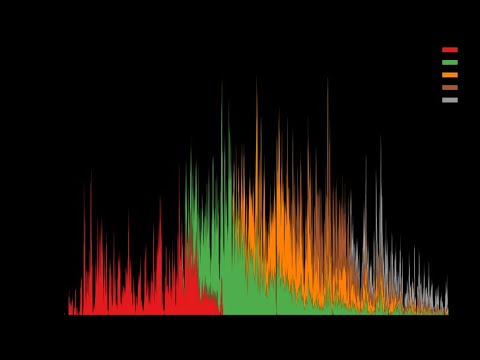
Usage
There are serveral Jupyter notebooks in the examples/ directory of this
repository. To open them and begin exploring, run the following commands in the root directory of this repository:
source activate bigbang
jupyter notebook --notebook-dir=examples/
BigBang contains scripts that make it easy to collect data from a variety of sources. For example, to collect data from an open mailing list archive hosted by Mailman, use:
bigbang collect-mail --url https://mail.python.org/pipermail/scipy-dev/
You can also give this command a file with several urls, one per line. One of these is provided in the examples/ directory.
bigbang collect-mail --file examples/urls.txt
Once the data has been collected, BigBang has functions to support analysis.
You can read more about data source supported by BigBang in the documentation.
Development
Unit tests
To run the automated unit tests, use: pytest tests/unit.
Our current goal is code coverage of 60%. Add new unit tests within tests/unit. Unit tests run quickly, without relying on network requests.
Documentation
Docstrings are preferred, so that auto-generated web-based documentation will be possible (#412). You can follow the Google style guide for docstrings.
Formatting
Run pre-commit install to get automated usage of black, flake8 and isort to all Python code files for consistent formatting across developers. We try to follow the PEP8 style guide.
Community
If you are interested in participating in BigBang development or would like support from the core development team, please subscribe to the bigbang-dev mailing list and let us know your suggestions, questions, requests and comments. A development chatroom is also available.
In the interest of fostering an open and welcoming environment, we as contributors and maintainers pledge to make participation in our project and our community a harassment-free experience for everyone.
Publications
These academic publications use BigBang as part of their methods:
- Becker, Christoph., ten Oever, Niels, and Riccardo Nanni. 2022 “The standardisation of lawful interception technologies in the 3GPP: interrogating 5G and surveillance amid US-China competition“, TPRC2022, Washington DC https://papers.ssrn.com/sol3/papers.cfm?abstract_id=4167105
- Benthall, Sebastian. 2015. “Testing Generative Models of Online Collaboration with BigBang.” In , 182–89. https://conference.scipy.org/proceedings/scipy2015/sebastian_benthall.html.
- Doty, Nick. 2015. “Reviewing for Privacy in Internet and Web Standard-Setting.” In Security and Privacy Workshops (SPW), 2015 IEEE, 185–192. IEEE. https://ieeexplore.ieee.org/document/7163224/
- Milan, Stefania, and Niels ten Oever. 2017. “Coding and Encoding Rights in Internet Infrastructure.” Internet Policy Review 6 (1)
- ten Oever, Niels. 2018. “Productive Contestation, Civil Society, and Global Governance: Human Rights as a Boundary Object in ICANN.” Policy & Internet, June. https://doi.org/10.1002/poi3.172.
- Nanni, Riccardo. “Digital Sovereignty and Internet Standards: Normative Implications of Public-Private Relations among Chinese Stakeholders in the Internet Engineering Task Force.” Information, Communication & Society 0, no. 0 (October 1, 2022): 1–21. https://doi.org/10.1080/1369118X.2022.2129270.
- ten Oever, Niels. 2021. “‘This Is Not How We Imagined It’ - Technological Affordances, Economic Drivers and the Internet Architecture Imaginary.” New Media & Society. https://journals.sagepub.com/doi/full/10.1177/1461444820929320
- ten Oever, N., Milan, S., & Beraldo, D. (2020). Studying Discourse in Internet Governance through Mailing-list Analysis. In D. L. Cogburn, L. DeNardis, N. S. Levinson, & F. Musiani (Eds.), Research Methods in Internet Governance. Cambridge, MA: MIT Press. https://direct.mit.edu/books/oa-monograph/4936/chapter/625914/Studying-Discourse-in-Internet-Governance-through
License
MIT, see LICENSE for its text. This license may be changed at any time according to the principles of the project Governance.
Acknowledgements
This project is funded by:


1 maintainer

Metadata
1 maintainer
Release files for bigbang-py 0.6.1
For a detailed explanation of source distributions (sdists) and built distributions (wheels), please see the package formats documentation.
Source distribution (sdist)
| File | Size | Uploaded | Provenance | Actions |
|---|---|---|---|---|
| bigbang_py-0.6.1.tar.gz | 13.9 MB | Without provenance | Details for bigbang_py-0.6.1.tar.gz |
Built distribution (wheel)
| File | Interpreter | ABI | Platform | Actions Reset |
|---|---|---|---|---|
| bigbang_py-0.6.1-py3-none-any.whl | Python 3 | none | any | Details for bigbang_py-0.6.1-py3-none-any.whl |
Total release size: 14.0 MB
Release files / bigbang_py-0.6.1.tar.gz
| Download URL | bigbang_py-0.6.1.tar.gz |
|---|---|
| Size | 13.9 MB |
| Tags | Source |
|
SHA-256 checksum How to use checksums |
c70d2182b2cb90ad40f390ca5c69b495c7cfccf1016765efc40e95d8b0689ded
|
|
BLAKE2b-256 checksum How to use checksums |
ecc2264ac6754fb9d4de00beb0a491eef2cc25ac1a1a06b8d1e22016539eb439
|
| Upload date | |
|
Uploaded using Trusted Publishing? What is trusted publishing? |
No |
| Uploaded via |
twine/6.1.0 CPython/3.9.22
|
Release files / bigbang_py-0.6.1-py3-none-any.whl
| Download URL | bigbang_py-0.6.1-py3-none-any.whl |
|---|---|
| Size | 156.3 kB |
| Tags | Python 3 |
|
SHA-256 checksum How to use checksums |
50558df11ffbbe6aeb2ac94faf731be40de74acafc56d9478ed620e6eceec183
|
|
BLAKE2b-256 checksum How to use checksums |
a506d7b7a09a476732c340b995ee0e7f138229caac1dd1f52346a2fc2018763f
|
| Upload date | |
|
Uploaded using Trusted Publishing? What is trusted publishing? |
No |
| Uploaded via |
twine/6.1.0 CPython/3.9.22
|
Security for bigbang-py 0.6.1
Provenance
Provenance describes where a file came from. On PyPI, provenance is shared via attestations, which provide a verifiable record of the build or publishing details. View details, limitations and caveats.
No provenance found
None of the files in this release were uploaded with provenance metadata.
A note on package security
PyPI is a repository for distributing packages, not a service for auditing them. While third-party security researchers and our staff do their best to detect and remove malicious packages, PyPI cannot guarantee the quality, security or suitability of any given package.
To learn more about protecting yourself from malicious actors, visit our package security documentation.














