

Bilinc





Hosted memory for AI agents. Save what your agents learn, recall it before they act, see who wrote each memory and what changed, and roll back when a run goes wrong.
The bilinc package on PyPI is the Python SDK, the bilinc CLI and the stdio MCP adapter for Bilinc Cloud. Its source is ReARCLabs/bilinc; the hosted service is not part of the package.
Start in 60 seconds
Claude, ChatGPT or Codex, without Python. In Claude, open Customize → Connectors → Add custom connector, name it Bilinc and paste https://mcp.bilinc.space/mcp. Sign in and choose read-only or read and write. In Claude Code:
claude mcp add --transport http --scope user bilinc https://mcp.bilinc.space/mcp
The same address works in ChatGPT and Codex: remote MCP guide.
Python, the CLI or any MCP client.
pip install -U bilinc
bilinc login        # browser sign-in, free, no card required
bilinc quicktest    # one hosted commit, one recall and a status check
bilinc login saves an API key for this computer with owner-only permissions; the key never appears in a URL or your terminal. Without a browser, use bilinc login --device. For CI and scripts, set BILINC_API_KEY.
Where Bilinc sits
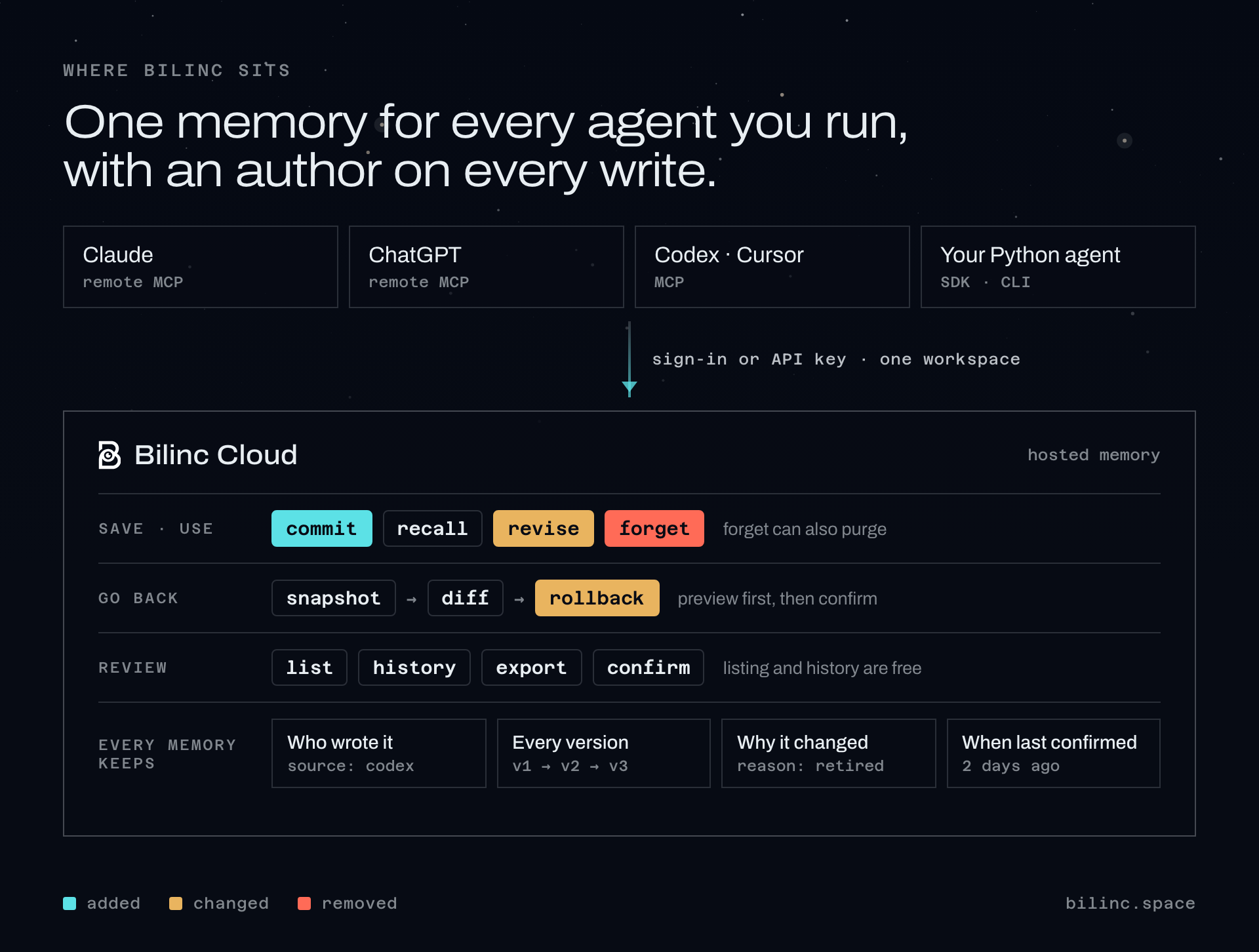
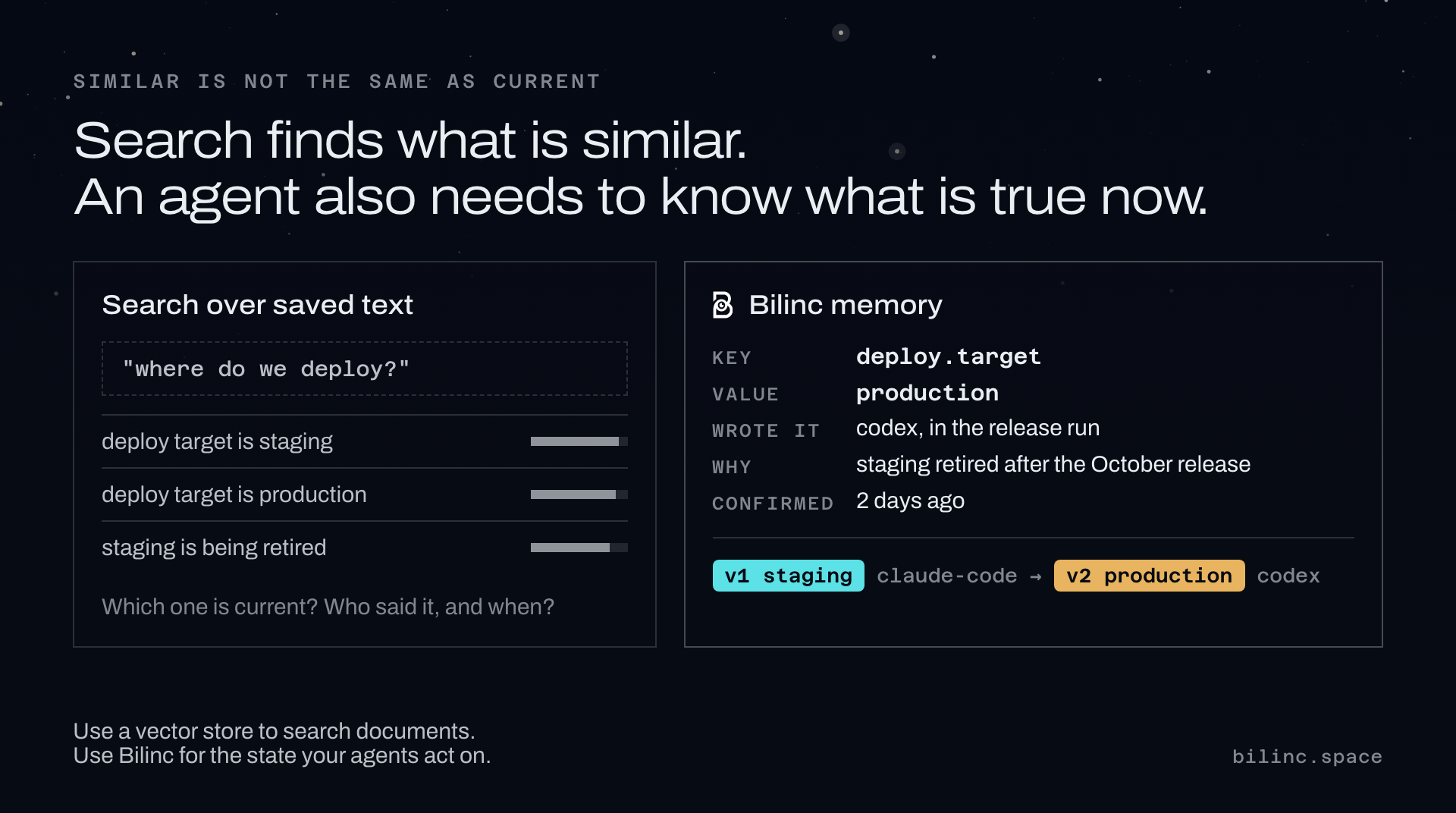
Every write records where it came from and returns a version you can pass back, so a change is refused if the memory moved since you read it. Forget requires a reason and revise accepts one. In the remote connector, recall shows when each memory was last confirmed and marks entries past their review window as possibly outdated; nothing is hidden or deleted by that check.
Similar is not the same as current
Use Bilinc when:
- a long-running agent (coding, support, research, a personal assistant) needs earlier decisions before a risky action;
- you need to know which run, tool or person wrote a piece of agent state;
- a bad run wrote wrong state and you need a way back, not a manual cleanup;
- several agents or teammates share one memory and you want per-key access and visible usage.
Reach for something else when you only need semantic search over documents (a vector database is the simpler tool), when you need an Apache-2.0, fully self-hosted runtime (this package is cloud-only and BUSL-1.1), or when you want the memory layer to also be your agent framework.
Python SDK
from bilinc import CloudClient

client = CloudClient()  # reads BILINC_API_KEY or the key saved by `bilinc login`

# Write, and keep the version for optimistic concurrency.
written = client.commit("agent.goal", {"ship": "reliable memory"}, memory_type="semantic")
results = client.recall("agent goal", limit=5)

# Correct something you already know. Fails if the key does not exist.
client.revise("agent.goal", {"ship": "verifiable memory"},
              reason="scope corrected", expected_version=written["entryVersion"])

# Checkpoint before risky work, then see what changed.
snapshot = client.create_snapshot(label="before-autonomous-run")["snapshot"]
client.diff(snapshot["id"])

# Recover. The preview is free; executing needs its token.
preview = client.rollback_preview(snapshot["id"], reason="undo bad agent run")
client.rollback(snapshot["id"], confirmation_token=preview["confirmationToken"],
                reason="undo bad agent run")

# Review what is stored. Listing, history and export are free reads.
for entry in client.iter_memories(prefix="agent."):
    print(entry["key"], entry["updatedAt"])
client.history("agent.goal")
client.confirm("agent.goal")   # still accurate; costs one write

# Take a memory out of use. A reason is required and recorded.
client.forget("agent.goal", reason="superseded by the planner service")
CLI
bilinc status                          # plan, capabilities, limits, usage
bilinc commit --key agent.goal --value '{"ship":"reliable memory"}'
bilinc recall --query "agent goal"
bilinc revise --key agent.goal --value '{"ship":"verifiable memory"}' --reason "scope corrected"
bilinc list --prefix agent.            # keys, types, update times, value previews
bilinc history agent.goal              # recorded changes, newest first
bilinc snapshot create --label before-autonomous-run
bilinc diff --from-snapshot snap_...
bilinc export -o bilinc-export.json    # full values; the file is readable only by you
bilinc forget --key agent.goal --reason "superseded by the planner service"
Rollback is two steps, and execute never prompts, so it is safe in automation:
bilinc rollback preview --snapshot snap_... --reason "undo bad agent run"
bilinc rollback execute --snapshot snap_... --reason "undo bad agent run" \
  --confirmation-token <token-from-preview>
MCP adapter
The stdio adapter works with any MCP client: Claude Code, Codex, Cursor, Hermes Agent, opencode and others. After bilinc login, let the CLI write the setup:
bilinc mcp install --client claude-code     # prints a ready `claude mcp add ...` command
bilinc mcp install --client claude-desktop  # prints the config and where Claude Desktop keeps it
bilinc mcp install                          # plain mcpServers JSON for any other client
The config carries no key; the adapter reads the one bilinc login saved. On a machine without one, add "env": { "BILINC_API_KEY": "..." }.
| Tool | What it does |
|---|---|
commit_mem |
Save durable state with its source; returns a version. |
recall |
Find earlier context and decisions before acting. |
revise |
Correct an existing memory. It never creates one. |
forget |
Take a memory out of use. Destructive; a reason is required. |
status |
Workspace, plan, capabilities, limits and usage. Never billed. |
snapshot |
Save a checkpoint before risky work, or list checkpoints. |
diff |
Compare a checkpoint with another one or with now. |
rollback |
Restore a checkpoint: a free preview, then a confirmed execute. |
list_memories |
Browse what is stored. Free. |
history |
One memory's changes, newest first. Free. |
confirm |
Record that a memory is still accurate. One write. |
The remote connector at https://mcp.bilinc.space/mcp has ten tools; a read-only connection lists only the four read tools. Client guides: Claude Code · Codex · Cursor · any MCP client.
Forget and purge
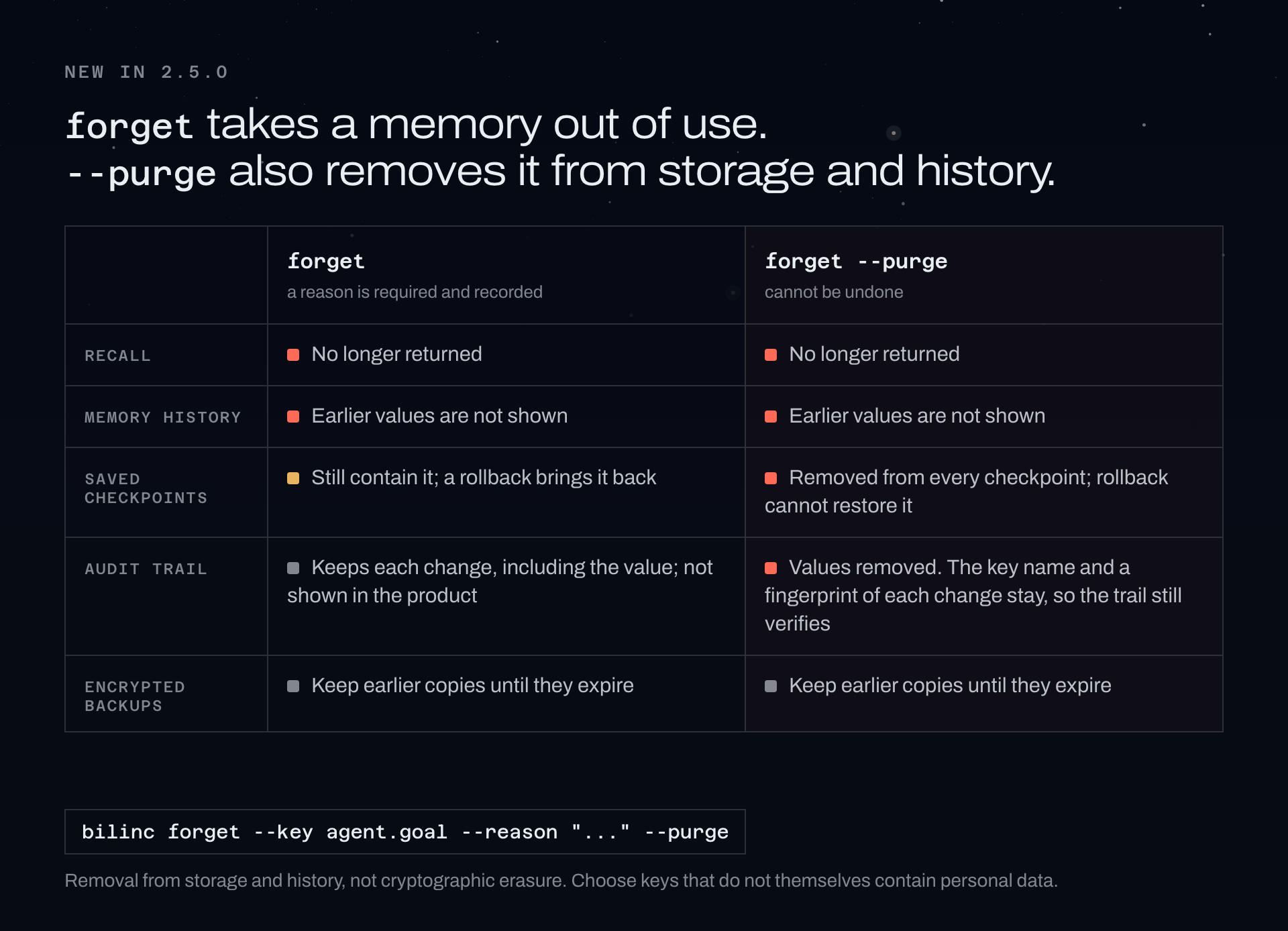
Since 2.5.0: client.forget(key, reason=..., purge=True), bilinc forget --key ... --reason ... --purge, or "purge": true in the REST API also removes the memory's stored content from storage and history. It works on a memory you forgot earlier and cannot be undone. See the privacy policy for what is kept and for how long.
Hosted API
All endpoints live under https://bilinc.space. Memory operations need an API key and an active Bilinc Cloud plan; the free plan needs no card.
| Endpoint | Notes |
|---|---|
GET /api/cloud/health |
Public service health. No key, never billed. |
GET /api/cloud/status |
What one key can do. Never billed. |
POST /api/cloud/memory/commit · recall · revise |
Write, read, correct. |
POST /api/cloud/memory/forget |
Destructive. Reason required; "purge": true also removes stored content. |
GET · POST /api/cloud/memory/snapshots |
List (free) or create checkpoints. |
POST /api/cloud/memory/diff |
Compare checkpoints. Free. |
POST /api/cloud/memory/rollback/preview |
Free. Returns a confirmation token. |
POST /api/cloud/memory/rollback |
Destructive. Requires that token. |
Send an Idempotency-Key header on any write you might retry: the same key with the same payload replays the original result and is billed once; a different payload is refused with 409 idempotency_conflict. Saves that contain a credential, such as an API key, token or private key, are refused with secret_detected and the value is never echoed back.
What's new in 2.6.1
- Forget means gone: a hosted forget or purge also removes the names and aliases taken from the memory, the purged text the server still held in memory, and the evaluation records that name the key.
- Get one memory:
CloudClient.get_memory(key)returns a memory by its exact key, and rollback previews take alimitin the CLI and thebilincMCP adapter. - Fewer false "expired" flags: a memory saved again with a new TTL is no longer reported as expired while its new expiry is ahead.
- One history under concurrent writes: two writers can no longer split a project's audit chain.
Every release: changelog.
Links
- bilinc.space · Docs · Install guide · Pricing (free plan, no card) · Changelog · Trust
- Compare: vector memory · Mem0 · Zep · Letta
- Guides: What is AI agent memory? · Rolling back an agent memory write · Auditing what an agent remembered
- For machines: llms.txt · ai-index.json
Feedback and security
Questions, bugs and ideas: GitHub Issues. Report security issues privately to bilincsupport@rearclabs.com (see security.txt). Please keep memory values, API keys and production logs out of issues and screenshots.
License
Business Source License 1.1, licensed by ReARC Labs Inc. See LICENSE.
1 maintainer

Metadata
1 maintainer
Release files for bilinc 2.6.1
For a detailed explanation of source distributions (sdists) and built distributions (wheels), please see the package formats documentation.
Source distribution (sdist)
| File | Size | Uploaded | Provenance | Actions |
|---|---|---|---|---|
| bilinc-2.6.1.tar.gz | 41.6 kB | Without provenance | Details for bilinc-2.6.1.tar.gz |
Built distribution (wheel)
| File | Interpreter | ABI | Platform | Actions Reset |
|---|---|---|---|---|
| bilinc-2.6.1-py3-none-any.whl | Python 3 | none | any | Details for bilinc-2.6.1-py3-none-any.whl |
Total release size: 76.6 kB
Release files / bilinc-2.6.1.tar.gz
| Download URL | bilinc-2.6.1.tar.gz |
|---|---|
| Size | 41.6 kB |
| Tags | Source |
|
SHA-256 checksum How to use checksums |
4432f7bdb1cddfb8302c991038f7580fd8c36bb5a82ceeda4dd0d88ffa3ec801
|
|
BLAKE2b-256 checksum How to use checksums |
5eafdcbee3dc93e7c2740abefb65b614b41bce90234a951d4af2af5675bd6f35
|
| Upload date | |
|
Uploaded using Trusted Publishing? What is trusted publishing? |
No |
| Uploaded via |
twine/6.2.0 CPython/3.11.7
|
Release files / bilinc-2.6.1-py3-none-any.whl
| Download URL | bilinc-2.6.1-py3-none-any.whl |
|---|---|
| Size | 35.0 kB |
| Tags | Python 3 |
|
SHA-256 checksum How to use checksums |
b9b7a5c9e5d78a07749bf69a4bf4b8a354b5aa72d43e896e61b75bec93a90ca0
|
|
BLAKE2b-256 checksum How to use checksums |
a6af8a6e88414de60e123d4c39e88ef89da2ed4ac7e468b626e5872f1e9e9bbb
|
| Upload date | |
|
Uploaded using Trusted Publishing? What is trusted publishing? |
No |
| Uploaded via |
twine/6.2.0 CPython/3.11.7
|
Security for bilinc 2.6.1
Provenance
Provenance describes where a file came from. On PyPI, provenance is shared via attestations, which provide a verifiable record of the build or publishing details. View details, limitations and caveats.
No provenance found
None of the files in this release were uploaded with provenance metadata.
A note on package security
PyPI is a repository for distributing packages, not a service for auditing them. While third-party security researchers and our staff do their best to detect and remove malicious packages, PyPI cannot guarantee the quality, security or suitability of any given package.
To learn more about protecting yourself from malicious actors, visit our package security documentation.














