



BLayers
The missing layers package for Bayesian regression.
BLayers is in beta, errors are possible! We invite you to contribute on GitHub.
Write code immediately
pip install blayers
deps are: numpyro, jax, and optax.
Concept
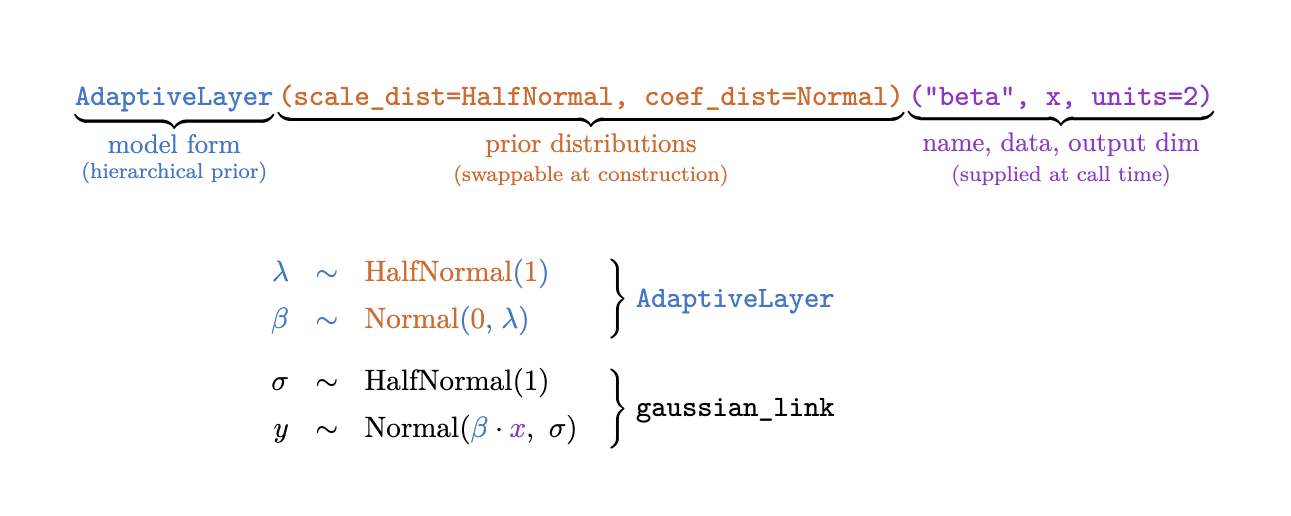
Easily build Bayesian models from parts, abstract away the boilerplate, and tweak priors as you wish.
Inspiration from Keras and Tensorflow Probability, but made specifically for Numpyro + Jax.
Scope. BLayers works best for structured Bayesian regression — GLMs, hierarchical /
mixed-effects models, factorization machines, splines, and sparse priors. Layers
are meant to be added together into a linear predictor (mu = layer1(...) + layer2(...) + ...). You can stack them into a deep net, but better tools exist for this:
numpyro.contrib.module's
random_flax_module / random_haiku_module instead — they drop a full Flax or
Haiku net into a NumPyro model with priors on the weights.
Every built-in layer must support both variational inference and HMC/NUTS. This is a requirement for adding new layers to the library.
BLayers provides tools to
- Quickly build Bayesian models from layers which encapsulate useful model parts
- Fit models either using Variational Inference (VI) or your sampling method of choice without having to rewrite models
- Write pure Numpyro to integrate with all of Numpyro's super powerful tools
- Add more complex layers (model parts) as you wish
- Fit models in a greater variety of ways with less code
The starting point
The simplest non-trivial (and most important!) Bayesian regression model form is
the adaptive prior (note I'm using a . to denote the regression sigma and any
prior on it just to save space),
scale ~ HalfNormal(1)
beta  ~ Normal(0, scale)
y     ~ Normal(beta * x, .)
BLayers encapsulates a generative model structure like this in a BLayer. The
fundamental building block is the AdaptiveLayer.
from blayers.layers import AdaptiveLayer
from blayers.links import gaussian_link

def model(x, y):
    mu = AdaptiveLayer()('mu', x)
    return gaussian_link(mu, y)
All AdaptiveLayer is doing is writing Numpyro for you under the hood. This
model is exactly equivalent to writing the following, just using way less code.
import jax.numpy as jnp
from numpyro import distributions, sample

def model(x, y):
    # Adaptive layer does all of this
    input_shape = x.shape[1]
    # adaptive prior
    scale = sample(
        name="scale",
        fn=distributions.HalfNormal(1.),
    )
    # beta coefficients for regression
    beta = sample(
        name="beta",
        fn=distributions.Normal(loc=0., scale=scale),
        sample_shape=(input_shape,),
    )
    mu = jnp.einsum('ij,j->i', x, beta)

    # the link function does this
    sigma = sample(name='sigma', fn=distributions.Exponential(1.))
    return sample('obs', distributions.Normal(mu, sigma), obs=y)
Mixing it up
The AdaptiveLayer is also fully parameterizable via arguments to the class, so let's say you wanted to change the model from
scale ~ HalfNormal(1)
beta  ~ Normal(0, scale)
y     ~ Normal(beta * x, .)
to
scale ~ Exponential(1.)
beta  ~ LogNormal(0, scale)
y     ~ Normal(beta * x, .)
you can just do this directly via arguments
from numpyro import distributions
from blayers.layers import AdaptiveLayer
from blayers.links import gaussian_link

def model(x, y):
    mu = AdaptiveLayer(
        scale_dist=distributions.Exponential,
        coef_dist=distributions.LogNormal,
        scale_kwargs={'rate': 1.},
        coef_kwargs={'loc': 0.}
    )('mu', x)
    return gaussian_link(mu, y)
"Factories"
Since Numpyro traces sample sites and doesn't record any parameters on the class, you can re-use with a particular generative model structure freely.
from numpyro import distributions
from blayers.layers import AdaptiveLayer
from blayers.links import gaussian_link

my_lognormal_layer = AdaptiveLayer(
    scale_dist=distributions.Exponential,
    coef_dist=distributions.LogNormal,
    scale_kwargs={'rate': 1.},
    coef_kwargs={'loc': 0.}
)

def model(x, y):
    mu = my_lognormal_layer('mu1', x) + my_lognormal_layer('mu2', x**2)
    return gaussian_link(mu, y)
Layers
The full set of layers included with BLayers:
AdaptiveLayer— Adaptive prior layer:scale ~ HalfNormal(1),beta ~ Normal(0, scale).FixedPriorLayer— Fixed prior over coefficients (e.g., Normal or Laplace), no hierarchical scale.InterceptLayer— Intercept-only layer (bias term).EmbeddingLayer— Bayesian embeddings for sparse categorical features.RandomEffectsLayer— Classical random-effects (embedding with output dim 1); learned variance component → partial pooling.RandomSlopesLayer— Group-specific slope deviations with one learned pooling scale per predictor/output, shared across groups.FixedEffectsLayer— Per-category coefficients with a fixed, user-specified prior; the no-pooling counterpart ofRandomEffectsLayer.FMLayer— Factorization Machine (order 2) for pairwise interaction terms.FM3Layer— Factorization Machine (order 3).LowRankInteractionLayer— Low-rank interaction between two feature sets.InteractionLayer— All pairwise interactions between two feature sets.HorseshoeInteractionLayer— Pairwise interactions with a per-pair horseshoe prior; the layer to reach for to identify sparse interactions (most pairs shrink to zero, the real ones stand out). Omitzfor unique within-feature pairsi<j; passzfor the full cross-set grid.BilinearLayer— Bilinear interaction:x^T W z.LowRankBilinearLayer— Low-rank bilinear interaction.AR1Layer— Stationary, mean-reverting effects over equally spaced time slots; learned persistence and innovation scale.PSplineLayer— Anchored B-spline smoother with learned second-difference penalties and a separate unpenalized-trend prior.RandomWalkLayer— Gaussian random walk prior over an ordered index (e.g., time).HorseshoeLayer— Horseshoe prior for sparse regression; global-local shrinkage via HalfCauchy.MixtureLayer— Finite mixture-of-priors on coefficients (default Normal + Laplace) with a logistic-normal (or fixed) weight; the component indicator is marginalised so it works under VI, MCMC, and SVGD. Good for robustness / elastic-net-style priors.HSGPLayer— Hilbert-space approximate Gaussian process (1-D, squared-exponential; Riutort-Mayol et al. 2021). A GP smoother that learns its own lengthscale; usehsgp_L(x_train)to pick the domain boundary.
All layer prior kwargs are validated at construction time — bad kwargs raise TypeError immediately.
Random slopes
RandomSlopesLayer adds partially pooled group-specific deviations to population
slopes. Each predictor/output gets its own learned scale; slopes are independent
conditional on those scales.
from blayers import AdaptiveLayer, InterceptLayer, RandomSlopesLayer, gaussian_link, fit

slopes = RandomSlopesLayer(scale_kwargs={"scale": 0.5})

def model(x, groups, num_categories, y=None):
    mu = (
        InterceptLayer()("intercept")
        + AdaptiveLayer()("population", x)
        + slopes("groups", x, groups, num_categories)
    )
    return gaussian_link(mu, y)

result = fit(model, x=X, groups=group_ids, num_categories=G, y=y,
             num_steps=20000, batch_size=256)
# The same model supports method="mcmc" (NUTS).
For predictor j and output u: scale[j, u] ~ HalfNormal(0.5) and
beta[g, j, u] ~ Normal(0, scale[j, u]). Smaller scales enforce stronger pooling.
The layer returns only deviations; add population coefficients separately.
Pass only predictors whose slopes should vary. A column of ones adds a varying
intercept. Slopes need within-group predictor variation to be learned.
VI scale estimates can be sensitive to parameterization and optimization time.
Compare autoreparam_model=False for strongly informed slopes: in the scale
recovery test, centered VI converges substantially faster than non-centered VI.
Both parameterizations are tested, along with NUTS.
groups must be integer IDs in [0, num_categories), shaped (n,) or (n, 1).
Keep num_categories and the ID mapping fixed across batches and prediction.
Reserve slots upfront for groups without training observations; their slopes
retain the prior conditional on the learned scales. Adding new group slots
or remapping existing IDs after fitting is unsupported. Invalid concrete IDs
raise errors; invalid IDs encountered under JIT produce NaNs instead of silently
wrapping or clipping. All coefficient-table entries are global latent variables
for the minibatched ELBO.
Links
We provide link helpers in links.py to reduce Numpyro boilerplate. Available links:
gaussian_link— Gaussian likelihood with configurable sigma prior (see below).lognormal_link— LogNormal likelihood with configurable sigma prior.student_t_link— StudentT likelihood for robust regression (defaultdf=4).gamma_link— Gamma likelihood (log link) for positive continuous data; learned shape.exponential_link— Exponential likelihood (log link) for positive / survival data.logit_link— Bernoulli link for binary logistic regression.categorical_link— Categorical / softmax link for multiclass classification (units = num_classes).poisson_link— Poisson link with log-rate input.negative_binomial_link— NegativeBinomial2 for overdispersed counts; learned concentration viaExponential.ordinal_link— Cumulative logit / proportional odds for ordinal outcomes.zip_link— Zero-inflated Poisson for count data with excess zeros.zinb_link— Zero-inflated NegativeBinomial2 for overdispersed, zero-heavy counts.beta_link— Beta regression for proportions strictly in (0, 1).
For a single response, likelihood helpers accept targets shaped either (n,)
or (n, 1), including models decorated with @autoreshape. They align the
singleton output dimension before evaluating the likelihood, so each row
contributes one log probability. Multi-output targets must match the predictor's
output dimensions; incompatible shapes raise ValueError. Predictive output
shapes retain the likelihood's existing convention.
For location-scale likelihoods, a vector scale or untransformed_scale is
interpreted as one scale per row. For multi-output predictions, use (1, units)
for per-output scales or (n, units) for a separate scale per row and output.
gaussian_link, lognormal_link, and student_t_link
All three share a common location-scale base and support three scale modes:
from blayers.layers import AdaptiveLayer
from blayers.links import gaussian_link

# Default: sigma ~ Exp(1) learned from data
gaussian_link(mu, y)

# Fixed known scale (e.g. from XGBoost quantile regression)
gaussian_link(mu, y, scale=pred_std)

# Learned scale from a layer — softplus applied internally for stable gradients
raw = AdaptiveLayer()("log_sigma", x)
gaussian_link(mu, y, untransformed_scale=raw)
Swap the sigma prior via functools.partial:
from functools import partial
import numpyro.distributions as dists
from blayers.layers import AdaptiveLayer
from blayers.links import gaussian_link

# HalfNormal prior instead of Exponential
hn_gaussian = partial(gaussian_link, sigma_dist=dists.HalfNormal, sigma_kwargs={"scale": 1.0})

def model(x, y=None):
    mu = AdaptiveLayer()("mu", x)
    return hn_gaussian(mu, y)
Splines
Non-linear transformations via B-splines. Compute the basis matrix once with make_knots + bspline_basis, then pass it to any layer.
from blayers.splines import make_knots, bspline_basis
from blayers.layers import AdaptiveLayer
from blayers.links import gaussian_link

knots = make_knots(x_train, num_knots=10)   # clamped knot vector from data quantiles

def model(x, y=None):
    B = bspline_basis(x, knots)             # (n, num_basis) design matrix
    f = AdaptiveLayer()("f", B)
    return gaussian_link(f, y)
Additive models are straightforward:
knots1 = make_knots(x1_train, num_knots=10)
knots2 = make_knots(x2_train, num_knots=10)

def model(x1, x2, y=None):
    f1 = AdaptiveLayer()("f1", bspline_basis(x1, knots1))
    f2 = AdaptiveLayer()("f2", bspline_basis(x2, knots2))
    return gaussian_link(f1 + f2, y)
Penalized splines
PSplineLayer learns smoothness by shrinking second differences of adjacent
B-spline coefficients (Eilers and Marx, 1996).
A smaller scale means stronger smoothing. Each output has its own scale.
from blayers import PSplineLayer, InterceptLayer, fit, gaussian_link
from blayers.splines import make_knots

knots = make_knots(x_train, num_knots=10)  # prepare once, outside the model
smooth = PSplineLayer(scale_kwargs={"scale": 0.5}, trend_scale=1.0)

def model(x, y=None):
    mu = InterceptLayer()("intercept") + smooth("f", x, knots)
    return gaussian_link(mu, y)

vi = fit(model, x=x_train, y=y_train, num_steps=5000)
# Also supports batch_size=128, or method="mcmc" for NUTS.
predictions = vi.predict(x=x_test)
The smooth equals zero at a fixed reference (the knot-domain midpoint by
default; override with reference=). An InterceptLayer provides the level.
The coefficient-linear trend has a proper Normal(0, trend_scale) prior and
is exempt from the smoothing penalty. With clamped or uneven knots this trend
is not necessarily exactly linear in the input, especially near boundaries.
It is already part of the smooth, so a separate linear term may be confounded.
Keep knots, degree, and reference fixed for fitting and prediction. Capture
knots in the model closure: passing them as array data to fit would batch
them as if they were observations. Outside the domain the curve holds its
boundary value. Smoothing priors depend on knot count and placement; inspect
prior curves when changing the basis. Multiple smooths add directly, each
anchored at its own reference.
AR(1) ordered effects
AR1Layer adds a zero-mean stationary process over an equally spaced integer
grid. It learns persistence rho in (-1, 1) and innovation SD scale, separately
for each output. Its recurrence is theta[t] = rho * theta[t-1] + scale * z[t],
with standard-normal innovations. The initial state has stationary SD
scale / sqrt(1-rho**2). Use a separate intercept for the population mean.
from blayers import AR1Layer, InterceptLayer, fit, gaussian_link

num_periods = 120  # includes future slots; retain this size after fitting
ar = AR1Layer(scale_kwargs={"scale": 0.5}, rho_concentration=2.0)

def model(time, y=None):
    mu = InterceptLayer()("intercept") + ar("time", time, num_periods)
    return gaussian_link(mu, y)

# time_train contains integer slots 0..99, possibly repeated or with gaps.
result = fit(model, time=time_train, y=y_train, method="mcmc")
# time_future contains reserved slots 100..119.
forecast = result.predict(time=time_future)
Reserve the forecast horizon before fitting. Future innovations remain latent, so forecasts include innovation uncertainty as well as parameter uncertainty. Keep missing periods in the grid: slots 2 and 5 are three steps apart. Irregular physical time intervals require a different model; this layer does not infer time spacing from row order. Repeated/unsorted observations and row-wise VI minibatches use the same full latent time grid.
The persistence prior is rho = 2*p - 1, with
p ~ Beta(rho_concentration, rho_concentration). The default 2 mildly favors
zero; 1 gives a uniform prior on (-1, 1). Negative persistence is supported.
scale is the innovation SD, not the stationary marginal SD. By default the
layer samples states directly. AR1Layer(noncentered=True) instead samples
standardized innovations; both forms define the same prior and support VI
and NUTS. This choice is independent of fit(autoreparam_model=...).
In our informative-data recovery test, direct-state diagonal VI recovers
persistence; innovation-based diagonal VI substantially underestimates it.
For weakly observed states the innovation form may be preferable. Correlated
posterior uncertainty, especially over missing/future periods, benefits from
guide=AutoMultivariateNormal or NUTS; the Gaussian posterior validity tests
use that full-covariance guide. Guide choice and convergence still need to
be assessed for your data.
Gaussian processes (HSGP)
HSGPLayer is a Hilbert-space approximate GP (Riutort-Mayol et al. 2021) — a smoother like splines, but it learns its own lengthscale and carries a proper GP interpretation. Pick the domain boundary L once on the training inputs with hsgp_L and reuse it at predict time; m is the number of basis functions (~20–50).
from blayers.layers import HSGPLayer, hsgp_L
from blayers.links import gaussian_link
from blayers.decorators import autoreshape

L = hsgp_L(x_train)     # domain boundary = 1.5 * max(|x|); fixed across fit/predict

@autoreshape
def model(x, y=None, L=L, m=30):
    f = HSGPLayer()("f", x, L=L, m=m)
    return gaussian_link(f, y)
Like splines, HSGP terms add for a GAM-style additive model (f1(x1) + f2(x2) + ...). Center/scale each input so it lies within [-L, L].
Mixture priors
MixtureLayer draws each coefficient from a finite mixture of priors (default Normal + Laplace) — useful for robustness (a heavy-tailed component absorbs outlier coefficients) or elastic-net-flavoured priors. The mixing weights get a logistic-normal prior by default (softmax of Normal(0, weight_scale) logits — an unconstrained parameterisation that fits under VI, MCMC, and SVGD), or pass fixed weights=. The component indicator is marginalised internally, so it works under VI, MCMC, and SVGD.
from blayers.layers import MixtureLayer
from blayers.links import gaussian_link

def model(x, y=None):
    mu = MixtureLayer()("beta", x)                 # Normal + Laplace, logistic-normal weights
    return gaussian_link(mu, y)
For sparse shrinkage prefer HorseshoeLayer.
fit() helpers
fit() handles the guide, ELBO, batching, and LR schedule. All built-in layers support both VI and HMC/NUTS; the fitting helpers also provide SVGD.
VI and MCMC automatically non-center supported latent distributions by default
(autoreparam_model=True). For VI, the default diagonal-normal guide is built
in these transformed coordinates, allowing hierarchical coefficient uncertainty
to vary with its learned prior scale. No @autoreparam decorator is needed.
Set autoreparam_model=False to keep the model's supplied parameterization;
centering can work better for strongly informed coefficients. SVGD is unaffected.
Guide classes work with automatic reparameterization. Prebuilt guide instances
and custom guide functions require autoreparam_model=False and must match the
supplied model; to non-center them, wrap the model with autoreparam before
constructing the guide and pass that same model to fit().
from blayers.fit import fit
from blayers.decorators import autoreshape
from blayers.layers import AdaptiveLayer, InterceptLayer
from blayers.links import gaussian_link

@autoreshape
def model(x, y=None):
    mu = AdaptiveLayer()("beta", x)
    intercept = InterceptLayer()("intercept")
    return gaussian_link(mu + intercept, y)

# Variational Inference (default)
result = fit(model, y=y, num_steps=1000, batch_size=256, lr=0.01, x=X)

# MCMC
result = fit(model, y=y, method="mcmc", num_mcmc_samples=1000, num_warmup=500, x=X)

# SVGD
result = fit(model, y=y, method="svgd", num_steps=1000, num_particles=20, x=X)
result.predict() returns a Predictions object with .mean, .std, and .samples. result.summary() returns posterior stats per latent variable.
preds = result.predict(x=X, num_samples=500)
summary = result.summary(x=X)
Keyword arguments that are JAX arrays are treated as data (batched during training). Non-array kwargs are bound as constants.
Diagnostics & model comparison (ArviZ)
result.to_arviz() hands the fit to ArviZ for R-hat,
ESS, divergences, PSIS-LOO, and the full plotting suite — reusing NumPyro's own
ArviZ bridge rather than reinventing diagnostics. Install with pip install blayers[arviz] (arviz ≥ 1.0, Python ≥ 3.12).
import arviz as az

# MCMC: divergences, R-hat, ESS, and log-likelihood come through automatically
idata = fit(model, y=y, method="mcmc", num_chains=2, x=X).to_arviz()
az.summary(idata)          # R-hat / ESS per latent
az.loo(idata)              # PSIS-LOO

# VI: pass the observed y (and inputs) so the log_likelihood group can be built
idata_vi = fit(model, y=y, num_steps=2000, x=X).to_arviz(y=y, x=X)

# Compare models on out-of-sample predictive fit
az.compare({"mcmc": idata, "vi": idata_vi})
SVGD is not supported by to_arviz() (too few particles to be a meaningful
sample for LOO); fit with method="mcmc" or method="vi" for comparison.
Model to LaTeX
model_to_latex() traces a model once and prints its generative form — every
prior plus the likelihood — as a block of sampling statements, the "methods
section" version you'd otherwise hand-transcribe. Pass the model and its inputs
the same way you would to fit(), but without y.
from blayers import AdaptiveLayer, InterceptLayer, RandomEffectsLayer, gaussian_link
from blayers.latex import model_to_latex

def model(x, g, y=None):
    mu = (
        InterceptLayer()("intercept")
        + AdaptiveLayer()("mu", x)
        + RandomEffectsLayer()("grp", g, num_categories=n_groups)
    )
    return gaussian_link(mu, y)

print(model_to_latex(model, x=X, g=G))   # raw LaTeX
model_to_latex(model, x=X, g=G)           # renders inline in a notebook
\begin{align}
\beta_{\mathrm{intercept}} &\sim \mathrm{Normal}(0, 1) \\
\lambda_{\mathrm{mu}} &\sim \mathrm{HalfNormal}(1) \\
\beta_{\mathrm{mu}} &\sim \mathrm{Normal}(0, \lambda_{\mathrm{mu}}) \\
\lambda_{\mathrm{grp}} &\sim \mathrm{HalfNormal}(1) \\
\theta_{\mathrm{grp}} &\sim \mathrm{Normal}(0, \lambda_{\mathrm{grp}}) \\
\sigma &\sim \mathrm{Exponential}(1) \\
y_i &\sim \mathrm{Normal}(\eta_i,\; \sigma),\quad i = 1, \dots, n
\end{align}
The hierarchy is recovered automatically: a coefficient whose scale is a sampled
site prints Normal(0, λ), not a number. Priors and the likelihood are exact
(read straight from the trace); how the layers combine into the linear
predictor lives in plain Python, so it's denoted η_i rather than reconstructed.
The return value is a str (so print() gives raw LaTeX) that also renders as
typeset math in Jupyter.
Batched loss
The default Numpyro way to fit batched VI models is to use plate, which confuses
me a lot. Instead, BLayers provides Batched_Trace_ELBO which does not require
you to use plate to batch in VI. Just drop your model in.
from numpyro.infer import SVI
from numpyro.infer.autoguide import AutoDiagonalNormal
import optax
from blayers.vi_infer import Batched_Trace_ELBO, svi_run_batched

loss = Batched_Trace_ELBO(num_obs=len(y), batch_size=1000)
guide = AutoDiagonalNormal(model_fn)
svi = SVI(model_fn, guide, optax.adam(0.01), loss=loss)

svi_result = svi_run_batched(
    svi,
    rng_key,
    batch_size=1000,
    num_steps=500,
    **model_data,
)
The likelihood is scaled by N / B, where B is the actual number of
rows in each batch, including a short final batch. Array inputs must be aligned
by row; bind static arrays such as spline knots into the model with a closure
or functools.partial. The constructor's batch_size is a fallback for loss
calls without array inputs.
NumPyro scale and mask handlers are preserved for both model and guide
sites. All observed sites, including numpyro.factor terms, are treated as
row-wise likelihood contributions and scaled by N / B; global latent priors
and guide densities are not batch-scaled. Models with global factors or
per-observation latent variables need a standard NumPyro ELBO instead.
⚠️⚠️⚠️ numpyro.plate + Batched_Trace_ELBO do not mix. ⚠️⚠️⚠️
Batched_Trace_ELBO does not support numpyro.plate: its N / batch_size log-likelihood rescaling double-counts plate-subsampled sites and yields an incorrect ELBO. If your model needs plates, either:
- Batch via
plateand use the standardTrace_ELBO, or - Remove plates and use
Batched_Trace_ELBO+svi_run_batched.
Batched_Trace_ELBO raises ValueError if your model contains a plate.
Reparameterizing
To fit MCMC models well it is crucial to reparameterize. BLayers helps you do this via @autoreparam, which automatically applies LocScaleReparam to all LocScale distributions in your model (Normal, LogNormal, StudentT, Cauchy, Laplace, Gumbel).
Note:
fit(method="vi")andfit(method="mcmc")already apply@autoreparamfor you (controlled byautoreparam_model=True, on by default). Apply the decorator yourself when driving SVI or NUTS / HMC manually, as shown below for MCMC.
from numpyro.infer import MCMC, NUTS
from blayers.layers import AdaptiveLayer
from blayers.links import gaussian_link
from blayers.decorators import autoreparam

data = {...}

@autoreparam
def model(x, y):
    mu = AdaptiveLayer()('mu', x)
    return gaussian_link(mu, y)

kernel = NUTS(model)
mcmc = MCMC(
    kernel,
    num_warmup=500,
    num_samples=1000,
    num_chains=1,
    progress_bar=True,
)
mcmc.run(
    rng_key,
    **data,
)
1 maintainer

Metadata
1 maintainer
Release files for blayers 0.3.8
For a detailed explanation of source distributions (sdists) and built distributions (wheels), please see the package formats documentation.
Source distribution (sdist)
| File | Size | Uploaded | |
|---|---|---|---|
| blayers-0.3.8.tar.gz | 63.3 kB | Details |
Built distribution (wheel)
| File | Interpreter | ABI | Platform | Reset |
|---|---|---|---|---|
| blayers-0.3.8-py3-none-any.whl | Python 3 | none | any | Details |
Total release size: 120.3 kB
Release files / blayers-0.3.8.tar.gz
| Download URL | blayers-0.3.8.tar.gz |
|---|---|
| Size | 63.3 kB |
| Tags | Source |
|
SHA-256 checksum How to use checksums |
aaae6728f5ba9d5d83547b6677d6c1f73f266ebc89e8192b40cb64c50fcfb50f
|
|
BLAKE2b-256 checksum How to use checksums |
4a371f7f389e8e4ca1191ec7161a74e2e85e2df0013ff028d79b857eb59e953c
|
| Upload date | |
|
Uploaded using Trusted Publishing? What is trusted publishing? |
Yes |
| Uploaded via |
twine/7.0.0 CPython/3.13.14
|
Provenance
Provenance describes where a file came from. On PyPI, provenance is shared via attestations, which provide a verifiable record of the build or publishing details. View details, limitations and caveats.


PyPI Publish Attestation
PyPI verified that this artifact, at this checksum, originated from the publisher listed below.
Signed by GitHub Actions, verified by PyPI on Oct 13, 2026.
Transparency logRelease files / blayers-0.3.8-py3-none-any.whl
| Download URL | blayers-0.3.8-py3-none-any.whl |
|---|---|
| Size | 57.1 kB |
| Tags | Python 3 |
|
SHA-256 checksum How to use checksums |
da73b27f2fa3801fcbad94a21187cd22ec3beaf3d11671bd1a6e5caea0786a40
|
|
BLAKE2b-256 checksum How to use checksums |
dd110ebfbd23e3163b0fbc129fbb74e4710b8959576ff9fdcaf9532627db84b0
|
| Upload date | |
|
Uploaded using Trusted Publishing? What is trusted publishing? |
Yes |
| Uploaded via |
twine/7.0.0 CPython/3.13.14
|
Provenance
Provenance describes where a file came from. On PyPI, provenance is shared via attestations, which provide a verifiable record of the build or publishing details. View details, limitations and caveats.
PyPI Publish Attestation
PyPI verified that this artifact, at this checksum, originated from the publisher listed below.
Signed by GitHub Actions, verified by PyPI on Oct 13, 2026.
Transparency log













