




blue-sampler
Generate large hyperuniform point patterns (i.e. blue noise) on the unit torus $[0, 1)^D$, uniformly or following a given target distribution.
Hyperuniform point patterns exhibit vanishing density fluctuations at low frequencies, making them particularly suited for Monte Carlo integration, image stippling, and any application requiring well-distributed, low-discrepancy points.
For the companion dataset of this repository, with pregenerated hyperuniform samples in various dimensions, see hyperuniform-samplers
📦 Installation
pip install blue-sampler
Quick Start
import blue_sampler as blue

# Generate 10,000 2D blue-noise points
x = blue.sample_points(N=10_000, D=2)
blue.plot(x)

# Structure factor
blue.plot_structure_factor(x)

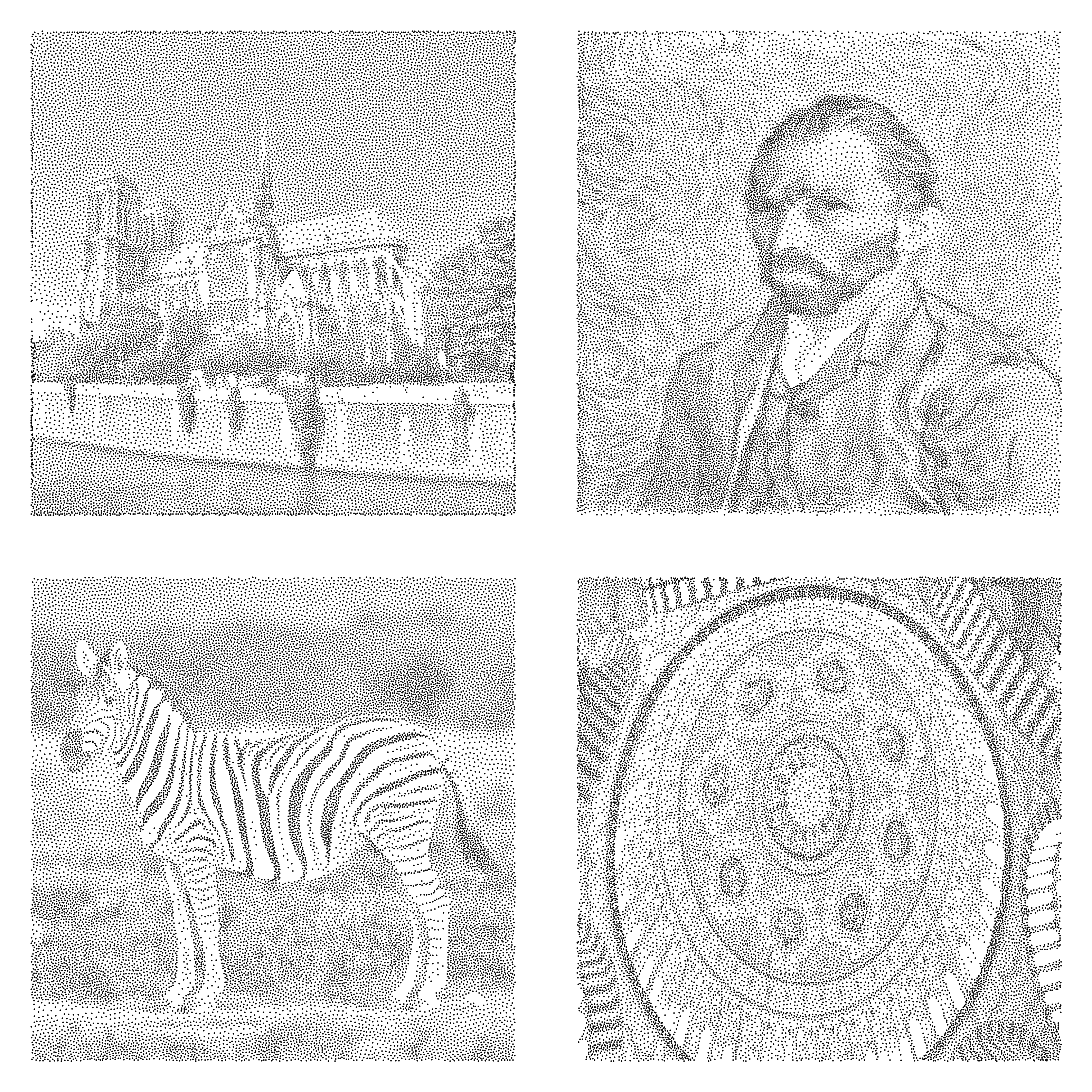
# Image stippling
x = blue.image_to_points("plots/zebra.jpg")
🖼️ Examples
Uniform sampling (3k points)
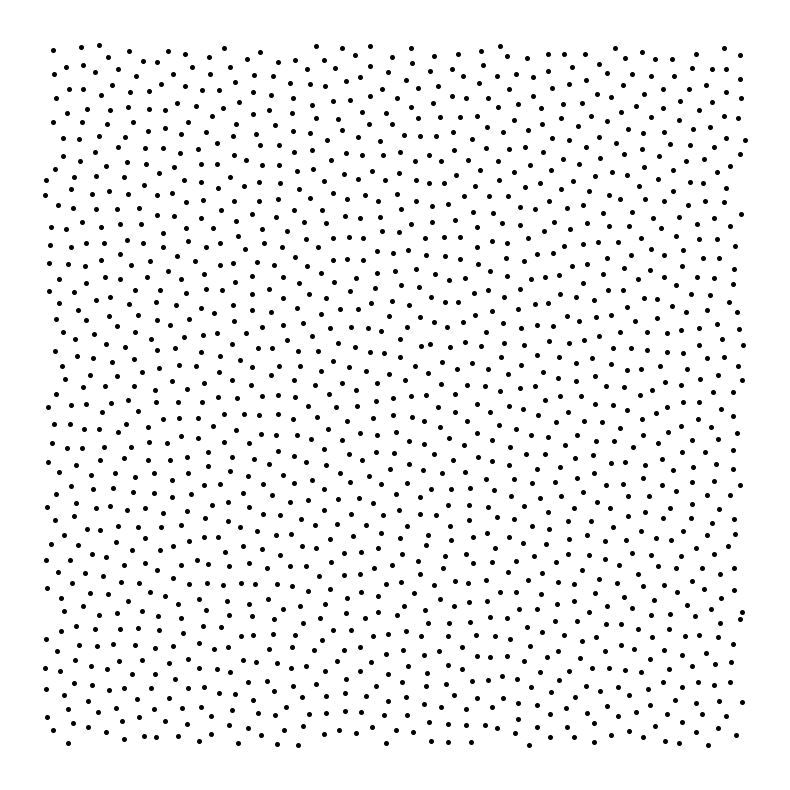
Image stippling (20k points)
📋 Available Samplers
Main sampling methods
x = blue.sample_points(N, D, method="rgbn") #(N, D)
| Method | Description |
|---|---|
gaussian |
original Gaussian-Blue-Noise sampler (high quality, slow), A. G. M. Ahmed, J. Ren, and P. Wonka. |
rgbn |
Recursive Gaussian-Blue-Noise (speed-up GBN with recursive initialisation) |
nufft/nufft+ |
Non-Uniform FFT (speed-up spectral methods with fast fourier transform) |
cstit |
Fair-STIT inspired clustering (clusters replace complex polygon geometry) |
latjit |
fast and simple lattice jittering |
Supported Dimensions
| Dimension | Status |
|---|---|
| 2–3D | Fast |
| 4–5D | Supported |
| ≥6D | Experimental |
All presented samplers but the original GBN (quadratic complexity), having near linear complexity in the number of points, are thus intended to scale up to million points beyond the minute (GPU) or 20 minutes (CPU) in low dimension (<=3d). They all face increasing challenges when the dimension grow, whether it being the hyperuniformity strength or the required sampling runtime. The recommanded default is:
- dimension D = 2:
rgbn(non-uniform target),nufft(uniform points) - dimension D = 3:
nufft - dimension D = 4/5:
rgbnorgaussian(depending on N + gpu availability) - dimension 6 or more:
gaussian
If sampling runtime is realy a problem, then cstit is recommended (much faster, but not so good blue noise)
. QUality can be checked with the structure factor.
Note on GPU support: Most methods can run on CPU only, but they can benefit from GPU acceleration. To install the optional GPU dependencies for a
cuda12environment:pip install blue-sampler[gpu12]On
cuda13:pip install blue-sampler[gpu13]If the CUDA installation fails, you may need to install
jax,cupy, andcufinufftmanually. Once installed, you can check that GPU support is correctly configured by running:import blue_sampler blue_sampler.check_gpu()
Note on Keops acceleration: gaussian and nufft (if dimension D >= 4) samplers will get much faster on gpu, if
pykeopsis installed on the hardware along with all it's dependency (which will be automatically detected). This is optional, and mainly usefull to sample large datasets on a GPU. See pykeops documentation
Note on structure factor: The structure factor characterizes the density fluctuations of the points in Fourier space and is equivalent to the power spectrum (up to normalization). The estimation of structure factor assumes that the points domain is the unit hypercube and uses the standard
scattering intensityestimator. To compute and plot a structure factor:blue.plot_structure_factor(points)
Documentation & Links 🔗
- 📖 Documentation: https://blue-sampler.readthedocs.io
- 📦 PyPI: https://pypi.org/project/blue-sampler
- 💻 GitHub: https://github.com/For-a-few-DPPs-more/rgbn
References
The algorithms and mathematical tools implemented in blue-sampler are based or inspired from the following works.
-
Gaussian Blue Noise (repulsive interaction kernel)
A. G. M. Ahmed, J. Ren, and P. Wonka.
Gaussian Blue Noise.
ACM Transactions on Graphics (SIGGRAPH Asia), 41(6), 2022.
DOI: 10.1145/3550454.3555519 -
FReSCo A. Shih, M. Casiulis, and S. Martiniani.
Fast Generation of Spectrally-Shaped Disorder.
Physical Review E, 110(3):034122, 2024.
DOI: 10.1103/PhysRevE.110.034122 -
STIT tessellations and moment matching
L. Lotz and M. A. Klatt.
Persistence of asymptotic variance under transport: from hyperfluctuation to stealthy hyperuniformity.
arXiv:2605.22803, 2026. -
Aperiodic tiling for hyuperuniformity (here pinwheel)
A. Gabrielli, B. Jancovici, M. Joyce, J. L. Lebowitz, L. Pietronero, and F. Sylos Labini.
Generation of Primordial Cosmological Perturbations from Statistical Mechanical Models.
Physical Review D, 67(4):043506, 2003. -
Gridpoints.
Grid data structure for point clouds, codeveloped with RGBN
for efficient neighbor query and fourier trnasform in Python. -
Sobol sequences
Wrapped fromscipy.stats.qmc.Sobol(SciPy).
The package strongly benefits from following libraries:
-
Nufft: The non uniform fast fourier transform (nufft) is performed using the finufft / cufinufft library [FIN] A parallel non-uniform fast Fourier transform library based on an “exponential of semicircle”
kernel. A. H. Barnett, J. F. Magland, and L. af Klinteberg. SIAM J. Sci. Comput. 41(5), C479-C504 (2019). -
KEOPS B. Charlier, J. Feydy, J. A. Glaunès, F.-D. Collin, and G. Durif. “Kernel Operations on the GPU, with Autodiff, without Memory Overflows.” Journal of Machine Learning Research, 22(74):1–6, 2021. See keops.
Alternative Samplers (extras)
import blue_sampler.extras as bluex
Sobol sequence 📏
x = bluex.sobol(N, D) #(N, D)
Low-discrepancy quasi-random sequence.
STIT Tessellations (2D only) 🧩
# Raw STIT tessellation (quadrilaterals)
ts = bluex.sample_tessels(N) #(N, 4, D=2)
bluex.plot_tessels(ts)

# Convert to point set
x = bluex.tessel_to_points(ts) #(N, m, D=2)
Pinwheel Tilings (2D only) 𖣘
# Base pinwheel triangle
pw0 = bluex.pinwheel_base()  #(3, D=2)

# Triangulation level 4
pw4 = bluex.pinwheel_transform(pw0, depth=4) #(4*5**depth, 3, D=2)
bluex.plot_polygons(pw4)

#===============================
# Convert Pinwheel to point set:
#===============================
#sample points from the BASE pinwheel
x0 = bluex.tessel_to_points(pw0) #(m, D=2)
#then replicate the sample on the full triangulation,
#in a fractal way
x4 = bluex.pinwheel_transform(x0, depth = 4) #(4*5**depth, m, D=2)
Positioning and scope
One can find extensive Blue-noise and hyperuniform sampling methods in the literature, all involving different trade-offs between spectral quality, computational cost, dimensionality, hardware requirements, implementation complexity, and support for adaptive sampling. To briefly cite some of them: Perturbed lattices are simple and fast; Poisson-disk is a mature and popular tool; Void-and-Cluster masks offer instant execution but are restricted to regular grids; Relaxation methods (such as Lloyd or CCVT) are classic but slow to converge and prone to structural artifacts; Optimal Transport (BNOT) provides natural adaptive sampling but is computationally heavy; Gaussian blue noise (GBN) achieves ultra-high spatial quality but has quadratic complexity; and Fast reciprocal space Correlator (FReSCo) combines ultra-high quality with near-linear complexity, though it requires installing heavy external dependencies or familiarity with docker containers.
blue-sampler is not intended as a universal replacement for these methods. It is a lightweight Python framework for experiments on blue noise and hyperuniformity, targeting simple installation (native Python code, jax powered) and device flexibility (CPU/GPU), high spectral quality (achieving the commonly accepted "stealthy" criterions $S(k) \lesssim 10^{-3} - 10^{-4}$), adaptive sampling, and support for 3D and higher dimensions.
License
MIT
1 maintainer

Metadata
1 maintainer
Release files for blue-sampler 4.0.0
For a detailed explanation of source distributions (sdists) and built distributions (wheels), please see the package formats documentation.
Source distribution (sdist)
| File | Size | Uploaded | Provenance | Actions |
|---|---|---|---|---|
| blue_sampler-4.0.0.tar.gz | 129.6 kB | Without provenance | Details for blue_sampler-4.0.0.tar.gz |
Built distribution (wheel)
| File | Interpreter | ABI | Platform | Actions Reset |
|---|---|---|---|---|
| blue_sampler-4.0.0-py3-none-any.whl | Python 3 | none | any | Details for blue_sampler-4.0.0-py3-none-any.whl |
Total release size: 204.7 kB
Release files / blue_sampler-4.0.0.tar.gz
| Download URL | blue_sampler-4.0.0.tar.gz |
|---|---|
| Size | 129.6 kB |
| Tags | Source |
|
SHA-256 checksum How to use checksums |
a2868b9dc2f9269112b3d4471743d143669caa6da1c8c040bade5fe4a0864cb6
|
|
BLAKE2b-256 checksum How to use checksums |
f560dffe69dee41ea6cf2b7dcf82326cae370ee950c4860c41d344df76c98aa7
|
| Upload date | |
|
Uploaded using Trusted Publishing? What is trusted publishing? |
No |
| Uploaded via |
twine/7.0.0 CPython/3.14.4
|
Release files / blue_sampler-4.0.0-py3-none-any.whl
| Download URL | blue_sampler-4.0.0-py3-none-any.whl |
|---|---|
| Size | 75.1 kB |
| Tags | Python 3 |
|
SHA-256 checksum How to use checksums |
1900553c86f5667208e2d572cd5cea04eebb23deaf0c9c933aab8f272450eab9
|
|
BLAKE2b-256 checksum How to use checksums |
f6e76a2cb7dadf8c2aef2d347a107d3fc12563e87d5445526cadf5ec312c6edc
|
| Upload date | |
|
Uploaded using Trusted Publishing? What is trusted publishing? |
No |
| Uploaded via |
twine/7.0.0 CPython/3.14.4
|
Security for blue-sampler 4.0.0
Provenance
Provenance describes where a file came from. On PyPI, provenance is shared via attestations, which provide a verifiable record of the build or publishing details. View details, limitations and caveats.
No provenance found
None of the files in this release were uploaded with provenance metadata.
A note on package security
PyPI is a repository for distributing packages, not a service for auditing them. While third-party security researchers and our staff do their best to detect and remove malicious packages, PyPI cannot guarantee the quality, security or suitability of any given package.
To learn more about protecting yourself from malicious actors, visit our package security documentation.














