
Agent-native AWS misconfiguration detection and remediation powered by BlueArch rules.
Verified details
These details have been verified by PyPIProject links
GitHub Statistics
Maintainers

Project description
BlueArch AWS Steward
BlueArch AWS Steward Beta: an MCP-first, read-only AWS recommendation and remediation planning engine.
BlueArch AWS Steward is a local, MCP-first AWS assessment and guarded remediation engine. It evaluates live AWS configuration against the BlueArch misconfiguration catalog, returns only resources caught by executable rules, builds evidence-backed remediation plans, and verifies approved changes.
Steward is standalone. It does not use BlueArch Core, hosted login, hosted telemetry, or a local AWS inventory database. AWS remains the source of truth.
What It Provides
- 100 native rules across 16 runtime scopes.
- Searchable knowledge for all 631
aws-misconfig-dbcatalog entries. - Point-in-time, read-only assessments using user-owned AWS credentials.
- MCP-native clarification for objective, service, profile, and Region.
- Guided, focused, and full-report assessment modes with multi-objective and multi-service selection.
- Background assessments with status, partial results, and cancellation.
- Complete ephemeral findings with filtered, cursor-paginated exploration that does not rescan AWS.
- Local JSON, Markdown, HTML, CSV, SARIF, and PDF report exports.
- Automatic terminal PDF choice; prompts do not need to request reporting.
- Evidence, risk, cost estimate status/confidence, and remediation safety on every presented finding.
- No assessment applies AWS changes; guarded writes require approval of one exact short-lived plan.
- Structured resource identity and redacted evidence using schema
0.2. - Planning for every native finding and guarded apply for eight low-risk rules.
- One prioritized queue combining native Steward, live Security Hub, Compute Optimizer, Cost Optimization Hub, and optional Prowler/exported JSON signals.
- Source-independent deduplication with provenance, freshness, confidence, evidence, live-validation status, and an explainable 0-100 priority score.
Steward complements broad scanners such as Prowler and AWS Security Hub. It is
not a replacement for either product, a continuous inventory, or an autonomous
AWS administrator. Its focus is the local last mile from a finding to a
reviewed AWS or IaC fix and post-fix verification. See
docs/competitive-strategy.md and
docs/expansion-plan.md for positioning and roadmap.
Install
Steward requires Python 3.10 or newer. The recommended uv installer can
manage a compatible Python runtime and works on macOS and Linux:
curl -LsSf https://astral.sh/uv/install.sh | sh
On macOS, Homebrew is also supported:
brew install uv
The intended public installation is a persistent, isolated uv tool:
uv tool install 'bluearch-aws-steward==0.7.0b4'
uv tool update-shell
bluearch-steward --version
bluearch-steward mcp smoke
Register the installed runtime with one or more supported MCP clients:
bluearch-steward mcp install --client codex
bluearch-steward mcp install --client cursor
bluearch-steward mcp install --client claude
Use --dry-run to preview changes. Existing client configuration is preserved,
and changed configuration files are backed up before installation. Restart the
client after registration.
For clients that should resolve the exact released package on demand, generate
a version-pinned uvx configuration:
bluearch-steward mcp config --runtime uvx
The package is not published yet. The tag-only preview workflow builds and validates the exact distribution, publishes it to TestPyPI, and creates a draft GitHub prerelease. PyPI publication starts only when a maintainer manually publishes that draft release. Ordinary pushes and pull requests cannot publish packages.
Until then, install a repository checkout:
git clone https://github.com/bluearchio/bluearch-aws-steward.git
cd bluearch-aws-steward
make dev-sync
Configure an MCP client to start the repository runtime over stdio. Use the absolute repository path in local installations:
{
  "mcpServers": {
    "bluearch-aws-steward": {
      "command": "/absolute/path/bluearch-aws-steward/.venv/bin/bluearch-steward-mcp",
      "args": [],
      "env": {
        "AWS_SDK_LOAD_CONFIG": "1",
        "PYTHONUNBUFFERED": "1"
      }
    }
  }
}
uv run python -m bluearch_aws_steward mcp config generates this shape with an
absolute environment path. After changing source, run make dev-sync and then
restart the MCP server or start a new agent task. This reinstalls the current
checkout instead of allowing an MCP startup to mutate the environment; an
already running Python process does not hot reload modules.
See docs/public-installation.md for package,
upgrade, uninstall, and MCP-client setup flows. Maintainers should follow
docs/publishing-preview.md for the guarded
TestPyPI and PyPI release procedure.
Verify the active runtime at any time:
make runtime-info
The checkout version, installed package metadata version, and runtime version must match. The check runs outside the repository so a stale package cannot be hidden by Python importing the working directory.
Do not put credentials, SSO tokens, a default profile, or a default Region in the MCP configuration. Steward uses the AWS SDK credential chain and asks the user when multiple contexts are possible.
First Assessment
-
Configure AWS credentials outside the conversation. AWS SSO users can run:
aws sso login --profile my-sso-profile
-
Restart or reconnect the MCP client.
-
Ask:
Assess my AWS environment comprehensively. Ask me to select the AWS profile and Region. Show only resources caught by native rules, report skipped rules and coverage.
Steward returns an assessment ID immediately. The client polls status, may read
partial results, and retrieves concise solution cards without starting the scan
again. Every finding remains queryable and exportable from process memory for
15 minutes. A 50,000-finding guard reports incomplete=true and an exact reason
instead of silently truncating a complete assessment.
Read-only assessment, finding evidence and risk, cost estimate status and confidence, individual-plan approval, and the terminal PDF choice are product defaults; users do not need to request them in the prompt.
See docs/prompt-library.md for focused cost,
security, reliability, catalog, planning, and verification prompts.
Unified Recommendation Queue
Native rules remain the default. Select additional AWS recommendation sources when the account has them enabled:
{
  "prompt": "Build one prioritized queue from all available recommendation sources.",
  "services": ["all"],
  "objectives": ["all"],
  "signal_sources": [
    "native",
    "security-hub",
    "compute-optimizer",
    "cost-optimization-hub"
  ]
}
Steward reads each selected source during the same point-in-time assessment.
It fingerprints account, Region, canonical resource, and canonical problem;
merges corroborating signals; preserves every source receipt; and returns one
recommendation. Current native evidence can resolve an equivalent stale config
finding, but a narrower native detector never invalidates a broader Compute
Optimizer or Cost Optimization Hub recommendation. Missing permissions or an
AWS service that is not enabled appears under capability_errors and
incomplete_sources; it is never reported as clean.
bluearch_query_results can filter the queue by sources and
validation_statuses. Every report format includes the fingerprint, source
list, freshness, priority score, evidence, risk, savings estimate/confidence,
and remediation safety.
MCP Workflow
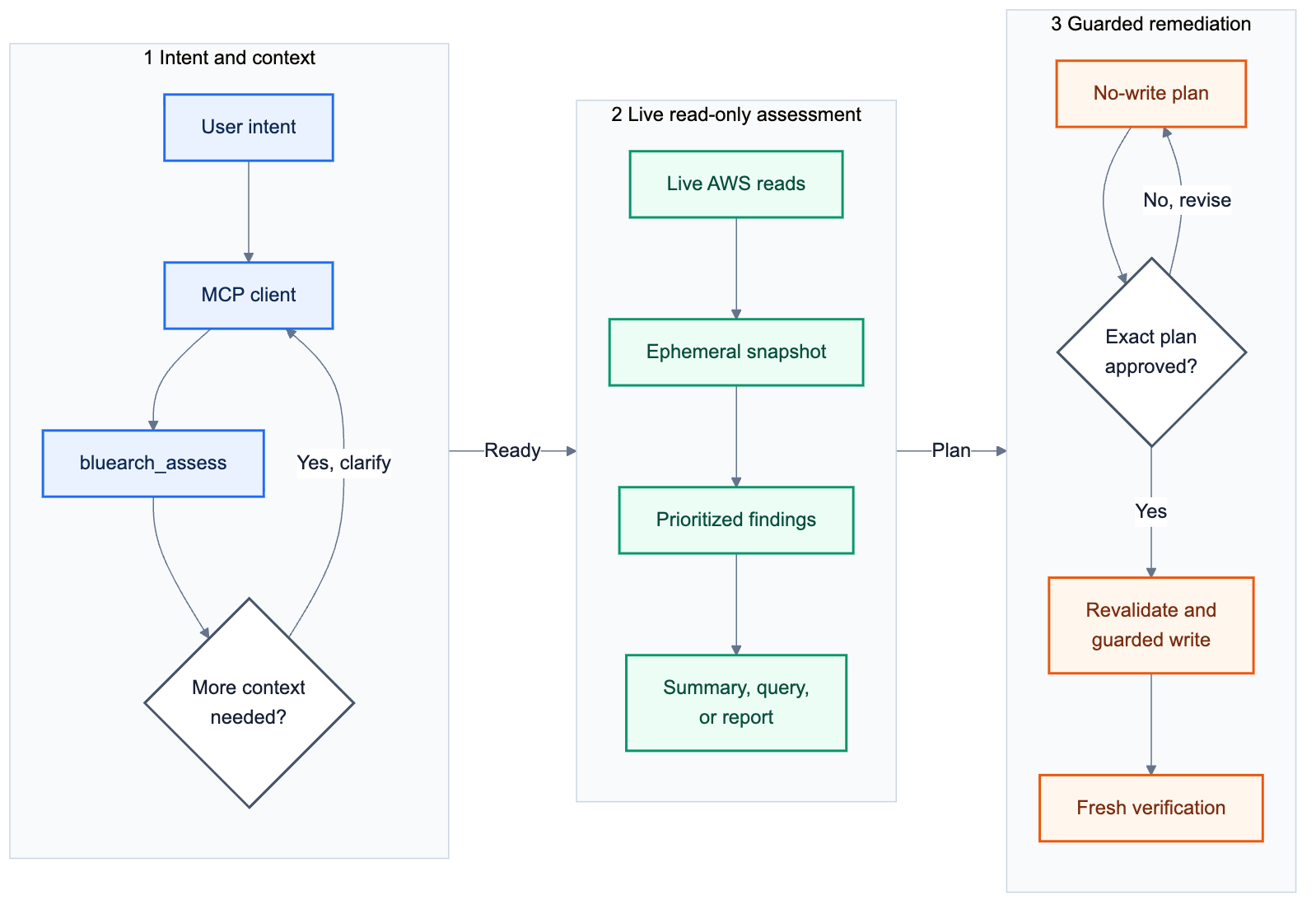
Primary tools:
| Tool | Purpose | AWS write |
|---|---|---|
bluearch_assess |
Resolve intent and start a background assessment. | No |
bluearch_list_aws_profiles |
List non-secret AWS profile metadata for user selection. | No |
bluearch_import_findings |
Import supported external finding JSON into an ephemeral assessment. | No |
bluearch_get_scan_status |
Return progress without repeating work. | No |
bluearch_get_scan_results |
Return final or include_partial results. |
No |
bluearch_query_results |
Filter, sort, facet, and paginate the stored snapshot without rescanning. | No |
bluearch_export_report |
Export a completed result, including local PDF with charts. | No |
bluearch_cancel_assessment |
Stop pending work and preserve completed reads. | No |
bluearch_get_resource_details |
Inspect or refresh one matched resource. | No |
bluearch_get_coverage |
Report catalog and native detector coverage. | No |
bluearch_status |
Check runtime, AWS identity, and rule coverage. | No |
bluearch_rules_search |
Search all 631 catalog rules. | No |
bluearch_explain_finding |
Explain evidence and impact. | No |
bluearch_plan_remediation |
Revalidate and create a short-lived plan. | No |
bluearch_apply_remediation |
Apply an exact approved plan. | Guarded |
bluearch_verify_remediation |
Re-read AWS and verify selected findings. | No |
The legacy CLI and Textual dashboard remain developer diagnostics. The normal user flow is MCP.
Detection Coverage
bluearch_get_coverage reports:
| Measure | v0.7.0b4 |
|---|---|
| Catalog rules | 631 |
| Native canonical rules | 100 |
| Native aliases | 7 |
| Runtime scopes | 16 |
| Catalog automation | 15.85% |
Runtime scopes are iam, cloudtrail, cloudwatch, dynamodb, s3, ec2,
rds, lambda, efs, ecs, alb, kms, secrets-manager, sns, sqs,
and api-gateway. The aliases ebs and networking route to the EC2 collector
and do not increase the canonical rule count.
All 100 current rules have access_tier: free. This is the stable open-source
baseline. Future canonical rules beyond this baseline are reserved for a
premium tier unless the project governance explicitly promotes them. v0.7.0
does not add hosted login, licensing calls, or telemetry; entitlement enforcement
is a separate future boundary.
Every result distinguishes evaluated, skipped, and unevaluated rules. A rule blocked by provider capability or AWS permissions is skipped with a reason; it is never reported as passing. Zero findings means only that no evaluated rule matched.
See docs/rule-coverage.md for the complete native
rule list and evidence type.
Release Status
The current 0.7.0b4 work is a release candidate, not a published stable release.
Public-preview and stable-release gates are tracked in
docs/public-release-readiness.md. The
planned progressive result experience is documented in
docs/result-experience-plan.md.
Source adapter contracts and the security boundary are documented in
docs/source-compatibility.md and
docs/security-threat-model.md.
Safety Model
Read access is generated from the typed operation registry:
Keep those policies on separate roles. Routine assessment needs only the read policy.
Most findings are planning-only. Guarded apply is limited to:
- S3 public access block, default encryption, lifecycle, versioning, and server access logging;
- CloudWatch Logs retention;
- CloudTrail log file validation; and
- ALB access logging.
S3 and ALB logging require a pre-existing destination in the selected Region,
SSE-S3 encryption, and a bucket policy that grants s3:PutObject to the
appropriate AWS log-delivery service principal for the requested prefix. An S3
server-access-log destination must not have server access logging enabled; an
ALB prefix must not contain AWSLogs. Steward validates these conditions when
planning and immediately before applying. It never creates destination buckets,
bucket policies, credentials, or supporting infrastructure. It does not
automatically delete resources, rotate keys, remove permissions, stop workloads,
change traffic, or perform migrations.
Every write requires:
- a fresh read that reproduces the finding;
- a server-held plan with exact operation, preconditions, IAM, rollback, and verification;
- a short expiry and digest;
- unchanged account, Region, and live resource state; and
- explicit
allow_write=truefor that exact plan.
Architecture
MCP client
  -> intent and AWS-context refinement
  -> ephemeral assessment store
      -> concise conversational projection
      -> filtered cursor-paginated exploration
      -> prioritized remediation queue
      -> complete report export
  -> collector registry + ExecutableRuleSpec registry
  -> live recommendation-source adapters + deterministic deduplication
  -> AWS SDK provider (default) or AWS CLI compatibility provider
  -> typed read allowlist + assessment-local metric cache
  -> detectors + structured evidence
  -> plan store + explicit guarded writes
Service collectors run with bounded concurrency. A service snapshot is reused
between its rules, and rule_filter narrows both rules and AWS calls.
Twenty-four signal rules batch CloudWatch GetMetricData requests through an
assessment-local cache. Missing metric data is unknown, never zero.
This release does not include multi-account traversal, all-Region orchestration,
IaC scanning, attack graphs, hosted history, telemetry, or an AWS MCP provider.
See docs/expansion-plan.md for the planned rule,
LocalEmu, EKS, performance, and IaC remediation expansion path.
Development
Install quality tools with Python 3.10, 3.11, or 3.13:
make dev-sync
make test
make quality
make security
make package
Run the actual stdio MCP protocol against deterministic LocalEmu fixtures:
make emulator-doctor
make emulator-mcp-e2e
The E2E proves assess -> status -> partial results -> unified source deduplication -> concise results -> paginated complete query -> complete PDF -> plan -> verify using dummy
credentials and no writes. make emulator-coverage also
requires a positive finding for every one of the 100 active rules through the
AWS SDK and AWS CLI providers. Eighty-eight fixtures use LocalEmu APIs directly;
twelve historical, account-level, metric-dimension, or synthetic-size states use
a test-only loopback response overlay documented in
tests/aws-emulator/rule-map.yml.
LocalEmu remains running unless make emulator-down is called.
For a manual read-only AWS validation:
AWS_PROFILE=my-sso-profile AWS_REGION=us-east-1 make aws-live-cost-parity
AWS_PROFILE=my-sso-profile AWS_REGION=us-east-1 make aws-live-mcp
Never place AWS credentials in GitHub Actions. CI uses dummy credentials with
LocalEmu and never selects an AWS profile. LocalStack remains available only as
an optional compatibility target through make localstack-compat-coverage.
Catalog And IAM Artifacts
Refresh the catalog from a sibling aws-misconfig-db checkout:
.venv/bin/python -m bluearch_aws_steward rules sync --source ../aws-misconfig-db
make catalog-check CATALOG_SOURCE=../aws-misconfig-db
.venv/bin/python -m bluearch_aws_steward.iam_policies
.venv/bin/python -m bluearch_aws_steward.iam_policies --check
make test is standalone and does not require a sibling catalog checkout.
make catalog-check is the explicit maintainer gate that compares the bundled
catalog with a selected aws-misconfig-db checkout.
Catalog text is untrusted data. Only reviewed ExecutableRuleSpec mappings may
drive AWS calls or pass/fail results.
Contributing And Security
Read CONTRIBUTING.md before opening a pull request. Report
vulnerabilities privately according to SECURITY.md. The
project is licensed under Apache-2.0; see LICENSE.
Project details
Verified details
These details have been verified by PyPIProject links
GitHub Statistics
Maintainers
Release history Release notifications | RSS feed


Download files
Download the file for your platform. If you're not sure which to choose, learn more about installing packages.
Source Distribution
Built Distribution
Filter files by name, interpreter, ABI, and platform.
If you're not sure about the file name format, learn more about wheel file names.
Copy a direct link to the current filters
File details
Details for the file bluearch_aws_steward-0.7.0b4.tar.gz.
File metadata
- Download URL: bluearch_aws_steward-0.7.0b4.tar.gz
- Upload date:
- Size: 342.1 kB
- Tags: Source
- Uploaded using Trusted Publishing? Yes
- Uploaded via: twine/6.1.0 CPython/3.13.14
File hashes
| Algorithm | Hash digest | |
|---|---|---|
| SHA256 |
07a665f185b5c770cc3a6497f7bd332b3bf0da1cedd65e1d76d5d62651166736
|
|
| MD5 |
075a8b9491057ce4314f895cfae337ae
|
|
| BLAKE2b-256 |
283fab516ccac0fa6234a5ef51ab04fb4b43b3eb5bf61c1c879d7920e16998fd
|
Provenance
The following attestation bundles were made for bluearch_aws_steward-0.7.0b4.tar.gz:
Publisher:
publish-pypi.yml on bluearchio/bluearch-aws-steward
-
Statement:
-
Statement type:
https://in-toto.io/Statement/v1 -
Predicate type:
https://docs.pypi.org/attestations/publish/v1 -
Subject name:
bluearch_aws_steward-0.7.0b4.tar.gz -
Subject digest:
07a665f185b5c770cc3a6497f7bd332b3bf0da1cedd65e1d76d5d62651166736 - Sigstore transparency entry: 2212385762
- Sigstore integration time:
-
Permalink:
bluearchio/bluearch-aws-steward@f1de90355902b80e37f7ff37e6bcb626da186850 -
Branch / Tag:
refs/tags/v0.7.0b4 - Owner: https://github.com/bluearchio
-
Access:
private
-
Token Issuer:
https://token.actions.githubusercontent.com -
Runner Environment:
github-hosted -
Publication workflow:
publish-pypi.yml@f1de90355902b80e37f7ff37e6bcb626da186850 -
Trigger Event:
release
-
Statement type:
File details
Details for the file bluearch_aws_steward-0.7.0b4-py3-none-any.whl.
File metadata
- Download URL: bluearch_aws_steward-0.7.0b4-py3-none-any.whl
- Upload date:
- Size: 371.8 kB
- Tags: Python 3
- Uploaded using Trusted Publishing? Yes
- Uploaded via: twine/6.1.0 CPython/3.13.14
File hashes
| Algorithm | Hash digest | |
|---|---|---|
| SHA256 |
2eabe23c3d01c4087f1f0d71e6bc70f84a9369f697ea718c7476059a1ca57164
|
|
| MD5 |
d4281abf1edd51fda39215ead1efd17b
|
|
| BLAKE2b-256 |
6334b0ea8570cfca0aa1721a62c9d04f99188e721120ba241f84f2d98383eae4
|
Provenance
The following attestation bundles were made for bluearch_aws_steward-0.7.0b4-py3-none-any.whl:
Publisher:
publish-pypi.yml on bluearchio/bluearch-aws-steward
-
Statement:
-
Statement type:
https://in-toto.io/Statement/v1 -
Predicate type:
https://docs.pypi.org/attestations/publish/v1 -
Subject name:
bluearch_aws_steward-0.7.0b4-py3-none-any.whl -
Subject digest:
2eabe23c3d01c4087f1f0d71e6bc70f84a9369f697ea718c7476059a1ca57164 - Sigstore transparency entry: 2212385777
- Sigstore integration time:
-
Permalink:
bluearchio/bluearch-aws-steward@f1de90355902b80e37f7ff37e6bcb626da186850 -
Branch / Tag:
refs/tags/v0.7.0b4 - Owner: https://github.com/bluearchio
-
Access:
private
-
Token Issuer:
https://token.actions.githubusercontent.com -
Runner Environment:
github-hosted -
Publication workflow:
publish-pypi.yml@f1de90355902b80e37f7ff37e6bcb626da186850 -
Trigger Event:
release
-
Statement type:






