











bnlearn is Python package for causal discovery by learning the graphical structure of Bayesian networks, parameter learning, inference, and sampling methods.
Because probabilistic graphical models can be difficult to use, Bnlearn contains the most-wanted pipelines. Navigate to API documentations for more detailed information. ⭐️ Star it if you like it ⭐️
Key Features
| Feature | Description | Medium | Gumroad/Podcast |
|---|---|---|---|
| Causal Discovery - Overview and Starters Guide | Learn the basics of causal modelling. | link | --- |
| Structure Learning | Learn the model structure from data or with expert knowledge. | link | Podcast |
| Causal Predictions | Learn to make causal predictions. | link | --- |
| Parameter Learning | Estimate model parameters (e.g., conditional probability distributions) from observed data. | link | Podcast |
| Causal Inference | Compute interventional and counterfactual distributions using do-calculus. | link | Podcast |
| Generate Synthetic Data | Generate synthetic data. | link | Podcast |
| Discretize Data | Discretize continuous datasets. | --- | --- |
| Data Types | Discrete, continuous and mixed datasets. | --- | --- |
| Comparisons | Comparison with other causal libraries. | link | Podcast |
Resources and Links
- Example Notebooks: Examples
- Blog Posts: Medium
- Documentation: Website
- Bug Reports and Feature Requests: GitHub Issues
The following functions are available after installation:
| Feature | Description |
|---|---|
| Key Pipelines | |
| Structure learning | bn.structure_learning.fit() |
| Parameter learning | bn.parameter_learning.fit() |
| Inference | bn.inference.fit() |
| Make predictions | bn.predict() |
| Generate Synthetic Data | bn.sampling() |
| Compute Edge Strength | bn.independence_test() |
| Key Functions | |
| Imputations | bn.knn_imputer() |
| Discretizing | bn.discretize() |
| Check Model Parameters | bn.check_model() |
| Create DAG | bn.make_DAG() |
| Get Node Properties | bn.get_node_properties() |
| Get Edge Properties | bn.get_edge_properties() |
| Get Parents From Edges | bn.get_parents() |
| Generate Default CPT per Node | bn.generate_cpt() |
| Generate Default CPTs for All Edges | bn.build_cpts_from_structure() |
| Make Plots | |
| Plotting | bn.plot() |
| Plot Graphviz | bn.plot_graphviz() |
| Compare 2 Networks | bn.compare_networks() |
| Load DAG (bif files) | bn.import_DAG() |
| Load Examples | bn.import_example() |
| Transformation Functions | |
| Convert DAG to Undirected | bn.to_undirected() |
| Convert to one-hot | bn.df2onehot() |
| Convert Adjacency Matrix to Vector | bn.adjmat2vec() |
| Convert Adjacency Matrix to Dictionary | bn.adjmat2dict() |
| Convert Vector to Adjacency Matrix | bn.vec2adjmat() |
| Convert DAG to Adjacency Matrix | bn.dag2adjmat() |
| Convert DataFrame to Onehot | bn.df2onehot() |
| Convert Query to DataFrame | bn.query2df() |
| Convert Vector to DataFrame | bn.vec2df() |
| Metrics | |
| Compute Topological Ordering | bn.topological_sort() |
| Compute Structure Scores | bn.structure_scores() |
| General | |
| Save Model | bn.save() |
| Load Model | bn.load() |
| Print CPTs | bn.print_CPD() |
Installation
Python 3.10 or newer is required.
Installation: uv-pypi
uv venv
.venv\Scripts\activate
uv pip install bnlearn
Installation: uv-local
uv venv
.venv\Scripts\activate
git clone https://github.com/erdogant/bnlearn.git
cd bnlearn
uv pip install -U -e .
Installation: conda-pypi
conda create -n env_bnlearn python=3.12
conda activate env_bnlearn
pip install bnlearn
Installation: GitHub source
pip install git+https://github.com/erdogant/bnlearn
uv pip install git+https://github.com/erdogant/bnlearn
Run tests (uv)
uv pip install -e ".[dev]"
uv run pytest
Run tests (pip)
pip install -e ".[dev]"
pytest -v
Installation of bnlearn skills
Installation of bnlearn skills for various harnesses. Default is .claude
Install skill (default claude)
bnlearn install skill
Install skill: harnass options {claude, opencode agents or any other name}
bnlearn install skill --harness opencode
Load library
# Import library
import bnlearn as bn
Code Examples
    import bnlearn as bn
    # Example dataframe sprinkler_data.csv can be loaded with:
    df = bn.import_example()
    # df = pd.read_csv('sprinkler_data.csv')

Cloudy  Sprinkler  Rain  Wet_Grass
0         0          1     0          1
1         1          1     1          1
2         1          0     1          1
3         0          0     1          1
4         1          0     1          1
..      ...        ...   ...        ...
995       0          0     0          0
996       1          0     0          0
997       0          0     1          0
998       1          1     0          1
999       1          0     1          1


    model = bn.structure_learning.fit(df)
    # Compute edge strength with the chi-square test statistic
    model = bn.independence_test(model, df)
    G = bn.plot(model)

# Example: Structure Learning

    model_hc_bic  = bn.structure_learning.fit(df, methodtype='hc', scoretype='bic')
    model_hc_k2   = bn.structure_learning.fit(df, methodtype='hc', scoretype='k2')
    model_hc_bdeu = bn.structure_learning.fit(df, methodtype='hc', scoretype='bdeu')
    model_ex_bic  = bn.structure_learning.fit(df, methodtype='ex', scoretype='bic')
    model_ex_k2   = bn.structure_learning.fit(df, methodtype='ex', scoretype='k2')
    model_ex_bdeu = bn.structure_learning.fit(df, methodtype='ex', scoretype='bdeu')
    model_cl      = bn.structure_learning.fit(df, methodtype='cl', root_node='Wet_Grass')
    model_tan     = bn.structure_learning.fit(df, methodtype='tan', root_node='Wet_Grass', class_node='Rain')

# Example: Parameter Learning

    import bnlearn as bn
    # Import dataframe
    df = bn.import_example()
    # As an example we set the CPD at False which returns an "empty" DAG
    model = bn.import_DAG('sprinkler', CPD=False)
    # Now we learn the parameters of the DAG using the df
    model_update = bn.parameter_learning.fit(model, df)
    # Make plot
    G = bn.plot(model_update)

# Example: Inference

    import bnlearn as bn
    model = bn.import_DAG('sprinkler')
    query = bn.inference.fit(model, variables=['Rain'], evidence={'Cloudy':1,'Sprinkler':0, 'Wet_Grass':1})
    print(query)
    print(query.df)

    # Lets try another inference
    query = bn.inference.fit(model, variables=['Rain'], evidence={'Cloudy':1})
    print(query)
    print(query.df)
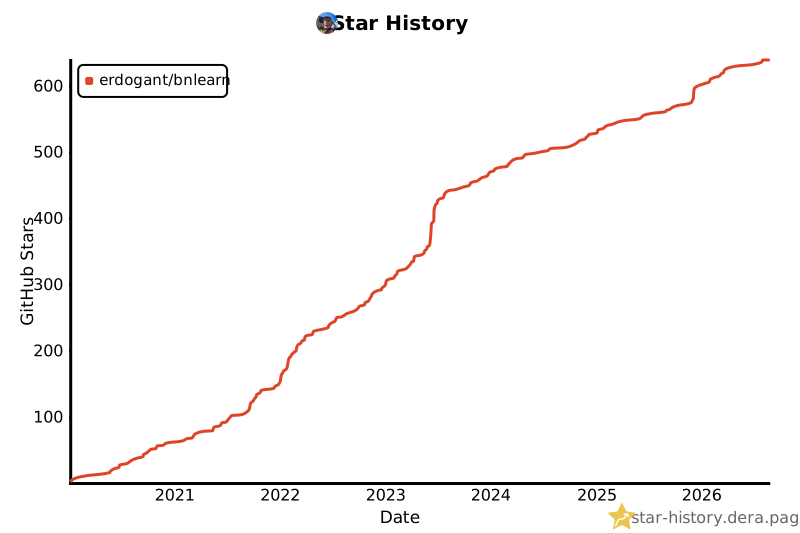
Star history
Contributors
Thank the contributors!

Maintainer
- Erdogan Taskesen, github: erdogant
- Contributions are welcome.
- Yes! This library is entirely free but it runs on coffee! :) Feel free to support with a Coffee.

1 maintainer

Release files for bnlearn 1.0.0
For a detailed explanation of source distributions (sdists) and built distributions (wheels), please see the package formats documentation.
Source distribution (sdist)
| File | Size | Uploaded | |
|---|---|---|---|
| bnlearn-1.0.0.tar.gz | 185.6 kB | Details |
Built distribution (wheel)
| File | Interpreter | ABI | Platform | Reset |
|---|---|---|---|---|
| bnlearn-1.0.0-py3-none-any.whl | Python 3 | none | any | Details |
Total release size: 387.1 kB
Release files / bnlearn-1.0.0.tar.gz
| Download URL | bnlearn-1.0.0.tar.gz |
|---|---|
| Size | 185.6 kB |
| Tags | Source |
|
SHA-256 checksum How to use checksums |
d10e16b5691bde4f222e89df886d96ab8aacf05b232a6c57b3b99baf2fc664a1
|
|
BLAKE2b-256 checksum How to use checksums |
7265debb7391d3656cc4447328f4e2323cfdc99a797273935615e9284df335fb
|
| Upload date | |
|
Uploaded using Trusted Publishing? What is trusted publishing? |
Yes |
| Uploaded via |
twine/7.0.0 CPython/3.13.14
|
Provenance
Provenance describes where a file came from. On PyPI, provenance is shared via attestations, which provide a verifiable record of the build or publishing details. View details, limitations and caveats.


PyPI Publish Attestation
PyPI verified that this artifact, at this checksum, originated from the publisher listed below.
Signed by GitHub Actions, verified by PyPI on Sep 24, 2026.
Transparency logRelease files / bnlearn-1.0.0-py3-none-any.whl
| Download URL | bnlearn-1.0.0-py3-none-any.whl |
|---|---|
| Size | 201.5 kB |
| Tags | Python 3 |
|
SHA-256 checksum How to use checksums |
663e4041a7f0396731787a82fd828f1ece3510bc06cea6a3c22c6593516a7fc6
|
|
BLAKE2b-256 checksum How to use checksums |
070443051c83e1e2d6e9933d984f16f87384698bbb9d3309e3aed438c0e06b98
|
| Upload date | |
|
Uploaded using Trusted Publishing? What is trusted publishing? |
Yes |
| Uploaded via |
twine/7.0.0 CPython/3.13.14
|
Provenance
Provenance describes where a file came from. On PyPI, provenance is shared via attestations, which provide a verifiable record of the build or publishing details. View details, limitations and caveats.
PyPI Publish Attestation
PyPI verified that this artifact, at this checksum, originated from the publisher listed below.
Signed by GitHub Actions, verified by PyPI on Sep 24, 2026.
Transparency log













