
BrainSeg-container
This repository provides a streamlined Python wrapper and CLI tool to automatically download, run, and standardize outputs from state-of-the-art brain segmentation tools using Apptainer / Singularity containers.
Brain segmentation tools often have conflicting dependencies, complex installation steps, or require specific versions of system libraries. This package solves that problem by containerizing the tools and handling the execution, file binding, and label standardization for you.
The Tools
This pipeline currently supports the following deep-learning-based segmentation tools. We may add more in the future.
-
GOUHFI This tool was designed to handle the challenges of Ultra-High Field MRI (7T+). It utilizes "domain randomization" during training, which allows it to remain robust across different MRI contrasts and resolutions, including standard clinical scans.
-
Resolution: Native (preserves input resolution).
-
CSF Availability: Yes (segments ventricles and subarachnoid space CSF). Note that the quality of the SAS segmentation depends on the skull stripping (default antspynet). One can pass in a skull-stripped image (running e.g. synthstrip before), and might obtain better results.
-
-
SynthSeg Developed by the FreeSurfer team, this tool is famous for working "out of the box" on almost any kind of MRI scan (different contrasts, resolutions, or messy clinical data).
-
Resolution: Fixed 1mm isotropic (always resamples input to 1mm).
-
CSF Availability: Yes.
-
-
FastSurfer A rapid deep-learning-based segmentation tool.
-
Resolution: Native (but experimental below 0.7mm).
-
CSF Availability: No (segments ventricles, but ignores subarachnoid space CSF).
-
-
SimNIBS (Charm) The "Complete Head Anatomy Reconstruction Method" from the SimNIBS suite. While designed for modeling brain stimulation (TMS/TES), it produces high-quality segmentation of extra-cerebral tissues (skull, scalp, etc.) in addition to the brain.
-
Resolution: Native (pipeline uses the upsampled output to match input).
-
CSF Availability: Yes.
-
Segmented regions: Charm provides the following segmentation labels: White-Matter, Gray-Matter, CSF, Bone, Scalp, Eye_bals, Compact_bone, Spongy_bone, Blood, Muscle, Cartilage, Fat, Electrode, Saline_or_gel
-
-
SynthStrip A robust, contrast-agnostic brain extraction tool from the FreeSurfer suite. While not a full segmentation tool, it is optimized for creating accurate brain masks across diverse MRI contrasts and resolutions.
- Resolution: Native (preserves input resolution).
- Output: Skull-stripped image and binary brain mask.
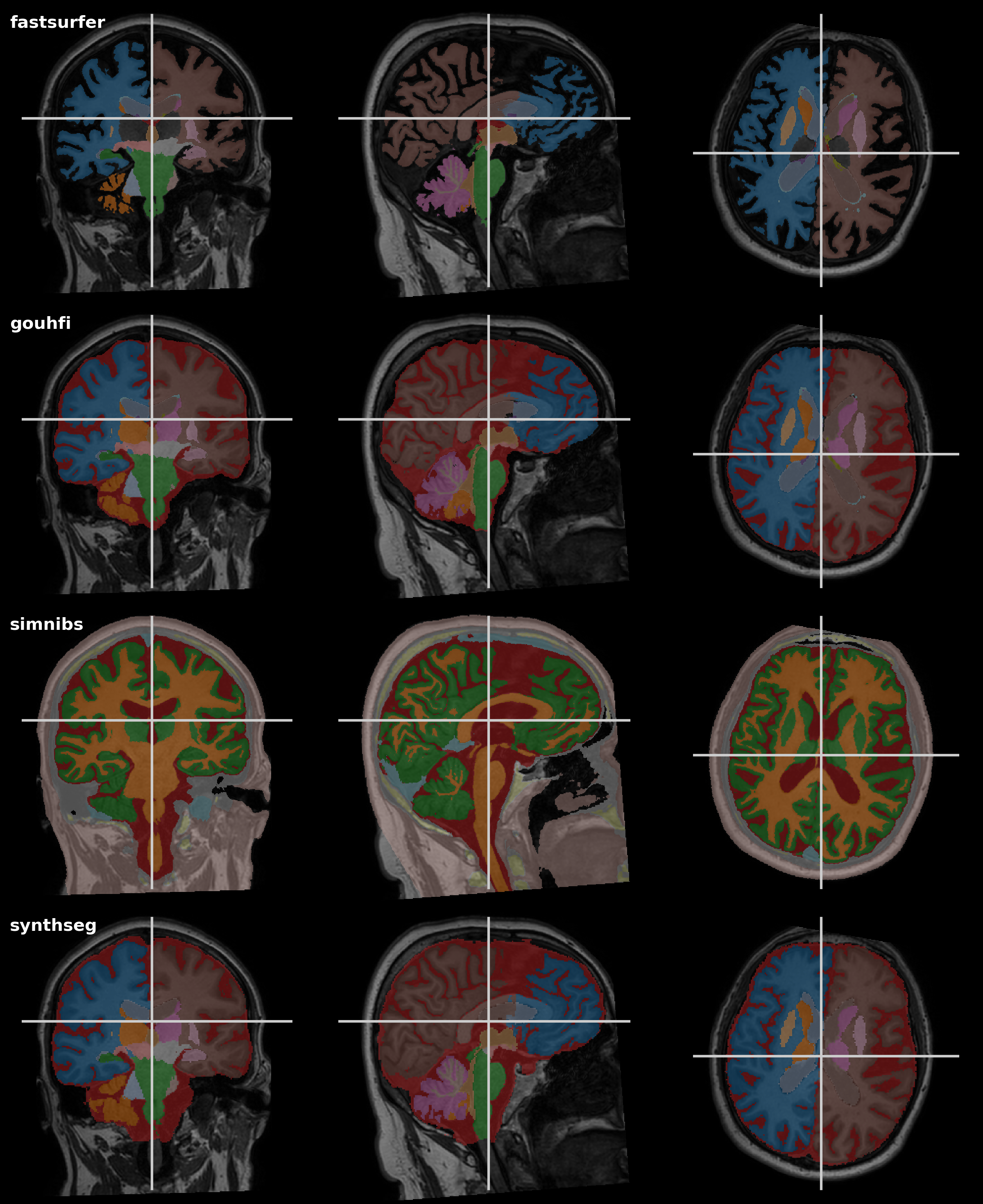
Comparison Output
The pipeline can automatically generate a comparison grid so you can quickly inspect the differences between the tools.
Getting Started
Prerequisites
You must have Apptainer (or Singularity) installed on your system to run the containers.
- Ubuntu/Debian:
sudo apt install apptainer - Conda/Mamba:
conda install -c conda-forge apptainer
Installation
You can install the package directly via pip:
pip install brainseg-containers
(Optional) If you want to use the plotting and comparison features, install with the plot extras:
pip install brainseg-containers[plot]
Usage
The package provides a simple command-line interface. The first time you run a specific tool, the wrapper will automatically download the corresponding container from the GitHub Container Registry and store it in ~/.brainseg_containers/.
Basic Command
brainseg -t <tool_name> -i <input_file.nii.gz> -o <output_file.nii.gz>
Available Tools: synthseg, gouhfi, fastsurfer, simnibs, synthstrip, hybrid_gouhfi_T2
Examples
Run GOUHFI on a single subject:
brainseg -t gouhfi -i inputs/sub-01_T1w.nii.gz -o results/sub-01_gouhfi.nii.gz
Run SynthSeg on the same subject:
brainseg -t synthseg -i inputs/sub-01_T1w.nii.gz -o results/sub-01_synthseg.nii.gz
Note: You can optionally provide a custom path to a pre-downloaded .sif image using the --container flag.
Parcellations
synthseg, gouhfi, fastsurfer and hybrid_gouhfi_T2 also support the --parc flag, which enables the cortical segmentation. In this case, the resulting segmentation will contain both the cortical parcellation and the subcortical segmentation.
Hybrid GOUHFI-CSF Segmentation (hybrid_gouhfi_T2)
Standard deep-learning segmentation tools (like GOUHFI or SynthSeg) often struggle to produce accurate and continuous segmentations of the Subarachnoid Space (SAS). For example, GOUHFI's CSF boundary is highly dependent on the initial skull-stripping tool used.
For computational modeling tasks that require highly accurate SAS labels, this package includes a fully automated T1/T2 Hybrid Pipeline. This method leverages the structural clarity of a T1w image for solid brain tissue alongside the superior fluid contrast of a T2w image.
Under the hood, the pipeline automatically:
- Co-registers your T2 image to your T1 image using ANTsPy.
- Brain Extraction: Runs SynthStrip on the T2 to generate a highly accurate brain mask.
- CSF Thresholding: Extracts a continuous physical fluid mask from the stripped T2 using Li thresholding.
- Anatomical Segmentation: Runs GOUHFI on the T1 image (after masking it with SynthStrip) to create an accurate tissue segmentation.
- Topological Merging: Merges the T1 anatomy with the T2 fluid mask.
Example Command:
brainseg -t hybrid_gouhfi_T2 -i inputs/sub-01_T1w.nii.gz --t2 inputs/sub-01_T2w.nii.gz -o results/sub-01_hybrid_seg.nii.gz
Note on Labels
Different tools use different numbers to represent brain regions. To make comparison easier, this pipeline automatically remaps the output labels of FastSurfer and GOUHFI to match the standard FreeSurfer lookup table.
1 maintainer

Metadata
1 maintainer
Release files for brainseg-containers 1.1.1
For a detailed explanation of source distributions (sdists) and built distributions (wheels), please see the package formats documentation.
Source distribution (sdist)
| File | Size | Uploaded | Provenance | Actions |
|---|---|---|---|---|
| brainseg_containers-1.1.1.tar.gz | 37.3 kB | Without provenance | Details for brainseg_containers-1.1.1.tar.gz |
Built distribution (wheel)
| File | Interpreter | ABI | Platform | Actions Reset |
|---|---|---|---|---|
| brainseg_containers-1.1.1-py3-none-any.whl | Python 3 | none | any | Details for brainseg_containers-1.1.1-py3-none-any.whl |
Total release size: 79.2 kB
Release files / brainseg_containers-1.1.1.tar.gz
| Download URL | brainseg_containers-1.1.1.tar.gz |
|---|---|
| Size | 37.3 kB |
| Tags | Source |
|
SHA-256 checksum How to use checksums |
c82813da099aa23d55fa650d5e1012b4f9f947db6529a453c2507e0bbc902bd5
|
|
BLAKE2b-256 checksum How to use checksums |
c6a75382b230d56bce040df6363e89c26159814533d67d7ab2c76afe50b44cb4
|
| Upload date | |
|
Uploaded using Trusted Publishing? What is trusted publishing? |
No |
| Uploaded via |
twine/6.1.0 CPython/3.13.12
|
Release files / brainseg_containers-1.1.1-py3-none-any.whl
| Download URL | brainseg_containers-1.1.1-py3-none-any.whl |
|---|---|
| Size | 41.9 kB |
| Tags | Python 3 |
|
SHA-256 checksum How to use checksums |
2532c2f216d0e939d6db77ad998b9462d51e26cf5baf814802b4d1779832bfc4
|
|
BLAKE2b-256 checksum How to use checksums |
c0db53ae52f104a697da36cb3c199521ef58a1a411ef9b2ad6f1678f6774d9f8
|
| Upload date | |
|
Uploaded using Trusted Publishing? What is trusted publishing? |
No |
| Uploaded via |
twine/6.1.0 CPython/3.13.12
|
Security for brainseg-containers 1.1.1
Provenance
Provenance describes where a file came from. On PyPI, provenance is shared via attestations, which provide a verifiable record of the build or publishing details. View details, limitations and caveats.
No provenance found
None of the files in this release were uploaded with provenance metadata.
A note on package security
PyPI is a repository for distributing packages, not a service for auditing them. While third-party security researchers and our staff do their best to detect and remove malicious packages, PyPI cannot guarantee the quality, security or suitability of any given package.
To learn more about protecting yourself from malicious actors, visit our package security documentation.














