
Building Regulariser
A Python library for regularizing building footprints in geospatial data. This library helps clean up and standardize building polygon geometries by aligning edges to principal directions. Built as an open source alternative to the ArcGIS Regularize Building Footprint (3D Analyst) tool.






Example Results
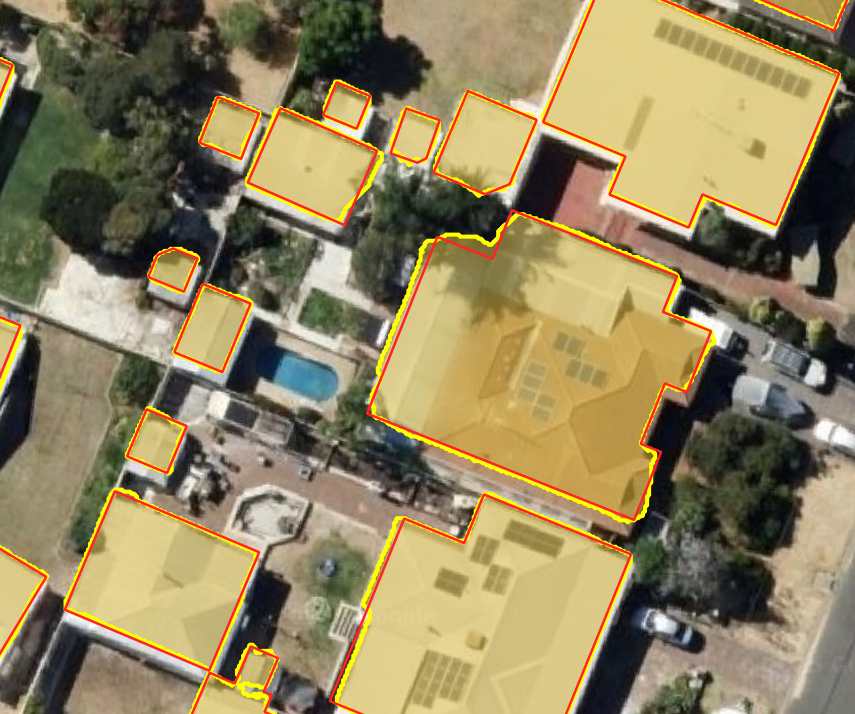
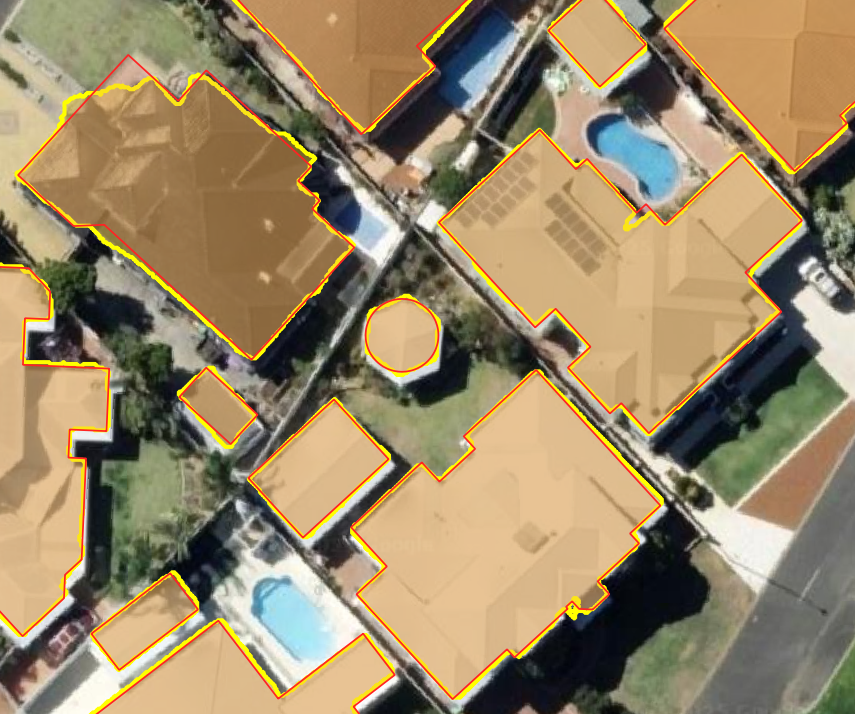
Before and after regularization:
Try in Colab

Overview
Building footprints extracted from remote sensing imagery often contain noise, irregular edges, and geometric inconsistencies. This library provides tools to regularize these footprints by:
- Aligning edges to principal directions (orthogonal and optional 45-degree angles)
- Converting near-rectangular buildings to perfect rectangles
- Converting near-circular buildings to perfect circles
- Simplifying complex polygons while maintaining their essential shape
- Supporting parallel processing for efficient computation with large datasets
- Fine-tune building alignment with neighboring buildings
Inspired by RS-building-regularization, this library takes a geometric approach to building regularization with improvements for usability and integration with the GeoPandas ecosystem.
Installation
pip install buildingregulariser
or
conda install conda-forge::buildingregulariser
or
uv add buildingregulariser
Quick Start
import geopandas as gpd
from buildingregulariser import regularize_geodataframe

# Load your building footprints
buildings = gpd.read_file("buildings.gpkg")

# Regularize the building footprints
regularized_buildings = regularize_geodataframe(
    buildings,
)

# Save the results
regularized_buildings.to_file("regularized_buildings.gpkg")
Features
- GeoDataFrame Integration: Works seamlessly with GeoPandas GeoDataFrames
- Polygon Regularization: Aligns edges to principal directions
- 45-Degree Support: Optional alignment to 45-degree angles
- Align with neighboring buildings: Align each building with neighboring buildings
- Circle Detection: Identifies and converts near-circular shapes to perfect circles
- Edge Simplification: Reduces the number of vertices while preserving shape
- Parallel Processing: Utilizes multiple CPU cores for faster processing of large datasets
Usage Examples
Basic Regularization
from buildingregulariser import regularize_geodataframe
import geopandas as gpd

buildings = gpd.read_file("buildings.gpkg")
regularized = regularize_geodataframe(buildings)
Fine-tuning Regularization Parameters
regularized = regularize_geodataframe(
    buildings,
    parallel_threshold=2.0,        # Higher values allow less edge alignment
    simplify_tolerance=0.5,        # Controls simplification level, should be 2-3 x the raster pixel size
    allow_45_degree=True,          # Enable 45-degree angles
    allow_circles=True,            # Enable circle detection
    circle_threshold=0.9,          # IOU threshold for circle detection
    neighbor_alignment=True,       # After regularization try to align each building with neighboring buildings
    neighbor_search_distance=100,  # Search distance around each building when looking for neighbors
    neighbor_max_rotation=10,      # Maximum rotation allowed to align with neighbors
)
Parameters
- geodataframe: Input GeoDataFrame with polygon geometries
- parallel_threshold: Distance threshold for handling parallel lines (default: 1.0)
- target_crs: Optional CRS (string or
pyproj.CRS) to reproject the input to before regularization (default: None) - simplify: If True, applies simplification to the geometry (default: True)
- simplify_tolerance: Tolerance for simplification (default: 0.5)
- allow_45_degree: If True, allows edges to be oriented at 45-degree angles (default: True)
- diagonal_threshold_reduction: Used to reduce the chance of diagonal edges being generated, can be from 0 to 22.5 (default: 15.0)
- allow_circles: If True, detects and converts near-circular shapes to perfect circles (default: True)
- circle_threshold: Intersection over Union (IoU) threshold for circle detection (default: 0.9)
- num_cores: Number of CPU cores to use for parallel processing; 0 uses all available cores (default: 0)
- include_metadata: Include the main direction, IOU, perimeter and aligned_direction (if used) in output gdf (default: False)
- neighbor_alignment: If True, try to align each building with neighboring buildings (default: False)
- neighbor_search_distance: The distance to find neighboring buildings (default: 100.0)
- neighbor_max_rotation: The maximum allowable rotation to align with neighbors (default: 10)
Returns
- A new GeoDataFrame with regularized polygon geometries
How It Works
- Edge Analysis: Analyzes each polygon to identify principal directions
- Edge Orientation: Aligns edges to be parallel, perpendicular, or at 45 degrees to the main direction
- Circle Detection: Optionally identifies shapes that are nearly circular and converts them to perfect circles
- Edge Connection: Ensures proper connectivity between oriented edges
- Angle Enforcement: Post-processing to ensure target angles are precisely maintained
- Neighbor Alignment: Optionally align each building with neighboring buildings, via rotation around centroid.
License
This project is licensed under the MIT License
Acknowledgments
This library was inspired by the RS-building-regularization project, with improvements for integration with the GeoPandas ecosystem and enhanced regularization algorithms.
1 maintainer

Metadata
1 maintainer
Release files for buildingregulariser 0.3.0
For a detailed explanation of source distributions (sdists) and built distributions (wheels), please see the package formats documentation.
Source distribution (sdist)
| File | Size | Uploaded | Provenance | Actions |
|---|---|---|---|---|
| buildingregulariser-0.3.0.tar.gz | 189.1 kB | With provenance | Details for buildingregulariser-0.3.0.tar.gz |
Built distribution (wheel)
| File | Interpreter | ABI | Platform | Actions Reset |
|---|---|---|---|---|
| buildingregulariser-0.3.0-py3-none-any.whl | Python 3 | none | any | Details for buildingregulariser-0.3.0-py3-none-any.whl |
Total release size: 209.9 kB
Release files / buildingregulariser-0.3.0.tar.gz
| Download URL | buildingregulariser-0.3.0.tar.gz |
|---|---|
| Size | 189.1 kB |
| Tags | Source |
|
SHA-256 checksum How to use checksums |
4f9ad33f11ab03daaef4c8f6a5af02db4331ee026f28f11dc4fa10495e285392
|
|
BLAKE2b-256 checksum How to use checksums |
2de1e5bdfa3933a5a6d51aedfca7fd107221cd929e7beebdae717a68d9c76db1
|
| Upload date | |
|
Uploaded using Trusted Publishing? What is trusted publishing? |
Yes |
| Uploaded via |
twine/7.0.0 CPython/3.13.16
|
Provenance
Provenance describes where a file came from. On PyPI, provenance is shared via attestations, which provide a verifiable record of the build or publishing details. View details, limitations and caveats.


PyPI Publish Attestation
PyPI verified that this artifact, at this checksum, originated from the publisher listed below.
Signed by GitHub Actions, verified by PyPI on Nov 10, 2026.
Transparency logRelease files / buildingregulariser-0.3.0-py3-none-any.whl
| Download URL | buildingregulariser-0.3.0-py3-none-any.whl |
|---|---|
| Size | 20.8 kB |
| Tags | Python 3 |
|
SHA-256 checksum How to use checksums |
a61b4c2bd4abafe65cb33c9da4a640781123b9b0493abaca6a71c2e5701f6702
|
|
BLAKE2b-256 checksum How to use checksums |
85007632cbb51d7f511adac5baa7bc980eb85cd2ff2e2b894b850a7215ee1b26
|
| Upload date | |
|
Uploaded using Trusted Publishing? What is trusted publishing? |
Yes |
| Uploaded via |
twine/7.0.0 CPython/3.13.16
|
Provenance
Provenance describes where a file came from. On PyPI, provenance is shared via attestations, which provide a verifiable record of the build or publishing details. View details, limitations and caveats.
PyPI Publish Attestation
PyPI verified that this artifact, at this checksum, originated from the publisher listed below.
Signed by GitHub Actions, verified by PyPI on Nov 10, 2026.
Transparency logSecurity for buildingregulariser 0.3.0
Provenance
Provenance describes where a file came from. On PyPI, provenance is shared via attestations, which provide a verifiable record of the build or publishing details. View details, limitations and caveats.
Full provenance
Both files in this release have been uploaded with provenance metadata.
Attestation for buildingregulariser-0.3.0.tar.gz
PyPI Publish Attestation
PyPI verified that this artifact, at this checksum, originated from the publisher listed below.
Signed by GitHub Actions, verified by PyPI on Nov 10, 2026.
Transparency logA note on package security
PyPI is a repository for distributing packages, not a service for auditing them. While third-party security researchers and our staff do their best to detect and remove malicious packages, PyPI cannot guarantee the quality, security or suitability of any given package.
To learn more about protecting yourself from malicious actors, visit our package security documentation.














