
c50py: C5.0 decision trees for Python, with native categorical splits





Decision trees were born able to split on categories. Quinlan's ID3, C4.5 and C5.0 ask questions like "is the sector in {mining, tourism, construction}?". scikit-learn's CART only splits on numbers, so categorical columns have to be one-hot encoded first, and one question becomes a staircase of dummy variables.
c50py brings the C5.0 way back to Python, as a scikit-learn estimator:
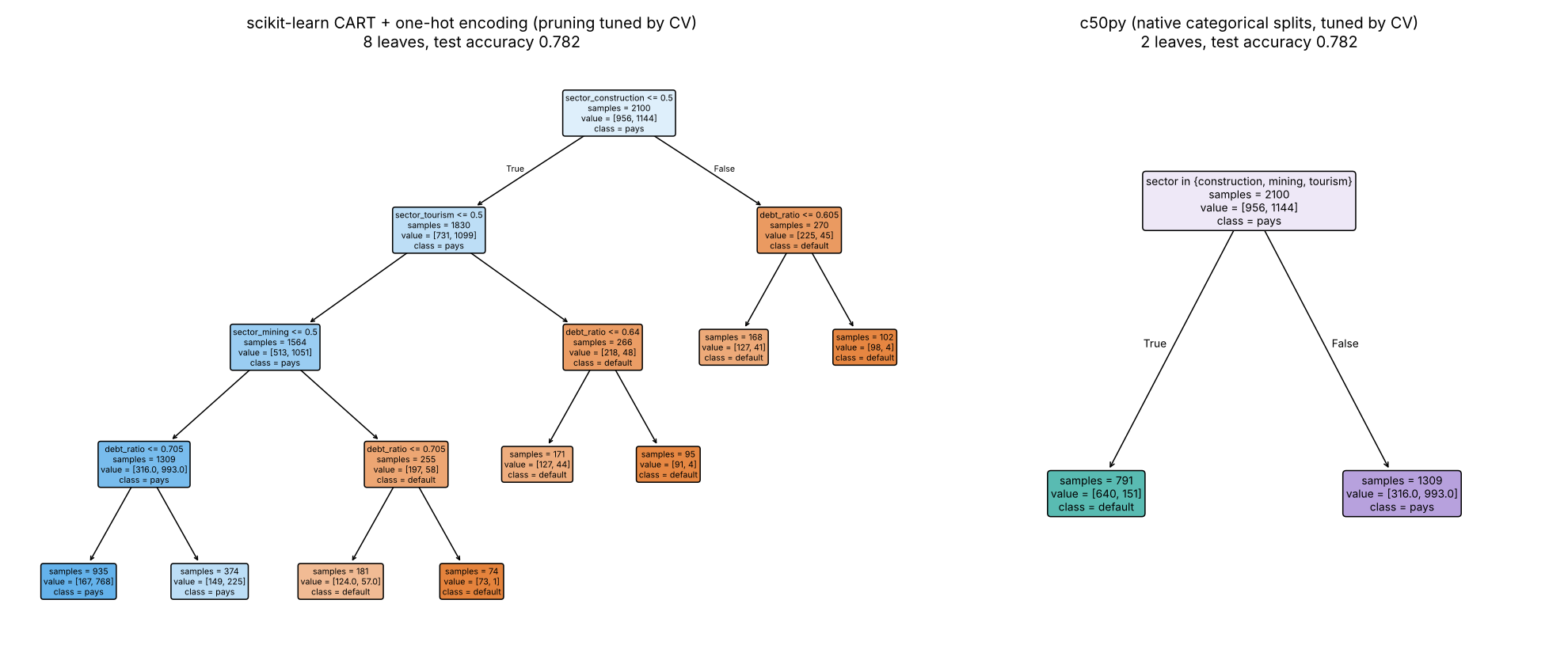
Same data, same test accuracy (0.782), both pruned by 5-fold cross-validation.
CART needs three dummy variables and 8 leaves; C5.0 asks one question.
Reproduce it with examples/make_readme_figure.py.
Install
pip install c50py
Python 3.9+, NumPy and scikit-learn. pandas is optional (DataFrames are used
directly) and matplotlib is needed for plot_tree.
Quickstart
import pandas as pd
from sklearn.model_selection import train_test_split
from c50py import C5Classifier

url = "https://raw.githubusercontent.com/daviddiazsolis/c50py/main/examples/titanic.csv"
df = pd.read_csv(url)
X = df[["pclass", "sex", "age", "fare", "embarked"]].astype({"pclass": "category"})
y = df["survived"].map({0: "died", 1: "survived"})
X_tr, X_te, y_tr, y_te = train_test_split(X, y, test_size=0.3, random_state=0)

# no one-hot encoding, no imputation: sex, embarked and pclass are used as
# categories, and the missing ages are handled by the tree
clf = C5Classifier(min_samples_leaf=10).fit(X_tr, y_tr)
print(f"test accuracy: {clf.score(X_te, y_te):.3f}")      # 0.794

for rule in clf.export_rules():
    print(rule)
# sex IN {male} => died
# sex NOT IN {male} AND pclass IN {3} AND fare <= 23.3500 => survived
# sex NOT IN {male} AND pclass IN {3} AND fare > 23.3500 => died
# sex NOT IN {male} AND pclass NOT IN {3} => survived

clf.plot_tree(filled=True, rounded=True)   # same look and options as sklearn.tree.plot_tree
A scikit-learn estimator
C5Classifier and C5Regressor pass scikit-learn's check_estimator, so they
work with clone, Pipeline, cross_val_score, GridSearchCV and the rest
of the ecosystem:
from sklearn.model_selection import GridSearchCV

grid = GridSearchCV(C5Classifier(), {"cf": [0.1, 0.25, 0.5], "min_samples_leaf": [1, 5, 20]}, cv=5)
grid.fit(X_tr, y_tr)
print(grid.best_params_, grid.score(X_te, y_te))
What C5.0 does differently from CART
| scikit-learn CART | c50py (C5.0) | |
|---|---|---|
| Categorical columns | must be encoded (one-hot, ordinal) | split natively: sector in {a, b, c} |
| Missing values | imputed, or one learned direction | cases go down both branches with fractional weights, as in C4.5/C5.0 |
| Split criterion | Gini or entropy | gain ratio, among splits with at least average gain, with C4.5's MDL penalty for numeric thresholds |
| Pruning | cost-complexity (ccp_alpha) |
pessimistic error pruning with confidence factor cf (C4.5's AddErrs) |
| Boosting | separate AdaBoostClassifier |
built in: trials=10 |
Main features
- Classification and regression:
C5Classifier,C5Regressor. - Categorical columns detected automatically: pandas
category,object,stringandboolcolumns, or object columns holding strings. You can also list them withcategorical_features=["region", 3](names or indices). - Missing values (
None,np.nan,pd.NA) in training and prediction. - Case weights through
sample_weight. - Boosting with
trials > 1. - Readable output:
export_rules()(one rule per leaf),predict_rule(X)(the rule each case follows) andprint_tree(). - Drawings identical to scikit-learn:
plot_tree,export_graphvizandexport_text, with the same parameters. Boxes use c50py's own palette so a C5.0 tree is easy to tell apart from a CART tree (palette="sklearn"gives scikit-learn's colours).
Regression
from sklearn.datasets import load_diabetes
from c50py import C5Regressor

X, y = load_diabetes(return_X_y=True, as_frame=True)
reg = C5Regressor(min_samples_leaf=20).fit(X, y)
print(reg.export_rules()[:3])
Key parameters
| Parameter | Default | Meaning |
|---|---|---|
cf |
0.25 |
Confidence factor for pruning; smaller values prune more. |
min_samples_leaf |
1 (classifier), 2 (regressor) |
Minimum (weighted) cases in each child. |
trials |
1 |
Number of boosted trees (classifier). |
categorical_features |
None |
Extra columns to treat as categorical, by name or index. |
infer_categorical |
True |
Detect categorical columns from their dtype or content. |
max_categories_exhaustive |
12 |
Up to this many categories every binary subset is evaluated. |
max_depth |
None |
Optional depth limit. |
The Usage Guide covers every option.
How close is it to Quinlan's C5.0?
c50py is a from-scratch Python implementation that follows C4.5/C5.0 in the
split criterion, the handling of missing values and the pessimistic pruning.
Some parts of the original are not (yet) implemented:
- splits are binary; categorical splits group categories into two subsets (C5.0's default is one branch per category, with subset grouping as an option);
- no winnowing (C5.0's built-in feature selection);
- no rulesets:
export_rules()returns the rules of the tree, one per leaf, not C5.0's simplified, independent rules; - boosting follows AdaBoost.M1/SAMME reweighting, close to but not identical with C5.0's;
- no misclassification costs.
Rulesets and winnowing are on the roadmap. Contributions are welcome.
Citation
If you use c50py in research, please cite it (a JOSS submission is in
preparation; meanwhile cite the repository):
@software{diaz_solis_c50py,
  author = {D{\'i}az Sol{\'i}s, David},
  title  = {c50py: C5.0 decision trees for Python},
  url    = {https://github.com/daviddiazsolis/c50py},
  year   = {2026}
}
Contributing and license
Bug reports and pull requests are welcome; see CONTRIBUTING.md
and the CHANGELOG. c50py is released under the MIT License.
The drawing code is adapted from scikit-learn (BSD-3-Clause).
1 maintainer

Metadata
1 maintainer
Release files for c50py 0.4.2
For a detailed explanation of source distributions (sdists) and built distributions (wheels), please see the package formats documentation.
Source distribution (sdist)
| File | Size | Uploaded | |
|---|---|---|---|
| c50py-0.4.2.tar.gz | 49.4 kB | Details |
Built distribution (wheel)
| File | Interpreter | ABI | Platform | Reset |
|---|---|---|---|---|
| c50py-0.4.2-py3-none-any.whl | Python 3 | none | any | Details |
Total release size: 91.5 kB
Release files / c50py-0.4.2.tar.gz
| Download URL | c50py-0.4.2.tar.gz |
|---|---|
| Size | 49.4 kB |
| Tags | Source |
|
SHA-256 checksum How to use checksums |
49d3c70944f1a3a0c21996210f43bf6a0a3a7a030de677db39de8e75686d3b83
|
|
BLAKE2b-256 checksum How to use checksums |
3380dbebd9b77b9ac2dda22261dcf231852f0e50c5bd7428bb6d876444153559
|
| Upload date | |
|
Uploaded using Trusted Publishing? What is trusted publishing? |
Yes |
| Uploaded via |
twine/7.0.0 CPython/3.13.14
|
Provenance
Provenance describes where a file came from. On PyPI, provenance is shared via attestations, which provide a verifiable record of the build or publishing details. View details, limitations and caveats.


PyPI Publish Attestation
PyPI verified that this artifact, at this checksum, originated from the publisher listed below.
Signed by GitHub Actions, verified by PyPI on Oct 2, 2026.
Transparency logRelease files / c50py-0.4.2-py3-none-any.whl
| Download URL | c50py-0.4.2-py3-none-any.whl |
|---|---|
| Size | 42.1 kB |
| Tags | Python 3 |
|
SHA-256 checksum How to use checksums |
c51765c55587dc173edc0aa7119dbb72f4b3835dc1486cedf37734e51cf2d01e
|
|
BLAKE2b-256 checksum How to use checksums |
01b92e1efe0856be8cfce9f27d3871be2c01fced9dc29f3f3ed42fa4f84d1777
|
| Upload date | |
|
Uploaded using Trusted Publishing? What is trusted publishing? |
Yes |
| Uploaded via |
twine/7.0.0 CPython/3.13.14
|
Provenance
Provenance describes where a file came from. On PyPI, provenance is shared via attestations, which provide a verifiable record of the build or publishing details. View details, limitations and caveats.
PyPI Publish Attestation
PyPI verified that this artifact, at this checksum, originated from the publisher listed below.
Signed by GitHub Actions, verified by PyPI on Oct 2, 2026.
Transparency log













