

cachemaxxing




Stop paying full price for the same tokens.
Anthropic, OpenAI and Gemini bill a repeated prompt prefix at a fraction of the input price, but only when the bytes really repeat. cachemaxxing finds where they don't, tells you what it costs, and lays your prompts out so they do. It is a thin library, not a proxy: zero runtime dependencies, and you keep your own SDK client.
- Measure.
usage()turns any provider's response into the same numbers: input, cache read, cache write, output, estimated $ and hit rate.cachemaxxing reporttotals them per call site. - Diagnose. Give
Statseach request and it tells you, as soon as it happens, the first byte where a request stopped repeating the previous one, why, and how to fix it.cachemaxxing reportprints the same from a log. - Fix.
Promptorders your prompt from most to least stable and places each provider's cache markers for you.
from openai import OpenAI
from cachemaxxing import Prompt, usage

chat = [
    {"role": "system", "content": SYSTEM},  # your long, fixed instructions: cached
    {"role": "user", "content": "How do I reset my router?"},
]
p = Prompt(call_site="support.answer").messages(chat)  # call_site: any name for this call, used in reports

resp = OpenAI().chat.completions.create(**p.openai_chat("gpt-6-luna"))
# same p: anthropic.messages.create(max_tokens=1024, **p.anthropic("claude-haiku-5-5"))
#         genai_client.models.generate_content(**p.gemini("gemini-3.8-flash"))

u = usage(resp)
print(f"{u.hit_rate:.0%} of input from cache, ~${u.est_cost or 0:.4f}")
The system prompt and the conversation so far get the provider's cache markers, so each turn reads everything before the new question from cache. For tools, RAG chunks or a timestamp, build the prompt from parts: p.tools(TOOLS).system(SYSTEM).history(chat).retrieved(chunks).user(question). The quickstart shows where the markers go, and the exact request.
Works with
| How | |
|---|---|
| Anthropic | client.messages.create(**p.anthropic(model)) |
| OpenAI | client.responses.create(**p.openai(model)) or client.chat.completions.create(**p.openai_chat(model)) |
| Gemini | client.models.generate_content(**p.gemini(model)), with an explicit cache via gemini_cache() when should_cache() says it pays |
| LiteLLM | litellm.completion(**p.litellm("anthropic/claude-haiku-5-5")) |
| LangChain agents | create_agent(..., middleware=[CacheMiddleware("support.agent")]) |
| LangChain messages, LangGraph graphs, LCEL | llm = CachedModel(chat_model), then llm.invoke([SystemMessage(...), HumanMessage(...)]) |
On OpenAI GPT-5.6+ it places explicit cache breakpoints. On Anthropic it places cache_control markers, at most 4. Gemini stays on implicit caching unless an explicit cache pays.
Find the misses
$ cachemaxxing report calls.jsonl --min-hit-rate 0.6     # from record() logs; exits 1 below the threshold
call site   calls  hit rate  input   cache read  cache write  output  est $   top drift
rag.answer  4      88.8%     31,574  28,024      714          2,601   0.0020

$ cachemaxxing diff request_1.json request_2.json
diverges at system[0].text char 41 (timestamp), after ~14 matching tokens
  a: 'You are helpful. Today is 2026-10-30T10:00:00Z.'
  b: 'You are helpful. Today is 2026-10-30T10:05:00Z.'
Add --html report.html for the same report as a self-contained dashboard page. See the demo, built from a real log. For the provider's own verdict, add diagnose= to an adapter; usage(resp).miss_reason then says system_changed, tools_changed, and so on. To gate CI on hit rate, use the bundled GitHub Action: uses: ashhadahsan/cachemaxxing@v0.10.0 with log: and min-hit-rate:.
Before you put it in a production request path, read Running in production. It covers rollout, what happens when something fails (cachemaxxing never fails a call that would have worked without it), logs without prompt text, concurrency and the stability policy.
Benchmark
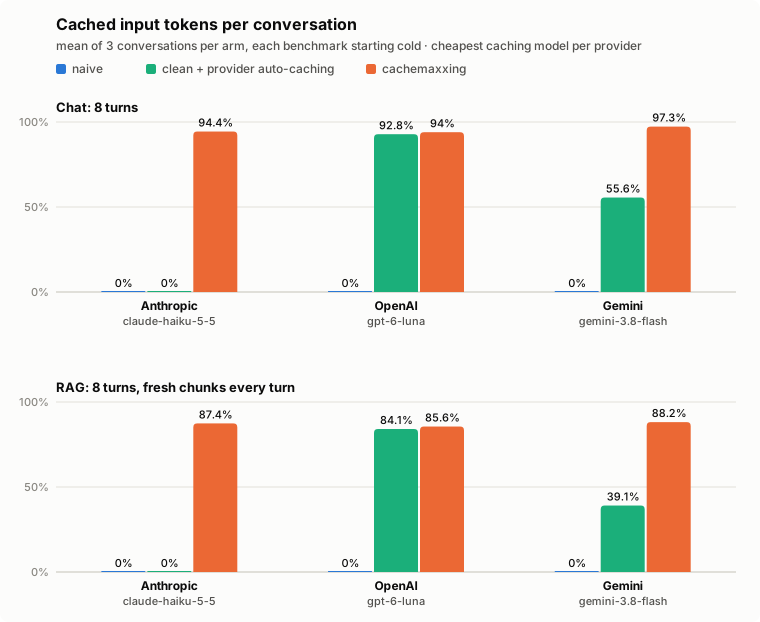
- Against a sloppy app (the naive arm, chat and RAG): input cost is 76–88% lower on every model.
- Against a clean prompt using the provider's own one-line caching, it depends on the provider:
- Anthropic: automatic caching puts its single cache entry after the per-turn context (time, request id, retrieved chunks). That entry changes every turn, so the app pays the 1.25× write premium on every call and reads nothing back. That is 0% cached, and dearer than not caching at all. A breakpoint after the static prompt, which cachemaxxing places, fixes it: 82–89% cheaper.
- Gemini: implicit caching is best-effort and reached 39–56%. The explicit cache cachemaxxing creates when
should_cache()says it pays reached 88–97%, 62–67% cheaper, with creation and storage included. - OpenAI: implicit caching already finds a stable prefix, and cachemaxxing is only 6–19% cheaper. On OpenAI the win is fixing the habits, plus the measuring tools.
- LangChain agents:
CacheMiddlewareties LangChain'sAnthropicPromptCachingMiddlewareon Anthropic and the default agent on OpenAI. It adds one setup for every provider and per-call-site measurement, not extra savings.
| Workload | Model | naive | clean + provider auto-caching | cachemaxxing | vs naive | vs clean |
|---|---|---|---|---|---|---|
| chat | claude-haiku-5-5 |
0% · $0.0090 | 0% · $0.0112 | 94.4% · $0.0014 | 84% cheaper | 87% cheaper |
| chat | gpt-6-luna |
0% · $0.0068 | 92.8% · $0.0009 | 94% · $0.0009 | 87% cheaper | 6% cheaper |
| chat | gemini-3.8-flash |
0% · $0.0468 | 55.6% · $0.0236 | 97.3% · $0.0077 | 83% cheaper | 67% cheaper |
| chat | claude-sonnet-5-5 |
0% · $0.1791 | 0% · $0.2232 | 92.4% · $0.0247 | 86% cheaper | 89% cheaper |
| chat | gpt-6.1-sol |
0% · $0.1389 | 88.4% · $0.0209 | 91% · $0.0168 | 88% cheaper | 19% cheaper |
| rag | claude-haiku-5-5 |
0% · $0.0069 | 0% · $0.0086 | 87.4% · $0.0015 | 78% cheaper | 82% cheaper |
| rag | gpt-6-luna |
0% · $0.0049 | 84.1% · $0.0011 | 85.6% · $0.0010 | 80% cheaper | 15% cheaper |
| rag | gemini-3.8-flash |
0% · $0.0352 | 39.1% · $0.0226 | 88.2% · $0.0086 | 76% cheaper | 62% cheaper |
| agent | claude-haiku-5-5 |
0% · $0.0044 | 89.8% · $0.0010 | 89.9% · $0.0009 | 78% cheaper | 1% cheaper |
| agent | gpt-6-luna |
90.4% · $0.0006 | — | 90.1% · $0.0006 | 2% dearer | — |
Cells: cached share of input tokens · estimated input cost per conversation at list price (cache writes and explicit-cache storage included; output excluded, since answer length varies between runs regardless of caching).
Setup: 8-turn conversations (agents: 3 questions with a tool call), 3 customers per arm. Every arm starts from a cold cache with its own prompt, so no arm reads another's entries. The naive arm has the four habits: a timestamp and request id at the top of the system prompt, tool order that varies, JSON key order that varies, and history re-rendered every turn; in RAG, chunks also go in the system prompt. The clean arm has the same content laid out well, with Anthropic's top-level cache_control or OpenAI's and Gemini's default implicit caching. Data: benchmarks/results/, run 2026-10-30. Rerun with uv run --env-file .env python benchmarks/bench_<provider>.py --workload chat|rag and benchmarks/bench_agent.py; the table comes from benchmarks/summary.py.
Examples
examples/chat.py: start here. A chat kept as a plain list of messages, cached on every turn, on any providerexamples/langchain_chat.py: the same with LangChainSystemMessage/HumanMessage/AIMessageexamples/quickstart.py: one prompt, every provider and LiteLLMexamples/rag_chat.py: a multi-turn RAG chat with per-turn retrieval, logging and a reportexamples/langchain_agent.py: a LangChaincreate_agentagent withCacheMiddlewareexamples/langgraph_custom.py: a hand-built LangGraph graph withCachedModel
Install
pip install cachemaxxing                  # or: uv add cachemaxxing
pip install "cachemaxxing[anthropic]"     # extras: anthropic, openai, gemini, litellm, langchain
New here? The tutorial takes ten minutes, from a broken cache to a fixed one.
Docs: https://ashhadahsan.github.io/cachemaxxing/ covers the tutorial, the quickstart, how caching works per provider, diagnosing a low hit rate, LangChain and LangGraph, the API reference, and how it compares.
MIT licensed.
1 maintainer

Metadata
1 maintainer
Release files for cachemaxxing 0.10.0
For a detailed explanation of source distributions (sdists) and built distributions (wheels), please see the package formats documentation.
Source distribution (sdist)
| File | Size | Uploaded | Provenance | Actions |
|---|---|---|---|---|
| cachemaxxing-0.10.0.tar.gz | 41.1 kB | With provenance | Details for cachemaxxing-0.10.0.tar.gz |
Built distribution (wheel)
| File | Interpreter | ABI | Platform | Actions Reset |
|---|---|---|---|---|
| cachemaxxing-0.10.0-py3-none-any.whl | Python 3 | none | any | Details for cachemaxxing-0.10.0-py3-none-any.whl |
Total release size: 87.0 kB
Release files / cachemaxxing-0.10.0.tar.gz
| Download URL | cachemaxxing-0.10.0.tar.gz |
|---|---|
| Size | 41.1 kB |
| Tags | Source |
|
SHA-256 checksum How to use checksums |
4a7d0b38f0dee2a4d80d2cff9e64fc23156541d332dfc142a0588db30db1acca
|
|
BLAKE2b-256 checksum How to use checksums |
cffdd710ab1d1ac003c10c86b1a8c1ef4ca4e8b0adcc024b5c9cb0985d48d1be
|
| Upload date | |
|
Uploaded using Trusted Publishing? What is trusted publishing? |
Yes |
| Uploaded via |
twine/7.0.0 CPython/3.13.16
|
Provenance
Provenance describes where a file came from. On PyPI, provenance is shared via attestations, which provide a verifiable record of the build or publishing details. View details, limitations and caveats.


PyPI Publish Attestation
PyPI verified that this artifact, at this checksum, originated from the publisher listed below.
Signed by GitHub Actions, verified by PyPI on Oct 31, 2026.
Transparency logRelease files / cachemaxxing-0.10.0-py3-none-any.whl
| Download URL | cachemaxxing-0.10.0-py3-none-any.whl |
|---|---|
| Size | 45.8 kB |
| Tags | Python 3 |
|
SHA-256 checksum How to use checksums |
9afd38a03af1a13d30158de40ec43e814c7848d4afaa84ec37bfbc7b7b3317c9
|
|
BLAKE2b-256 checksum How to use checksums |
2867b51aeacb6935f3240ee6e95f09cfa36b028716d7e8392e5c3b2c6b2cbe05
|
| Upload date | |
|
Uploaded using Trusted Publishing? What is trusted publishing? |
Yes |
| Uploaded via |
twine/7.0.0 CPython/3.13.16
|
Provenance
Provenance describes where a file came from. On PyPI, provenance is shared via attestations, which provide a verifiable record of the build or publishing details. View details, limitations and caveats.
PyPI Publish Attestation
PyPI verified that this artifact, at this checksum, originated from the publisher listed below.
Signed by GitHub Actions, verified by PyPI on Oct 31, 2026.
Transparency logSecurity for cachemaxxing 0.10.0
Provenance
Provenance describes where a file came from. On PyPI, provenance is shared via attestations, which provide a verifiable record of the build or publishing details. View details, limitations and caveats.
Full provenance
Both files in this release have been uploaded with provenance metadata.
Attestation for cachemaxxing-0.10.0.tar.gz
PyPI Publish Attestation
PyPI verified that this artifact, at this checksum, originated from the publisher listed below.
Signed by GitHub Actions, verified by PyPI on Oct 31, 2026.
Transparency logA note on package security
PyPI is a repository for distributing packages, not a service for auditing them. While third-party security researchers and our staff do their best to detect and remove malicious packages, PyPI cannot guarantee the quality, security or suitability of any given package.
To learn more about protecting yourself from malicious actors, visit our package security documentation.














