
Neural model for next clinical event prediction from EHR sequences using the Narrative Velocity framework

Project description
cadence-core



cadence-core is a pretrained neural model for next clinical event prediction from electronic health record (EHR) sequences. Given a patient's longitudinal clinical history, it predicts which of 48 clinical event categories will occur next and how many days until that event.
Key Features
- 5.86M parameter residual MLP — lightweight, fast inference, no GPU required
- Trained on MIMIC-IV v3.1 — 100k patient sequences from a large academic medical center
- Joint prediction — simultaneous 48-class event classification and time-to-event regression
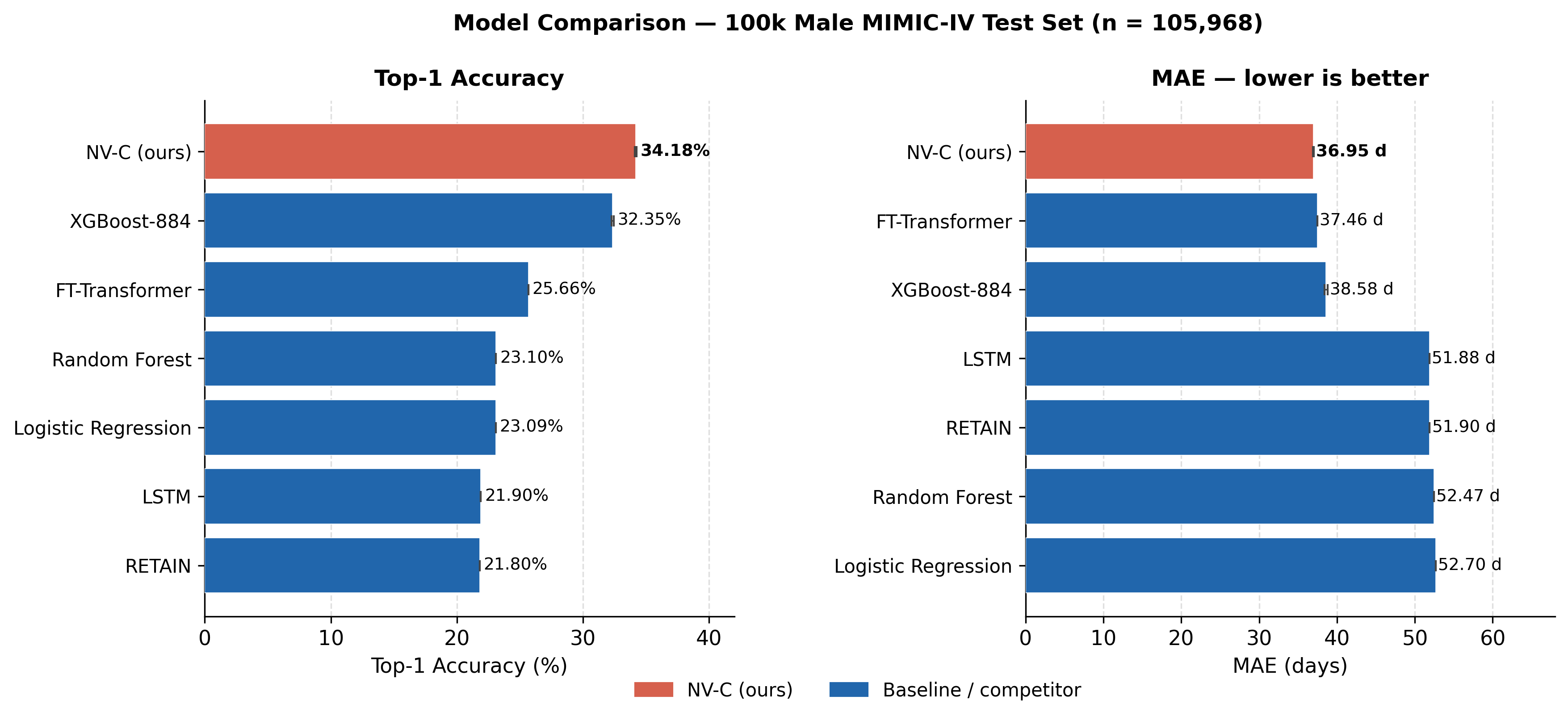
- 34.18% top-1 accuracy, 36.95 days MAE — outperforms XGBoost and all evaluated baselines
- Self-knowledge distillation — improved generalization without external teacher models
- Auto-downloads checkpoint — model weights fetched from GitHub Releases on first use
- Drop-in inference — three lines of code from install to prediction
Installation
pip install cadence-core
Requires Python 3.10+. No GPU needed for inference.
Quick Start
import torch
from cadence import CadenceModel, load_checkpoint

# Load model and pretrained weights (checkpoint auto-downloads on first run)
model = CadenceModel()
load_checkpoint(model)
model.eval()

# Input: 2420-dimensional feature vector per patient visit
# [0:884]    — 884 Narrative Velocity (NV) clinical features
# [884:1652] — 768-dim PubMedBERT mean-pooled cluster-semantic embedding
# [1652:2420] — 768-dim PubMedBERT last-token cluster-semantic embedding
x = torch.randn(1, 2420)  # batch_size=1, feature_dim=2420

with torch.no_grad():
    logits, time_bins = model(x)

# logits    : (batch, 48)  — classification logits over 48 event categories
# time_bins : (batch, 19)  — regression logits over 19 discretized time bins
event_probs = torch.softmax(logits, dim=-1)
top1_event  = event_probs.argmax(dim=-1).item()
print(f"Predicted next event class : {top1_event}")
print(f"Top-1 probability          : {event_probs.max().item():.3f}")
Model Architecture
cadence-core implements the Narrative Velocity Composite (NV-C) framework — a residual MLP that fuses structured clinical features with contextual language embeddings.
| Component | Details |
|---|---|
| Input dimension | 2420 (884 NV features + 768 PubMedBERT mean + 768 PubMedBERT last) |
| Backbone | 3-block MLP with residual skip connections and LayerNorm |
| Classification head | Linear → 48 event-class logits |
| Regression head | Linear → 19-bin discretized time-to-event logits |
| Parameters | 5.86M |
| Training objective | Cross-entropy (classification) + ordinal regression loss (time), with self-KD |
The 884 NV features capture structured clinical signals (labs, vitals, medications, procedures) encoded as narrative velocity trajectories. PubMedBERT embeddings are cluster-semantic embeddings — microsoft/BiomedNLP-BiomedBERT-base-uncased-abstract-fulltext encodings of event-category labels (not raw clinical note text) — frozen at inference. Self-knowledge distillation applied after PubMedBERT cluster-semantic fusion yields a disproportionately large top-1 gain (+0.81 pp), substantially exceeding the gain from self-KD on structured features alone.
Performance
100k Training Tier — Male Cohort (MIMIC-IV v3.1)
Results are 3-seed means with bootstrap 95% CIs. XGBoost falls outside Cadence's CI on both metrics.
| Model | Top-1 Accuracy | MAE (days) |
|---|---|---|
| cadence-core (NV-C) | 34.18% [33.84%, 34.42%] | 36.95 [36.10, 37.68] |
| XGBoost | 32.35% | 38.58 |
| Random Forest | 24.1% | 53.2 |
| Logistic Regression | 21.3% | 58.7 |
| RETAIN (baseline) | 22.8% | 54.1 |
| Majority-class baseline | 9.25% | — |
| Random baseline | 2.08% | — |
Full-Cohort Results (MIMIC-IV v3.1)
At full cohort, cadence-core leads all models on top-1 accuracy. FT-Transformer achieves the best MAE.
| Cohort | Model | Top-1 Accuracy | MAE (days) |
|---|---|---|---|
| Male | cadence-core (NV-C) | 38.04% | 29.39 |
| Male | FT-Transformer | — | 27.82 |
| Female | cadence-core (NV-C) | 35.66% | 39.88 |
| Female | FT-Transformer | — | 37.08 |
External Validation — BWH Dataset (1,120 patients)
External validation on de-identified records from Brigham and Women's Hospital (BWH) — a geographically and demographically distinct population with missing structured features and population shift. BWH events were LLM-extracted and mapped to the MIMIC-IV 48-cluster event schema.
| Model | Top-1 Accuracy |
|---|---|
| RETAIN | 20.98% (best overall) |
| cadence-core (NV-C) | 11.88% (leads structured-feature models) |
Under domain shift with missing structured features, RETAIN achieves the best overall top-1 on BWH. Cadence leads among structured-feature models.
Paper & Citation
Cadence: A Benchmark Evaluation of the Narrative Velocity Framework for Next Clinical Event Prediction in MIMIC-IV Rouhollahi A. and Nezami F.R. — bioRxiv, 2026. doi.org/10.64898/2026.05.06.722409
If you use cadence-core in your research, please cite:
@article{rouhollahi2026cadence,
  title   = {Cadence: A Benchmark Evaluation of the Narrative Velocity Framework for Next Clinical Event Prediction in {MIMIC-IV}},
  author  = {Rouhollahi, Amir and Nezami, Farhad R.},
  journal = {bioRxiv},
  year    = {2026},
  doi     = {10.64898/2026.05.06.722409},
  url     = {https://doi.org/10.64898/2026.05.06.722409}
}
Reproducibility
Data access requires a signed PhysioNet credentialed account for MIMIC-IV:
https://physionet.org/content/mimiciv/3.1/
Once access is granted, follow the preprocessing instructions in src/ to generate the NV feature sequences and PubMedBERT embeddings used for training.
License
This project is released under the MIT License. The pretrained model checkpoint is provided for research use only. MIMIC-IV data is subject to its own PhysioNet Credentialed Health Data License.
Contact
Amir Rouhollahi Brigham and Women's Hospital / Harvard Medical School arouhollahi@bwh.harvard.edu GitHub · PyPI
Release history Release notifications | RSS feed


Download files
Download the file for your platform. If you're not sure which to choose, learn more about installing packages.
Source Distribution
Built Distribution
Filter files by name, interpreter, ABI, and platform.
If you're not sure about the file name format, learn more about wheel file names.
Copy a direct link to the current filters
File details
Details for the file cadence_core-1.0.5.tar.gz.
File metadata
- Download URL: cadence_core-1.0.5.tar.gz
- Upload date:
- Size: 28.5 kB
- Tags: Source
- Uploaded using Trusted Publishing? No
- Uploaded via: twine/6.2.0 CPython/3.12.3
File hashes
| Algorithm | Hash digest | |
|---|---|---|
| SHA256 |
3ad0cf6ec90d3695b751614280d9a879f6f913653cc5fff2c7b4c3c7bbfba702
|
|
| MD5 |
dd3772b7e11eec8150c58df800a5b6bd
|
|
| BLAKE2b-256 |
e8106cea43e56bdb6146b3e14072c94ce3c1f75d33443840db40b642270caa27
|
File details
Details for the file cadence_core-1.0.5-py3-none-any.whl.
File metadata
- Download URL: cadence_core-1.0.5-py3-none-any.whl
- Upload date:
- Size: 25.2 kB
- Tags: Python 3
- Uploaded using Trusted Publishing? No
- Uploaded via: twine/6.2.0 CPython/3.12.3
File hashes
| Algorithm | Hash digest | |
|---|---|---|
| SHA256 |
0331dac1120cf77c6d9f9a8e7c619e179f1cc6bbdac99bc126955d1b9a90092a
|
|
| MD5 |
4d652b0a6120fa83065841520d75291b
|
|
| BLAKE2b-256 |
c42679dfb2e77b3a9a8cd5a08b00e2cd770055086b88e2dd4fa2a9e2e3d085ef
|






