
Calendar Data Visualisation
Terminal interface to visualise calendar data.
Features:
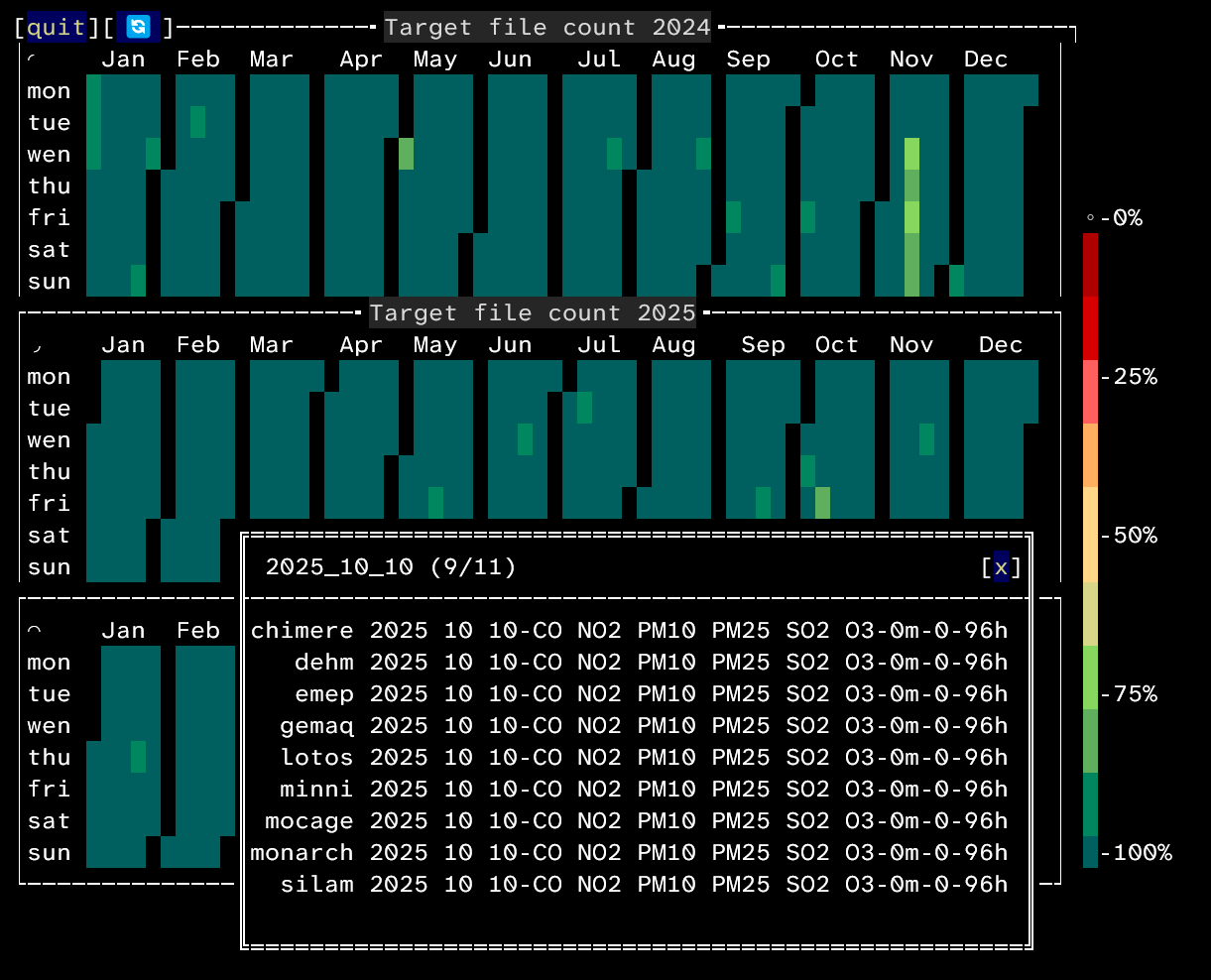
- Terminal User Interface that displays a calendar with different colors for each date.
- Allows to click on a date to reveal a popup with more informations about this date.
- Color bar and file count widget ready to use.
- Multiprocessing computing of the calendar.
- Requires you to implement a single class to adapt to your project.
Install
This package is available on pypi. Install with your prefered package manager.
pip install calendardataviz
# or
uv add calendardataviz
Usage
In your project, create a script that implements the InspectorABC class, then call the start_app function. You can read demo code in the demos folder.
Here is a presentation of the different classes and functions you need to know:
RichString
A class used to define a background and foreground color along side a string. This string representation is expected to be returned by your implementation of the InspectorABC class.
class RichString(ttk.TTkString):
    """String class offering the possiblity to define a
    background and foreground color along a string.

    In practice, is an easy to use interface for the
    TermTk.TTkString class, and only override its init method.
    """

    def __init__(
        self,
        text: str,
        bg_color: str | tuple[int, int, int] | tuple[float, float, float] = "#000000",
        fg_color: str | tuple[int, int, int] | tuple[float, float, float] = "#ffffff",
    ) -> None:
        """
        Args:
            text: Text.
            bg_color: Background color, either as an hexadecimal value
                such as `#ff00ff` or as a tuple of values, `(255, 0, 255)`.
            fg_color: Foreground color, in the same format as bg_color.
        """
InspectorABC
Abstract base class you need to implement. It has 3 method to override:
color_for_datewich returns the color for a given date.as_color_barwich returns values for a color bar of a given size.popup_contentwich returns content for the popup displayed when the user clicks on a date.
Described in more details in the script template available bellow.
start_app
Entry point for the app, starts the Terminal User Interface.
def start_app(
    inspector_cls: type[InspectorABC],
    years: Sequence[int],
    nb_processes: int = 1,
    target_nb_files: int | None = None,
    root_dir: Path | None = None,
) -> None:
    """Library entry point, instantiates and starts the terminal interface.
    If target_nb_files and root_dir are given, also spawns a file count
    widget, wich displays informations about the file count and the
    completion percentage (nb of files in root dir / target_nb_files).

    Args:
        inspector_cls: Your project's implementatino of the
            `calendardataviz.InspectorABC`. This is the class
            used by the app to get information for each dates.
        years: A sequence of years. A calendar will be displayed
            for each year.
        nb_processes: Number of multiprocessing processes to use.
            If your inspector's `color_for_date` method is not
            instantaneous, helps speed up the calendar's initialisation.
        target_nb_files: If given with `root_dir`, will spawn a
            file count widget.
        root_dir: If given with `target_nb_files`, will spawn a
            file count widget.
    """
Script template
Here is a script template you can copy to start your own implementation
of the InspectorABC class.
import datetime as dt
from typing import override

from calendardataviz import InspectorABC, RichString, start_app


class YourInspector(InspectorABC):
    name = "my inspector"

    @override
    def color_for_date(self, date: dt.date) -> RichString:
        """Returns the color for a given date.

        Args:
            date: date.

        Returns:
            RichString: The text and color associated
                to the given date.
        """
        pass

    @override
    def as_color_bar(self, size: int) -> list[RichString]:
        """Returns values for a color bar of the given size.

        Args:
            size: Size of the colorbar to generate.

        Returns:
            list[RichString]: A list of length "size"
                containing one character TTkStrings, one
                for each cell of the color bar.
        """
        pass

    @override
    def popup_content(self, date: dt.date) -> tuple[str, str]:
        """Return the information displayed when a date is selected.

        Args:
            date: Date selected.

        Returns:
            str: The pop-up window title.
            str: The pop-up window content.
        """
        pass


if __name__ == "__main__":
    start_app(
        inspector_cls=YourInspector,
        years=[2024, 2025, 2026],
        nb_processes=1,
    )
Default colors for color bar
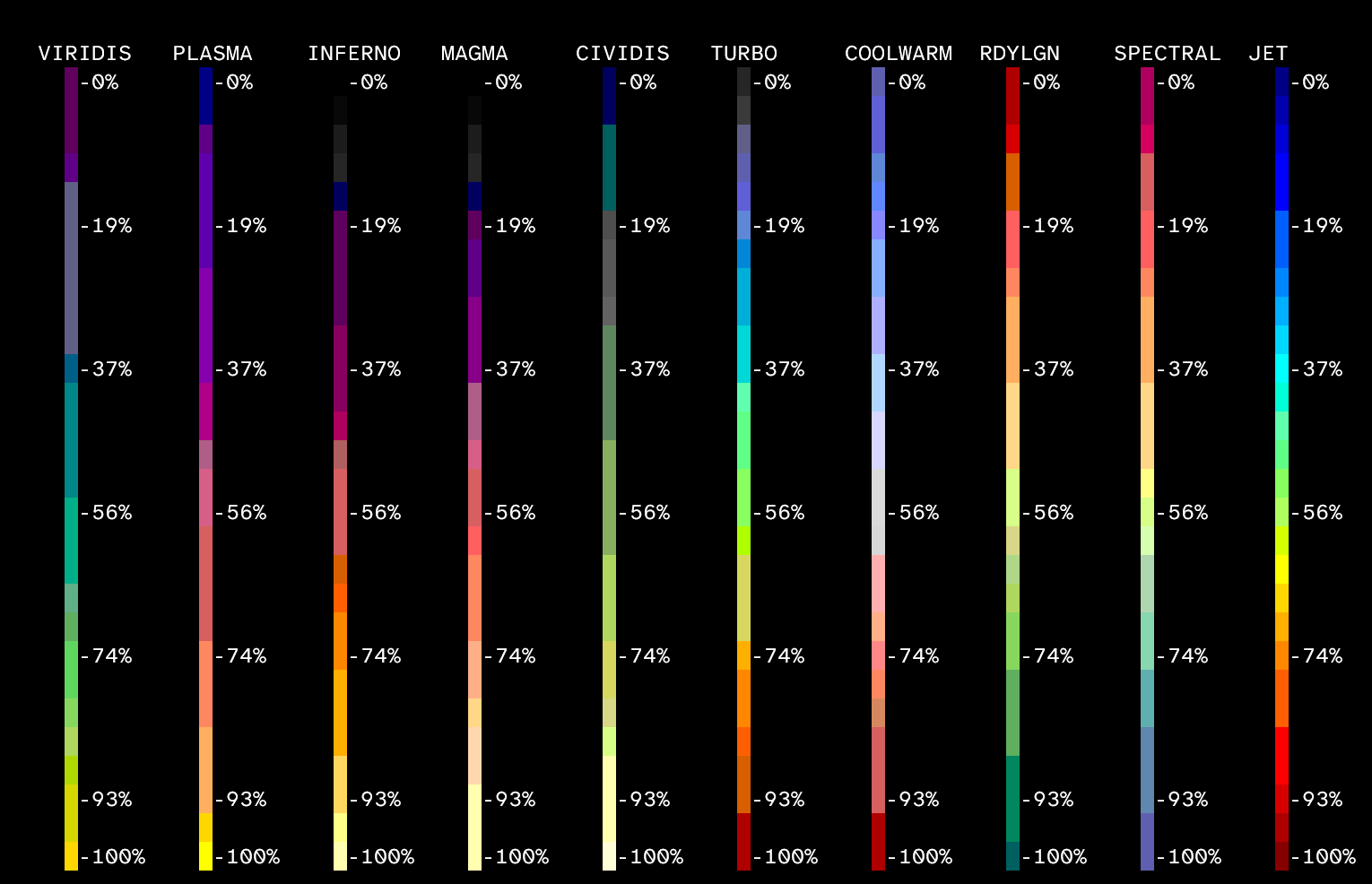
You can use color bars shipped with calendardataviz.
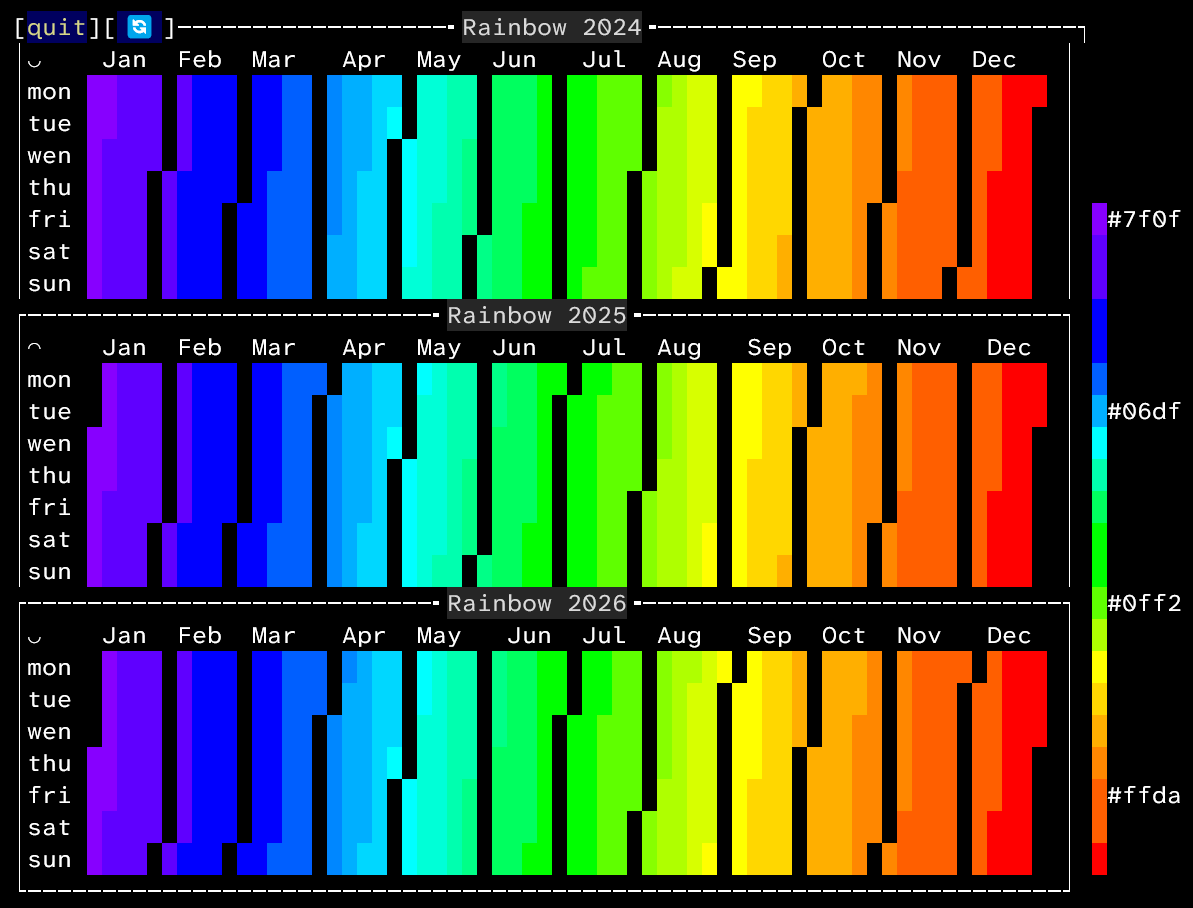
For exemple, here is the implementation of the color_for_date function of the InspectorABC class for the rainbow demo.
import datetime as dt
from typing import override

from calendardataviz import InspectorABC, RichString, start_app
from calendardataviz.colors import RAINBOW, color_from_pct


class RainbowInspector(InspectorABC):
    # ...

    @override
    def color_for_date(self, date: dt.date) -> RichString:
        """Returns the color for a given date.

        Args:
            date: date.

        Returns:
            RichString: The text and color associated
                to the given date.
        """

        # Compute the number of the day from the start of the year
        day_nb = (date - dt.date(date.year, 1, 1)).days

        # Compute the total number of days in the year
        nb_days_in_year = (dt.date(date.year + 1, 1, 1) - dt.date(date.year, 1, 1)).days

        # Compute the position of the day in the year as a percentage
        pct = day_nb / nb_days_in_year

        # Return a rich string with a background color from a color map
        return color_from_pct(pct, RAINBOW)
You can see that this implementation of the InspectorABC uses the calendardataviz.colors.RAINBOW color bar and uses the calendardataviz.colors.color_from_pct function to sample it.
Demos
To run the demos yourself, follow the contribution guide instructions to install the project in development mode, then run:
uv run demos/rainbow.py
uv run demos/color_bars.py


Contribution
Please contribute by proposing a merger request.
You can install the project in development mode like so:
git clone https://github.com/meteofrance/calendardataviz.git
cd calendardataviz
uv sync --all-extras
To format then test your code:
uvx ruff format
uvx ruff check --fix
uv run pytest -s
Once your code is formated and tested, you can create a merge request of your branch into the main branch.
1 maintainer

Metadata
1 maintainer
Release files for calendardataviz 0.3.1
For a detailed explanation of source distributions (sdists) and built distributions (wheels), please see the package formats documentation.
Source distribution (sdist)
| File | Size | Uploaded | |
|---|---|---|---|
| calendardataviz-0.3.1.tar.gz | 26.0 kB | Details |
Built distribution (wheel)
| File | Interpreter | ABI | Platform | Reset |
|---|---|---|---|---|
| calendardataviz-0.3.1-py3-none-any.whl | Python 3 | none | any | Details |
Total release size: 51.7 kB
Release files / calendardataviz-0.3.1.tar.gz
| Download URL | calendardataviz-0.3.1.tar.gz |
|---|---|
| Size | 26.0 kB |
| Tags | Source |
|
SHA-256 checksum How to use checksums |
f1ca85274233cf4bf22ed68c79cdbee57906cb53254e9f5e226f1ff9ba00b89d
|
|
BLAKE2b-256 checksum How to use checksums |
50398ecb0a525410f89709f1d6613c0a51efa8b021f9ff2a89606311e12607a5
|
| Upload date | |
|
Uploaded using Trusted Publishing? What is trusted publishing? |
Yes |
| Uploaded via |
twine/7.0.0 CPython/3.13.14
|
Provenance
Provenance describes where a file came from. On PyPI, provenance is shared via attestations, which provide a verifiable record of the build or publishing details. View details, limitations and caveats.


PyPI Publish Attestation
PyPI verified that this artifact, at this checksum, originated from the publisher listed below.
Signed by GitHub Actions, verified by PyPI on Oct 12, 2026.
Transparency logRelease files / calendardataviz-0.3.1-py3-none-any.whl
| Download URL | calendardataviz-0.3.1-py3-none-any.whl |
|---|---|
| Size | 25.7 kB |
| Tags | Python 3 |
|
SHA-256 checksum How to use checksums |
802ae02d32d1b9703bbdca83cd33bd91a377715894d69aadf2bdc420ac30ef5f
|
|
BLAKE2b-256 checksum How to use checksums |
67968840b0587b227446af70a6f28a94c35cf71dcdc7b67f4c2025b202ae14cf
|
| Upload date | |
|
Uploaded using Trusted Publishing? What is trusted publishing? |
Yes |
| Uploaded via |
twine/7.0.0 CPython/3.13.14
|
Provenance
Provenance describes where a file came from. On PyPI, provenance is shared via attestations, which provide a verifiable record of the build or publishing details. View details, limitations and caveats.
PyPI Publish Attestation
PyPI verified that this artifact, at this checksum, originated from the publisher listed below.
Signed by GitHub Actions, verified by PyPI on Oct 12, 2026.
Transparency log













