
call-limiter ⏱️♻️🛡️





A high-precision concurrency control library for distributed systems resilience.
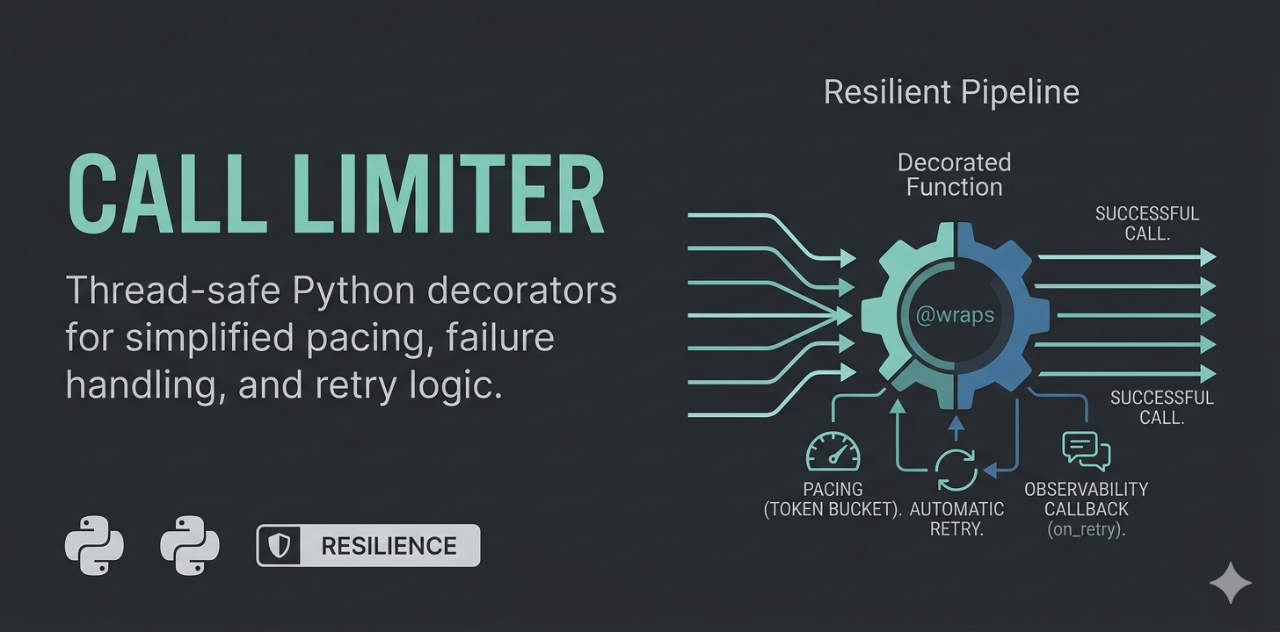
✨ Key Features
- Low-Jitter Timing: Uses time.perf_counter() and resolution-aware sleeping to prevent the "creeping delays" common in standard rate limiters.
- Dynamic Jitter Compensation: Automatically adjusts for OS-level scheduling delays to ensure time.sleep intervals remain precise under heavy system load.
- Thread-Safe: Designed for multithreaded environments where multiple workers hit the same limited resource.
- Thread-Synchronized State: Shared locks ensure that 10 threads hitting the same limiter behave as a single unit.
- Synchronized Pacing: In hybrid mode, retries are queued through the global limiter, preventing a 'thundering herd' and ensuring you never exceed your quota during recovery.
📦 Core Components
- ⏱️ CallLimiter: A high-precision throttler that paces function calls to stay within specific rate limits.
⏱️ View Throttling Strategy Diagram
Burst mode for 5 calls per 10 seconds:
Time (s)  0              5              10                            20
          |-----|-----|-----|-----|-----|-----|-----|-----|-----|-----|-----
Call-1    [████]                        |                             |
Call-2    [█████]                       |                             |
Call-3    [██]                          |                             |
Call-4    [█████]                       |                             |
Call-5    [█]                           |                             |
Call-6                                  |[████]                       |
Call-7                                  |[█████]                      |
Call-8                                  |[██]                         |
Call-9                                  |[█████]                      |
Call-10                                 |[█]                          |

Drip mode for 5 calls per 10 seconds:
Time (s)  0              5              10                            20
          |-----|-----|-----|-----|-----|-----|-----|-----|-----|-----|
Call-1    [████]                        |                             |
Call-2          [█████]                 |                             |
Call-3                [██]              |                             |
Call-4                      [█████]     |                             |
Call-5                            [█]   |                             |
Call-6                                  |[████]                       |
Call-7                                  |      [█████]                |
Call-8                                  |            [██]             |
Call-9                                  |                 [█████]     |
Call-10                                 |                       [█]   |
- ♻️ CallRetry: A resilience decorator that re-runs failed functions with a configurable delay and exception handling.
⏱️ View Retry Strategy Diagram
sequenceDiagram
    autonumber
    participant App as "Client Code"
    participant R as "CallRetry Decorator"
    participant API as "Downstream Service"

    App->>R: Invoke Function

    loop "Up to max_retry times"
        R->>API: Attempt Execution
        alt "Success"
            API-->>R: Return Data
            R-->>App: Return Result
        else "Error (Retryable)"
            Note over R, API: "Trigger on_retry hook"
            R->>R: "Wait (retry_interval)"
        end
    end

    alt "All Attempts Exhausted"
        R->>R: "Execute fallback_handler"
        R-->>App: "Return Fallback Result"
    else "No Fallback"
        R-->>App: "Raise Final Exception"
    end
- 🛡️ ResilientLimiter: A hybrid solution that combines pacing with Coordinated Recovery, ensuring retries never exceed your defined rate limit across threads.
⏱️ View Resilient Strategy Diagram
sequenceDiagram
    autonumber
    participant App as "Client Code"
    participant RL as "ResilientLimiter"
    participant L as "Shared CallLimiter"
    participant API as "Downstream Service"

    App->>RL: Invoke Function

    loop "Retry Loop (Max 3)"
        Note over RL, L: Check Rate Limit Contract
        RL->>L: Request Execution Slot
        L->>L: Calculate Window (perf_counter)
        L-->>RL: Slot Granted (after Paced Wait)

        RL->>API: Attempt Execution

        alt "Success"
            API-->>RL: 200 OK
            RL-->>App: Return Result
        else "Error"
            Note over RL: Trigger on_retry
            RL->>RL: Backoff Delay
        end
    end

    alt "Final Failure"
        RL->>RL: Execute Fallback
        RL-->>App: Fallback Result
    end
🛠 Installation
pip install call-limiter
Usage
Component 1: ⏱️ CallLimiter
Scenario: I want to "rate limit" (throttle) my function so it limits my calls to 5 calls per second. I also want to have an option to select if I want 5 calls to fire instantly or spread across evenly in the 1 second period.
Usage-1: 5 calls per 1 second with burst (instantly fire all 5 calls) Best for: Maximizing throughput when the target API allows short spikes.
My function to throttle: my_function
from call_limiter import CallLimiter

limiter = CallLimiter(calls=5, period=1, allow_burst=True)
throttled_func = limiter(my_function)
Usage-2: 5 calls per 1 second paced (evenly spread calls) Best for: Avoiding "spiky" traffic patterns that trigger anti-bot protections.
from call_limiter import CallLimiter

# This forces a call exactly every 0.2 seconds (1s / 5 calls)
limiter = CallLimiter(calls=5, period=1, allow_burst=False)
throttled_func = limiter(my_function)
Component 2: ♻️ CallRetry
Scenario: I want a retry logic to use with my function calls.
If my_function raises ValueError exception, it should retry up to 5 times with 1-second delay between attempts.
I want to log every retry with retry_logger function.
if it still fails, it should use fail_handler function. (if not provided, raise error)
from call_limiter import CallRetry

# This configuration perfectly mirrors your scenario:
retry = CallRetry(
    retry_count=5,
    retry_interval=1.0,
    retry_exceptions=(ValueError,), # Trigger
    on_retry=retry_logger,           # Observability
    fallback=fail_handler            # Outcome (Plan B)
)

# If fail_handler is a function, this returns its result on ultimate failure.
# If you didn't pass fail_handler, it would raise the ValueError.
resilient_func = retry(my_function)
Component 3: 🛡️ ResilientLimiter
Scenario: I want a rate limiter that can also handle failed calls. my_function should be called
Flow Logic:
- 5 calls/per second with burst (or drip),
- max_retry = 3 (if it fails)
- on_retry=
retry_handler, notify me by calling optionalretry_handler, if not provided ignore! - fallback=
falback_handlerif it still fails notify me, if not provided raise error! Note: each retry will comply "5 calls/per second with burst (or drip)" tempo to respect rate limiter
Note: on_retry receives (exception, attempt_number), while fallback is a simple callable.
from call_limiter import ResilientLimiter


limiter = ResilientLimiter(
    calls=5,
    period=1.0,
    allow_burst=True,
    retry_count=3,
    on_retry=retry_handler,
    fallback=fail_handler
)

@limiter
def my_function():
    # This will respect the 5/sec pace, even during retries.
    pass
📋 Links


1 maintainer

Metadata
1 maintainer
Release files for call-limiter 1.2.0
For a detailed explanation of source distributions (sdists) and built distributions (wheels), please see the package formats documentation.
Source distribution (sdist)
| File | Size | Uploaded | Provenance | Actions |
|---|---|---|---|---|
| call_limiter-1.2.0.tar.gz | 2.3 MB | With provenance | Details for call_limiter-1.2.0.tar.gz |
Built distribution (wheel)
| File | Interpreter | ABI | Platform | Actions Reset |
|---|---|---|---|---|
| call_limiter-1.2.0-py3-none-any.whl | Python 3 | none | any | Details for call_limiter-1.2.0-py3-none-any.whl |
Total release size: 2.4 MB
Release files / call_limiter-1.2.0.tar.gz
| Download URL | call_limiter-1.2.0.tar.gz |
|---|---|
| Size | 2.3 MB |
| Tags | Source |
|
SHA-256 checksum How to use checksums |
a3ec748a75ac4bf46187dd2056d90c7000097015c322ddc248115636006ceff2
|
|
BLAKE2b-256 checksum How to use checksums |
9f9612a9987982b538f03ca2cc1eafc3346ed037f442bc205240a17994ad5a19
|
| Upload date | |
|
Uploaded using Trusted Publishing? What is trusted publishing? |
Yes |
| Uploaded via |
twine/7.0.0 CPython/3.13.16
|
Provenance
Provenance describes where a file came from. On PyPI, provenance is shared via attestations, which provide a verifiable record of the build or publishing details. View details, limitations and caveats.


PyPI Publish Attestation
PyPI verified that this artifact, at this checksum, originated from the publisher listed below.
Signed by GitHub Actions, verified by PyPI on Nov 22, 2026.
Transparency logRelease files / call_limiter-1.2.0-py3-none-any.whl
| Download URL | call_limiter-1.2.0-py3-none-any.whl |
|---|---|
| Size | 9.6 kB |
| Tags | Python 3 |
|
SHA-256 checksum How to use checksums |
64e102c08f73738406f8d9aee02c047537be0d443c6e269d8484bdaf9bfc9f69
|
|
BLAKE2b-256 checksum How to use checksums |
d982a2e818454dce47c57be9a8684f826bfbd32e01f613ab4e7a4ef66607ee7a
|
| Upload date | |
|
Uploaded using Trusted Publishing? What is trusted publishing? |
Yes |
| Uploaded via |
twine/7.0.0 CPython/3.13.16
|
Provenance
Provenance describes where a file came from. On PyPI, provenance is shared via attestations, which provide a verifiable record of the build or publishing details. View details, limitations and caveats.
PyPI Publish Attestation
PyPI verified that this artifact, at this checksum, originated from the publisher listed below.
Signed by GitHub Actions, verified by PyPI on Nov 22, 2026.
Transparency logSecurity for call-limiter 1.2.0
Provenance
Provenance describes where a file came from. On PyPI, provenance is shared via attestations, which provide a verifiable record of the build or publishing details. View details, limitations and caveats.
Full provenance
Both files in this release have been uploaded with provenance metadata.
Attestation for call_limiter-1.2.0.tar.gz
PyPI Publish Attestation
PyPI verified that this artifact, at this checksum, originated from the publisher listed below.
Signed by GitHub Actions, verified by PyPI on Nov 22, 2026.
Transparency logA note on package security
PyPI is a repository for distributing packages, not a service for auditing them. While third-party security researchers and our staff do their best to detect and remove malicious packages, PyPI cannot guarantee the quality, security or suitability of any given package.
To learn more about protecting yourself from malicious actors, visit our package security documentation.














