
Cartage
Declarative data migrations. Describe sources, destinations and pipelines in YAML, put custom logic in plain Python, run locally to test, and generate thin Airflow DAGs, Dagster jobs or Prefect flows for production.
Cartage is an abstraction and simplification layer over data load tools. You describe what to move and how to reshape it; an engine moves the data. dlt is the default engine. The engine is pluggable, so other load tools can be supported later without changing your pipelines.
  what you write      cartage.yaml · connections.yaml · pipelines/*.yaml · transforms/*.py
                                              │
                                              ▼
                ┌───────────────────────── Cartage ─────────────────────────┐
                │  validate · plan · run · state · rejects                  │
                │  secrets: ${secret:…} ${env:…} ${airflow:…}               │
                │  generate: Airflow · Dagster · Prefect  (they call `run`) │
                └─────────────────────────────┬─────────────────────────────┘
                                              │ runs each pipeline on
                ┌───────────────────────── engine ──────────────────────────┐
                │  dlt (default)  │  python (reference)  │  future: others  │
                └───────┬─────────────────────────────────────────┬─────────┘
                        │ reads                                   │ writes
  files (local · S3 · GCS · HTTP) · dlt sources   SAP BAPIs · file exports · dlt destinations
                        └──── your Python transforms in between ──┘
- Sources: files (CSV, JSON Lines, Parquet) in a local folder, S3, GCS, Azure or over HTTP, and any dlt source (REST APIs, databases, SaaS) from YAML or Python.
- Destinations: any dlt destination (Snowflake, DuckDB, Postgres, BigQuery, a filesystem data lake, ...), loaded natively by dlt; SAP via BAPIs (ships a mock SAP; the RFC transport is planned); and file exports (JSON, JSON Lines, XML, CSV). One pipeline can write to several destinations.
- Connections are named after the system (
type: snowflake,type: filesystem,type: sap_bapi), never after the engine: see docs/connections.md. - Engines:
dlt(default) andpython, a plain-loop reference engine for tests (see Engines). - Orchestrators: Airflow, Dagster and Prefect. Generated code only calls
cartage run, so local and production run the same code.
Quickstart
pip install cartage
cartage init demo --answers https://raw.githubusercontent.com/datacoves/cartage/main/examples/sap/answers.yaml --yes
cd demo
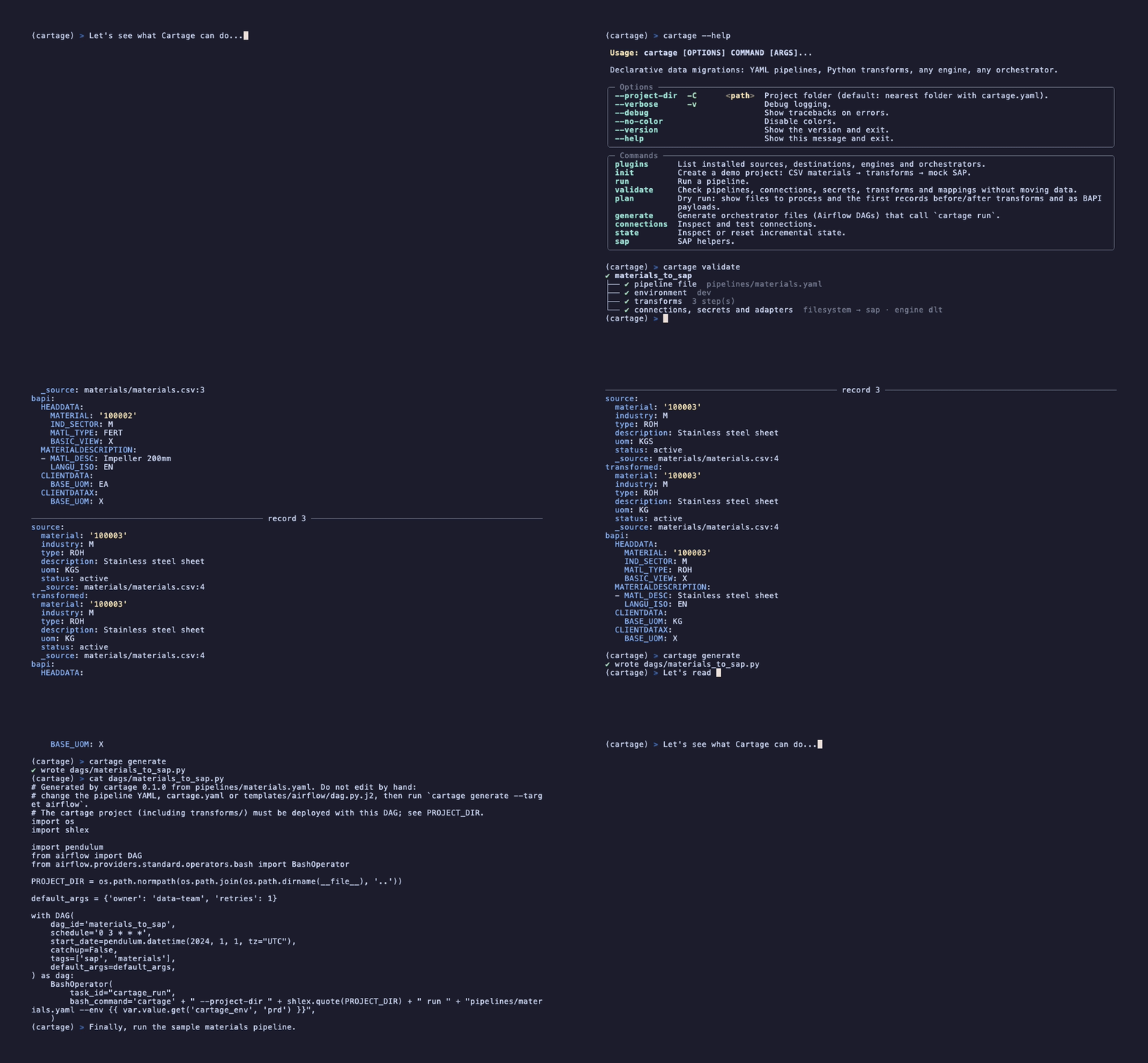
cartage validate
cartage plan materials        # dry run: records before/after transforms and the BAPI payloads
cartage run materials         # reads 20 rows, filters 2, sends 18: 16 load, 2 fail on purpose (exit 1)
cartage run materials --advance-state
cartage run materials         # incremental: nothing new to load
cartage generate              # dags/materials.py
The demo runs in dev on a sample file and a mock SAP; its prd environment reads S3 and calls SAP, once the
"<fill me>" placeholders are filled. Run cartage init <dir> without --answers to create your own project; see
Creating a project.
Split-screen demo: run cartage sap mock in one terminal, set url: http://localhost:8765 on sap.dev
in connections.yaml, and run the pipeline in another terminal.
Creating a project
cartage init <dir> asks a few questions and writes a project that validates straight away:
- the project name and environments (
dev, prd; the first is the default), - the source system: files (a folder,
s3://,gs://,az://,https://), a REST API, a SQL database or a Python function, plus a few details for it, - the destination: any dlt destination (
snowflake,duckdb,postgres, ...),file_exportorsap_bapi, - an optional sample file: with one, the first environment is fully local (the sample replaces the source through
source.envs, and the destination becomes DuckDB, the SAP mock or a local folder), socartage runworks before any credentials exist, - the pipeline name and an optional schedule (Airflow, Dagster or Prefect).
Credentials become placeholders: settings in connections.yaml and ${secret:<connection>.<env>.<field>}
references to .cartage/secrets.yaml, both "<fill me>". The fields come from dlt's own credential classes, so every
dlt destination is covered; optional fields are listed as comments. cartage validate --env <env> names every
placeholder still to fill.
--answers <path-or-url> answers questions from a file (the rest are asked, or take their defaults with --yes).
An answers file can also carry pipeline content: transforms, destination_options and copy (files to copy, relative
to the answers file). examples/sap/answers.yaml builds the demo above this way.
Install
Cartage needs Python 3.11.4 or newer. dlt is included; extras add the rest.
| Install | Adds |
|---|---|
pip install cartage |
CLI, both engines, local files, file exports, SAP (mock), all generators |
pip install "cartage[s3]" |
s3:// filesystem connections and state (same as dlt[s3]) |
pip install "cartage[all]" |
s3 and airflow |
pip install "dlt[snowflake]" |
the driver for a dlt destination (postgres, bigquery, ...) |
pip install "dlt[gs]" |
other file locations: dlt[gs], dlt[az], dlt[http] (https://), dlt[sftp] |
cartage[dlt] still works; since 0.6 it adds nothing, as dlt is a core dependency.
Generating Airflow, Dagster or Prefect files needs nothing extra; the orchestrator itself runs them.
Engines
The engine runs a pipeline: it reads from the source, applies your transforms, and hands records to the destination.
Set it in cartage.yaml (defaults.engine), per pipeline (engine:), or per run (--engine).
dlt(default) runs every pipeline as a dlt pipeline: dlt's extraction, normalization, incremental state and loading. dlt destinations load natively (bulk loads, staging, merge); record destinations (sap_bapi,file_export) plug in as a dlt custom destination, so Cartage can still report each record's result (rejects, warnings).pythonis a plain loop: the reference implementation of the engine contract, for tests and framework development. It reads sources and writes record destinations; dlt destinations andincrementalsources need the dlt engine, which keeps the cursor.
The engines differ in two ways today: dlt drops fields whose value is None before a record destination sees them,
and the dlt engine hands record destinations batches of 100 (which is what SAP commit: per_batch groups).
Engines are plug-ins (the cartage.engines entry point group, see Extending), so another load tool can
become an engine without changing pipelines, as long as it can run Python transforms between reading and writing.
Commands
| Command | Does |
|---|---|
cartage init <dir> [--answers <file-or-url>] [--yes] |
create a project from questions or an answers file |
cartage validate [pipelines...] |
check YAML, connections, secrets, transforms and mappings; moves no data |
cartage plan <pipeline> [-n 3] |
dry run: each record before/after transforms (or why it was dropped), and the payloads |
cartage run <pipeline> |
run it; --env, --engine, --full-refresh, --advance-state, --json |
cartage generate [-t airflow|dagster|prefect] |
write orchestrator files; --check, --output, --show-context <pipeline> |
cartage connections list|test <name> |
list connections (secrets as references) or check one |
cartage state show|reset <pipeline> |
inspect or delete incremental state |
cartage plugins |
list installed adapters and the connection types dlt provides |
cartage sap mock [--port 8765] |
run a mock SAP server that validates BAPI calls |
Global options go before the command: -C/--project-dir, -v/--verbose, --debug (tracebacks), --no-color.
Project layout
| Path | Purpose |
|---|---|
cartage.yaml |
environments, default engine, state location, orchestrator settings |
connections.yaml |
named connections with settings per environment — secrets only as references |
pipelines/*.yaml |
source → transforms → destination(s) (+ schedule) |
transforms/*.py |
map / filter / batch functions referenced as module:function |
templates/airflow/dag.py.j2 |
optional DAG template override ({% extends "cartage/airflow_dag.py.j2" %}) |
templates/<target>/... |
optional Dagster/Prefect overrides (dagster.py.j2, prefect.py.j2) |
.cartage/ |
git-ignored: secrets.yaml, state/, rejects/ |
YAML configuration
Cartage uses three YAML layers: cartage.yaml sets project-wide defaults, connections.yaml defines named services
per environment, and each pipelines/*.yaml file describes one flow from a source to one or more destinations.
cartage.yaml
project: inventory
environments: [dev, prd]
default_env: dev

defaults:
  engine: dlt # or python

state:
  dev: { path: .cartage/state }

orchestrators:
  airflow:
    dags_dir: dags
    default_args: { owner: data-team, retries: 1 }
The default_env must be listed in environments. A pipeline can override the default engine with its own engine.
State settings are optional; when omitted, Cartage stores local state under .cartage/state.
connections.yaml
Connections have a type and an envs map. Put service-specific settings under the environment where they apply;
pipelines refer to the connection by name. Keep credentials out of the file and use secret or environment references.
connections:
  local_files:
    type: filesystem                  # a local folder, s3://, gs://, az://, https://, ...
    envs:
      dev: { bucket_url: ./data }

  warehouse:
    type: snowflake                   # any dlt destination: duckdb, postgres, bigquery, ...
    envs:
      dev: { type: duckdb, credentials: dev.duckdb }     # an environment may use another system
      prd: { credentials: "${secret:snowflake.connection_string}" }

  sap:
    type: sap_bapi
    envs:
      dev: { transport: mock, client: "100" }
      prd:
        transport: rfc
        ashost: sap.example.com
        sysnr: "00"
        client: "100"
        user: "${secret:sap.user}"
        passwd: "${secret:sap.passwd}"
${secret:key} resolves from CARTAGE_SECRET__<KEY> (dots become double underscores and names are uppercased),
then .cartage/secrets.yaml. ${env:NAME} reads an environment variable directly. See Secrets for details.
docs/connections.md lists every connection type (filesystem, the dlt destinations,
file_export, sap_bapi): which settings go in connections.yaml and which options go in the pipeline.
pipelines/*.yaml
Each pipeline names a source connection, applies an ordered list of transforms, and writes to a destination (or a
list of destinations, see Multiple destinations). A step
must have exactly one of map, filter, or batch; each reference uses the module:function format.
name: materials
source:
  connection: local_files
  format: csv
  path: materials/*.csv
  incremental: true

transforms:
  - map: transforms.materials:normalize_uom
  - filter: transforms.materials:is_active
  - batch: transforms.materials:dedupe
    with: { key: material }

destination:
  connection: sap
  bapi: BAPI_MATERIAL_SAVEDATA
  mapping:
    HEADDATA.MATERIAL: material
    MATERIALDESCRIPTION[].MATL_DESC: description
    CLIENTDATA.BASE_UOM: uom
  constants:
    MATERIALDESCRIPTION[].LANGU_ISO: EN
  commit: per_record

schedule:
  airflow:
    schedule: "0 3 * * *"
    tags: [sap, materials]
Transforms run top to bottom, and each kind can appear any number of times and in any order, so several maps,
filters or batches chain naturally (each step with its own with:):
transforms:
  - map: transforms.materials:normalize_uom
  - map: transforms.materials:trim_text
  - filter: transforms.materials:is_active
  - map: transforms.materials:add_defaults
    with: { plant: "1000" }
  - filter: transforms.materials:has_description
  - batch: transforms.materials:dedupe
    with: { key: material }
Source and destination fields other than connection are adapter options. Transform functions live in your transforms/
package; with passes keyword arguments to the function, and on_error: fail stops the run on that step's first
error instead of rejecting the record. The optional schedule.airflow, schedule.dagster and schedule.prefect
blocks control generation with cartage generate (see Orchestrators). Run cartage validate after
editing YAML to check the project and references.
Sources
Full reference for every type: docs/connections.md.
| Source | Connection settings | Pipeline options |
|---|---|---|
filesystem connection |
bucket_url, credentials |
path (glob), format (csv, jsonl, parquet), reader_options, incremental, batch_size |
ref: (a dlt source, no connection) |
— | ref (module:function), with, resources, incremental, batch_size |
A filesystem source reads every file matching path with dlt's typed readers (pandas for CSV), so numbers arrive as
numbers. reader_options go to the reader, e.g. { dtype: str, keep_default_na: false } to keep codes such as
000123 as text and empty cells as "". With incremental: true only files modified since the last run are read
(a changed file is read again in full). The same connection can be a destination (a dlt data lake) and the state
store for SAP and file export pipelines.
A dlt source's ref returns a dlt source or resource; incremental: { cursor: updated_at, initial: "2024-01-01" }
adds a dlt cursor. Incremental sources need the dlt engine (the default).
Other keys go to dlt.sources.incremental: lag (re-read a window before the last value, e.g. for late updates),
end_value, primary_key, row_order, last_value_func, on_cursor_value_missing, range_start, range_end.
When ref returns a dlt source with several resources, resources: [name, ...] picks the ones to read (default: the
source's selected resources).
Generic sources (no Python)
Files need no code: point a filesystem connection at a folder, a bucket or a web server (bucket_url: https://raw.githubusercontent.com/datasets/population/master/data, then path: population.csv). ref also takes
installed modules, so dlt's built-in sources need only YAML, e.g. a REST API:
# dlt's declarative rest_api source; `config` is its configuration dict.
source:
  ref: dlt.sources.rest_api:rest_api_source
  with:
    config:
      client: { base_url: "https://earthquake.usgs.gov/fdsnws/event/1/" }
      resources:
        - name: earthquakes
          endpoint:
            path: query
            params: { format: geojson, starttime: "2026-10-01", endtime: "2026-10-02" }
            data_selector: features      # where the records are in the response
            paginator: single_page
Remote files need the matching dlt extra: dlt[http] for https://, dlt[s3], dlt[gs], dlt[az]. CSV and JSON
Lines are read as records, so a column that is empty in every row is not created; declare it in the destination's
columns ({ my_column: { data_type: double } }) if it must exist. See dlt's
REST API docs for every option
(authentication, pagination, incremental parameters). Reshape records with transforms; write a Python source only
for logic the configuration can't express.
SAP destination (sap_bapi)
bapi names the BAPI, mapping fills BAPI parameters (HEADDATA.MATERIAL, TABLE[].FIELD) from record fields and
constants fills them with fixed values; both are keyed by the BAPI parameter. commit is per_record (default), per_batch or none. cartage validate checks
mapped parameters and fields against the bundled BAPI metadata; the mock SAP also rejects values that are too long,
not allowed, or missing when required, as SAP would.
File export destination (file_export)
type: file_export writes each run to one local file, in json (an array), jsonl (default), xml or csv. It works with
both engines and needs no extra dependencies. cartage plan shows each record as it will be written.
connections:
  exports:
    type: file_export
    envs:
      dev: { path: ./output }       # folder, relative to the project
destinations:
  - { connection: exports, format: json }                                 # output/<pipeline>.json
  - { connection: exports, name: as_xml, format: xml, root: materials, record: material }
  - { connection: exports, name: as_csv, format: csv, file: "materials_{date}.csv" }
file is the name inside the folder ({pipeline}, {date} as YYYYMMDD UTC, {ext}; default {pipeline}.{ext}).
The file is written to <file>.partial and moved into place only when the run succeeds, so a failed run never leaves
a half-written file and the previous one stays. Nested values become nested elements in XML (lists as <item>) and
JSON text in CSV; XML names that start with a digit get a leading _. A CSV's columns come from its first record;
records with other columns are rejected. Records that fail transforms go to rejects as usual, and the file holds the
rest.
dlt destinations
Every dlt destination is a connection type of its own:
snowflake, duckdb, postgres, bigquery, databricks, filesystem (a data lake), ... (cartage plugins lists
them). The settings are that destination's dlt settings (credentials, database, bucket_url, ...). A project
module:function returning a dlt destination works as a type too. Install the driver extra, e.g.
pip install "dlt[snowflake]". dlt destinations need the dlt engine (the default).
connections:
  warehouse:
    type: snowflake
    envs:
      prd:
        credentials: "${secret:snowflake.connection_string}"
        naming: sql_ci_v1                              # connection-level default
  lake:
    type: filesystem                                   # also a source and a state store for sinks
    envs:
      dev: { bucket_url: ./lake }
destination:
  connection: warehouse
  dataset_name: raw                 # default: the pipeline name
  table_name: materials             # default: the source resource name
  write_disposition: merge          # append | replace | merge; unset: the source resource's hint, else append
  primary_key: material             # merge key: here, or the source resource's own hints
  columns: { price: { data_type: decimal, precision: 18, scale: 4 } }
  loader_file_format: parquet
  naming: direct                    # dlt naming convention, or a project module (e.g. naming.upper)
  dlt_config:                       # any dlt config key, applied to this run only
    data_writer.buffer_max_items: 100000
    extract.max_parallel_items: 15
  after_load:                       # called as f(pipeline, **with) after a successful load
    - { ref: utils.snowflake:enable_change_tracking, with: { tables: [materials] } }
The dlt engine loads straight into the destination: bulk loads, staging and merge are dlt's, run once per run.
Without transforms, source batches reach dlt untouched, so Arrow/pandas batches (e.g. sql_database with the
pyarrow backend, ConnectorX) stay columnar. Hints the source resource sets itself (write_disposition,
primary_key, columns, ...) are kept unless the destination sets them. after_load hooks get the dlt pipeline, so
they can run SQL with pipeline.sql_client() (grants, tags, change tracking); if one fails the data stays loaded, the
run exits with code 3 and state is not saved. dlt fails whole load jobs, not single records: a failed load stops the
run and state is not saved. Database-specific extraction (casts for Oracle LOBs and NUMBERs, MSSQL datetime2, Postgres
enums and timestamptz, time zones) belongs in your dlt source factory, not in Cartage.
Example: an incremental table copy from a database into Snowflake, kept columnar end to end.
# sources/erp.py
from dlt.sources.sql_database import sql_table

def materials(credentials: str, schema: str):
    return sql_table(credentials=credentials, schema=schema, table="materials", backend="pyarrow")
name: erp_materials
source:
  ref: sources.erp:materials
  with: { credentials: "${secret:erp.url}", schema: ERP }
  incremental: { cursor: updated_at, initial: "2024-01-01" }
destination:
  connection: warehouse
  dataset_name: raw_erp
  write_disposition: merge
  primary_key: material
engine: dlt
Multiple destinations
Use destinations: instead of destination:. Each entry is its own run, in order, with its own state, rejects and
dlt pipeline (<pipeline>__<name>; name defaults to the connection and tells apart destinations that share
one), so a failed destination retries without reloading the others. The source is
read once per destination; to read it once, land it in a filesystem connection first and load from there.
destinations:
  - { connection: warehouse, table_name: materials, write_disposition: merge, primary_key: material }
  - { connection: sap, bapi: BAPI_MATERIAL_SAVEDATA, mapping: { ... } }
Orchestrators
cartage generate --target airflow|dagster|prefect writes one file per pipeline that has a schedule.<target> block.
Each file only runs cartage --project-dir <project> run <pipeline> --env <env>, so deploy the Cartage project (with
transforms/) next to it. Settings merge: built-in defaults ← orchestrators.<target> in cartage.yaml ← the
pipeline's schedule.<target> (dicts merge by key). Add --check in CI to fail on stale files.
schedule:
  airflow: { schedule: "0 3 * * *", tags: [sap] }
  dagster: { schedule: "0 3 * * *", tags: { team: data }, timezone: Europe/Brussels }
  prefect: { schedule: "0 3 * * *", tags: [sap], retries: 2 }
| Target | Output (default) | Settings | Environment at run time |
|---|---|---|---|
| airflow | dags/<dag_id>.py |
dags_dir, schedule, tags, default_args, task_decorator, operator_args, dependencies, task_env, image, ... |
Airflow var cartage_env |
| dagster | orchestration/dagster/<name>.py |
out_dir, name, schedule, timezone, tags, env, command, project_dir |
CARTAGE_ENV env var |
| prefect | orchestration/prefect/<name>.py |
out_dir, name, schedule, retries, tags, env, command, project_dir |
CARTAGE_ENV env var |
- Dagster: each file defines a job, its schedule, and
defs = dg.Definitions(...). Load it withdagster dev -f orchestration/dagster/<name>.py(repeat-fper pipeline), or merge thedefsobjects. - Prefect: each file defines the
cartage_runflow.python orchestration/prefect/<name>.pyserves it on the schedule, or pointprefect deployatorchestration/prefect/<name>.py:cartage_run. envdefaults toprd;command(defaultcartage) may include a launcher, e.g.uv run cartage.- Airflow: DAGs use the TaskFlow API (
@dag,@task.bash).task_decoratorpicks the task decorator, e.g.datacoves_bashfor@task.datacoves_bash;operator_argsare its keyword arguments.task_envadds environment variables to the task (e.g.UV_CACHE_DIR). See Airflow settings for packages, owner/email and functions that builddefault_argsor the schedule.
Airflow settings
# cartage.yaml
orchestrators:
  airflow:
    task_decorator: datacoves_bash
    command: uvx --from "cartage>=0.8.0" cartage
    dependencies: ["dlt[snowflake,parquet]"]                  # every DAG
    default_args: { owner: data-team, email: [data@example.com], retries: 1 }

# pipelines/loans.yaml
schedule:
  airflow:
    schedule: "0 3 * * *"
    dependencies: ["dlt[http]"]                               # only this DAG
    default_args: { owner: Noel Gomez, email: [noel@example.com] }
-
dependenciesfromcartage.yamland the pipeline add up (every other list replaces) and become--withflags right after auvx,uv tool runoruv runcommand:uvx --with 'dlt[snowflake,parquet]' --with 'dlt[http]' --from 'cartage>=0.8.0' cartage. -
default_argsmerge by key, so the owner and email can be set once and overridden per pipeline. -
Values are written into the DAG as Python literals. When
default_argsneed Python (timedeltas, callbacks), pointdefault_args_fromat a function that builds them;default_argsbecome its keyword arguments.schedule_fromwraps the schedule the same way, e.g. to turn it off outside production:default_args_from: orchestrate.utils.datacoves_utils:set_default_args default_args: { owner: Noel Gomez, owner_email: noel@example.com } schedule_from: orchestrate.utils.datacoves_utils:set_schedule
renders
default_args = set_default_args(owner='Noel Gomez', owner_email='noel@example.com')andschedule=set_schedule('0 3 * * *'). -
For anything else, a project template (
templates/airflow/dag.py.j2,{% extends "cartage/airflow_dag.py.j2" %}) can override the blocksheader,imports,default_args,schedule,dag,taskandextra.
Airflow connections
In Airflow, credentials usually live in Airflow connections. Cartage reads them with ${airflow:...} references, so
nothing has to copy them into variables by hand and they never appear in YAML or in the generated DAG.
1. Reference connection fields in connections.yaml, in the environment the DAGs run (the cartage_env Airflow
variable, prd by default):
warehouse:
  type: snowflake
  envs:
    dev: { destination_name: datacoves_snowflake }   # credentials from ~/.dlt/secrets.toml locally
    prd:
      credentials:
        host: "${airflow:main_load_keypair.extra.account}"
        username: "${airflow:main_load_keypair.login}"
        private_key: "${airflow:main_load_keypair.extra.private_key_content}"   # PEM, as stored
        warehouse: "${airflow:main_load_keypair.extra.warehouse}"
        role: "${airflow:main_load_keypair.extra.role}"
| Reference | Airflow connection field |
|---|---|
${airflow:<conn_id>.login} |
Login (also password, host, schema, port) |
${airflow:<conn_id>.extra.<key>} |
a key of the Extra JSON; nest with dots (extra.auth.token) |
2. Generate the DAGs. cartage generate collects every ${airflow:...} used by the pipeline (its source,
destinations, state store and options, in every environment) and passes them to the task as environment variables
whose values are Airflow templates:
@task.bash(
    env={"CARTAGE_AIRFLOW__MAIN_LOAD_KEYPAIR__LOGIN": "{{ conn.get('main_load_keypair').login or '' }}", ...},
    append_env=True,
)
def cartage_run():
    return "cartage --project-dir ... run pipelines/loans.yaml --env {{ var.value.get('cartage_env', 'prd') }}"
3. Airflow fills them in when the task runs, from wherever it keeps connections (metadata database, a secrets
backend such as Vault or AWS Secrets Manager, or AIRFLOW_CONN_<ID> variables), and masks passwords in the task log.
4. cartage run resolves each reference from its CARTAGE_AIRFLOW__<CONN_ID>__<FIELD> variable (dots and dashes
become __ and _). Values are never printed.
Notes:
- Rerun
cartage generatewhen references change;cartage generate --checkin CI catches stale DAGs. - A field that is empty in the connection resolves to
"". A missingextrakey fails the task when Airflow renders it (Airflow'sStrictUndefined), naming the key. - Outside Airflow,
cartage run/validatestop at the first${airflow:...}with a hint naming the variable. Use another environment locally (${secret:...},${env:...}or the driver's own config), or export the variable. - To test a DAG without a real connection, define one inline:
AIRFLOW_CONN_MAIN_LOAD_KEYPAIR='{"conn_type": "snowflake", "login": "...", "extra": {...}}' airflow dags test <dag_id>. - Dagster and Prefect pass secrets to tasks as environment variables; read them with
${env:...}.
Batches
batchtransforms see one source batch at a time (default 100 rows,batch_sizesource option).commit: per_batchcommits each batch the engine hands to the destination (the dlt engine re-chunks at 100).- dlt destinations are not fed in batches: dlt extracts, normalizes and loads the whole run. Size its files and
buffers with
dlt_config(e.g.data_writer.buffer_max_items,data_writer.file_max_items).
Secrets
${secret:sap.passwd} reads CARTAGE_SECRET__SAP__PASSWD, then .cartage/secrets.yaml (git-ignored; the dots are
nesting levels). ${env:VAR} reads an environment variable. Resolved values are never printed.
# .cartage/secrets.yaml
sap: { user: rfc_user, passwd: "..." }
snowflake: { connection_string: "snowflake://user:...@account/db?warehouse=wh&role=r" }
dlt destinations can also leave credentials out of connections.yaml entirely: dlt then reads its own
.dlt/secrets.toml (in the working directory) or ~/.dlt/secrets.toml (e.g. destination_name: my_snowflake reads
[destination.my_snowflake.credentials]).
${airflow:<conn_id>.<field>} reads a field of an Airflow connection inside DAGs from cartage generate; see
Airflow connections.
State and rejects
dlt destinations (snowflake, duckdb, postgres, filesystem, ...) keep their state the way any dlt pipeline
does: in the destination (_dlt_pipeline_state), loaded together with the data and restored from there on the next
run, so a fresh Airflow worker needs no state settings. Record errors don't hold that state back: the good rows and
the new cursor land together, and rejected records stay in the rejects file. --full-refresh drops the pipeline's
tables and state, then loads again.
dlt cannot keep state in SAP or in a file export, so those pipelines use Cartage's state store. It is saved only when a
run has no record errors (or with --advance-state), and it lives in .cartage/state unless cartage.yaml points an
environment at a filesystem connection: state: { prd: { connection: landing, prefix: cartage/state/ } } (S3, GCS,
Azure, ...). Local state is lost on orchestrator workers, so cartage generate refuses a SAP or file export pipeline
whose environment keeps it on local disk. --full-refresh ignores the stored state.
Rejected records go to .cartage/rejects/<pipeline>/<run_id>.jsonl. cartage state show|reset <pipeline> inspects
or clears state, wherever it lives.
With several destinations, each destination is its own run named <pipeline>__<name>: state, rejects and the
dlt pipeline are kept per destination, and state show|reset covers all of them. cartage run goes through the
destinations in order and stops at the first fatal error; destinations that already finished keep their state, so a
rerun only retries the rest. With --json, run prints one result line per destination and plan prints a list.
Exit codes
0 ok · 1 record errors · 2 configuration error · 3 fatal run error (connection, transport, failed dlt load,
on_error: fail).
Advanced: database extraction tuning
Cartage has no database drivers of its own: a dlt source's ref is your Python, so ConnectorX, sql_table,
SQLAlchemy, Oracle or Teradata clients, and every per-database fix are plain code in your project. Cartage calls the
function with with: (secrets resolved), adds incremental:, and hands what it yields to dlt. Keep tuning helpers in a
project package (e.g. utils/) and use them from source functions. Where each kind of tuning goes:
| Need | Where in Cartage |
|---|---|
| Driver and backend (ConnectorX, pyarrow, pandas, SQLAlchemy) | the source function |
| SQL casts per database (timestamps, LOBs, decimals, enums) | the source function builds the SELECT |
| Per-batch type fixes (epoch ms, ints → float, rounding) | resource.add_map(...) in the source function |
| Row-count / truncation checks | a generator wrapper in the source function |
| Credentials | with: + ${secret:...} |
| dlt performance and load settings | dlt_config: on the destination |
Identifier casing (direct, upper, lower, keep quotes) |
naming: on the destination |
| Column types, nullability | columns: on the destination, or hints in the source |
pipelines_dir, bucket URL, write disposition, file format |
Cartage state, the connection, destination options |
Driver, casts and fallback
The source function picks the driver and can fall back when a type isn't supported, then build its query from
metadata-driven casts (for example a build_select_with_casts-style helper that reads ALL_TAB_COLUMNS or
INFORMATION_SCHEMA):
# sources/erp.py
from urllib.parse import quote_plus

import connectorx as cx
import dlt

from utils.data_types import build_select  # your helper, e.g. adapted from build_select_with_casts


@dlt.resource(name="materials", max_table_nesting=0)
def materials(db: str, user: str, password: str, dsn: str, table: str, conversions: dict | None = None,
              updated_at=dlt.sources.incremental("UPDATED_AT")):
    conn = f"{db}://{quote_plus(user)}:{quote_plus(password)}@{dsn}"
    where = f" WHERE UPDATED_AT >= '{updated_at.start_value}'" if updated_at.start_value else ""
    query = f"SELECT {build_select(conn, table, conversions or {})} FROM {table}{where}"
    try:
        yield from cx.read_sql(conn, query, return_type="arrow_stream", batch_size=10_000)
    except BaseException:  # Arrow stream lacks some types (e.g. Oracle NCLOB): fall back to a DataFrame
        yield cx.read_sql(conn, query)
source:
  ref: sources.erp:materials
  with:
    db: oracle
    user: "${secret:erp.user}"
    password: "${secret:erp.password}"
    dsn: "${secret:erp.dsn}"
    table: ERP.MATERIALS
    conversions: { CREATED_ON: timestamp, NOTES: lob_text }
  incremental: { cursor: UPDATED_AT, initial: "2024-01-01" }
Cartage's incremental: binds to the function's dlt.sources.incremental argument, so start_value is the stored
cursor: put it in the WHERE to read only new rows. dlt's sql_table(..., backend="connectorx" | "pyarrow" | "sqlalchemy") does that pushdown for you, and takes query_adapter_callback (extra filters or suffixes),
table_adapter_callback (e.g. remove_nullability_adapter) and chunk_size. Pass with: values such as backend
or connector: sqlalchemy to switch drivers per pipeline when ConnectorX can't read a table.
Per-batch type normalization
Attach Arrow, pandas or row transforms with add_map. They run inside dlt on every batch, before normalization, and
keep batches columnar:
from utils.data_types import normalize_types  # timestamps → epoch ms, decimals/ints → float64, rounding

def orders(...):
    return sql_table(credentials=..., table="ORDERS", backend="pyarrow").add_map(normalize_types)
Prefer add_map in the source over Cartage transforms for bulk copies: Cartage transforms see row dicts, so Arrow
batches are converted to rows first.
Row-count checks
ConnectorX can silently return fewer rows (dropped batches, timeouts). Count what you yield and raise at the end; the run then fails with exit code 3 before anything is loaded, and no state is saved:
def checked(batches, expected: int, tolerance: int = 10):
    n = 0
    for batch in batches:
        n += len(batch)  # Arrow tables, DataFrames and lists all have len()
        yield batch
    if n < expected - tolerance:
        raise RuntimeError(f"extracted {n} rows, source had {expected}: try connector: sqlalchemy")

@dlt.resource(name="materials")
def materials(conn: str, table: str):
    expected = int(cx.read_sql(conn, f"SELECT COUNT(*) FROM {table}").iloc[0, 0])
    yield from checked(cx.read_sql(conn, f"SELECT * FROM {table}", return_type="arrow_stream"), expected)
dlt settings and naming
dlt_config: takes any dlt config key (as in dlt.config[...]), on the connection as a default or on the pipeline
destination as an override, applied only while that run executes:
destination:
  connection: lake
  loader_file_format: parquet
  write_disposition: replace
  naming: utils.sql_upper             # a module with a NamingConvention class, as dlt's schema.naming expects
  columns: { AMOUNT: { data_type: double, nullable: true } }
  dlt_config:
    sources.data_writer.file_max_items: 1000000
    sources.data_writer.file_max_bytes: 100000000
    data_writer.buffer_max_items: 100000
    extract.max_parallel_items: 15
    normalize.data_writer.disable_compression: false
    load.truncate_staging_dataset: true
naming takes dlt's built-ins (direct, snake_case, sql_cs_v1, sql_ci_v1) or a project module, so naming
classes such as upper, lower or keep-quotes variants work as they are. Two settings are Cartage's: leave
restore_from_destination on (the default; it is how a run gets its state back from the destination) and
load.delete_completed_jobs true (the SAP and file export state archive must not keep loaded data).
Process-wide patches to dlt internals (for example keeping all-null columns) are not run settings: apply them in the source module (at import, or at the start of the source function), knowing they affect every pipeline in that process.
Extending
Adapters are entry points in the groups cartage.sources, cartage.destinations, cartage.engines and
cartage.orchestrators. cartage plugins lists what is installed.
A destination is a record sink (preview + write, like sap_bapi and file_export) by default. Optional: finish(ok) is called
after the run (to finalize or discard output), and preview_label/preview_syntax name and highlight plan output. To have the dlt engine load into it natively
instead, expose dlt_destination() returning a dlt destination, plus hints (resource hints such as
write_disposition), dataset_name, loader_file_format and dlt_env (env vars applied to the run), as the dlt
destination adapter does. dlt destination names (snowflake, filesystem, ...) are reserved: a plug-in with one of
those names is an error.
License
Apache-2.0
1 maintainer

Metadata
1 maintainer
Release files for cartage 0.9.0
For a detailed explanation of source distributions (sdists) and built distributions (wheels), please see the package formats documentation.
Source distribution (sdist)
| File | Size | Uploaded | |
|---|---|---|---|
| cartage-0.9.0.tar.gz | 4.4 MB | Details |
Built distribution (wheel)
| File | Interpreter | ABI | Platform | Reset |
|---|---|---|---|---|
| cartage-0.9.0-py3-none-any.whl | Python 3 | none | any | Details |
Total release size: 4.5 MB
Release files / cartage-0.9.0.tar.gz
| Download URL | cartage-0.9.0.tar.gz |
|---|---|
| Size | 4.4 MB |
| Tags | Source |
|
SHA-256 checksum How to use checksums |
efe7073a11bdbe7d5069f5ac212501196e64d6098890712a0b90b333dd2dfb6b
|
|
BLAKE2b-256 checksum How to use checksums |
c6f3fbb93a8ecc79b8ca694cc3443130d1ed31ec38b9d34fb7e883bf0697c53d
|
| Upload date | |
|
Uploaded using Trusted Publishing? What is trusted publishing? |
Yes |
| Uploaded via |
uv/0.12.23 {"installer":{"name":"uv","version":"0.12.23","subcommand":["publish"]},"python":null,"implementation":{"name":null,"version":null},"distro":{"name":"Ubuntu","version":"24.04","id":"noble","libc":null},"system":{"name":null,"release":null},"cpu":null,"openssl_version":null,"setuptools_version":null,"rustc_version":null,"ci":true}
|
Release files / cartage-0.9.0-py3-none-any.whl
| Download URL | cartage-0.9.0-py3-none-any.whl |
|---|---|
| Size | 87.5 kB |
| Tags | Python 3 |
|
SHA-256 checksum How to use checksums |
b4dcb1c30faa9424e1a53fab3f3a54934764ad6dc0187616679514aabe49e5fd
|
|
BLAKE2b-256 checksum How to use checksums |
1fe45af9717d1081665d8c88505a6360fd1a6b77b80f15e5028e78e7433d66d1
|
| Upload date | |
|
Uploaded using Trusted Publishing? What is trusted publishing? |
Yes |
| Uploaded via |
uv/0.12.23 {"installer":{"name":"uv","version":"0.12.23","subcommand":["publish"]},"python":null,"implementation":{"name":null,"version":null},"distro":{"name":"Ubuntu","version":"24.04","id":"noble","libc":null},"system":{"name":null,"release":null},"cpu":null,"openssl_version":null,"setuptools_version":null,"rustc_version":null,"ci":true}
|














