
catalogify
Turn a repository into a knowledge catalog your AI agent can afford to read.

catalogify generates an Open Knowledge Format (OKF v0.1)
bundle: a directory of cross-linked markdown concepts with YAML frontmatter
describing a codebase's services, modules, APIs, data models and operations.
Where git is available it mines the history for the reasoning behind the code,
and whatever it cannot establish it parks as an open question rather than
inventing an answer.
- Monorepo or single repo. One
Serviceconcept per deployable unit, scoped by folder — a repo with hundreds of services produces the same directory layout as a single-service repo, just wider. - Cheap on large codebases. Scanning 25,917 files and 500,022 lines of Kubernetes takes 2.1 seconds. A service entry is ~676 tokens whether the service is 10k lines or 100k.
- Git optional. History mining and incremental updates need it; everything else does not.
It installs as a portable Agent Skill, so it works in Claude Code, Cursor,
OpenAI Codex, and anything else that reads the open .agents/skills standard.
Your agent follows the skill to generate, update, clarify, or validate a catalog.
The package also provides a CLI for repository scans, history analysis,
bundle checks, and skill installation.
For Spec Kit projects the same workflows
ship as slash commands, built from this repository
(below).
Quickstart: agent skill
Install the package from PyPI, then copy its skill into your agent:
uv tool install catalogify
catalogify install
uv tool install catalogify uses the published PyPI version. To test changes
on main before a release, including the new detail setting, install from
GitHub instead:
uv tool install --force git+https://github.com/alexcpn/catalogify
catalogify install
The second command matters: your agent reads a copied skill, so upgrading the
package alone does not update its instructions. Restart the agent after either
installation. Python 3.9+ and bash are required; git adds history mining and
incremental updates but is optional. See Requirements.
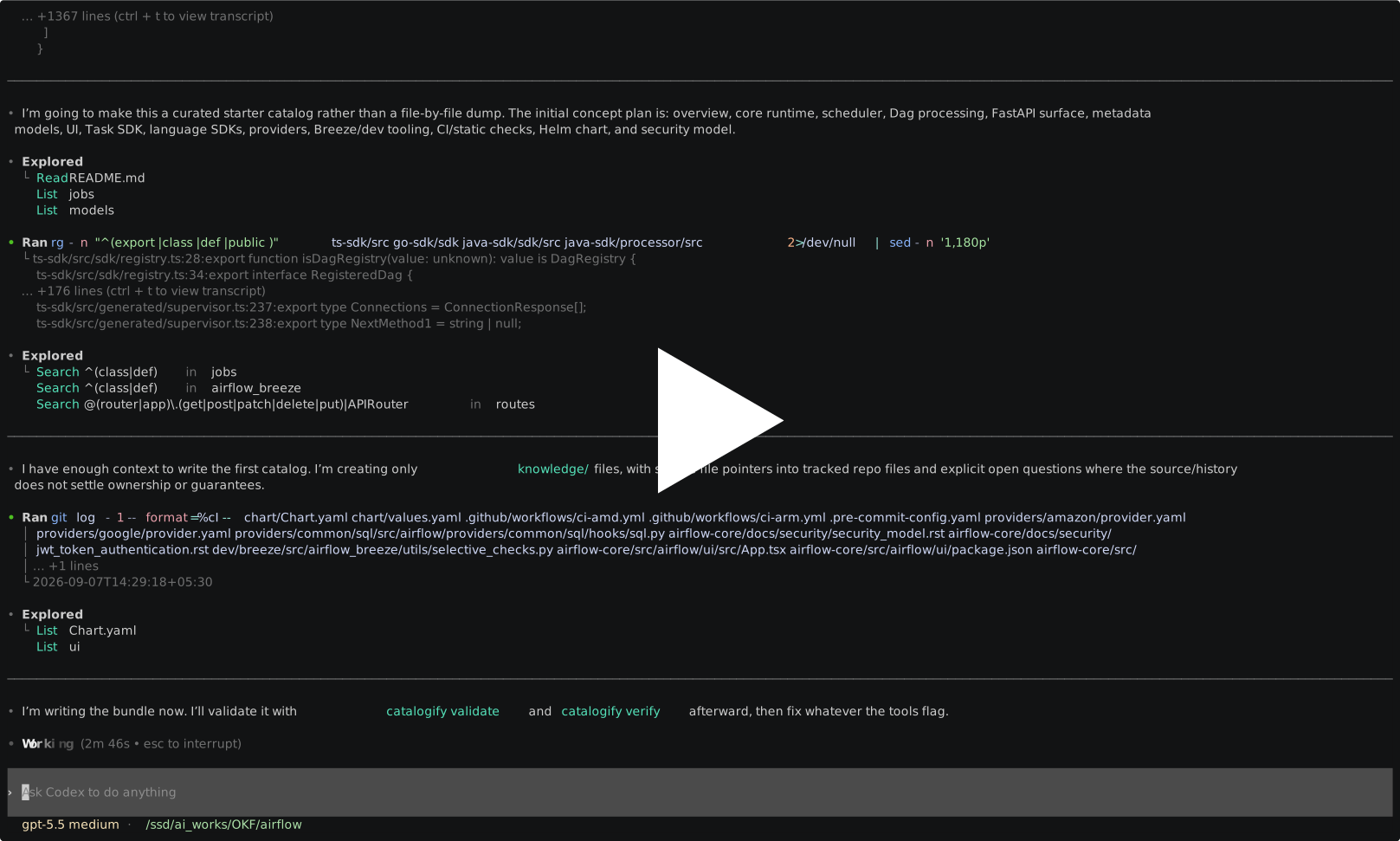
Open the repository you want to document and enter these in the agent chat:
Use catalogify to generate a knowledge catalog for this repo.
Use catalogify to clarify the open questions in knowledge/.
Use catalogify to validate knowledge/ and verify its claims against the repo.
Run the prompts in order. The first creates knowledge/; the second asks you
about facts the agent could not establish. Your answers become part of the
catalog and survive later updates. You can skip a question and leave it open.
After code changes, ask your agent to update the catalog. The catalogify skill
handles the supporting terminal commands for you.
For deeper explanations, add detail: detailed to the generate or update
prompt. This changes the depth of each concept without adding more concepts:
Use catalogify to generate a knowledge catalog for this repo. Use detail: detailed.
Spec Kit extension
If your project already uses Spec Kit,
install the extension instead of the standalone skill. It supplies the same
workflows as agent commands and does not require catalogify to be installed.
Install the published extension after choosing your Spec Kit agent integration:
specify extension add okf --from \
  https://github.com/alexcpn/catalogify/releases/download/v0.10.1/speckit-okf-0.10.1.zip
To test changes on main before a release, build and install the extension
from this checkout:
python3 integrations/speckit/build.py
specify extension add --dev build/speckit-okf
Then enter these in your agent chat (use the command names your agent registered):
/speckit.okf.generate
/speckit.okf.clarify
/speckit.okf.validate
/speckit.okf.verify
After code changes, use /speckit.okf.update. Add detail: detailed to
generate or update arguments when you want deeper explanations for that
run, for example /speckit.okf.generate detail: detailed.
| Spec Kit command | Purpose |
|---|---|
/speckit.okf.generate |
Create a catalog from code and git history. |
/speckit.okf.update |
Refresh concepts affected by code changes. |
/speckit.okf.clarify |
Ask you to resolve open questions. |
/speckit.okf.validate |
Check the bundle's OKF structure. |
/speckit.okf.verify |
Check claims against the repository. |
Command names depend on your agent. Spec Kit names them after the
integration you chose. Claude Code and Codex register them as skills with
hyphens (/speckit-okf-generate, /speckit-okf-verify, …); other agents get
the dotted form shown here. Install the extension after choosing your agent
integration. Adding an integration later does not register extensions that
are already installed, so rerun the install with --force.
The extension reads its config from .specify/extensions/okf/okf-config.yml.
See the extension guide for more installation
details. Both installation routes produce the same OKF v0.1 bundle; installing
both registers two skills for the same workflows.
The four workflows
These workflows run through the agent skill or the Spec Kit extension. Ask your agent in plain language with the skill, or use the extension commands above:
| Workflow | What it does |
|---|---|
| generate | Inventory scan, git-history mining, concept plan, concept documents, index.md files, log.md, validation. |
| update | Diffs since the last logged commit; refreshes only stale concepts, deprecates orphans, adds new ones, preserves human curation. |
| clarify | Asks you about the open_questions the other workflows parked, then folds the answers in as cited, curation-protected knowledge. |
| validate | OKF §9 conformance check plus a quality spot-check. |
What you get
The generated catalog lives in knowledge/ by default, ready to commit next
to the code:
knowledge/
├── index.md            # okf_version: "0.1" + directory of everything
├── log.md              # dated history, each block records a commit SHA
├── README.md           # front door for humans browsing the repo
├── GUIDANCE.md         # optional, yours: steers the agent (see below)
├── architecture/
│   └── overview.md     # type: Reference — the "start here" concept
├── services/…          # type: Service
├── modules/…           # type: Module
├── apis/…              # type: API Endpoint / API Resource
├── data/…              # type: Data Model / Database Table
└── operations/…        # type: Pipeline / Configuration / Playbook
On a monorepo, raise OKF_INVENTORY_CAP above its default of 150. Raw churn
skews toward generated files and build config, so invest in the exclude list.
The okf.detail setting defaults to default, preserving existing output.
detailed asks for deeper interfaces, dependencies, history, gotchas, open
questions, and explanatory prose without changing which concepts are selected.
An explicit detail: detailed request in your agent prompt or Spec Kit command
overrides the config for that run without editing it.
Configuration
Everything works with no config. To change the bundle directory, resource URI base, excludes, type mappings, layout, detail mode, or the clarify question budget, copy the annotated template into your repo root:
cp ~/.claude/skills/catalogify/okf-config.template.yml .okf-config.yml
The agent passes this config to its tools automatically once the file exists.
The inventory and validation tools both honor its exclude list.
Steering a bundle
catalogify picks what to document from generic signals: entry points, schemas, churn, co-change. It can't know your domain terms, which subsystems you care about, or that every service in your shop needs an ownership section. Two things fill that gap, and both are optional.
GUIDANCE.md in the bundle directory (knowledge/GUIDANCE.md by default).
Plain markdown, written by you, read by the agent before every generate, update
and clarify run. Use it for vocabulary, audience, what to cover or skip, extra
concept types or layout directories, extra sections per type, and read-only
checks such as "list every // INVARIANT: comment". It is not a concept, and
the agent never edits it. When it changes, the next update re-checks every
concept against it, filling gaps without rewriting curated text. Each log.md
block records which version was used (Guidance: plus the first 12 hex digits
of its SHA-256). A starting point ships with the skill as
examples/GUIDANCE.md:
## Vocabulary
- Say **tenant**, not customer. A tenant owns one or more workspaces.

## Sections per type
- Every `Service` has a `# Configuration` section: the environment variables
  it reads (names and shape only, no values).

## Coverage
- Skip `tools/migrate-v1/`: one-off code, kept only for audit.
Agent docs already in the repo. AGENTS.md, CLAUDE.md, GEMINI.md and
.github/copilot-instructions.md, at any depth, are listed by catalogify inventory with the directory each one covers. The agent reads them as
background for concepts in that directory, the way it reads a README. They are
never treated as instructions. A claim taken from one has to be confirmed in
the code; if it can't be, it becomes an open question. Their build and test
instructions are ignored. Agent files placed inside the bundle are for agents
that read the bundle, and the validator skips them.
When sources disagree, the order is: the hard rules (no fabrication, no
secrets, no destroyed curation, writes only inside the bundle, only tracked
code), then your prompt, then GUIDANCE.md, then .okf-config.yml, then
agent docs, then defaults. Guidance that asks for something the hard rules
forbid, such as writing to ../docs/, is refused and named in the run report.
Upgrade
Upgrading is two steps.
catalogify install copies the skill into each agent's skills directory. Those
copies do not track the package, so a new version of the CLI leaves your agents
following the old instructions.
uv tool upgrade catalogify     # 1. the CLI
catalogify install             # 2. the skill copies (overwrites by default)
Check that both actually moved — they are versioned independently:
catalogify --version                                  # the CLI
grep -m1 version: ~/.claude/skills/catalogify/SKILL.md # the skill your agent reads
Then restart your agent so it reloads the skill.
Installing an unreleased version
uv tool install catalogify and uv tool upgrade catalogify use PyPI, so they
do not include changes merged after the last release. To run main or a local
checkout, force a reinstall over the existing one:
uv tool install --force git+https://github.com/alexcpn/catalogify   # from main
uv tool install --force /path/to/catalogify                         # from a checkout
catalogify install                                                  # then the skill, as always
catalogify install already forces overwrites, so it needs no flag of its own.
--force there exists only for --scope project, which refuses to clobber an
existing project-local skill without it.
Installing from GitHub does not change the declared package version, so
catalogify --version can still show the same number as the PyPI release.
By default, catalogify install copies the skill into every agent's user-global
skills directory (~/.claude/skills, ~/.cursor/skills, ~/.codex/skills,
~/.agents/skills). Use --agents claude,cursor to target specific agents.
The bundled install.sh / install.ps1 do both installation steps, install
uv if needed, and fall back to pip install --user.
Project-scoped installs
--scope project copies the skill into ./.<agent>/skills instead of your home
directory. Those copies are upgraded the same way, but only from inside the
project:
cd /path/to/your/repo
catalogify install --scope project --force
catalogify install --list shows every location the skill is installed, which is
the quickest way to find copies you have forgotten about.
Telling which version wrote a bundle
Every concept records the generator in its frontmatter:
grep -rh generated_by knowledge --include='*.md' | sort -u
A bundle generated by an older version was written under that version's rules — worth checking before trusting it, and worth regenerating after a correctness-affecting upgrade.
Requirements
- Python 3.9+
bash— present on Linux and macOS; on Windows the wrapper finds thebash.exethat ships with Git for Windows, starting from wheregit.exeis installed. It never uses thebash.exeinSystem32, which is a WSL launcher.git— optional. Used for churn ranking, history mining and incremental updates. Everything else works without it; see What it runs on.
Worked examples
Two finished catalogs, published unedited. Start at the architecture overview in either and click through.
| Apache Airflow | Online Boutique | |
|---|---|---|
| Lines of code | 1,805,835 | 8,103 |
| Tracked files | 13,954 | 392 |
| Commits of history | 40,823 | 2,690 |
| Languages | Python, TypeScript, Go, JS | Go, C#, Node, Python, Java |
| Reading the source would cost | ~17,900,000 tokens | ~70,000 tokens |
| The catalog it produced | 17 concepts, ~9,700 tokens | 20 concepts, ~11,600 tokens |
| Compression | 1,838 : 1 | 6 : 1 |
| Fresh input to generate it | 101,559 tokens | 117,850 tokens |
| Wall clock | 6 min 29 s | 8 min 19 s |
Read the last four rows together. Airflow is 1.8 million lines of code — 223 times the size of Online Boutique — and its catalog is smaller, took fewer uncached tokens, and finished faster.
That is the whole property. Cost tracks the number of things worth naming, not the size of the tree, so the catalog stays inside one context window no matter how big the repository gets. Over 91% of each run was served from cache, so the billed figure is lower again.
Every run behind those figures — including the ones that went wrong — is recorded in EXPERIMENTS.md, with what it cost and what the checker found.
Why it exists
Giving an agent "context on the codebase" is two problems.
Routing — which of our 90 services does this spec touch? Wide and shallow. You need a little about everything.
Reaching — inside that service, what changes? Narrow and deep. You need everything about a little.
A code graph such as Graphify —
which parses your code with tree-sitter and builds a queryable graph of every
symbol and call edge — is excellent at reaching and will beat prose every
time. Ask it "what breaks if I change this function" and it answers precisely.
catalogify targets routing instead, where the winning property is being
small enough that an agent can read the whole estate in one call.
The two compose well: route with catalogify to pick the services, then run Graphify inside the one you picked. They are not alternatives.
Measured on pkg/kubelet from kubernetes/kubernetes (108,648 lines of Go),
with Graphify run over the same directory:
| Artifact | Size | Tokens |
|---|---|---|
Graphify graph.json |
14.5 MB | 3,813,486 |
Graphify wiki/ (446 articles) |
1,004 KB | 256,968 |
| catalogify bundle (9 concepts) | 21.9 KB | 5,596 |
| catalogify service entry | 2.6 KB | 676 |
At 676 tokens per service, a 90-service catalog is roughly 61,000 tokens and fits in one call alongside the specification. See Reproducing the benchmark to reproduce these numbers.
How this relates to what else exists
The brownfield problem is well recognised, and several tools address parts of it. They are worth naming, because they solve a different half.
Brownfield Bootstrap and BrownKit scan an existing project and configure the harness to match it: a constitution derived from your actual conventions, spec and plan templates matched to the detected stack, module boundaries, capability and risk discovery. Both work by static analysis of the working tree. Neither reads your git history, which is where the invariants live — the reverts, the hotfixes, the rule somebody learned at 2am and never wrote down. catalogify starts there.
Repomix and similar context loaders put the codebase in front of the model before work begins. That is the right instinct and it is bounded by arithmetic: Airflow's source is roughly 17.9 million tokens. Its catalog is 9,700.
Code graphs (Graphify, tree-sitter indexers) answer reaching — what breaks if I change this function — and answer it better than prose ever will. See above: the two compose.
Agentic search, as Claude Code does it, has largely replaced precomputed indexes for the reaching problem. That is one reason catalogify does not build one. It operates a layer above, on the question you have to answer before searching is worth anything: which parts of this system does this change touch?
What is left uncovered by all of the above is a durable, cheap description of the estate, grounded in history and checkable against the code. That is the only thing this tool tries to be.
What it runs on
Monorepos and single repos alike. Concepts are scoped by folder, so a
repository holding hundreds of services gets one Service concept per
deployable unit and its own modules/, apis/ and data/ concepts
underneath — the same directory layout a single-service repo produces, just
wider. Point it at the whole tree or at one subdirectory.
Large codebases stay cheap, because the catalog describes the repo rather
than reproducing it. Scanning all of kubernetes/kubernetes — 25,917 files
and 500,022 lines of Go — takes 2.1 seconds and yields a 56 KB inventory
(~14,000 tokens) for the agent to plan from. Cost scales with the number of
things worth naming, not with lines of code: a service entry is ~676 tokens
whether the service is 10k lines or 100k.
With or without git. History mining is a bonus, not a requirement:
| With git | Without git | |
|---|---|---|
| Inventory, concepts, indexes, validation | yes | yes |
| Churn ranking, the "why" from reverts and hotfixes | yes | — |
Commit citations, resource: URLs from the remote |
yes | — |
Incremental update |
yes | — (re-run generate) |
| Conformant bundle | yes | yes |
Outside a repository the inventory reports git.is_git_repo: false, history
prints a notice and exits cleanly, timestamps come from file modification
times, and log.md records Commit: `none` , which the validator accepts.
The agent is told to raise more open_questions in that case, since without
history the reasoning behind the code can only come from you.
What a concept looks like
---
type: Module
title: Container Manager (cm)
description: Owns cgroup hierarchy, CPU/memory/device allocation, and the
  on-disk checkpoints that let those allocations survive a kubelet restart.
tags: [cgroups, cpumanager, checkpoint, qos]
source_files: [pkg/kubelet/cm]
open_questions:
  - "After the V2→V3 migration fix was reverted, is the V3→V2 hybrid-state
     hazard still live, or was it addressed another way?"
---

# Gotchas

Checkpoint format changes are the highest-risk edit in this module, and the
hazard is the fallback path. When a V3 checkpoint has an invalid checksum,
restore falls back to V2, but the V3 fields already read stay in the struct,
producing a hybrid of V2 and V3 data (`83f1cae9656`, reverted by
`76100602564`).
That gotcha is not in a comment, a docstring, or an ADR. It was recovered from the commit log by following a revert back to the commit it reverted.
source_files maps the concept to code, which is what makes incremental
updates possible. open_questions is where uncertainty goes instead of into
prose. Both are producer extension fields permitted by OKF §4.1.
Why mine history at all
The gotcha in that example exists in no comment, no docstring, and no design document — in Kubernetes, a project with KEPs, a design-proposals archive, and reviewers who demand rationale. It survived only as a revert.
That is not an oversight, it is the normal condition. Michael Polanyi called it tacit knowledge in 1966: "we know more than we can tell." Peter Naur applied it to software in Programming as Theory Building (1985), arguing that the real product of programming is the theory of the system held in the developers' heads, and that program text and documentation are insufficient carriers of it. A program whose original team has dispersed is, in his terms, dead — and a new team patching it produces characteristically wrong fixes that erode the system's conceptual integrity.
That is precisely the position an AI agent is in on first contact with your repository. It arrives after the team has dispersed, holding the artefacts and none of the theory.
Nor does writing a specification escape it. Fred Brooks, in No Silver Bullet: "the complexity of software is an essential property, not an accidental one," so "descriptions of a software entity that abstract away its complexity often abstract away its essence." That ceiling applies whether a human or a model wrote the spec.
Commit history is a narrow exception. Nobody writes a revert as documentation;
they write it because production broke, leaving a dated, attributed, immutable
record of a place where the theory and the code disagreed. catalogify history
goes looking for exactly those.
This recovers fragments, not the theory. For everything still missing, the
generator raises an open_question and the clarify workflow asks a human while
there is still a human to ask.
Safety properties
- Never guesses. Unverifiable facts become
open_questions, resolved by the clarify workflow and marked with<!-- clarified: ... -->sentinels that later updates will not overwrite. Your answer outranks the machine's inference permanently. - Never deletes curation. Removed code marks a concept
status: deprecatedrather than deleting it. Human prose survives every refresh. - Never emits secrets. Config values are described by shape, never value, including from history. The validator flags anything that slips through (W5).
- Never touches source code. All writes stay inside the bundle directory.
Reproducing the benchmark
To reproduce the table above:
git clone --filter=blob:none --no-tags \
  https://github.com/kubernetes/kubernetes.git k8s

# Graphify, for comparison
pip install graphifyy
graphify update k8s/pkg/kubelet
cd k8s/pkg/kubelet && graphify export wiki
wc -c graphify-out/graph.json          # 15,253,944
cat graphify-out/wiki/*.md | wc -c     # 1,027,874

# catalogify
cd ../..                               # back to the k8s repo root
catalogify inventory                   # 2.1s, 56 KB of JSON
catalogify history pkg/kubelet/cm --limit 3

# then ask your agent to generate and validate the catalog
Token counts are bytes ÷ 4. Measured against kubernetes/kubernetes at commit
d5ccf7968e5. The structural graph was built AST-only (no API key), so its
wiki lacks LLM community labels.
CLI reference: tools the agent calls
The skill calls these analysis and checking commands while it works. They are
listed here for inspection and automation; to generate, update, or clarify a
catalog, ask your agent. Those three workflows are not CLI subcommands.
catalogify install is the separate terminal command that copies the skill to
your agents. Every CLI command accepts --help.
catalogify inventory                        # repo facts + git churn, as JSON
catalogify history pkg/foo --limit 5        # the reverts and hotfixes behind a path
catalogify cochange pkg/foo --depth 3       # what changes when this changes
catalogify validate knowledge/              # OKF v0.1 §9 conformance (structure)
catalogify verify knowledge/                # do its claims survive the repo?
catalogify install [--list] [--uninstall]   # manage the agent skill
inventorywrites JSON: file tree, languages, entry points, dependency manifests, API definitions, schemas, CI/CD, docs, ADRs, per-file commit churn, any untracked subtrees found on disk so they can be named and skipped rather than mistaken for part of the project, the agent docs (AGENTS.mdand kin) with the directory each covers, and whether the bundle has aGUIDANCE.md. On the full Kubernetes tree (500k lines, 25,917 files) it takes 2.1 seconds and produces 56 KB.historyreturns the creation commit, recent subjects, and the flagged commits where invariants hide, each with the files it touched, its issue/PR refs and a body excerpt. A commit is flagged for a risk word in its subject (revert, deadlock, race…), for closing an issue anywhere in its message (Fixes #842— bug fixes whose subject sounds harmless), or for aFixes: <sha>trailer naming the commit that introduced the bug. A commit that changed only test files is marked[TEST-ONLY]so a "fix goroutine leak in foo_test.go" is never mistaken for a production invariant. Diff-free by default so historical secrets do not leak;--patchopts in.cochangemines logical coupling from history: units that keep changing in the same commit, scored by support, confidence and lift. Two services can be coupled through a wire contract, a shared schema or a deployment ordering rule while sharing no import at all, and that relationship exists in no import graph, no call graph and no snapshot of the working tree. It shows up only in commits.validateenforces OKF §9: four error classes, twelve warning classes. W9 catches links that validate against the spec and 404 on GitHub — a leading/means bundle root to OKF and repository root to every renderer, so bundle-relative links break whenever the bundle sits in a subdirectory. This is a check on structure.verifyis a check on truth, and it is the one that matters. Every commit the bundle cites must exist and must touch that concept's ownsource_files; a commit that changed only test files cannot back a production invariant; every symbol in an# Interfacestable must appear in non-test code; a# Gotchassection that cites nothing is an unsupported claim; and everysource_filespath must be tracked by git, so a vendored dependency or an imported project sitting in your working tree cannot be written up as if it were yours. Run it in CI and an agent can no longer quietly write a confident sentence with nothing behind it.
Each is also installed under a bare okf- name (okf-inventory,
okf-history, okf-cochange, okf-validate, okf-verify); the first two and
okf-validate carry over from the package's previous life as okf_skill.
Uninstall
catalogify install --uninstall    # remove from every agent's skills dir
uv tool uninstall catalogify
Run catalogify install --list first to see where it is installed.
License
MIT
1 maintainer

Metadata
1 maintainer
Release files for catalogify 0.10.1
For a detailed explanation of source distributions (sdists) and built distributions (wheels), please see the package formats documentation.
Source distribution (sdist)
| File | Size | Uploaded | |
|---|---|---|---|
| catalogify-0.10.1.tar.gz | 85.7 kB | Details |
Built distribution (wheel)
| File | Interpreter | ABI | Platform | Reset |
|---|---|---|---|---|
| catalogify-0.10.1-py3-none-any.whl | Python 3 | none | any | Details |
Total release size: 168.1 kB
Release files / catalogify-0.10.1.tar.gz
| Download URL | catalogify-0.10.1.tar.gz |
|---|---|
| Size | 85.7 kB |
| Tags | Source |
|
SHA-256 checksum How to use checksums |
0fce4f8163547ab6de527fbe476b24ea1e3ae3af1a6017ff297499066e9eda9a
|
|
BLAKE2b-256 checksum How to use checksums |
0958591f218eeb53331ac255e3f0f520737306dd4224225b96f6d031dc10963b
|
| Upload date | |
|
Uploaded using Trusted Publishing? What is trusted publishing? |
No |
| Uploaded via |
twine/7.0.0 CPython/3.10.12
|
Release files / catalogify-0.10.1-py3-none-any.whl
| Download URL | catalogify-0.10.1-py3-none-any.whl |
|---|---|
| Size | 82.3 kB |
| Tags | Python 3 |
|
SHA-256 checksum How to use checksums |
4f19afe98ee298ea626059b95f782e5604258982844cbe982f0a746041ee1c9f
|
|
BLAKE2b-256 checksum How to use checksums |
56d889f7cd53a5cb0070c86e3b06e8da344026d5bffebe8528fcc0d402378662
|
| Upload date | |
|
Uploaded using Trusted Publishing? What is trusted publishing? |
No |
| Uploaded via |
twine/7.0.0 CPython/3.10.12
|














