
Chartwright
A dashboard compiler for Apache Superset. Describe the dashboard once, in a
small text file called a spec, and the chartwright command line creates it,
verifies it, and keeps it that way.
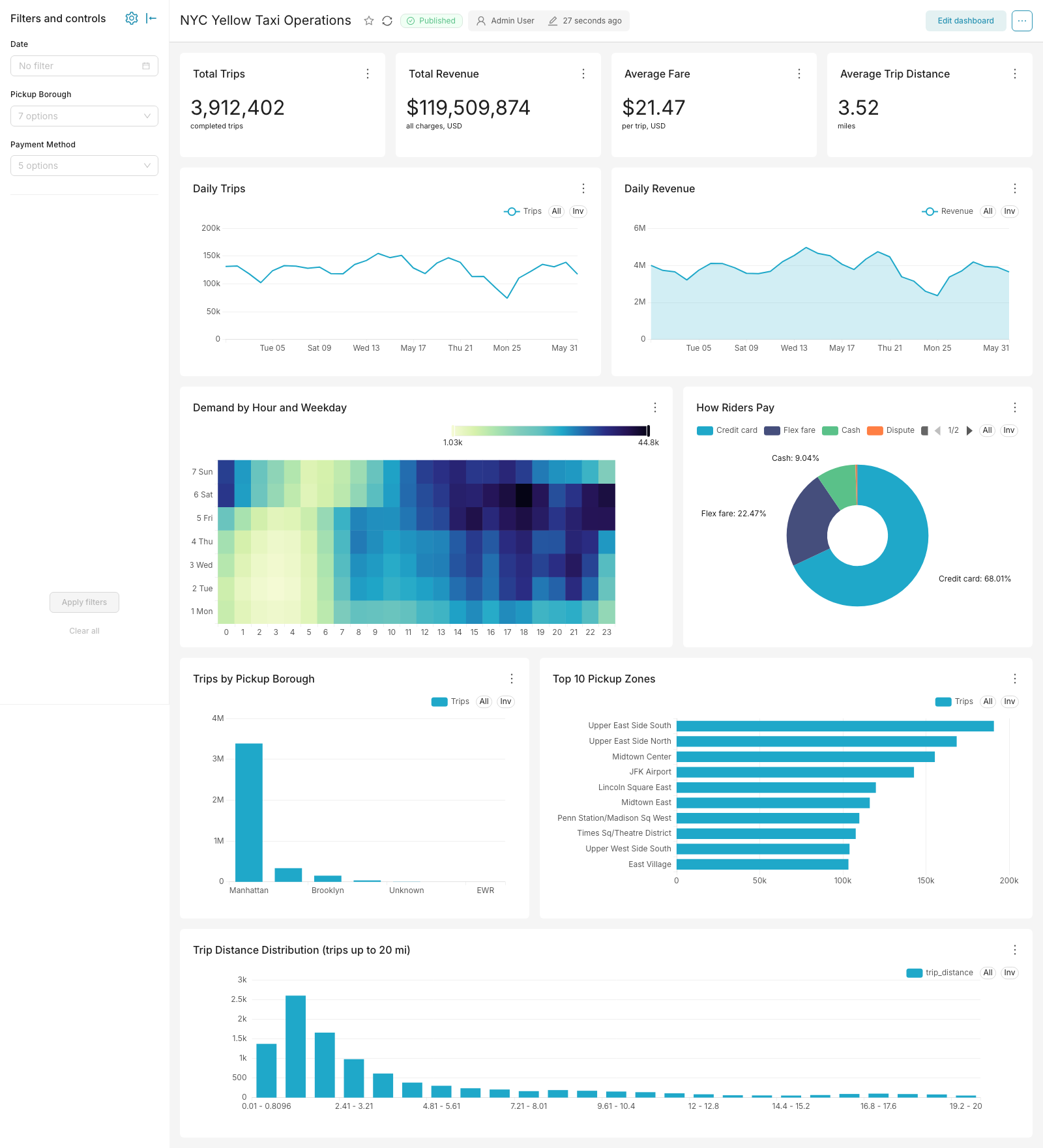
3.9 million yellow-taxi trips (NYC TLC trip records, May 2026), 11 verified
charts, three filters, one chartwright apply. An AI wrote
the spec from a one-paragraph request:
the request and rebuild steps.
A dashboard that lives in a file gets the workflow code already has: review it in a pull request, rebuild it identically, diff it against what is live, and bring it back after a bad change. Write the spec yourself or ask an AI for one; either way, every dataset, column, and metric the spec names is confirmed to exist before anything is built, and every chart is checked to load with data after.
What a spec looks like
{
  "spec_version": "1",
  "dashboard": {"title": "Sales Overview", "slug": "sales-overview"},
  "charts": [
    {
      "name": "Total Sales",
      "type": "big_number_total",
      "dataset": {"database": "examples", "table": "cleaned_sales_data"},
      "metric": "SUM(sales)"
    },
    {
      "name": "Sales Over Time",
      "type": "timeseries_line",
      "dataset": {"database": "examples", "table": "cleaned_sales_data"},
      "metrics": ["SUM(sales)"],
      "time_column": "order_date"
    }
  ],
  "layout": {"rows": [["Total Sales"], ["Sales Over Time"]]}
}
chartwright apply on this file signs in to your Superset, confirms the
cleaned_sales_data table and the sales and order_date columns exist,
builds a KPI card above a line chart, and finishes by running each chart's
query once to prove it shows data. A misspelled column or a missing table is a
clear error naming the problem, before anything is created.
Quick start
pip install chartwright
Python 3.11 or newer; three dependencies; Windows, macOS, and Linux.
Create ~/.config/chartwright/profiles.toml pointing at your Superset:
[prod]
base_url = "https://superset.your-company.com"
username = "your-username"
password_env = "CHARTWRIGHT_PROD_PASSWORD"
Point the example spec's dataset lines at a table your Superset already
knows, save it as sales_overview.json, then:
chartwright check sales_overview.json --profile prod   # read-only: verify every reference
chartwright apply sales_overview.json --profile prod   # build, import, verify
No Superset to point at? Clone this repo: sandbox/up.sh boots a disposable
Superset 6.1.0 with example data on localhost:8098 (Docker required;
sign-in is admin/admin), and tests/fixtures/kitchen_sink.json applies to it
as-is.
What you get
- Deterministic dashboards: the same spec always produces the identical dashboard. Diff it in git, review it in a PR.
- Verified at every step: every reference is checked before anything is written, and every chart's query runs once to prove it shows data; failures say what went wrong and where.
- Dashboards as code, in both directions:
chartwright decompileturns any live dashboard into a spec;chartwright planshows what differs between the spec and the live dashboard, ready as a CI gate;chartwright compilebuilds the import bundle offline, no server needed. - Safety built in: every apply backs up the previous state first; a failed apply restores it automatically; the tool only ever overwrites dashboards it created, and a hand-built dashboard is adopted by decompiling it into a spec first.
- The full design surface: 14 chart types, metrics as you write them, per-chart filters, a native filter bar, tabs, markdown notes, and layouts you can draw as ASCII sketches.
- Environment promotion: specs name their data (connection, schema, table), so the same file applies to dev, staging, and production unchanged.
Every capability, with the CLI verb reference: docs/FEATURES.md.
Creating dashboards with AI
- Claude Code skill: from a clone of this repo,
python install-skill.py, then ask for a dashboard in plain words; the AI writes the spec, and the tool verifies and builds it. - MCP server:
chartwright-mcp(installed withpip install "chartwright[mcp]") exposes six tools covering the whole lifecycle, usable from any MCP client. - Open contract:
chartwright schemaprints the spec's JSON Schema, so any LLM or tool can generate valid specs. - Guardrails: the AI proposes; the tool verifies, using your own Superset login. Verification reads names (datasets, columns, metrics), not rows.
Drawing layouts as text
The spec's sketch is the dashboard's shape, drawn with characters that you
and a model can both write: each letter is a chart, and repeating a sketch
line makes its charts taller.
KKKK LLLLLLLL
.... LLLLLLLL

L spans both lines, so it renders twice as tall as K; the dots keep the
space under K deliberately empty. Every rule, drawn and explained:
docs/LAYOUT-GUIDE.md.
Testing and evidence
Every push runs 125 tests on Linux and Windows, plus the full pipeline (apply, lifecycle soak, stale-tab adversary, fault injection) against real Superset 4.1.4, 5.0.0, and 6.1.0 containers. Chart options are checked against Superset's own source for every supported version, so a Superset change is caught in our tests before it reaches your dashboards.
Full evidence: docs/VERIFICATION.md. Source citations for every Superset behavior the tool relies on: docs/CONTRACTS.md.
Documentation
- docs/FEATURES.md: every capability, with the CLI verb reference
- docs/LAYOUT-GUIDE.md: drawing layouts as text, every rule illustrated
- docs/VERIFICATION.md: what is tested, what it caught, and how to reproduce it
- docs/CONTRACTS.md: the Superset behaviors the tool depends on, cited to source at each supported version
Apache Superset, Superset, and the Superset logo are trademarks of the Apache Software Foundation. No endorsement by the ASF is implied.
1 maintainer

Download files
Download the file for your platform. If you're not sure which to choose, learn more about installing packages.
Source Distribution
Built Distribution
Filter files by name, interpreter, ABI, and platform.
If you're not sure about the file name format, learn more about wheel file names.
Copy a direct link to the current filters
File details
Details for the file chartwright-0.1.0.tar.gz.
File metadata
- Download URL: chartwright-0.1.0.tar.gz
- Upload date:
- Size: 69.2 kB
- Tags: Source
- Uploaded using Trusted Publishing? Yes
- Uploaded via:
twine/6.1.0 CPython/3.13.12
File hashes
| Algorithm | Hash digest | |
|---|---|---|
| SHA256 |
7b1c0f3df7969aea7dc229d0d292b143159f534b231f9eab8c3482b1a2a17cd0
|
|
| MD5 |
66c8295e96d26c9f669e9cfaa6aad2d3
|
|
| BLAKE2b-256 |
46076fafbae078aae8e51940081f87cb5ebea250435c19c7714ddb1f7b49c74c
|
Provenance
The following attestation bundles were made for chartwright-0.1.0.tar.gz:
Publisher:
release.yml on debabsah/chartwright
-
Statement:
-
Statement type:
https://in-toto.io/Statement/v1 -
Predicate type:
https://docs.pypi.org/attestations/publish/v1 -
Subject name:
chartwright-0.1.0.tar.gz -
Subject digest:
7b1c0f3df7969aea7dc229d0d292b143159f534b231f9eab8c3482b1a2a17cd0 - Sigstore transparency entry: 2151930420
- Sigstore integration time:
-
Permalink:
debabsah/chartwright@6e52ff8a60df2554e3c56c134f036dbdb4cdc095 -
Branch / Tag:
refs/tags/v0.1.0 - Owner: https://github.com/debabsah
-
Access:
public
-
Token Issuer:
https://token.actions.githubusercontent.com -
Runner Environment:
github-hosted -
Publication workflow:
release.yml@6e52ff8a60df2554e3c56c134f036dbdb4cdc095 -
Trigger Event:
push
-
Statement type:
File details
Details for the file chartwright-0.1.0-py3-none-any.whl.
File metadata
- Download URL: chartwright-0.1.0-py3-none-any.whl
- Upload date:
- Size: 58.8 kB
- Tags: Python 3
- Uploaded using Trusted Publishing? Yes
- Uploaded via:
twine/6.1.0 CPython/3.13.12
File hashes
| Algorithm | Hash digest | |
|---|---|---|
| SHA256 |
f2319ffd6e2919198cef4dc7ce61b80a541d8c5c2c9aa402fe986c92bc938730
|
|
| MD5 |
90b6dc01139637036ca5661cafd48d3e
|
|
| BLAKE2b-256 |
ce452154b893c7c60b1fe73431270457fa6f2bd773eee287a0b8211517974e8a
|
Provenance
The following attestation bundles were made for chartwright-0.1.0-py3-none-any.whl:
Publisher:
release.yml on debabsah/chartwright
-
Statement:
-
Statement type:
https://in-toto.io/Statement/v1 -
Predicate type:
https://docs.pypi.org/attestations/publish/v1 -
Subject name:
chartwright-0.1.0-py3-none-any.whl -
Subject digest:
f2319ffd6e2919198cef4dc7ce61b80a541d8c5c2c9aa402fe986c92bc938730 - Sigstore transparency entry: 2151930441
- Sigstore integration time:
-
Permalink:
debabsah/chartwright@6e52ff8a60df2554e3c56c134f036dbdb4cdc095 -
Branch / Tag:
refs/tags/v0.1.0 - Owner: https://github.com/debabsah
-
Access:
public
-
Token Issuer:
https://token.actions.githubusercontent.com -
Runner Environment:
github-hosted -
Publication workflow:
release.yml@6e52ff8a60df2554e3c56c134f036dbdb4cdc095 -
Trigger Event:
push
-
Statement type:













