
chemdraw-mcp





Ask Claude for a molecule. Get a drawing you can turn, click and export.
chempane is the chemistry panel for Claude Desktop. Its Python package and repository are named chemdraw-mcp. Type "Draw caffeine" and the structure appears in the chat: a clean skeletal formula, a 3D model you rotate with the mouse, the PubChem data sheet one tab away, PNG and SVG on disk. The same works for reaction mechanisms with electron-flow arrows, proteins and antibodies from the PDB or AlphaFold, spectra, TLC plates and titration curves.
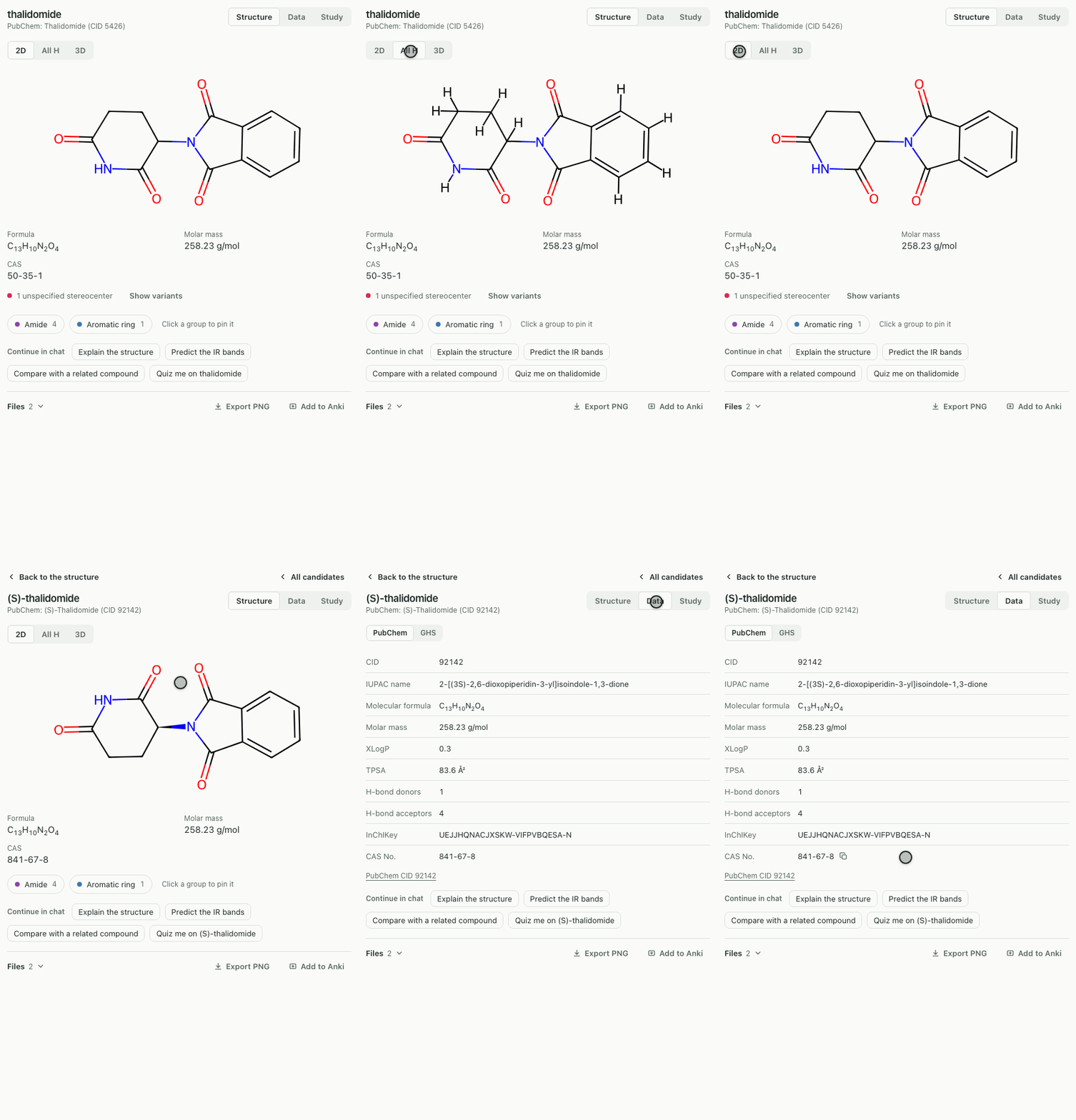
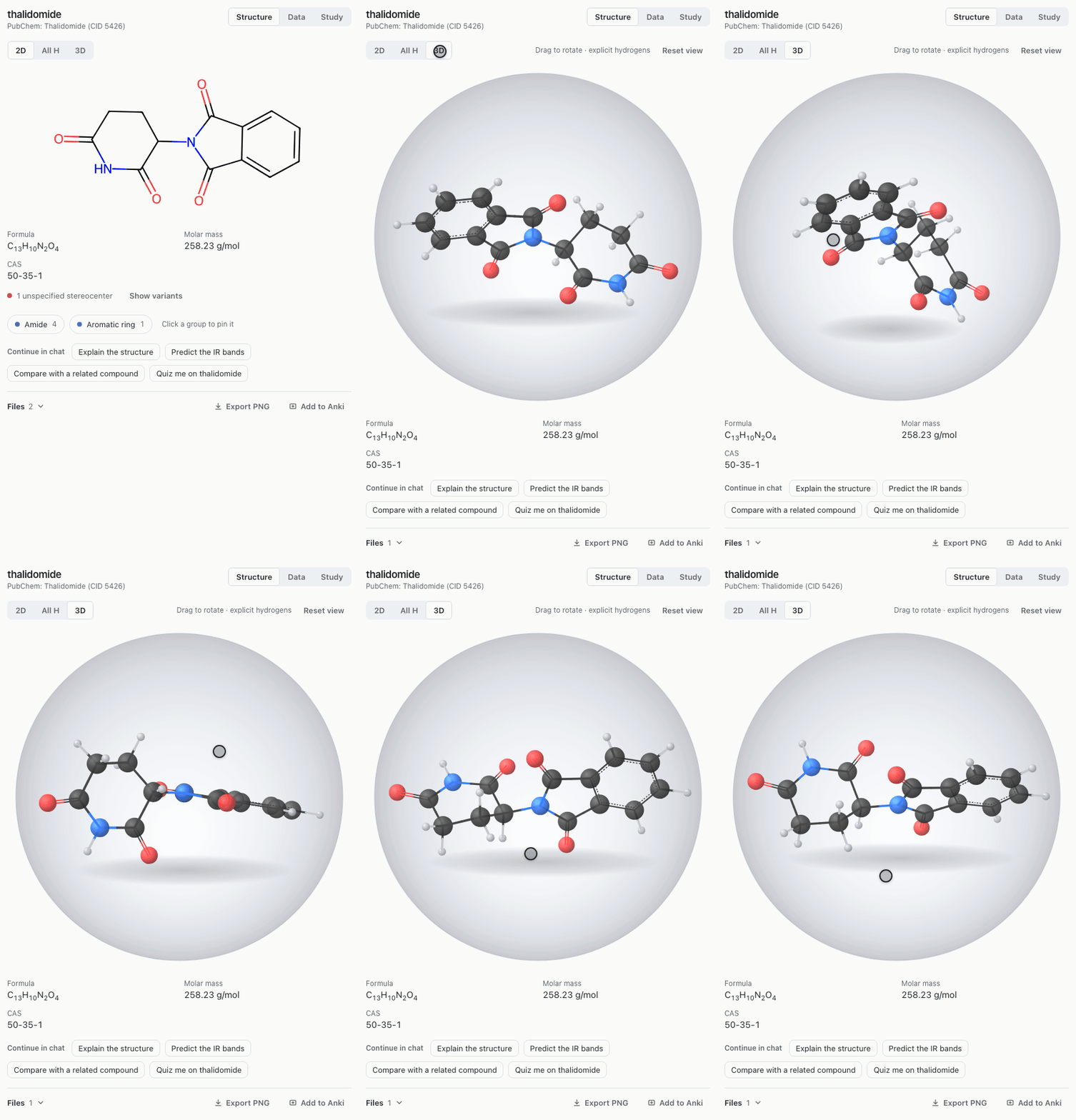
Prompt: "Draw thalidomide". Left: skeletal formula, all hydrogens, the (S) isomer, the data sheet. Right: the same molecule in 3D, turned by dragging.
If chempane saves you time, a ⭐ on GitHub helps other students and chemists find it.
- Interactive, not a picture. 13 of the 18 tools open a panel in the chat: switch views, pin a functional group, step through a mechanism, rotate a protein.
- Drawn on your machine. RDKit draws every molecule locally. By default a SMILES you type stays there; only its InChIKey, a hash, is looked up.
- Made for studying. A Study tab that covers name and groups, follow-up buttons that ask Claude about what you see, and Anki cards with the structure on the front.
- Checked before it ships. About 10,000 tests, 67 inputs pinned to their InChIKey, and a scripted run in the real Claude Desktop before every release.
- Free. No additional API key, no ChemDraw licence. Apache-2.0; unofficial, not affiliated with Revvity.
Install in Claude Desktop (macOS, Linux): download
chemdraw-mcp-<version>.mcpb from the
latest release,
double-click it, confirm, and restart Claude Desktop once.
Or with uv (uv must be installed):
uv tool install chemdraw-mcp && chemdraw-install
Names, data sheets and proteins are looked up online; drawing from a SMILES works offline.
Quick start
- Install as above and restart Claude Desktop once.
- Open a new chat and ask "Draw caffeine".
- In the panel, click a functional group to pin it, switch to 3D for a
rotatable model, Data for the PubChem data sheet or Study to quiz
yourself, use Continue in chat for a follow-up, or Export PNG to
copy the drawing as an image (where the clipboard is not available, it is
saved to
~/ChemDraw-Output/png/).
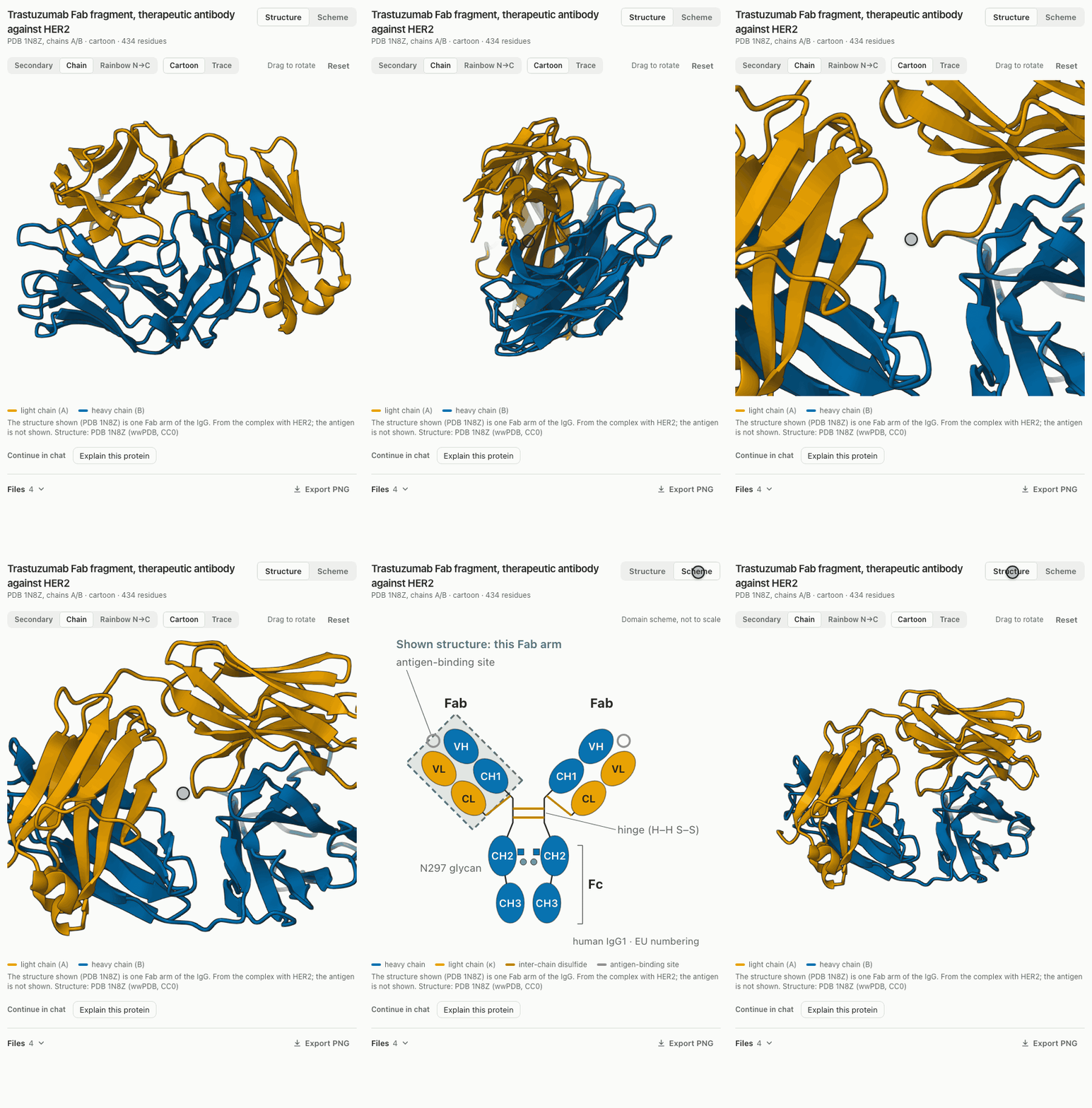
Proteins and antibodies come as a cartoon from the PDB or AlphaFold, rotatable in the panel:
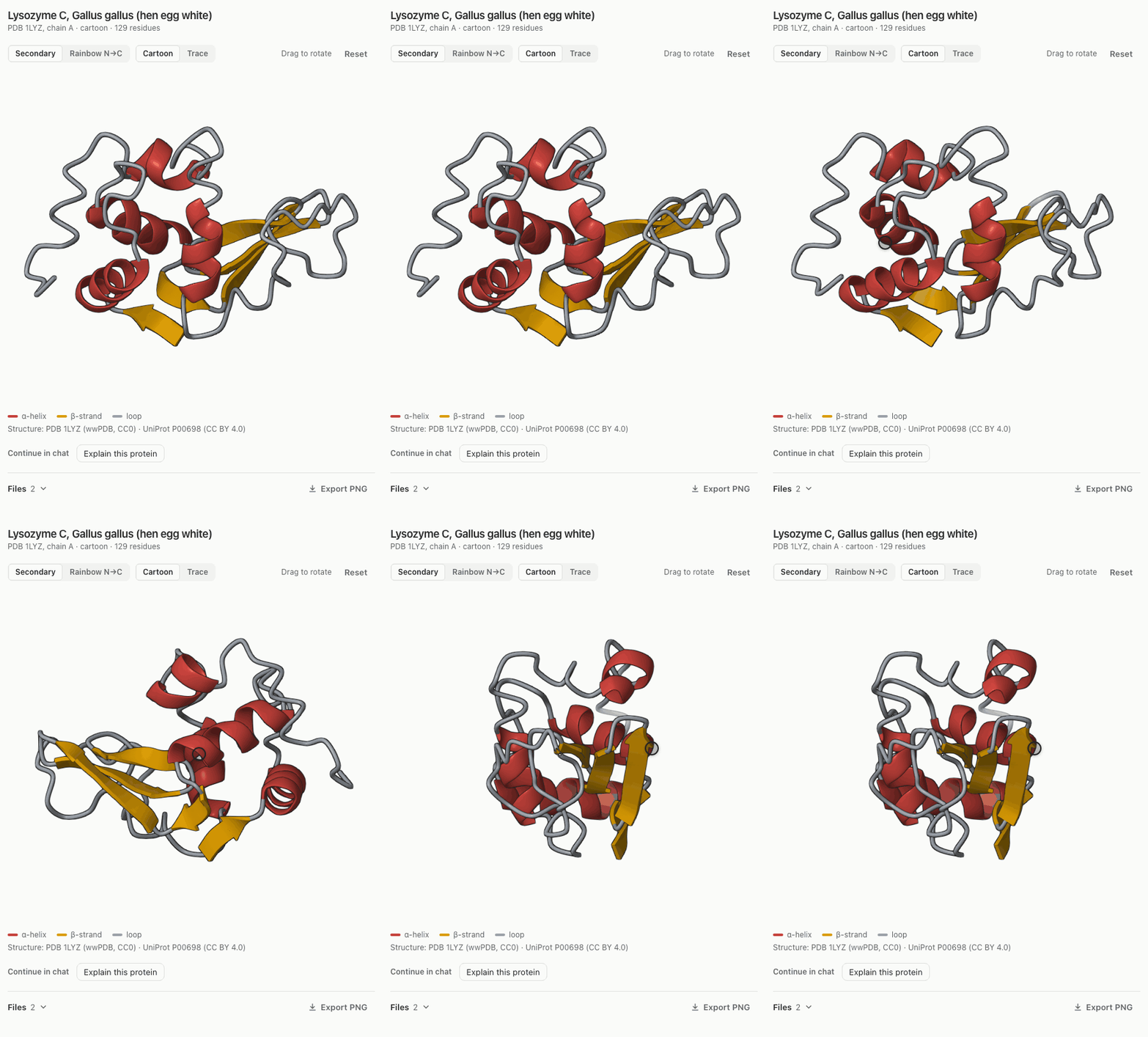
Prompt: "Draw lysozyme". Drag to rotate; colouring, Cartoon/Trace and Reset sit above the picture.
Gallery
Each picture is real output of the tool the prompt goes to (a panel screenshot or the written file), not a drawing made for this page. More examples are on the linked pages.
|
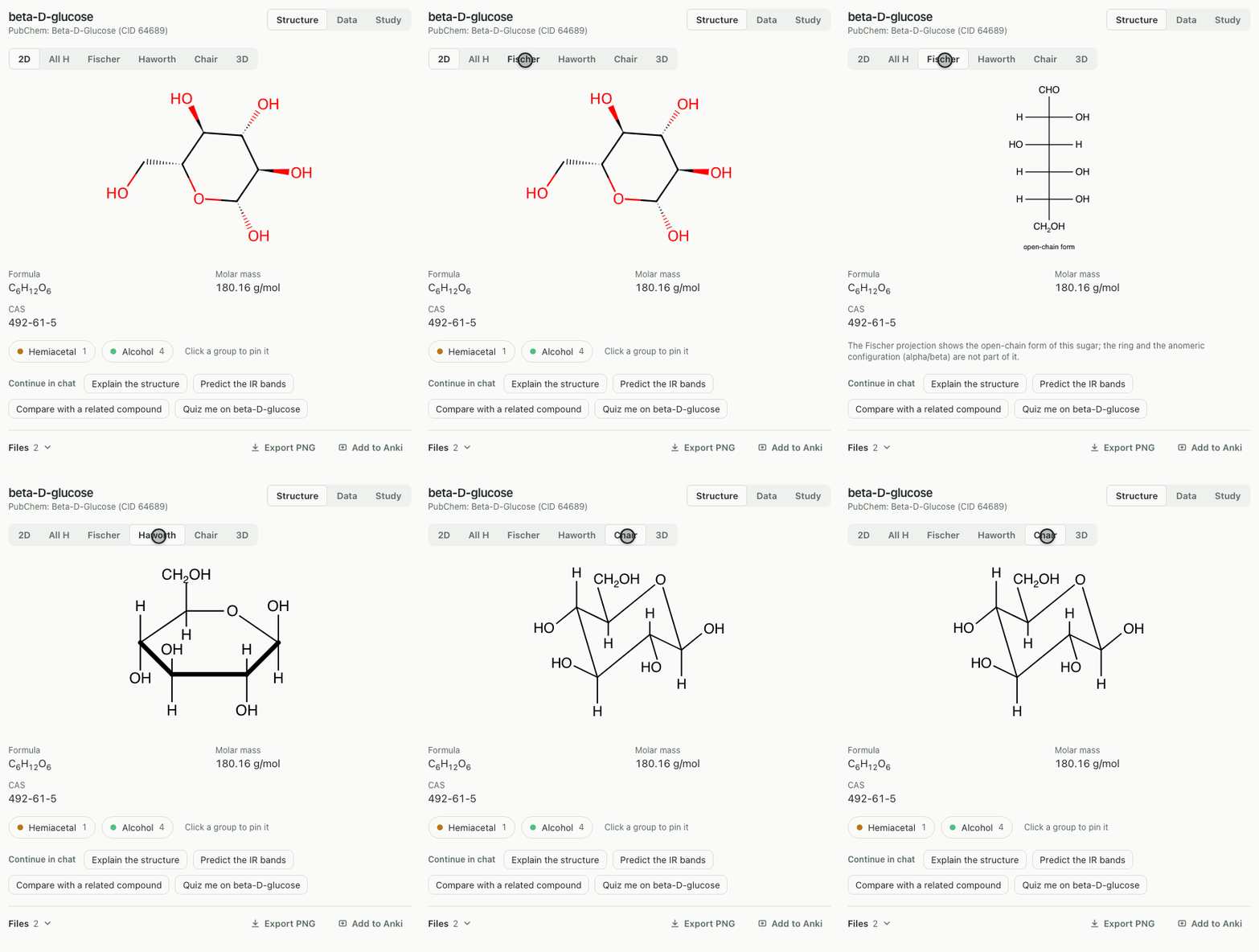
Structure · Drawing structures Draw beta-D-glucose
|
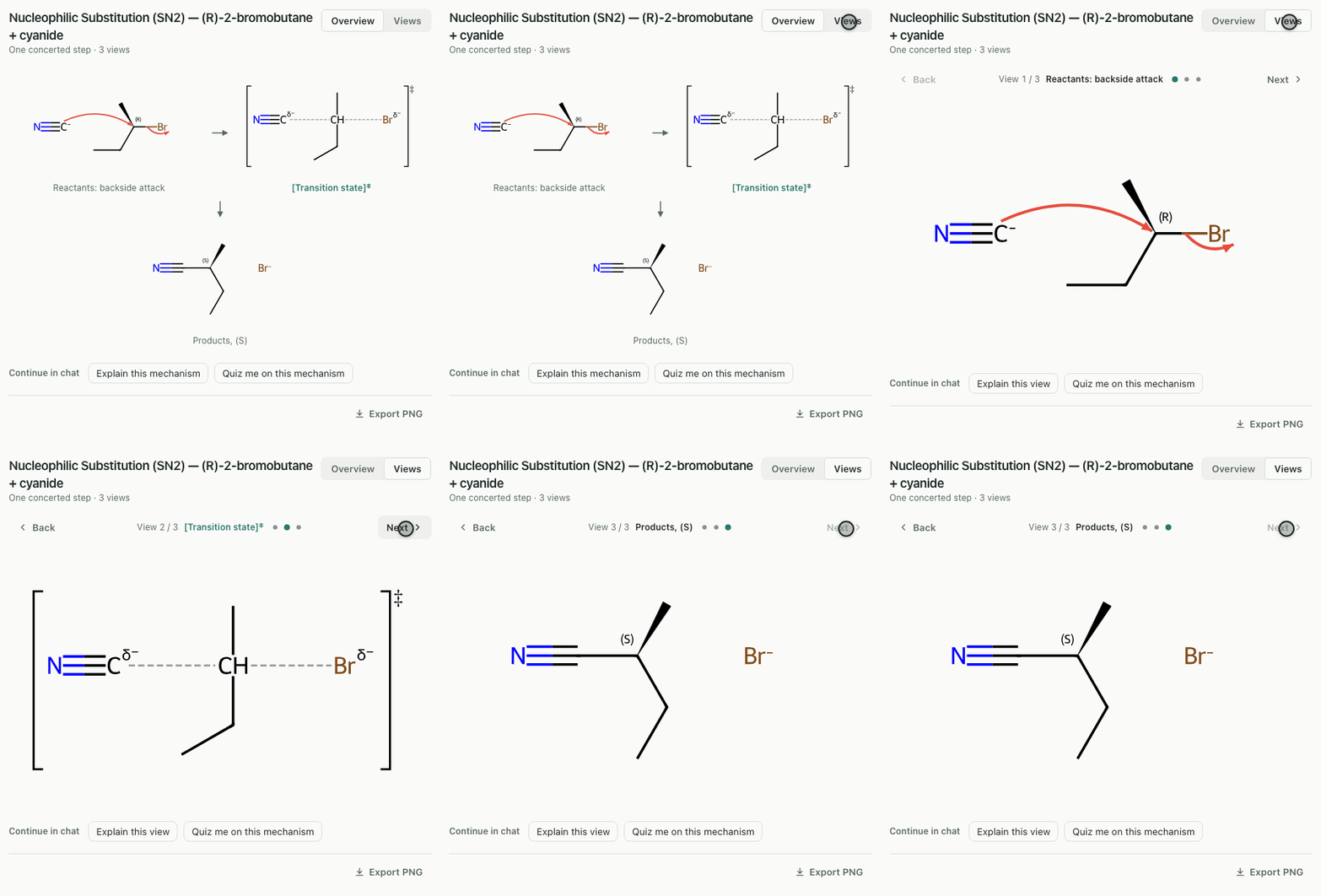
Mechanism · Reactions and mechanisms Show the SN2 mechanism of
(R)-2-bromobutane with cyanide, step by step
|
|
Antibody · Peptides and proteins Draw trastuzumab
|
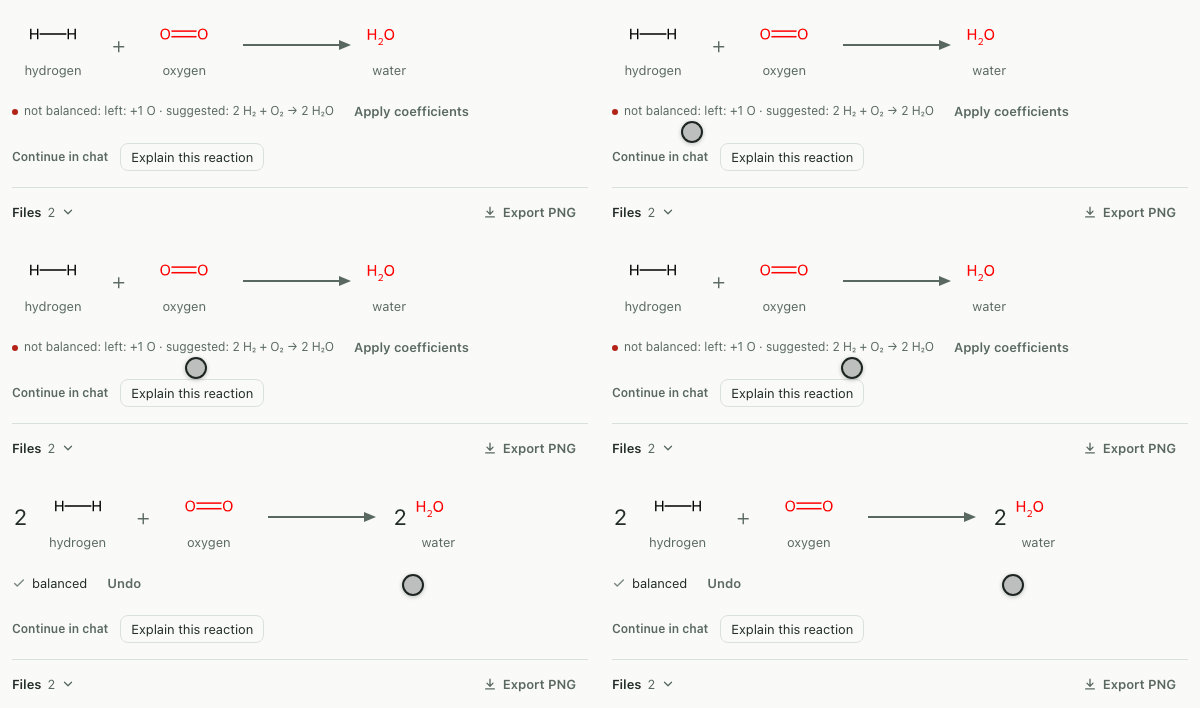
Reaction · Reactions and mechanisms Draw hydrogen + oxygen → water
as a reaction scheme
|
|
Lab graphic · Lab graphics Titrate 25 mL of 0.1 M acetic acid with
0.1 M NaOH, indicator phenolphthalein
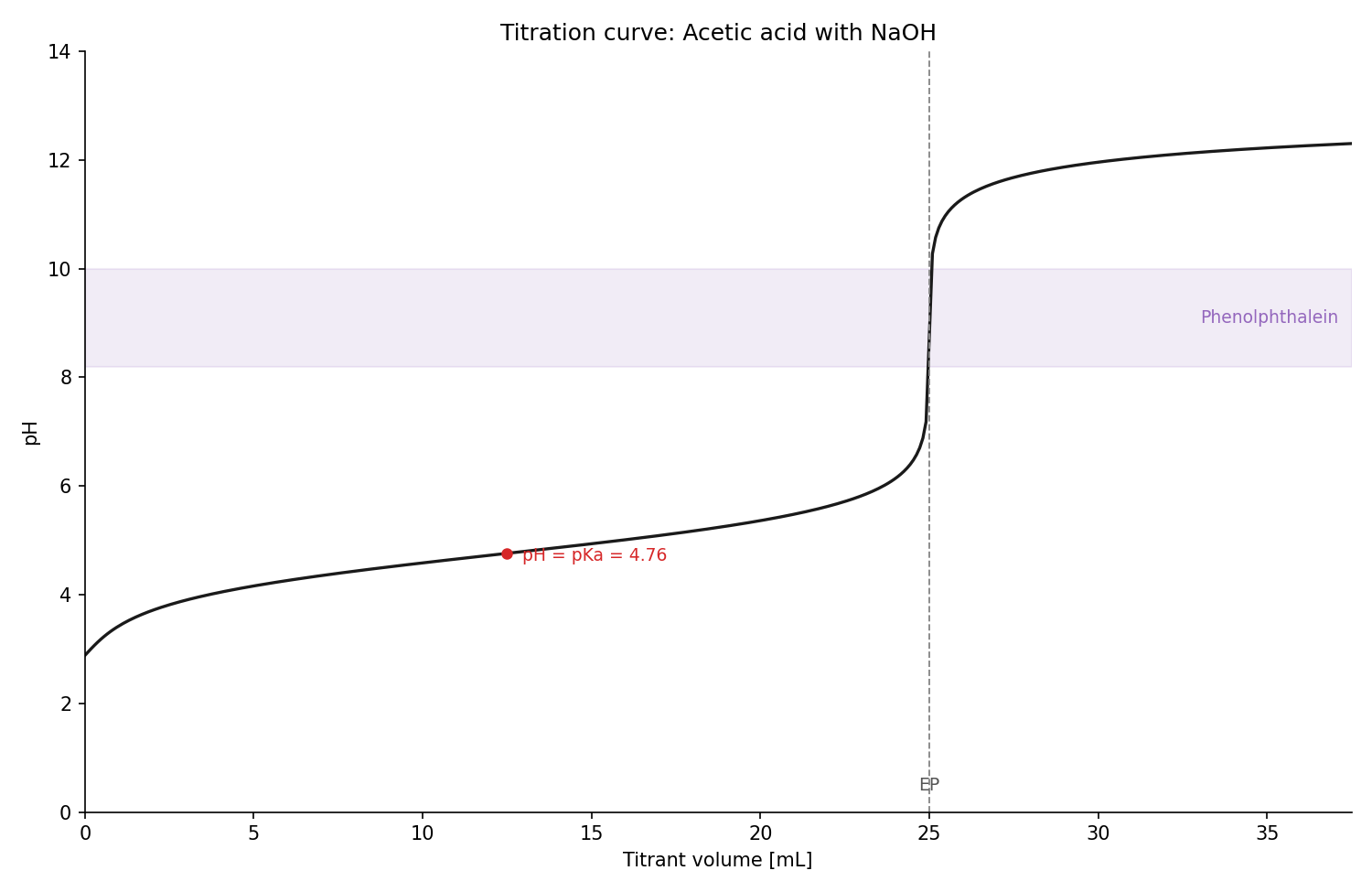
|
Anki · Anki decks Make an Anki card for aspirin
in a deck called NSAIDs
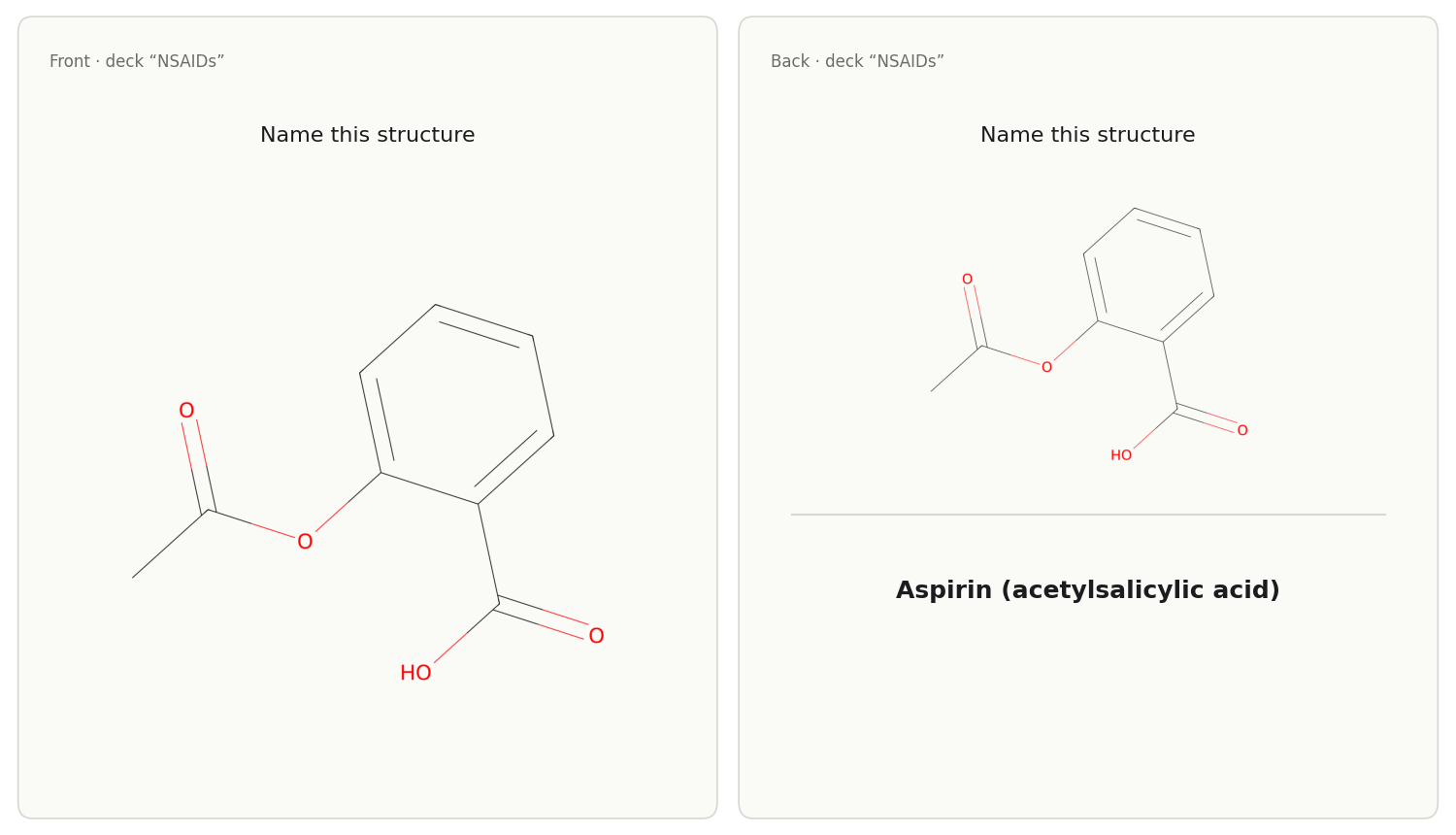
|
Installation
Pick one route for Claude Desktop. The extension and chemdraw-install
register the same connectors, and installing both registers them twice. After installing, restart Claude Desktop once and ask
"draw caffeine" in a new chat.
-
Claude Desktop extension (macOS, Linux): download
chemdraw-mcp-<version>.mcpbfrom the latest release, double-click it and confirm in Claude Desktop. The first start downloads the dependencies from PyPI, each file checked against hashes pinned at release time; later starts are offline. -
From PyPI (needs uv):
uv tool install chemdraw-mcp && chemdraw-install
-
From the repository (to read or change the code):
git clone https://github.com/jurimaxam-dotcom/chemdraw-mcp.git && cd chemdraw-mcp && ./install.sh
Something not working? uvx --from chemdraw-mcp chemdraw-doctor checks the
installation and prints the fix for each problem. Step-by-step instructions
and the config by hand:
docs/getting-started.md
and docs/installation.md.
Other clients (need uv):
- Claude Code:
claude plugin marketplace add jurimaxam-dotcom/chemdraw-mcp, thenclaude plugin install chemdraw-mcp@chemdraw-mcp. - VS Code:
- Cursor: add
{"command":"uvx","args":["chemdraw-mcp"]}as serverchemdraw-mcpinmcp.json, or opencursor://anysphere.cursor-deeplink/mcp/install?name=chemdraw-mcp&config=eyJjb21tYW5kIjoidXZ4IiwiYXJncyI6WyJjaGVtZHJhdy1tY3AiXX0=in the browser. - Codex:
codex mcp add chemdraw -- uvx chemdraw-mcp

The interactive panel appears in clients that render MCP Apps, such as Claude Desktop.
Profiles
Either Claude Desktop route registers two connectors from one installation. They complement each other: both can be on at once, and together they offer every tool, none of them twice.
| Connector | Profile | Tools | Contents |
|---|---|---|---|
chemdraw |
mvp (default) |
18, 13 with a panel | the five areas in the tool table |
chemdraw-pharma |
pharma |
9, 4 with a panel | substrate-scope figure, calibration curve, pharmacology curves, and calculators for solutions, content determination and pharmacokinetics (seven tools), plus the panel's two internal helpers |
The extension route ships them as two bundles (chemdraw-mcp-<version>.mcpb,
chemdraw-mcp-pharma-<version>.mcpb); chemdraw-install writes both entries
into claude_desktop_config.json. Turning a connector on or off in the
connector menu needs no restart. Up to 0.10.0, chemdraw-pharma started with
the full profile (every tool); if you used only that connector, enable
chemdraw as well, or keep one connector with everything by setting
CHEMDRAW_PROFILE=full in a config entry of your own. Re-run the installer to
update an existing entry. Details:
docs/configuration.md.
Tools
The default profile registers 18 tools, 13 of them with an interactive panel.
Files go to ~/ChemDraw-Output/.
| Area | Tool | Example prompt |
|---|---|---|
| Draw | generate_molecule |
"Draw caffeine" |
batch_generate |
"Draw adrenaline, noradrenaline and dopamine, each as its own file" | |
compare_molecules |
"What is the difference between morphine and codeine?" | |
generate_reaction |
"Draw the esterification of acetic acid with ethanol" | |
generate_mechanism |
"Show me the SN2 mechanism step by step" | |
generate_3d |
"Show methane as a rotatable 3D model" | |
generate_protein_or_antibody |
"Draw lysozyme", "Draw trastuzumab" | |
| Lab graphics | generate_spectrum |
"Draw the IR spectrum of aspirin" |
generate_tlc |
"TLC: educt Rf 0.3, product Rf 0.65, co-spot shows both" | |
generate_titration_curve |
"Titrate phosphoric acid with NaOH and show the curve" | |
generate_species_distribution |
"Species distribution of phosphoric acid over pH" | |
| Look up | lookup |
"What is the CAS number of paracetamol?" |
lookup_molecule_data |
"Give me a data sheet for capsaicin" | |
predict_spectrum |
"Which IR bands should capsaicin show?" | |
| Calculate | calculate_ph |
"What is the pH of 0.1 M acetic acid, pKa 4.76?" |
| Anki | export_anki_deck |
"Make Anki cards with the structures of aspirin, ibuprofen and paracetamol" |
The other two tools belong to the panel and are never called by the model on
its own: save_png is the server half of the export button, and
load_panel_part fetches the images of a large result (a big molecule, a long
batch) piece by piece, so that the result stays small enough for Claude Desktop
to display.
Every tool in detail, with its options and limits:
docs/tools.md.
What leaves your machine
Structures are drawn locally. A SMILES or InChI you type is not sent to any
database by default; to fetch its name, CAS number and properties, the server
sends PubChem only the structure's InChIKey, a hash computed on your machine.
The key does not contain the structure; it only matches a record PubChem
already holds. If PubChem has no record for it, those fields stay empty.
Common group abbreviations (Ph, Boc, OMe …) are expanded locally; a
SMILES that still cannot be read is refused, not searched as a name.
Compound names you type are sent to PubChem, NCI and, for enzyme and protein
names, UniProt to resolve them; protein names and gene symbols go to UniProt,
the UniProt accession to PDBe and the AlphaFold DB, the PDB ID to RCSB. A
systematic IUPAC name reveals the structure as much as a SMILES does. To also
search by the SMILES itself, turn on Look up typed structures by SMILES in
the extension settings of Claude Desktop, or set CHEMDRAW_SMILES_LOOKUP=1.
This holds from version 0.10.0. Version 0.9.1 and earlier posted a typed
SMILES to PubChem when PubChem did not know its InChIKey, and lookup passed a
typed SMILES or InChI to PubChem, ChEBI, UniProt or KEGG. Details:
docs/privacy.md.
Limits
- Lab graphics draw the numbers they are given. For a named compound Claude supplies literature values from memory; check them.
- Curved-arrow mechanisms exist for SN1, SN2 and Fischer esterification only; other reactions get the net scheme.
- Proteins: cartoon without side chains, up to 3000 residues; bound groups such as heme or an inhibitor are shown, water, buffer and detergents are not. Peptides from a sequence take up to 20 residues.
- Names, data sheets and proteins need the internet; without Java, systematic IUPAC names do too.
- Claude Desktop often answers knowledge questions from memory; add "use ChemDraw" to the prompt. The extension targets macOS and Linux; Windows is untested.
Documentation
- Getting started: install, first prompt, the panel, where files land, troubleshooting
- Drawing structures · Peptides and proteins · Reactions and mechanisms · Metal complexes
- Lab graphics · Data and lookup · Anki decks
- Privacy · Configuration · FAQ
- Reference: every tool in detail · installation · for developers · development
License and third-party data
Apache-2.0, see LICENSE. Copyright 2026 jurimaxam-dotcom.
The server builds on and asks:
- RDKit (BSD-3-Clause) for parsing, layout, rendering and 3D conformers.
- Mol* (MIT; Sehnal et al. 2021) for the protein cartoon in the panel; notices in THIRD_PARTY_LICENSES.
- OPSIN, shipped inside py2opsin, for offline IUPAC names when Java is installed.
- PubChem and NCI CIR for names, properties and GHS data; ChEBI and KEGG for
lookup. - UniProt (CC BY 4.0) for protein entries.
- PDB structures (CC0), fetched through PDBe and the RCSB ModelServer, cited with their PDB ID.
- AlphaFold DB models (CC BY 4.0; Jumper et al. 2021, Varadi et al. 2024).
Each protein image carries the source line of its structure.
Disclaimer: This is an unofficial, independent project, not affiliated with or endorsed by Revvity. ChemDraw is a trademark of Revvity Signals Software, Inc. This tool does not include or require ChemDraw; it can optionally export files in the open CDXML format.
Contributing
- Something broke? Open a bug report.
The form asks for the output of
chemdraw-doctor. - Wrong chemistry? Use the bug form and name the compound and the figure.
- Missing something in your course? Tell us what you would draw or calculate.
- Questions and things you made with it: Discussions.
- Code: CONTRIBUTING.md and docs/for-developers.md.
If chemdraw-mcp saves you an afternoon of drawing, a star on GitHub helps other students find it.
1 maintainer

Metadata
1 maintainer
Release files for chemdraw-mcp 0.11.3
For a detailed explanation of source distributions (sdists) and built distributions (wheels), please see the package formats documentation.
Source distribution (sdist)
| File | Size | Uploaded | Provenance | Actions |
|---|---|---|---|---|
| chemdraw_mcp-0.11.3.tar.gz | 1.3 MB | With provenance | Details for chemdraw_mcp-0.11.3.tar.gz |
Built distribution (wheel)
| File | Interpreter | ABI | Platform | Actions Reset |
|---|---|---|---|---|
| chemdraw_mcp-0.11.3-py3-none-any.whl | Python 3 | none | any | Details for chemdraw_mcp-0.11.3-py3-none-any.whl |
Total release size: 2.5 MB
Release files / chemdraw_mcp-0.11.3.tar.gz
| Download URL | chemdraw_mcp-0.11.3.tar.gz |
|---|---|
| Size | 1.3 MB |
| Tags | Source |
|
SHA-256 checksum How to use checksums |
18db7b24eeb93a72f6c28e1d5647a70d8ff2ae3960e95f8ecf398b11029dda72
|
|
BLAKE2b-256 checksum How to use checksums |
023821282265fa8dec5d5017944a71e06d35990ef01360b7ea2f1a561c685111
|
| Upload date | |
|
Uploaded using Trusted Publishing? What is trusted publishing? |
Yes |
| Uploaded via |
twine/7.0.0 CPython/3.13.16
|
Provenance
Provenance describes where a file came from. On PyPI, provenance is shared via attestations, which provide a verifiable record of the build or publishing details. View details, limitations and caveats.


PyPI Publish Attestation
PyPI verified that this artifact, at this checksum, originated from the publisher listed below.
Signed by GitHub Actions, verified by PyPI on Nov 22, 2026.
Transparency logRelease files / chemdraw_mcp-0.11.3-py3-none-any.whl
| Download URL | chemdraw_mcp-0.11.3-py3-none-any.whl |
|---|---|
| Size | 1.3 MB |
| Tags | Python 3 |
|
SHA-256 checksum How to use checksums |
21b3921c4354be48c1ea6db684264e122a8ce9c8bffaaea65779e2ec6855dca2
|
|
BLAKE2b-256 checksum How to use checksums |
00908f4eb8f1e409d905967aa2a096282ccc6622847def355a89a511888a37a0
|
| Upload date | |
|
Uploaded using Trusted Publishing? What is trusted publishing? |
Yes |
| Uploaded via |
twine/7.0.0 CPython/3.13.16
|
Provenance
Provenance describes where a file came from. On PyPI, provenance is shared via attestations, which provide a verifiable record of the build or publishing details. View details, limitations and caveats.
PyPI Publish Attestation
PyPI verified that this artifact, at this checksum, originated from the publisher listed below.
Signed by GitHub Actions, verified by PyPI on Nov 22, 2026.
Transparency logSecurity for chemdraw-mcp 0.11.3
Provenance
Provenance describes where a file came from. On PyPI, provenance is shared via attestations, which provide a verifiable record of the build or publishing details. View details, limitations and caveats.
Full provenance
Both files in this release have been uploaded with provenance metadata.
Attestation for chemdraw_mcp-0.11.3.tar.gz
PyPI Publish Attestation
PyPI verified that this artifact, at this checksum, originated from the publisher listed below.
Signed by GitHub Actions, verified by PyPI on Nov 22, 2026.
Transparency logA note on package security
PyPI is a repository for distributing packages, not a service for auditing them. While third-party security researchers and our staff do their best to detect and remove malicious packages, PyPI cannot guarantee the quality, security or suitability of any given package.
To learn more about protecting yourself from malicious actors, visit our package security documentation.














