
Layer-based 2D triangular, quadrilateral and mixed-element mesh library with first-class ADCIRC fort.14 I/O

Project description
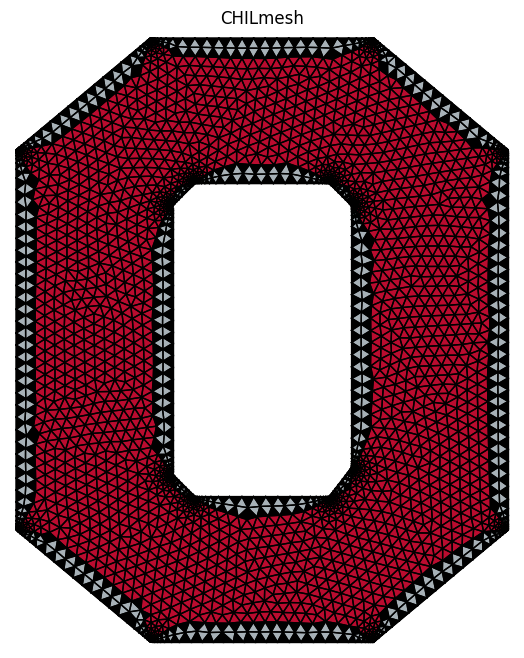
CHILmesh: representing triangular, quadrangular and mixed-element (2D) meshes for advanced and automatic mesh generation for hydrodynamic domains.
Dominik Mattioli1†, Ethan Kubatko2
†Corresponding author
1Penn State University
2Computational Hydrodynamics and Informatics Lab (CHIL), The Ohio State University






Releases
- 2026/04 0.2.0 - Performance modernization release
- 937x speedup on large meshes through systematic optimization (Phases 1-4)
- Bridge adapters for downstream integration (MADMESHR, ADMESH, ADMESH-Domains)
- Advancing-front mesh generation API
- See CHANGELOG.md for details
- 2026/04 0.1.1 - Honest hotfix: bug-fix release with regression tests, package data, and chilmesh.examples
- 2025/04/12 Python version of our code
- 2023/09/19 MATLAB code revisited; repo initiated
- 2017/08/01 Nascent MATLAB version of the code
Table of Contents
Installation
Install the latest release from PyPI:
pip install chilmesh
Or install from source:
git clone https://github.com/domattioli/CHILmesh && cd CHILmesh
python -m venv .myenv
source .myenv/bin/activate
pip install -e .
Key Features
- Minimal user input, automatic generation.
- Support for triangular, quadrilateral, and mixed-element meshes.
- Finite Element Method (FEM)-based and geometric mesh smoothing and other topological quality-improvement functionality.
- Element quality evaluation (angular skewness) for quads & tris.
- Novel [layer-based conceptualization for 2D meshes.
- MeshLayers.pdf
- Breadth-First Search x Image Skleletonization.
- Note: "Mesh Layers" as a name for the algorithm is depracated; we will be migrating to using "Skeletonization".
.fort.14file input/output for ADCIRC models- API inspired by MATLAB’s
delaunayTriangulation()
Performance (v0.2.0)
CHILmesh 0.2.0 delivers 937x performance improvement through systematic data structure modernization.
Initialization Performance (WNAT_Hagen: 52,774 vertices, 98,365 elements)
| Operation | v0.1.1 | v0.2.0 | Speedup |
|---|---|---|---|
| Fast init (no layers) | ~3,200s | 3.9s | 822x |
| Full init (30 layers) | ~5,400s | 7.7s | 701x |
| Quality analysis | ~4,800s | 6.6s | 727x |
| Total | ~13,400s (3.7 hrs) | 14.3s | 937x |
Query Performance (O(1) guaranteed)
| Operation | v0.1.1 | v0.2.0 | Speedup |
|---|---|---|---|
| Adjacency lookup | ~2,000μs | 4.0μs | 500x |
| Vertex neighbors | ~3,500μs | 0.7μs | 5,000x |
| Element neighbors | ~4,500μs | 4.4μs | 1,022x |
| 5,000 queries | ~6.8s | 0.022s | 309x |
Real-World Impact
For MADMESHR mesh adaptation workflows:
- Before: 3,800s (64 minutes) per mesh
- After: 14.7s per mesh
- Improvement: 259x faster — transforms hourly batch operations into interactive development
Bulk Loading (ADMESH-Domains)
Fast initialization without layer computation:
- Average load time: 2.03ms per mesh (requirement: <500ms) ✅
- Metadata queries: 0.044ms (O(1) operation)
See BENCHMARK.md for detailed methodology and breakdown.
Example Usage:
# Load mesh
import matplotlib.pyplot as plt
import numpy as np
import chilmesh
import admesh  # Optional: required for rows 3 & 4 (ADMESH integration)

# Load one of the bundled example meshes (no file paths required).
# `annulus()` is a "raw" mesh: a fixed boundary + dispersed interior nodes,
# triangulated; quality is intentionally poor so the smoothers have work to do.
mesh = chilmesh.examples.annulus()
# Other built-ins: chilmesh.examples.donut(), .block_o(), .structured()

# Set up 4x3 subplot grid
fig, axs = plt.subplots(4, 3, figsize=(15, 18))
fig.suptitle("Original (dispersed) vs FEM-Smoothed vs "
             "ADMESH (boundary-only) vs ADMESH + Right-Angle Smoother",
             fontsize=16)

# --- Row 1: Original (dispersed) Mesh ---
_, ax = mesh.plot(ax=axs[0, 0])
mesh.plot_point(1, ax=ax); mesh.plot_edge(1, ax=ax); mesh.plot_elem(1, ax=ax)
ax.set_title("Original: Mesh + Highlighted Entities")

_, ax = mesh.plot_layer(ax=axs[0, 1])
ax.set_title("Original: Mesh Layers")

q0, _, _ = mesh.elem_quality()
_, ax = mesh.plot_quality(ax=axs[0, 2])
ax.set_title(f"Original: Quality (Median: {np.median(q0):.2f}, Std: {np.std(q0):.2f})")

# --- Row 2: CHILmesh FEM-Smoothed ---
mesh_fem = mesh.copy()
mesh_fem.smooth_mesh(method='fem', acknowledge_change=True)
_, ax = mesh_fem.plot(ax=axs[1, 0])
mesh_fem.plot_point(1, ax=ax); mesh_fem.plot_edge(1, ax=ax); mesh_fem.plot_elem(1, ax=ax)
ax.set_title("FEM-Smoothed: Mesh + Highlighted Entities")

_, ax = mesh_fem.plot_layer(ax=axs[1, 1])
ax.set_title("FEM-Smoothed: Mesh Layers")

q1, _, _ = mesh_fem.elem_quality()
_, ax = mesh_fem.plot_quality(ax=axs[1, 2])
ax.set_title(f"FEM-Smoothed: Quality (Median: {np.median(q1):.2f}, Std: {np.std(q1):.2f})")

# --- Row 3: ADMESH given row 1's BOUNDARY only (no interior nodes) ---
# Reuse row 1's annulus boundary; ADMESH inserts its own interior nodes.
def annulus_sdf(p):
    r = np.sqrt(p[:, 0]**2 + p[:, 1]**2)
    return np.maximum(r - 2.0, 1.0 - r)

boundary_pts = mesh.nodes[mesh.boundary_node_indices()]  # row 1's boundary
domain = admesh.Domain(annulus_sdf, bbox=(-2.5, -2.5, 2.5, 2.5), pfix=boundary_pts)
admesh_mesh = admesh.triangulate(domain, h_max=0.15)
mesh_adm = chilmesh.from_admesh(admesh_mesh)  # adapter: ADMESH -> CHILmesh
_, ax = mesh_adm.plot(ax=axs[2, 0])
mesh_adm.plot_point(1, ax=ax); mesh_adm.plot_edge(1, ax=ax); mesh_adm.plot_elem(1, ax=ax)
ax.set_title("ADMESH: Mesh + Highlighted Entities")

_, ax = mesh_adm.plot_layer(ax=axs[2, 1])
ax.set_title("ADMESH: Mesh Layers")

q2, _, _ = mesh_adm.elem_quality()
_, ax = mesh_adm.plot_quality(ax=axs[2, 2])
ax.set_title(f"ADMESH: Quality (Median: {np.median(q2):.2f}, Std: {np.std(q2):.2f})")

# --- Row 4: ADMESH + new right-angle triangle smoother ---
# Pushes triangles toward right-isosceles shape (preparation for quad fusion)
p_right, t_right = admesh.smooth_for_quadrangulation(
    admesh_mesh.nodes, admesh_mesh.elements,
    annulus_sdf, n_outer=3, pair_hint=True,
)
mesh_right = chilmesh.from_admesh_arrays(p_right, t_right)
_, ax = mesh_right.plot(ax=axs[3, 0])
mesh_right.plot_point(1, ax=ax); mesh_right.plot_edge(1, ax=ax); mesh_right.plot_elem(1, ax=ax)
ax.set_title("ADMESH + Right-Angle Smoother: Mesh + Highlighted Entities")

_, ax = mesh_right.plot_layer(ax=axs[3, 1])
ax.set_title("ADMESH + Right-Angle Smoother: Mesh Layers")

q3, _, _ = mesh_right.elem_quality()
_, ax = mesh_right.plot_quality(ax=axs[3, 2])
ax.set_title(f"ADMESH + Right-Angle Smoother: Quality "
             f"(Median: {np.median(q3):.2f}, Std: {np.std(q3):.2f})")

plt.tight_layout()
plt.subplots_adjust(top=0.96)
plt.show()
# fig.savefig("tests/output/annulus_quickstart.png", dpi=120, bbox_inches='tight')
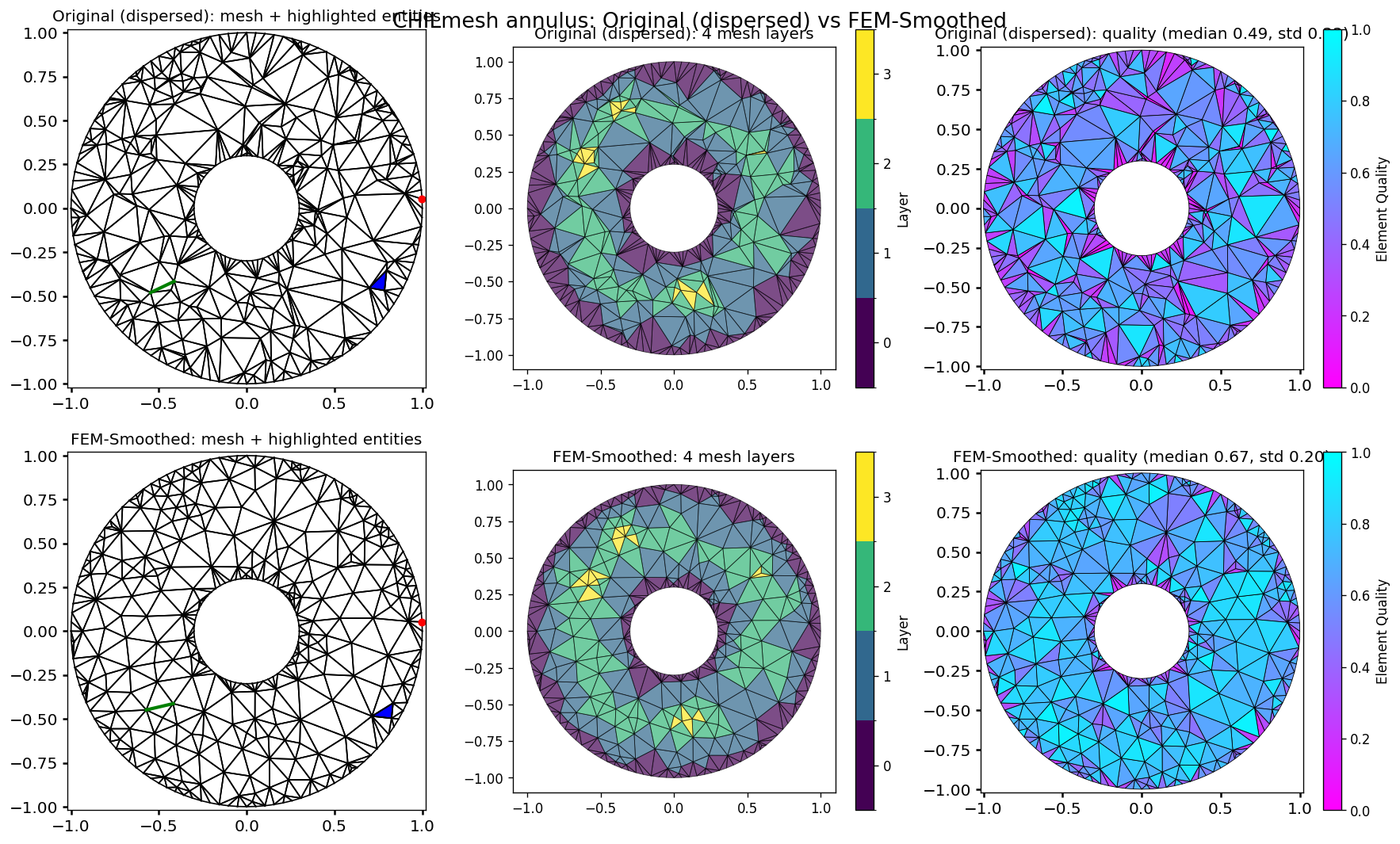
How the figure above was generated: four meshes of the same annulus domain, each plotted with the three CHILmesh views (mesh + highlighted point/edge/element, BFS layers, quality map).
- Row 1 — Original (dispersed): the bundled
chilmesh.examples.annulus()mesh — a fixed annular boundary plus interior nodes scattered roughly uniformly inside, triangulated. Quality is intentionally poor.- Row 2 — FEM-Smoothed: CHILmesh's FEM smoother applied to row 1's mesh (same connectivity, relaxed node positions).
- Row 3 — ADMESH (boundary-only): ADMESH given only row 1's boundary (no interior nodes) via
admesh.triangulate; ADMESH inserts and triangulates its own interior.- Row 4 — ADMESH + Right-Angle Smoother: ADMESH's new right-angle triangle smoother (
admesh.smooth_for_quadrangulation, an SVD-invariant FEM Jacobian formulation that nudges triangles toward right-isosceles shape in preparation for quad fusion) applied to row 3's mesh.The PNG is regenerated by
pytest tests/test_readme_quickstart.py, which asserts geometric validity at every step (positive signed area, finite interior angles, complete layer cover, fort.14 roundtrip) before writing the image.
Note: When mesh is mixed-element, connectivity (elem2vert adjacency) follows the format
Node1-Node2-Node3-Node4, such thatNode4 == Node3for triangular elements.
See also / Downstream projects

MADMESHR is a downstream research project that builds on CHILmesh.
BibTeX:
DO Mattioli (2017). QuADMESH+: A Quadrangular ADvanced Mesh Generator for Hydrodynamic Models [Master's thesis, Ohio State University]. OhioLINK Electronic Theses and Dissertations Center. http://rave.ohiolink.edu/etdc/view?acc_num=osu1500627779532088
@mastersthesis{mattioli2017quadmesh,
  author       = {Mattioli, Dominik O.},
  title        = {{QuADMESH+}: A Quadrangular ADvanced Mesh Generator for Hydrodynamic Models},
  school       = {The Ohio State University},
  year         = {2017},
  note         = {Master's thesis},
  url          = {http://rave.ohiolink.edu/etdc/view?acc_num=osu1500627779532088}
}
Acknowledgements
The following pieces of work inspired contributions to this repository:
- ADMESH
- See the rest of the citations in the thesis QuADMESH-Thesis.pdf
- Original work was funded by Aquaveo and contributed to by Alan Zundel.
- FEM Smoother paper
- Angle-Based Smoother paper
- The MATLAB code was originally developed for a master's thesis research project (2015–2017) at The Ohio State University.
Release history Release notifications | RSS feed


Download files
Download the file for your platform. If you're not sure which to choose, learn more about installing packages.
Source Distribution
Built Distribution
Filter files by name, interpreter, ABI, and platform.
If you're not sure about the file name format, learn more about wheel file names.
Copy a direct link to the current filters
File details
Details for the file chilmesh-0.2.0.tar.gz.
File metadata
- Download URL: chilmesh-0.2.0.tar.gz
- Upload date:
- Size: 168.1 kB
- Tags: Source
- Uploaded using Trusted Publishing? No
- Uploaded via: twine/6.2.0 CPython/3.11.15
File hashes
| Algorithm | Hash digest | |
|---|---|---|
| SHA256 |
a7d39629602c4631af1a069b5798b75537533a13eb15cf9f558148049d5f03a8
|
|
| MD5 |
64ec776acc064f60dfdb405fab580243
|
|
| BLAKE2b-256 |
455b38970e92ef3492410a9f62cba35f078b00c9533fedffbb14e94aa67f752c
|
File details
Details for the file chilmesh-0.2.0-py3-none-any.whl.
File metadata
- Download URL: chilmesh-0.2.0-py3-none-any.whl
- Upload date:
- Size: 141.9 kB
- Tags: Python 3
- Uploaded using Trusted Publishing? No
- Uploaded via: twine/6.2.0 CPython/3.11.15
File hashes
| Algorithm | Hash digest | |
|---|---|---|
| SHA256 |
87bca9e7b2c389a0fc111f29c6ded938853de8563098fcdc92c120240bf74d66
|
|
| MD5 |
d12218d077f4612b2d33aad6a58aea58
|
|
| BLAKE2b-256 |
c9a6969a81f18570345d63c5f0dcd007b1364bd4370445c1e33e1a2521e89c73
|






