
chordotomy




Dissect a song's harmony. Give it a recording (mp3, wav, flac or ogg) and it recognizes the chords on the beat, finds the key and its changes, labels the chords with Roman numerals, and points out the moves worth noticing (the secondary dominant, the borrowed chord). An agent skill writes the chords out for you and adds a short note on why each move works.
It analyzes; it doesn't transcribe. There is no staff notation, on purpose.
Yes, chordotomy is also a spinal surgery. This one cuts chords.
Everything runs locally. Your audio never leaves your machine.
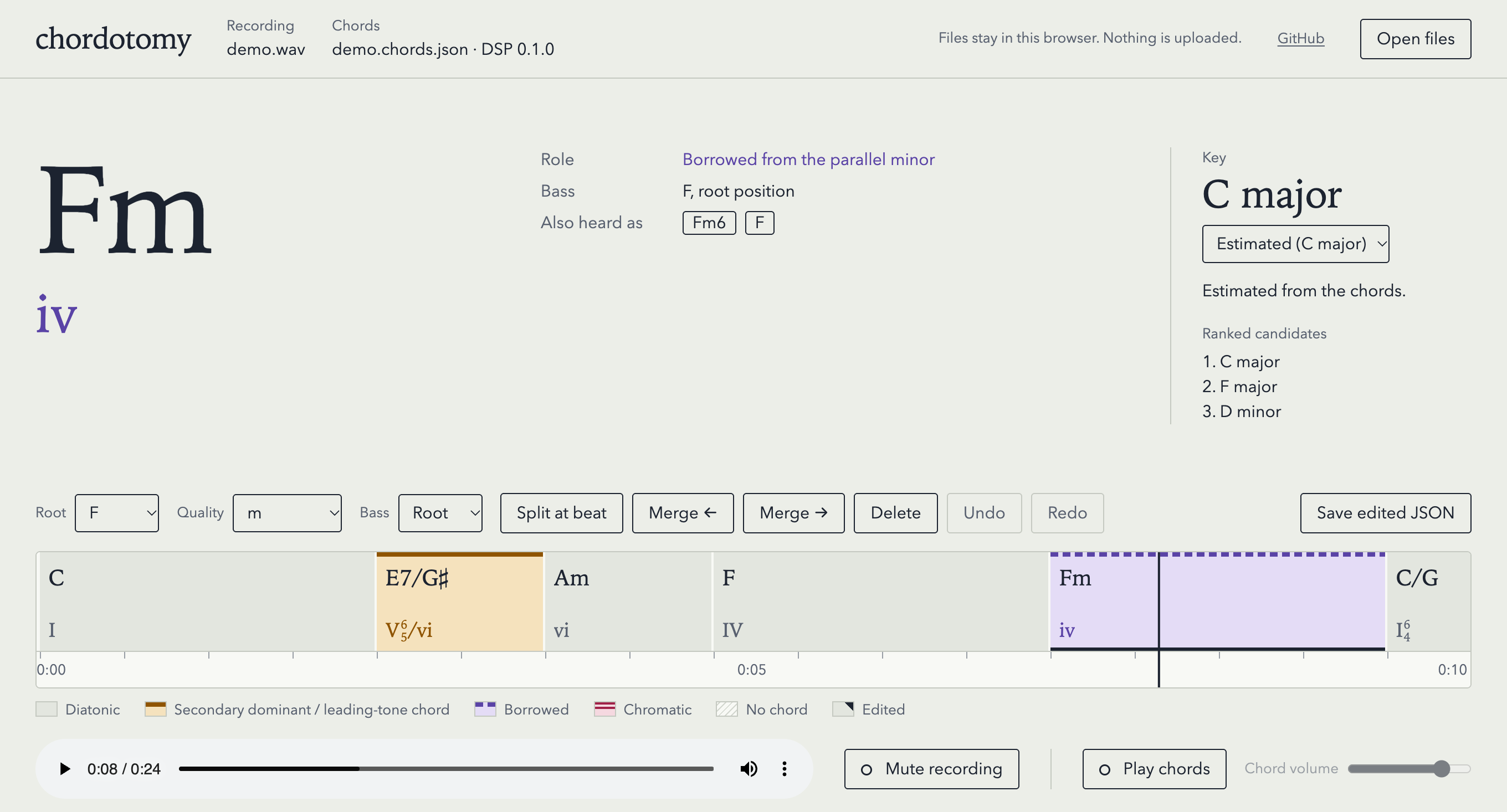
The viewer on a synthesized progression in C major, analyzed with --engine dsp. The current chord is a borrowed Fm (iv); earlier, E7/G♯ is the secondary dominant of Am (V⁶₅/vi).
What it does
- Chords on the beat. Major, minor, dominant 7th, major 7th, minor 7th, half-diminished 7th, diminished 7th, sus4, 7sus4, augmented, diminished triad, sus2 and minor 6th, with
Nfor no chord. The model calls all of them but minor 6th; the DSP all but sus2 and 7sus4. Corrections can also enter add9 and minor add9, which neither engine calls. - Two engines. The lv-chordia model (Jiang, Chen, Li and Xia, ISMIR 2019) when its optional extra is installed, chordotomy's DSP front end otherwise. The model engine's beats come from Beat This!, the DSP's from librosa, and both share the same harmonic analysis.
- Key and Roman numerals. Key changes are found from the chords, and each passage is analyzed in its own key. Secondary dominants, secondary leading-tone chords and borrowed chords are labeled and highlighted; the viewer adds figured bass for inversions.
- The bass note and inversion of each chord where a bass is heard, so slash chords (C/E, D/F♯) come out as such. A weak bass outside the chord is shown at root position instead of as a doubtful slash chord.
- A viewer that plays the recording with its chords, plays the chords themselves to check them by ear, and lets you correct and enter chords.
- An agent skill for Claude Code, Codex, Cursor and other agents,
extract-chords, that writes out the chords of a recording or a YouTube link and explains the highlighted moves.
Quick start
uv tool install "chordotomy[model]"   # with the lv-chordia model (recommended), about 600 MB
chordotomy analyze song.mp3           # writes song.chords.json
Then open the viewer and drop song.mp3 and song.chords.json on the page. Without [model], uv tool install chordotomy, pipx install chordotomy or pip install chordotomy installs the DSP engine only.
Usage
chordotomy analyze song.mp3                 # writes song.chords.json
chordotomy analyze song.mp3 -o out.json
chordotomy analyze song.mp3 --key A:min     # analyze the whole song in A minor, with no key changes
chordotomy analyze song.mp3 --engine dsp    # the DSP front end, even with the model installed
chordotomy analyze song.mp3 --source-url https://www.youtube.com/watch?v=…   # record where the recording came from
chordotomy fetch-weights                    # model extra: download and verify Beat This!'s weights once
--key takes <root>:maj or <root>:min, flats accepted. --source-url only records the page in the JSON; nothing is downloaded. --engine auto, the default, takes the lv-chordia model when it is installed and the DSP front end otherwise; a missing or broken model install is an error that names the fix, never a silent fallback. analyze overwrites an existing output only with --force.
The output, song.chords.json (schema 11), lists every beat, the estimated key, the key regions and the chord segments, each analyzed in its region's key. One segment of the screenshot's timeline:
{
  "start_beat": 4,
  "end_beat": 6,
  "start_time": 2.438,
  "end_time": 3.646,
  "chord": "E:7",
  "candidates": ["E:7", "G#:dim", "E:maj"],
  "bass": "G#",
  "inversion": "first",
  "numeral": "V7/vi",
  "role": "secondary_dominant",
  "function": null,
  "target": "vi",
  "edited": false
}
Chords are Harte labels, and candidates is a ranking, never a percentage. docs/timeline-json.md has every field.
The model engine (optional)
The model extra adds lv-chordia, Beat This! and torch, and takes about twice the DSP's time per minute of audio, on the CPU. lv-chordia's weights come inside its wheel; Beat This!'s, 81 MB, are downloaded on the first run and checked against a pinned SHA-256. Both models were trained on commercial recordings: lv-chordia on 1217 songs with public chord annotations (Isophonics, Billboard, RWC-Pop and USPOP), Beat This! on 15 beat-annotated datasets. If you would rather not use models trained that way, leave the extra out. docs/install.md has the size, speed and memory, the weights' cache, the CPU build of torch on Linux, and the full training data.
Accuracy
chordotomy evaluate scores both engines on two public datasets with mir_eval, weighted by duration, beside other open-source chord recognizers run on the same audio. root asks for the right root, majmin for the right major or minor triad, and sevenths for the right seventh chord too.
| Tiny AAM root | majmin | sevenths | GuitarSet root | majmin | sevenths | |
|---|---|---|---|---|---|---|
| chordotomy, model engine | 0.955 | 0.950 | 0.914 | 0.854 | 0.900 | 0.847 |
| lv-chordia, its own output | 0.951 | 0.947 | 0.911 | 0.846 | 0.893 | 0.839 |
| BTC (Park et al., 2019) | 0.931 | 0.920 | 0.880 | 0.809 | 0.864 | 0.775 |
| ChordMini BTC (Phan et al., 2026) | 0.921 | 0.908 | 0.844 | 0.818 | 0.869 | 0.798 |
| ChordMini 2E1D (Phan et al., 2026) | 0.924 | 0.913 | 0.836 | 0.742 | 0.801 | 0.746 |
| crema (McFee and Bello, 2017) | 0.898 | 0.893 | 0.794 | 0.816 | 0.873 | 0.785 |
| chordotomy, DSP front end | 0.842 | 0.803 | 0.768 | 0.722 | 0.696 | 0.583 |
Tiny AAM is 20 mixed tracks annotated in major and minor; GuitarSet is 180 solo-guitar accompaniment takes, which Beat This! trained on, so each take is scored with the Beat This! checkpoint that did not. These are numbers for development, not a benchmark claim; docs/evaluation.md has every column, the versions and settings, and the caveats.
Viewer
The viewer plays a recording with its chord timeline: the current chord with its Roman numeral, bass and ranked alternatives, the key at the playhead, and a chord strip colored by role. Play chords sounds the detected chords to check them by ear. You can correct chords, enter ones the analyzer missed, and save the edited JSON, which the skill then reads. Drop the recording and its .chords.json on the page, or open viewer/index.html from a checkout. The files stay in your browser, and the page makes no network requests. docs/viewer.md has the controls and keyboard shortcuts.
Agent skill
The repo carries one skill, extract-chords. It writes out the key and the chords of a recording or a YouTube link on a timeline, and on request explains the key changes, secondary dominants, borrowed chords and bass lines. It runs chordotomy analyze locally (it needs uv and python3; a link also needs ffmpeg, and yt-dlp runs through uvx) and reads the JSON. The audio stays on your machine; the agent reads only the chord timeline.
In Claude Code, install it as a plugin, which runs the plugin's own copy of chordotomy, on the DSP engine unless you run uv sync --extra model in the plugin's directory:
/plugin marketplace add zeikar/chordotomy
/plugin install chordotomy@chordotomy
For any agent skills.sh supports, Claude Code included:
npx skills add zeikar/chordotomy
Installed that way, the skill runs the chordotomy release it was written for through uvx, with the model engine, which installs about 600 MB into uv's cache on its first run (on an Intel Mac, which torch no longer builds for, it falls back to the DSP engine). Then ask something like "get the chords of song.mp3" or "explain the harmony of ".
What it won't do
- Staff notation. It doesn't produce MusicXML and doesn't work out note-level rhythm.
- Melody transcription. It doesn't produce melody → MIDI.
- Song sections. It doesn't label intro, verse, or chorus. Key changes are marked from the chords, without section names.
It stops at the chords and what they're doing. docs/decisions.md explains why.
Roadmap
Everything on the original roadmap works. Known gaps, none scheduled:
- Some slash chords still come out in root position: in one chart check, a C♯7/E♯ read as C♯7 under both engines.
- A chart may name a different chord over the same bass (D/A where the analyzer hears Bm/A); the bass is right, the chord is the recognizer's call.
Development
Requires uv.
git clone https://github.com/zeikar/chordotomy && cd chordotomy
uv sync --extra dev
uv run chordotomy --version
uv run pytest
uv run ruff check . && uv run ruff format --check .
node --test viewer/tests/
uv sync installs exactly the extras it is given, so name every one you want, as in uv sync --extra dev --extra model. The model tests skip without the extra, and those that run Beat This! also without its verified weights (uv run chordotomy fetch-weights); the suite never downloads. The viewer is plain HTML, CSS and JavaScript with no build step, and re-analyzes edits with a JavaScript port of the harmonic analysis that tests/harmony_vectors.json pins to the Python: after changing the analysis, regenerate it with uv run python tests/harmony_vectors.py. In a checkout, .claude/settings.json registers the checkout as a plugin marketplace, so the skill runs from the working tree once the first session's trust prompt is accepted; claude plugin marketplace add . does the same by hand. docs/ARCHITECTURE.md has the pipeline and links the rest of docs/.
The evaluation is opt-in:
uv sync --extra dev --extra eval
uv run chordotomy evaluate tiny-aam [--limit N] [--cache]
uv run chordotomy evaluate guitarset [--limit N] [--cache]
uv run chordotomy evaluate local work/ [--cache]   # your recordings, each with <name>.chart.txt
The datasets are downloaded on demand into the gitignored datasets/: 168 MB for Tiny AAM, about 700 MB for GuitarSet. --cache keeps the slow stages of each analysis, so a change after them rescores both datasets in seconds. local scores your own recordings against chord charts you type in. docs/evaluation.md has the chart format and what each column measures.
Acknowledgements
- The model engine is the work of Junyan Jiang, Ke Chen, Wei Li and Gus Xia, "Large-Vocabulary Chord Transcription via Chord Structure Decomposition", ISMIR 2019, with its original code and weights (MIT), as packaged for PyPI by Open MIR Lab (
lv-chordia, MIT). - The model engine's beats come from Beat This!, the work of Francesco Foscarin, Jan Schlüter and Gerhard Widmer, "Beat this! Accurate beat tracking without DBN postprocessing", ISMIR 2024, with its code and weights (MIT).
- librosa for the audio front end and beat tracking (the DSP engine's beats, and the one-tempo dynamic programming that places the model engine's on Beat This!'s activation), and mir_eval for scoring.
- The DSP front end's chroma whitening follows Matthias Mauch and Simon Dixon's 2010 chord recognition paper, implemented from the paper.
- Evaluation data: Tiny AAM and GuitarSet, both CC BY 4.0.
License
1 maintainer

Metadata
1 maintainer
Release files for chordotomy 0.3.1
For a detailed explanation of source distributions (sdists) and built distributions (wheels), please see the package formats documentation.
Source distribution (sdist)
| File | Size | Uploaded | |
|---|---|---|---|
| chordotomy-0.3.1.tar.gz | 401.4 kB | Details |
Built distribution (wheel)
| File | Interpreter | ABI | Platform | Reset |
|---|---|---|---|---|
| chordotomy-0.3.1-py3-none-any.whl | Python 3 | none | any | Details |
Total release size: 467.0 kB
Release files / chordotomy-0.3.1.tar.gz
| Download URL | chordotomy-0.3.1.tar.gz |
|---|---|
| Size | 401.4 kB |
| Tags | Source |
|
SHA-256 checksum How to use checksums |
a7ad45bd334e4c19a271f2972561db23e781384a1c761f0a726df35f4f9cc091
|
|
BLAKE2b-256 checksum How to use checksums |
80a95c17e84963b6c32239f92986dcc8335831773c6637fdcad4a149addbdb21
|
| Upload date | |
|
Uploaded using Trusted Publishing? What is trusted publishing? |
Yes |
| Uploaded via |
uv/0.12.23 {"installer":{"name":"uv","version":"0.12.23","subcommand":["publish"]},"python":null,"implementation":{"name":null,"version":null},"distro":{"name":"Ubuntu","version":"24.04","id":"noble","libc":null},"system":{"name":null,"release":null},"cpu":null,"openssl_version":null,"setuptools_version":null,"rustc_version":null,"ci":true}
|
Release files / chordotomy-0.3.1-py3-none-any.whl
| Download URL | chordotomy-0.3.1-py3-none-any.whl |
|---|---|
| Size | 65.6 kB |
| Tags | Python 3 |
|
SHA-256 checksum How to use checksums |
8eea0009cbba93599ee7970524659f3afa6ccc8c96e3e003aca211ab8f782cac
|
|
BLAKE2b-256 checksum How to use checksums |
f113b9df2b543b0ce66e67ccfe86f024beee23edf58fb252d60862b80e101cb7
|
| Upload date | |
|
Uploaded using Trusted Publishing? What is trusted publishing? |
Yes |
| Uploaded via |
uv/0.12.23 {"installer":{"name":"uv","version":"0.12.23","subcommand":["publish"]},"python":null,"implementation":{"name":null,"version":null},"distro":{"name":"Ubuntu","version":"24.04","id":"noble","libc":null},"system":{"name":null,"release":null},"cpu":null,"openssl_version":null,"setuptools_version":null,"rustc_version":null,"ci":true}
|














