
City2Graph: Geospatial Graphs for Network Analysis and GNNs
City2Graph is a Python library that turns buildings, streets, public transport feeds, origin–destination matrices, zones, and points of interest into spatial and heterogeneous graphs. It bridges GeoPandas, NetworkX, and PyTorch Geometric so the same geospatial data can support network analysis, urban research, and Graph Neural Networks (GNNs). See the documentation for installation, tutorials, and the Python API reference.





Features
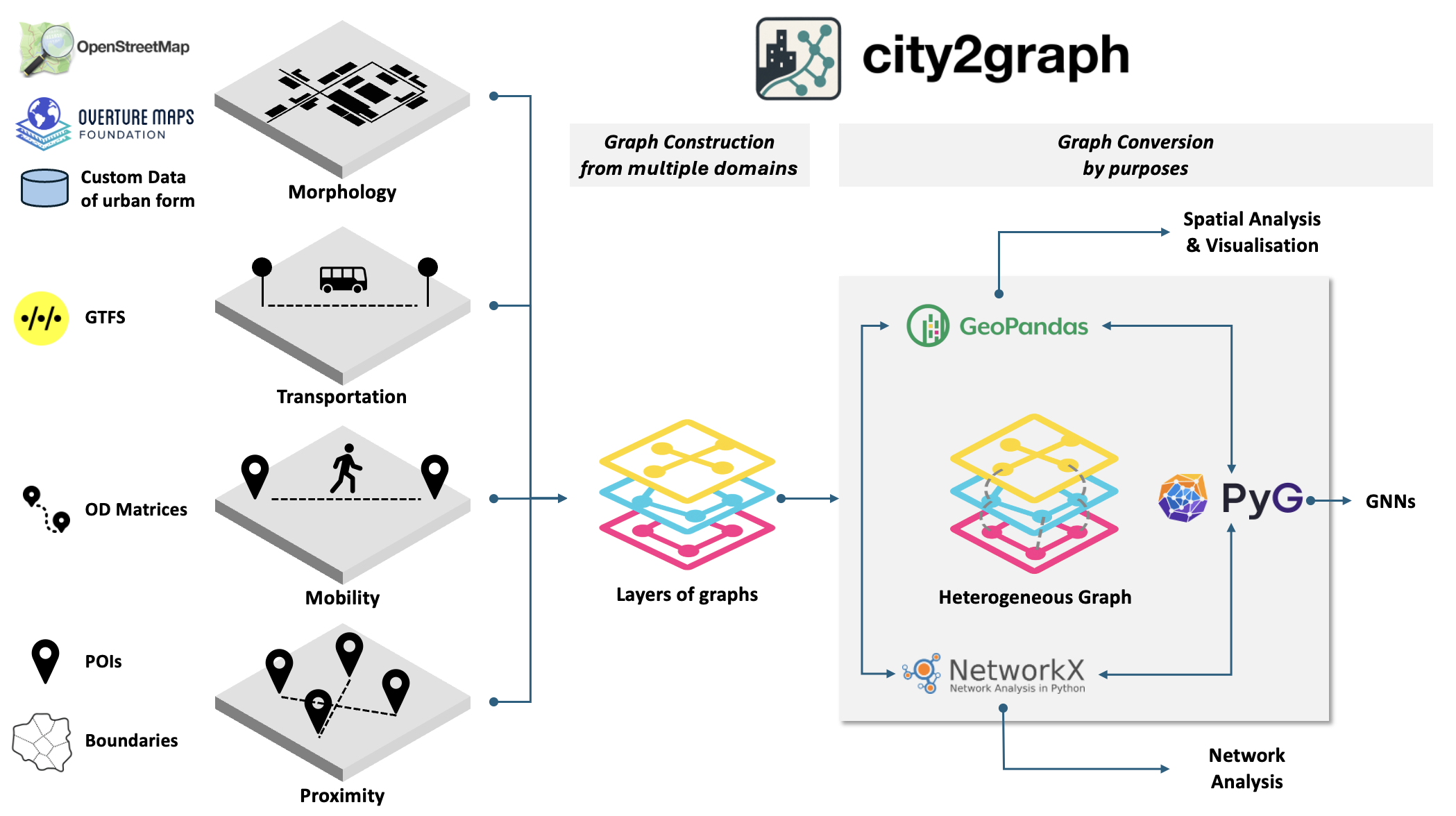
- Morphology: Graphs of buildings, streets, and tessellated urban fabric from OpenStreetMap and Overture Maps.
- Transportation: GTFS public transport and GBFS shared-mobility feeds loaded into DuckDB, with GTFS aggregated into stop-to-stop transit graphs.
- Mobility: Origin–destination matrices and flow data — migration, bike-sharing, pedestrian counts — as weighted spatial graphs.
- Proximity and Contiguity: KNN, Delaunay, Gilbert, and Waxman graphs plus queen/rook contiguity, under Euclidean, Manhattan, or network distances.
- Heterogeneous Graphs and Metapaths: Multiple node and edge types in one graph, with metapath-derived edges composing relations across them.
- GNN-ready Tensors: Round-trip conversion between GeoDataFrames, NetworkX, and PyTorch Geometric
Data/HeteroData.
Installation
Using pip
Basic Installation
City2Graph supports Python 3.12–3.14. The simplest way to install it is via pip:
pip install city2graph
This installs the core functionality without PyTorch and PyTorch Geometric.
With PyTorch (CPU)
If you need the Graph Neural Networks functionality, install with the cpu option:
pip install torch==2.14.1 torchvision==0.29.1 --index-url https://download.pytorch.org/whl/cpu
pip install "city2graph[cpu]"
This will install PyTorch and PyTorch Geometric with CPU support, suitable for development and small-scale processing.
With PyTorch + CUDA (GPU)
Install PyTorch and torchvision from the matching official wheel index before installing the City2Graph extra. For example, for CUDA 13.2 on Linux or Windows:
pip install torch==2.14.1 torchvision==0.29.1 --index-url https://download.pytorch.org/whl/cu132
pip install "city2graph[cu132]"
Supported CUDA extras are cu126, cu128, cu130, and cu132. The current
lockfile uses PyTorch 2.14.1, torchvision 0.29.1, and PyG 2.8.1 for CPU and all
CUDA variants except cu128, which uses PyTorch 2.11.0 and torchvision 0.26.0.
For CUDA 12.8, install those older versions from the cu128 index first.
An extra name alone does not select a CPU or CUDA wheel index in pip.
PyG's published 2.8 support matrix lists PyTorch through 2.12. City2Graph tests its graph conversions with PyTorch 2.14.1; this does not establish compatibility for optional PyG binary extensions. See the installation guide for the full commands and compatibility notes.
Using conda
Basic Installation
You can also install City2Graph using conda from conda-forge:
conda install -c conda-forge city2graph
This installs the core functionality without PyTorch and PyTorch Geometric.
With PyTorch (CPU)
To use PyTorch and PyTorch Geometric with City2Graph installed from conda-forge, you need to manually add these libraries to your environment:
# Install city2graph
conda install -c conda-forge city2graph

# Then install PyTorch and PyTorch Geometric
conda install -c conda-forge pytorch pytorch_geometric
With PyTorch + CUDA (GPU)
For GPU support, select an available CUDA build from the
conda-forge PyTorch files page.
For example, replace PYTORCH_VERSION and CUDA_VARIANT below with a version
and build variant listed there:
# Install city2graph
conda install -c conda-forge city2graph

# Then install PyTorch with CUDA support
conda install -c conda-forge "pytorch=PYTORCH_VERSION=*CUDA_VARIANT*"
conda install -c conda-forge pytorch_geometric
You can browse available CUDA-enabled builds on the conda-forge PyTorch files page and substitute the desired version and CUDA variant in your install command. Make sure that the versions of PyTorch and PyTorch Geometric you install are compatible with each other and with your system.
⚠️ Important: conda is not officially supported by PyTorch and PyTorch Geometric anymore, and only conda-forge distributions are available for them. We recommend using pip or uv for the most streamlined installation experience if you need PyTorch functionality.
For Development
See the Contributing Guide for the canonical development setup, testing, code quality, documentation, and pull request instructions.
Citation
City2Graph is described in a peer-reviewed article. Any use of City2Graph in research or software must cite the following paper, published in Computers, Environment and Urban Systems:
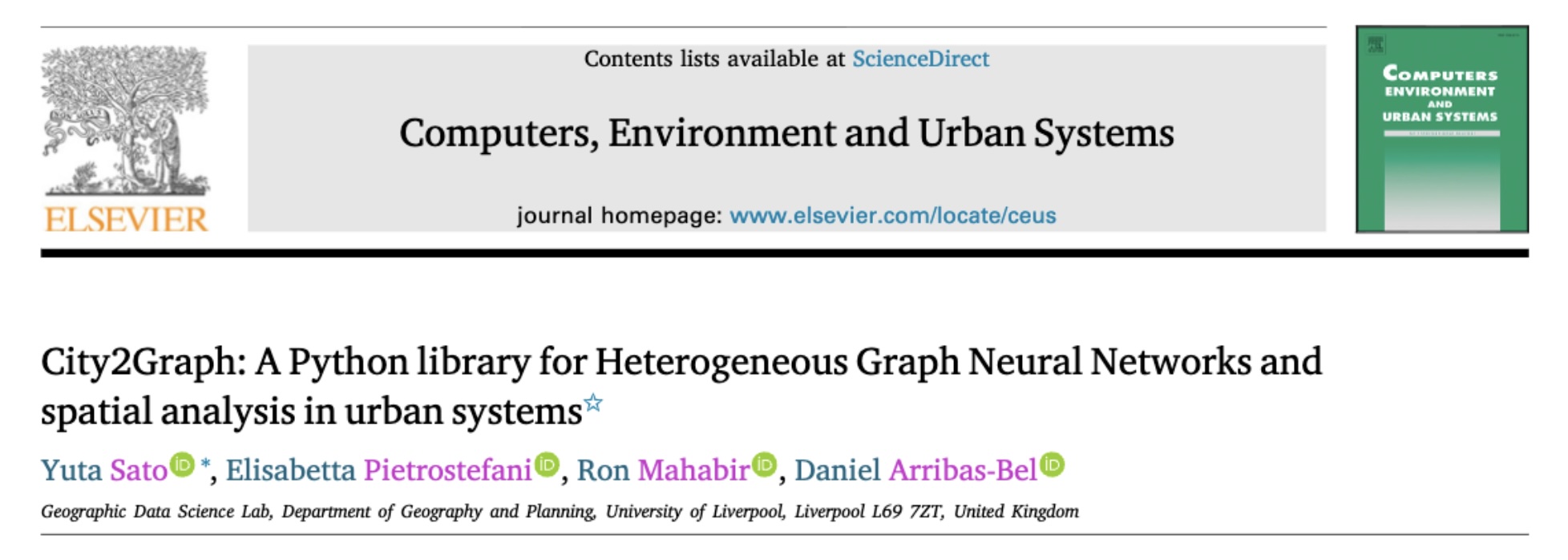
Sato, Y., Pietrostefani, E., Mahabir, R., & Arribas-Bel, D. (2026). City2Graph: A Python library for Heterogeneous Graph Neural Networks and spatial analysis in urban systems. Computers, Environment and Urban Systems, 130, 102492. https://doi.org/10.1016/j.compenvurbsys.2026.102492
@article{sato2026city2graph,
  title = {City2Graph: A Python library for Heterogeneous Graph Neural Networks and spatial analysis in urban systems},
  author = {Sato, Yuta and Pietrostefani, Elisabetta and Mahabir, Ron and Arribas-Bel, Daniel},
  journal = {Computers, Environment and Urban Systems},
  volume = {130},
  pages = {102492},
  year = {2026},
  issn = {0198-9715},
  doi = {10.1016/j.compenvurbsys.2026.102492},
  url = {https://www.sciencedirect.com/science/article/pii/S0198971526000943},
}
The same citation is recorded in the CITATION.cff file in this repository, which follows the Citation File Format standard.
Contributing
Contributions are welcome. The Contributing Guide contains the complete development and quality requirements.
Documentation
City2Graph uses MkDocs for current documentation (v0.2.0+) and keeps Sphinx for legacy releases (v0.1.0–v0.1.7).
- Legacy tags (
v0.1.*): Read the Docs buildsdocs/sourcevia Sphinx. - Everything else (branches / newer tags): Read the Docs builds via MkDocs (
mkdocs.yml).
This is controlled in .readthedocs.yaml using READTHEDOCS_VERSION_TYPE and READTHEDOCS_VERSION_NAME.

1 maintainer

Metadata
1 maintainer
Release files for city2graph 1.0.1
For a detailed explanation of source distributions (sdists) and built distributions (wheels), please see the package formats documentation.
Source distribution (sdist)
| File | Size | Uploaded | Provenance | |
|---|---|---|---|---|
| city2graph-1.0.1.tar.gz | 434.0 kB | Without provenance | Details |
Built distribution (wheel)
| File | Interpreter | ABI | Platform | Reset |
|---|---|---|---|---|
| city2graph-1.0.1-py3-none-any.whl | Python 3 | none | any | Details |
Total release size: 636.3 kB
Release files / city2graph-1.0.1.tar.gz
| Download URL | city2graph-1.0.1.tar.gz |
|---|---|
| Size | 434.0 kB |
| Tags | Source |
|
SHA-256 checksum How to use checksums |
c1413316d05d49bb3b2a84dbc47c0ded23bc2931f0ccf0cc4037f90fc200538c
|
|
BLAKE2b-256 checksum How to use checksums |
7c2432852b2d82e65539eeef2202dd1938eb2aadfcef03938dec9129e56a7e0c
|
| Upload date | |
|
Uploaded using Trusted Publishing? What is trusted publishing? |
Yes |
| Uploaded via |
uv/0.13.5 {"installer":{"name":"uv","version":"0.13.5","subcommand":["publish"]},"python":null,"implementation":{"name":null,"version":null},"distro":{"name":"Ubuntu","version":"26.04","id":"resolute","libc":null},"system":{"name":null,"release":null},"cpu":null,"openssl_version":null,"setuptools_version":null,"rustc_version":null,"ci":true}
|
Release files / city2graph-1.0.1-py3-none-any.whl
| Download URL | city2graph-1.0.1-py3-none-any.whl |
|---|---|
| Size | 202.2 kB |
| Tags | Python 3 |
|
SHA-256 checksum How to use checksums |
3f3bf0986cfb019b32d363dcccd993b857c320c404fcf4581571a5a4c938e054
|
|
BLAKE2b-256 checksum How to use checksums |
5324a5ee72349721cc54eeda8714400d9097aafa52e094871f9823b0228ec8bc
|
| Upload date | |
|
Uploaded using Trusted Publishing? What is trusted publishing? |
Yes |
| Uploaded via |
uv/0.13.5 {"installer":{"name":"uv","version":"0.13.5","subcommand":["publish"]},"python":null,"implementation":{"name":null,"version":null},"distro":{"name":"Ubuntu","version":"26.04","id":"resolute","libc":null},"system":{"name":null,"release":null},"cpu":null,"openssl_version":null,"setuptools_version":null,"rustc_version":null,"ci":true}
|
Security for city2graph 1.0.1
Provenance
Provenance describes where a file came from. On PyPI, provenance is shared via attestations, which provide a verifiable record of the build or publishing details. View details, limitations and caveats.
No provenance found
None of the files in this release were uploaded with provenance metadata.
A note on package security
PyPI is a repository for distributing packages, not a service for auditing them. While third-party security researchers and our staff do their best to detect and remove malicious packages, PyPI cannot guarantee the quality, security or suitability of any given package.














