
A Python library for browser-based manual image classification

Project description
Classto
Classto is a Python library for building lightweight, browser-based tools to manually classify images into custom categories - ideal for preparing datasets or sorting visual content.
With just a few lines of Python, Classto spins up a local web interface built on Flask and styled with Tailwind CSS to let you quickly review, label, and organize images - right from your browser.
Interface Previews
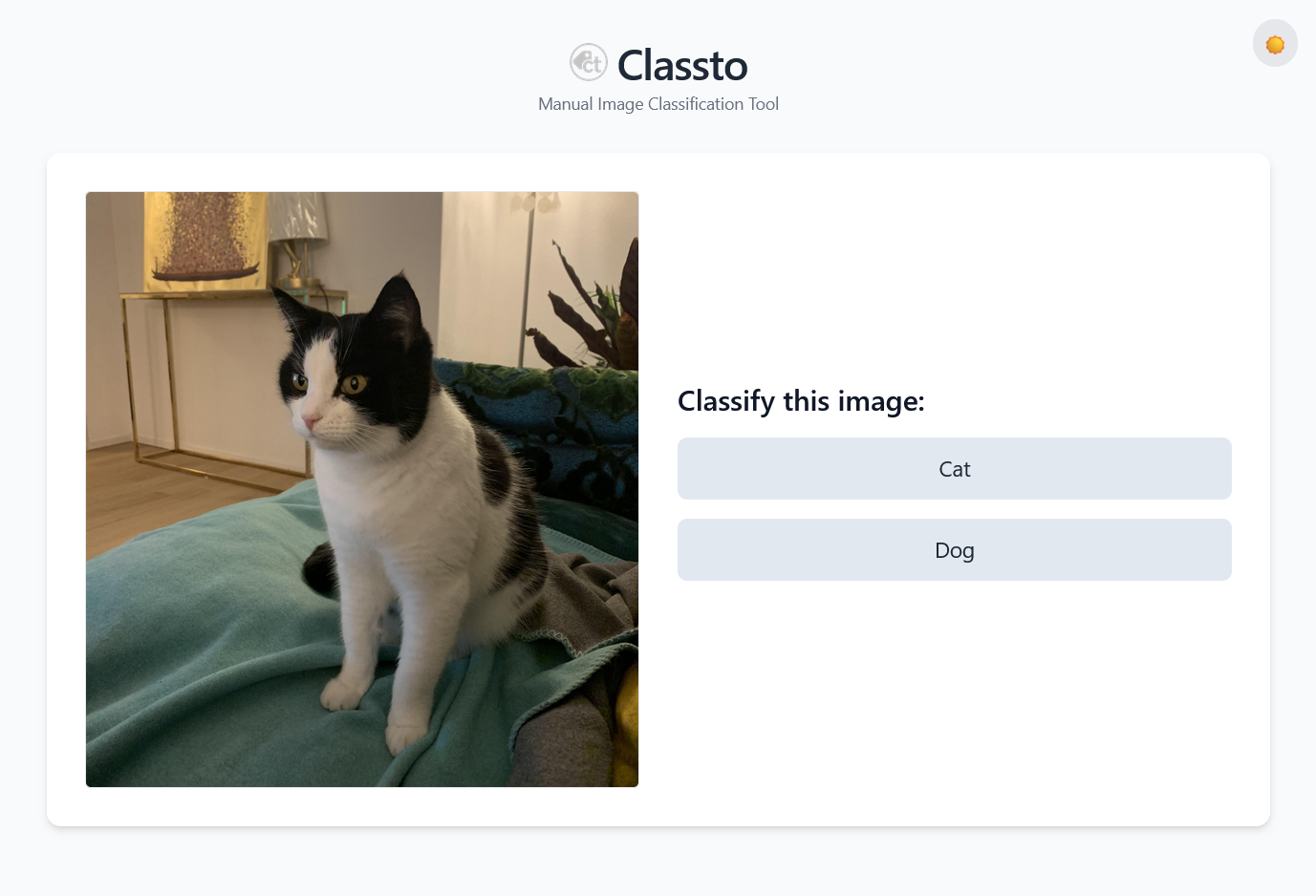
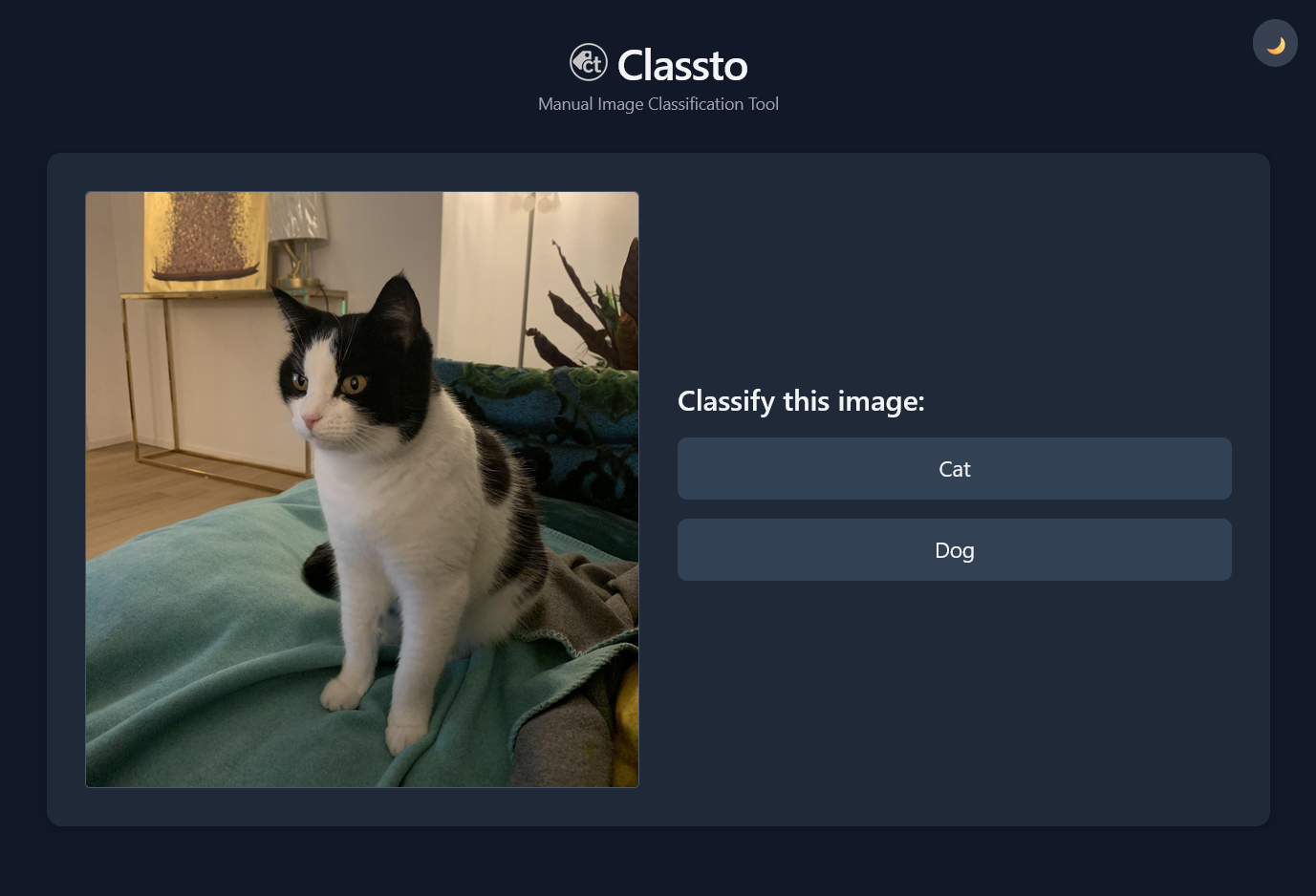
Classto in Light and Dark Mode
Features
- Three Operational Modes: Local Folder, Static URL, or Dynamic Database Hooks.
- One-Click Classification: Fast, keyboard-friendly browser UI.
- Flexible Data Management: Moves local files, logs to CSV, or streams directly from cloud/DB pipelines.
- Smart Suffixing: Optionally add unique filename suffixes to avoid naming conflicts.
- Dark Mode Toggle: Easy on the eyes during long labeling sessions.
Installation
You can install Classto via pip:
pip install classto
Quickstart
Classto adapts to your workflow. You can use it in exactly one of the following three modes at a time:
1. Local Folder Mode
Reads images from a local directory, moves them into per-label subfolders, and optionally creates a CSV log.
import classto as ct

labeler = ct.ImageLabeler(
    classes=["Cat", "Dog"],
    image_folder="images",     # Mandatory path to your images
    delete_button=True,        # Shows a button to delete/skip images
    suffix=True,               # Add unique suffix to avoid conflicts
    log_to_csv=True            # Saves results to a local CSV file
)

labeler.launch()
Then open your browser at http://127.0.0.1:5000.
Local Folder Architecture
Place your images in a folder (e.g. images/) relative to your script:
project/
├── images/
│   ├── cat1.jpg
│   ├── cat2.jpg
│   ├── dog1.jpg
│   └── dog2.jpg
├── app.py
After classification, images are moved to:
project/
├── classified/
│   ├── Cat/
│   │   ├── cat1__K8dLs.jpg
│   │   └── cat2__a7JkL.jpg
│   ├── Dog/
│   │   ├── dog1__Xy4Tz.jpg
│   │   └── dog2__Zx9Pm.jpg
│   └── labels-20260522-163400Z.csv
2. Static URL Mode
Streams images directly from a list of web URLs. Classifications are tracked via a local CSV file.
import classto as ct

urls = [
    "https://example.com/image1.jpg",
    "https://example.com/image2.png"
]

labeler = ct.ImageLabeler(
    classes=["Product", "Background Only"],
    urls=urls,                     # Mandatory for URL Mode
    log_to_csv=True,               # Keeps track of URLs in a CSV file
    shuffle=True
)

labeler.launch()
3. Dynamic Hook Mode (Database Integration)
Integrate seamlessly with databases (e.g., MongoDB, Cosmos DB) or cloud storages. Images are streamed on-demand via custom callback hooks without loading datasets into memory or enforcing local file moves.
import classto as ct

# Define your custom database connection logic
def my_next_hook():
    # Fetch next document from DB. Must return {"id": str, "url": str} or None
    doc = db.images.find_one({"labeled": False})
    return {"id": str(doc["_id"]), "url": doc["image_url"]} if doc else None

def my_label_hook(image_id, label):
    # Save the label back to your database
    db.images.update_one({"_id": ObjectId(image_id)}, {"$set": {"label": label, "labeled": True}})

def my_stats_hook():
    # Update live session progress badges in the UI
    return {
        "total_remaining": db.images.count_documents({"labeled": False}),
        "total_labeled": db.images.count_documents({"labeled": True})
    }

def my_delete_hook(image_id):
    # Optional: Action when the delete/skip button is pressed
    db.images.update_one({"_id": ObjectId(image_id)}, {"$set": {"is_deleted": True, "labeled": True}})

labeler = ct.ImageLabeler(
    classes=["Valid", "Corrupted"],
    delete_button=True,
    on_next=my_next_hook,           # Mandatory for Hook Mode
    on_label=my_label_hook,         # Mandatory for Hook Mode
    on_get_stats=my_stats_hook,     # Optional: Renders live stats UI badges
    on_delete=my_delete_hook,       # Mandatory if delete_button=True in Hook Mode
    log_to_csv=False                # Optional: Set to True for a parallel local CSV backup
)

labeler.launch()
Parameters
classes(List[str]): A list of categories for classification (e.g.["Dog", "Cat"]).image_folder(Optional[str]): Path to the folder containing local images. Required for Folder Mode. Defaults to None.urls(Optional[List[str]]): A list of image URLs to stream. Required for URL Mode. Defaults to None.delete_button(bool): IfTrue, shows a delete button to remove or skip images. Defaults toFalse.shuffle(bool): IfTrue, images are presented in a random order (applies to Folder and URL mode only). Defaults toFalse.suffix(bool): IfTrue, appends a random 5-character suffix to local filenames to prevent overwriting. Defaults toFalse.log_to_csv(bool): IfTrue, logs classifications into a local CSV file. Works as a primary tracker for URL mode or as a secondary backup across all modes. Defaults toFalse.log_path(Optional[str]): Custom directory path where the CSV log file should be written.log_file_name(Optional[str]): Custom file name for the CSV log. If omitted, a UTC-timestamped name is automatically generated.on_next(Optional[Callable]): Hook returning{"id": str, "url": str}orNone. Required for Hook Mode.on_label(Optional[Callable]): Hook accepting(image_id: str, label: str). Required for Hook Mode.on_get_stats(Optional[Callable]): Hook returning{"total_remaining": int, "total_labeled": int}to power the UI counter.on_delete(Optional[Callable]): Hook accepting(image_id: str). Required ifdelete_button=Truein Hook Mode.
CSV Logging Format
If log_to_csv=True is enabled, data is written into a CSV file containing the following structure:
| original_filename | new_filename | label | timestamp |
|---|---|---|---|
| img01.jpg | img01__4Fg7T.jpg | Cat | 2026-05-22T16:34:00+00:00 |
| img02.jpg | img02__8Hv2f.jpg | Dog | 2026-05-22T16:34:32+00:00 |
original_filename: The local filename (Folder Mode) or the custom database image_id (Hook Mode).new_filename: The new name after suffixing (Folder Mode) or the streamed image_url (Hook Mode/URL Mode).label: The category selected during classification (orDELETED).timestamp: Execution time in ISO 8601 format (UTC).
Release history Release notifications | RSS feed


Download files
Download the file for your platform. If you're not sure which to choose, learn more about installing packages.
Source Distribution
Built Distribution
Filter files by name, interpreter, ABI, and platform.
If you're not sure about the file name format, learn more about wheel file names.
Copy a direct link to the current filters
File details
Details for the file classto-2.1.0.tar.gz.
File metadata
- Download URL: classto-2.1.0.tar.gz
- Upload date:
- Size: 477.3 kB
- Tags: Source
- Uploaded using Trusted Publishing? No
- Uploaded via: twine/6.2.0 CPython/3.14.4
File hashes
| Algorithm | Hash digest | |
|---|---|---|
| SHA256 |
33b4aea9b72e8bd5484c1edc80e49a8e2b0e35a14e63c5bddcc5658408409f6e
|
|
| MD5 |
af8658ecf5e89bd62a3a9d0e203735e0
|
|
| BLAKE2b-256 |
e6797ce0efe6c9e43c2552acf0017865419204cdba776a71f4a91c55d15979c6
|
File details
Details for the file classto-2.1.0-py3-none-any.whl.
File metadata
- Download URL: classto-2.1.0-py3-none-any.whl
- Upload date:
- Size: 473.6 kB
- Tags: Python 3
- Uploaded using Trusted Publishing? No
- Uploaded via: twine/6.2.0 CPython/3.14.4
File hashes
| Algorithm | Hash digest | |
|---|---|---|
| SHA256 |
5fd492243b519a0140bc62fffcc231a77a3fa5303c13289efdbec74598c9d26b
|
|
| MD5 |
57aaba2b35194851c5ea1ded1fae801f
|
|
| BLAKE2b-256 |
1d8c16a8d9f034bb3f7651d3d51e2e0dc3b3ca10bfcf8a705e33119e94f6837b
|






