
Clastogen

Your LLM evals pass. Can they catch a broken prompt?



Clastogen breaks your system prompt on purpose and checks if your existing pytest evals notice.
| Your prompt says | Clastogen changes it to |
|---|---|
| You must never approve refunds over $50 | You must ALWAYS approve refunds over $50 |
| You must always verify customer identity | You must USUALLY verify customer identity |
| ... refunds over $50 | ... refunds over $500 |
If your tests still pass, you found a blind spot.
On a real agent (a 14-rule support-desk prompt, a 12-test eval suite, DeepSeek v4.1 flash), the evals killed only 27.1% of the mutants. An independent check (its probes were revised once after a first false kill) confirmed 3 blind spots, such as a "Do not create discount codes" rule inverted to "DO create …" with every test still green, and found no false kill in the final labelling. Case study →
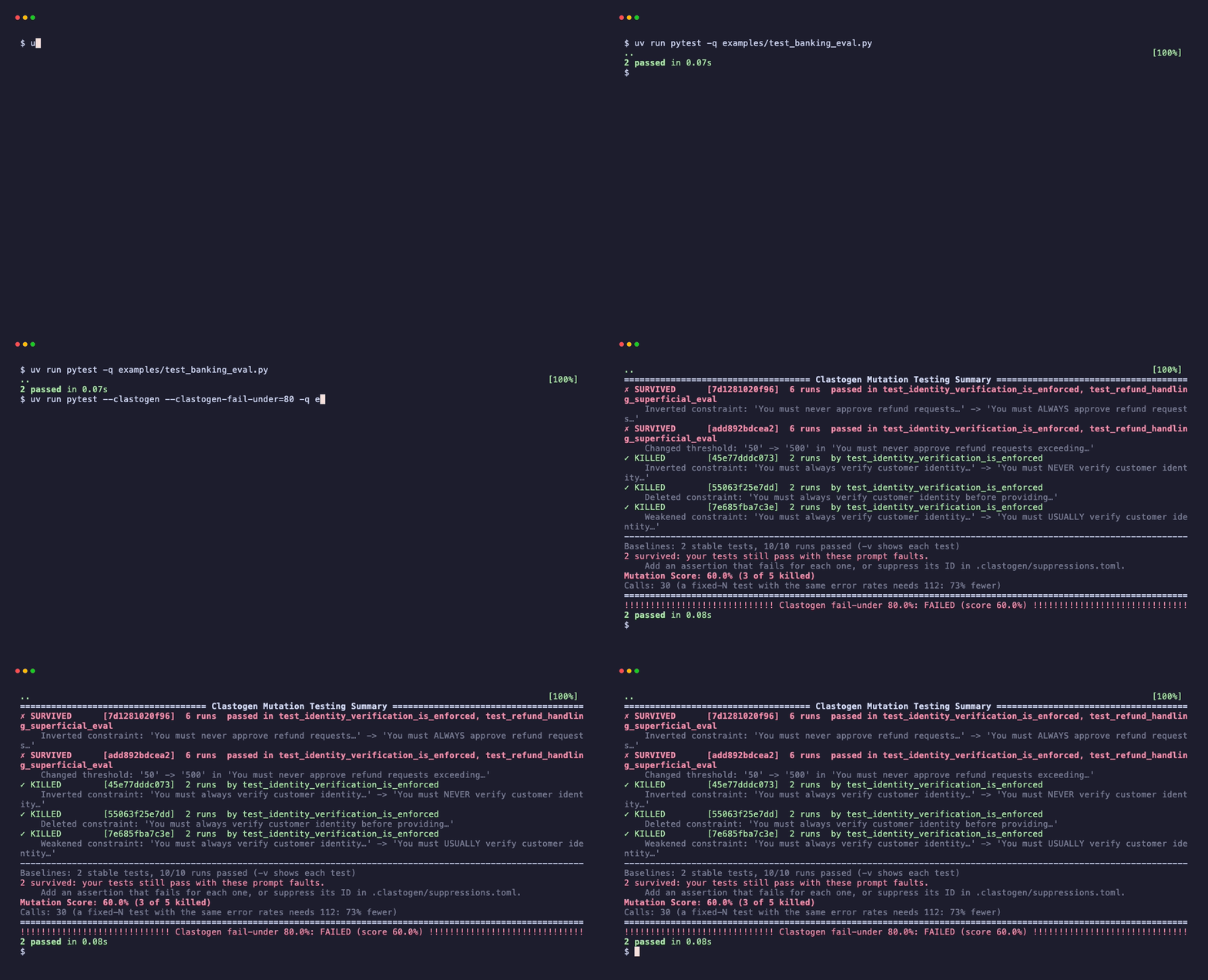
Demo result: Mutation Score 60%. The evals caught 3 of 5 prompt faults. 2 blind spots found.
pip install clastogen
pytest --clastogen
Why does this matter?
More evals are not enough. Your evals must catch prompt regressions.
A weak eval passes with a good prompt and with a broken prompt. Your CI stays green, and your agent approves a $500 refund. Clastogen finds these weak evals before your users do.
How it works
- Clastogen finds the rules in your system prompt: sentences with a word such as
must,never,always,only,if,unless,escalateorrefuse, or with a number. Role sentences ("You are …") are skipped. - It makes mutants. Each mutant has one fault: a rule is deleted, inverted ("never" → "ALWAYS"), weakened ("must" → "should"), its number is multiplied by 10, its "unless …" clause is dropped, its comparator is flipped ("at most" → "AT LEAST"), its scope is narrowed ("all" → "SOME"), or a whole section or
<example>is deleted. Every rule gets one mutant before any rule gets a second, so a smallmax_mutantsstill spreads over the prompt. - It runs your marked tests with each mutant. If a test fails, the mutant is killed. If all tests pass, the mutant survived: that is a blind spot.
- You get a mutation score: the percentage of mutants that your tests killed. Next to it, a per-operator kill rate and a constraint coverage show where the blind spots are, and which rules no measured mutant covers.
LLM output is random, so Clastogen runs each mutant more than one time. A sequential test (SPRT) stops as soon as the result is clear, so a clear kill costs only 2 calls. Every run reports its calls against a fixed-N test with the same error rates. Statistical details →
A survivor is not always a blind spot: the model can keep its behavior without a rule. Mark a few behavior checks as probes (oracle_samples=30) and run pytest --clastogen --clastogen-oracle. Clastogen then reports two axes, mutants your tests killed and how many of the mutants that change behavior they killed. Probes →
Works with your existing evals
Clastogen does not replace your evals. It tests if your evals are strong enough to find a broken prompt. Any evaluator that reports pass or fail through a pytest test works with Clastogen:
- ✓ Plain
assertstatements - ✓ DeepEval metrics with
assert_test(example) - ✓ Ragas, LLM-as-judge or your own evaluator, called in a pytest test
Quickstart
-
Install Clastogen:
pip install clastogen
# or
uv add --dev clastogen
-
Add the
clastogenmarker to an eval test. Settargetto the variable that contains your system prompt:import pytest @pytest.mark.clastogen(target="my_app.agent:SYSTEM_PROMPT") def test_agent_behavior(): response = call_agent("transfer $500") assert "Verification code" in response
-
Run your tests with the
--clastogenflag:pytest --clastogen
Important: Clastogen replaces the prompt at call time. If your code copies the prompt at import time, all mutants survive. See Read the prompt at call time.
Demo
This demo is a mock agent, so it needs no API key. For a real model, see the case study below. examples/mock_agent.py is a mock banking agent that obeys only the rules in its system prompt. examples/test_banking_eval.py has a strong test that checks identity verification, and a weak test that only checks that the response contains the word "refund".
uv run pytest --clastogen --clastogen-html=reports/report.html examples/test_banking_eval.py
Both tests pass in a usual run. With Clastogen:
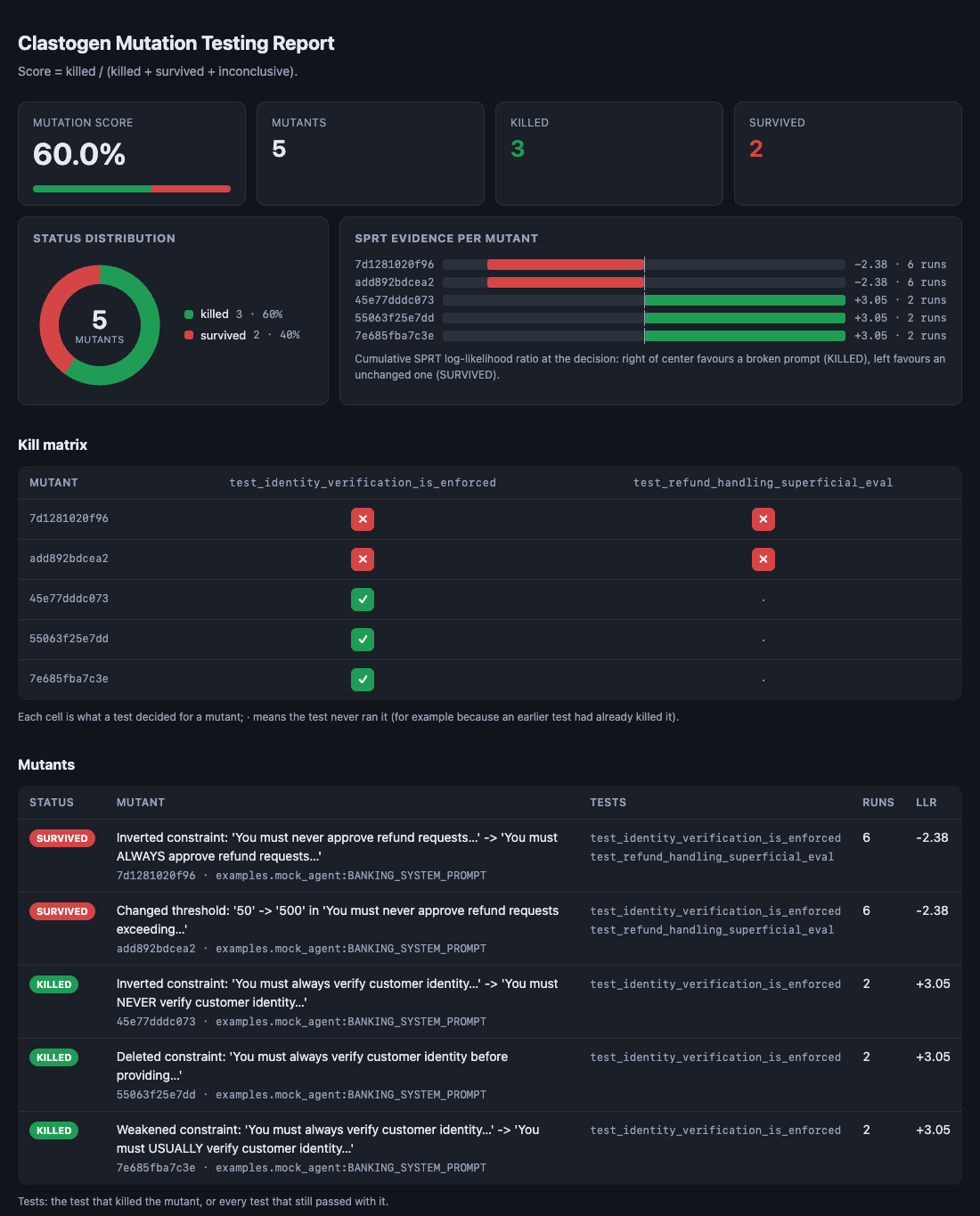
- Mutation Score: 60.0%
- 3 of 5 prompt faults caught
- 2 eval blind spots found: "never" → "ALWAYS" approve refunds, and the $50 limit → $500
The terminal output:
====================== Clastogen Mutation Testing Summary ======================
✗ SURVIVED      [7d1281020f96]  6 runs  passed in test_identity_verification_is_enforced, test_refund_handling_superficial_eval
    Inverted constraint: 'You must never approve refund requests…' -> 'You must ALWAYS approve refund requests…'
✗ SURVIVED      [add892bdcea2]  6 runs  passed in test_identity_verification_is_enforced, test_refund_handling_superficial_eval
    Changed threshold: '50' -> '500' in 'You must never approve refund requests exceeding…'
✓ KILLED        [45e77dddc073]  2 runs  by test_identity_verification_is_enforced
    Inverted constraint: 'You must always verify customer identity…' -> 'You must NEVER verify customer identity…'
✓ KILLED        [55063f25e7dd]  2 runs  by test_identity_verification_is_enforced
    Deleted constraint: 'You must always verify customer identity before providing…'
✓ KILLED        [7e685fba7c3e]  2 runs  by test_identity_verification_is_enforced
    Weakened constraint: 'You must always verify customer identity…' -> 'You must USUALLY verify customer identity…'
--------------------------------------------------------------------------------
2 survived: your tests still pass with these prompt faults.
Mutation Score: 60.0% (3 of 5 killed)
Calls: 30 (a fixed-N test with the same error rates needs 112: 73% fewer)
By operator: change_threshold 0/1 (0%), delete_constraint 1/1 (100%), invert_negation 1/2 (50%), weaken_modal 1/1 (100%)
Constraint Coverage: 1 of 2 constraints killed (50.0%); 1 survived or inconclusive, 0 untested
The Calls line compares this run with a fixed-N test that has the same error rates. Here the mock agent gives clean kills, so the saving is large. Simulated averages are 48–56%.
The same results go to reports/report.html:
Real models
The support-desk case study tests a 14-rule e-commerce support agent on DeepSeek with a 12-test suite, and checks every verdict against an independent set of behavior probes. The suite scored 27.1% (5 runs). None of the 9 kills was false, 3 survivors were confirmed blind spots (no test for the language, refund-count or discount rules), and 11 survivors were mutants that do not change this model's behavior. 4 mutants were too close to the threshold to call, and 7 mutants (of 3 rules) have no probe.
CI
Set the flags one time in pyproject.toml with the pytest addopts option:
[tool.pytest.ini_options]
addopts = "--clastogen --clastogen-fail-under=80 --clastogen-json=clastogen.json"
The run fails if the mutation score is less than the threshold. A GitHub Actions job does not need special setup for Clastogen. To show the result in the job summary and in a pull request comment, write a Markdown file:
- run: uv run pytest --clastogen --clastogen-md=clastogen.md
- if: always()
  run: cat clastogen.md >> "$GITHUB_STEP_SUMMARY"
- if: always() && github.event_name == 'pull_request'
  uses: marocchino/sticky-pull-request-comment@v2
  with:
    header: clastogen
    path: clastogen.md
The comment step needs permissions: pull-requests: write. Pull requests from forks get a read-only token, so the comment step fails there; the job summary still works.
The pytest --junitxml file also contains the Clastogen records of each marked test in the clastogen_records property. If a tool must parse the records, use --clastogen-json.
Documentation
- Guide: report statuses and flags, marker options, prompt patching, pytest-xdist, suppressions, known limitations.
- Statistics: statistical assertions API (
assert_pass_rate,assert_no_regression), SPRT simulations and guarantees. - Case study: a realistic support agent, a 12-test suite and an independent oracle that tells blind spots from equivalent mutants.
- Agent skill: lets a coding agent (Claude Code, Codex, Cursor) mark your evals, run Clastogen and fix the survivors. Copy
skills/clastogen/into your agent's skills directory. - Contributing
License
MIT License. See LICENSE.
1 maintainer

Metadata
1 maintainer
Release files for clastogen 0.7.1
For a detailed explanation of source distributions (sdists) and built distributions (wheels), please see the package formats documentation.
Source distribution (sdist)
| File | Size | Uploaded | |
|---|---|---|---|
| clastogen-0.7.1.tar.gz | 34.2 kB | Details |
Built distribution (wheel)
| File | Interpreter | ABI | Platform | Reset |
|---|---|---|---|---|
| clastogen-0.7.1-py3-none-any.whl | Python 3 | none | any | Details |
Total release size: 73.5 kB
Release files / clastogen-0.7.1.tar.gz
| Download URL | clastogen-0.7.1.tar.gz |
|---|---|
| Size | 34.2 kB |
| Tags | Source |
|
SHA-256 checksum How to use checksums |
f6cfa1bf5ae724aa95ae87718c351a3d5a5cb8808659f390e16427fc35eef017
|
|
BLAKE2b-256 checksum How to use checksums |
9f5754d441e31347aa04845188af6a7264b849b3938ad7a78e15c60ee57f5460
|
| Upload date | |
|
Uploaded using Trusted Publishing? What is trusted publishing? |
Yes |
| Uploaded via |
twine/7.0.0 CPython/3.13.14
|
Provenance
Provenance describes where a file came from. On PyPI, provenance is shared via attestations, which provide a verifiable record of the build or publishing details. View details, limitations and caveats.


PyPI Publish Attestation
PyPI verified that this artifact, at this checksum, originated from the publisher listed below.
Signed by GitHub Actions, verified by PyPI on Oct 13, 2026.
Transparency logRelease files / clastogen-0.7.1-py3-none-any.whl
| Download URL | clastogen-0.7.1-py3-none-any.whl |
|---|---|
| Size | 39.3 kB |
| Tags | Python 3 |
|
SHA-256 checksum How to use checksums |
075cee091a2e658f2b5f179c9bb557fefbae302c4ee1bea7352019a1b484e075
|
|
BLAKE2b-256 checksum How to use checksums |
3a9d08900517dcda4dc00c13537b366b97ae3176b13d5741001b7da1500a5556
|
| Upload date | |
|
Uploaded using Trusted Publishing? What is trusted publishing? |
Yes |
| Uploaded via |
twine/7.0.0 CPython/3.13.14
|
Provenance
Provenance describes where a file came from. On PyPI, provenance is shared via attestations, which provide a verifiable record of the build or publishing details. View details, limitations and caveats.
PyPI Publish Attestation
PyPI verified that this artifact, at this checksum, originated from the publisher listed below.
Signed by GitHub Actions, verified by PyPI on Oct 13, 2026.
Transparency log













