
Claude Code Cost Explorer
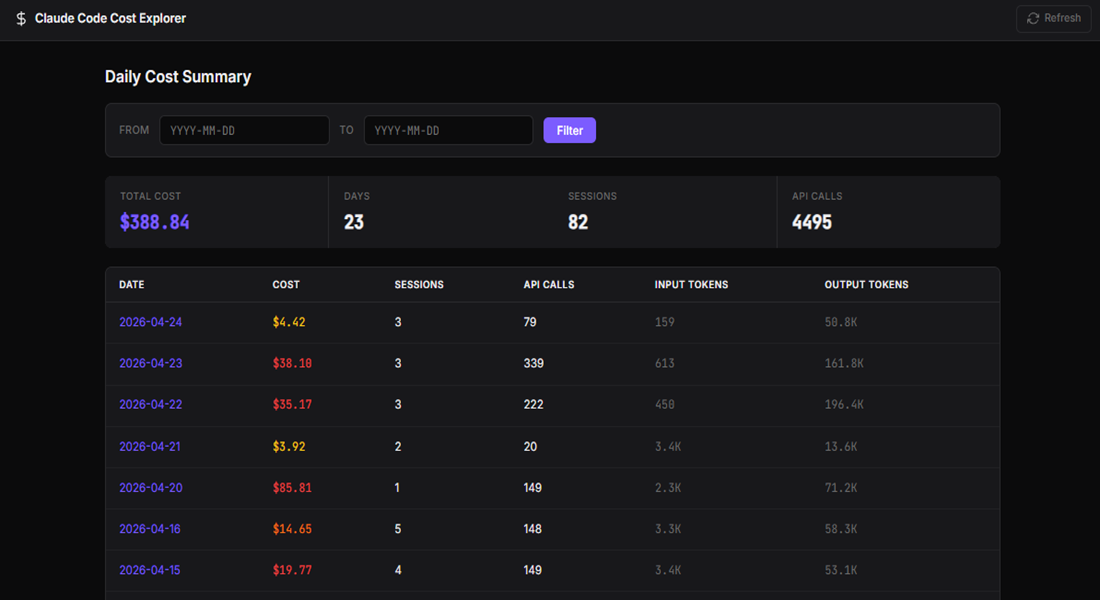
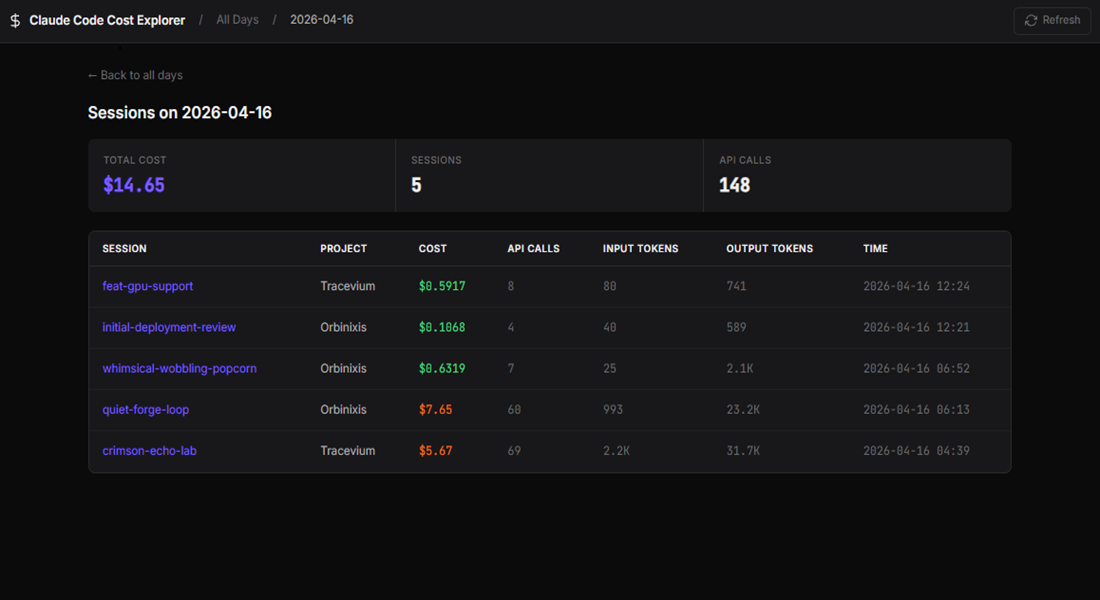
A local Flask web app for exploring Claude Code usage by day, session, and turn. It reads Claude Code JSONL logs from your machine, summarizes token usage, and estimates API cost without sending data anywhere.
No API key is needed. No database is used. No frontend build step is required.
What It Shows
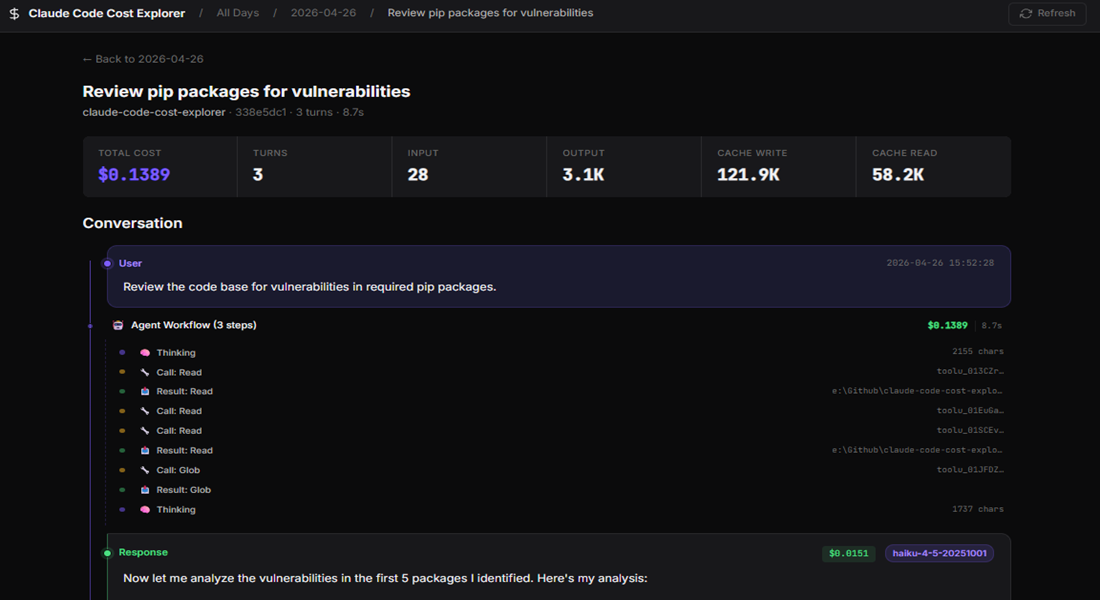
Drill down: Day → Session → Turn
- 💬 Conversation turns → full messages + collapsible thinking
- 🛠️ Tool calls →
[tool: Bash],[3 tools: Read, Write, Glob]→ inputs + raw output
At each level it shows cost and token summaries. Turn detail pages can show the full user message, assistant content blocks, collapsible thinking blocks when present in the source log, and tool call inputs/results.
| Home | Sessions | Detail |
|---|---|---|
 |
 |
 |
Install
pip install claude-code-cost-explorer
Run
ccx
Then open:
http://localhost:5050
You can also choose a port:
ccx --port 5051
If you want to view usage for a specific Claude root directory instead of your local ~/.claude/ directory, set CLAUDE_DIR:
CLAUDE_DIR=/path/to/claude_home ccx
Requirements
- Python 3.10 or newer
- Claude Code installed and used at least once
- A local
~/.claude/projects/directory containing Claude Code session JSONL files
How It Works
Claude Code Cost Explorer scans:
~/.claude/projects/*/*.jsonl
For each valid session file, it parses assistant records with token usage, associates them with the preceding user prompt or tool result, estimates cost from the model pricing table, and renders the result through local Flask/Jinja pages.
Session Naming Tips
Session titles come from Claude Code session metadata. Deliberate names make the session list much easier to scan when comparing costs across similar work.
| How | When |
|---|---|
claude -n "my-feature" |
At startup |
/rename my-feature |
During a conversation |
Press R in the /resume picker |
After the fact |
If you do not name a session, Claude assigns a random slug.
Development
uv run pytest -q
uv run ruff check .
uv run ruff format .
The project intentionally stays small: Flask, standard Python modules, Jinja templates, and tests.
License
MIT
1 maintainer

Metadata
1 maintainer
Release files for claude-code-cost-explorer 0.1.7
For a detailed explanation of source distributions (sdists) and built distributions (wheels), please see the package formats documentation.
Source distribution (sdist)
| File | Size | Uploaded | |
|---|---|---|---|
| claude_code_cost_explorer-0.1.7.tar.gz | 519.2 kB | Details |
Built distribution (wheel)
| File | Interpreter | ABI | Platform | Reset |
|---|---|---|---|---|
| claude_code_cost_explorer-0.1.7-py3-none-any.whl | Python 3 | none | any | Details |
Total release size: 568.6 kB
Release files / claude_code_cost_explorer-0.1.7.tar.gz
| Download URL | claude_code_cost_explorer-0.1.7.tar.gz |
|---|---|
| Size | 519.2 kB |
| Tags | Source |
|
SHA-256 checksum How to use checksums |
437de22973062ba05ccce4dc9781771c8b1f63b374e009e3d1c36c833d90c18a
|
|
BLAKE2b-256 checksum How to use checksums |
a8835e5839477d4ccd30f5fb9d079b7a3839a3a4eb37761225e290d4e204f037
|
| Upload date | |
|
Uploaded using Trusted Publishing? What is trusted publishing? |
Yes |
| Uploaded via |
twine/7.0.0 CPython/3.13.14
|
Provenance
Provenance describes where a file came from. On PyPI, provenance is shared via attestations, which provide a verifiable record of the build or publishing details. View details, limitations and caveats.


PyPI Publish Attestation
PyPI verified that this artifact, at this checksum, originated from the publisher listed below.
Signed by GitHub Actions, verified by PyPI on Aug 28, 2026.
Transparency logRelease files / claude_code_cost_explorer-0.1.7-py3-none-any.whl
| Download URL | claude_code_cost_explorer-0.1.7-py3-none-any.whl |
|---|---|
| Size | 49.5 kB |
| Tags | Python 3 |
|
SHA-256 checksum How to use checksums |
92f4bbd8932b8cc44061d96671d9ded4c344b68801e48395cf40976120bfca90
|
|
BLAKE2b-256 checksum How to use checksums |
8b9c9e05fedced64c9cee3f4204246d6bcd99a448ff6c54e8dc5e0dc4d2b2541
|
| Upload date | |
|
Uploaded using Trusted Publishing? What is trusted publishing? |
Yes |
| Uploaded via |
twine/7.0.0 CPython/3.13.14
|
Provenance
Provenance describes where a file came from. On PyPI, provenance is shared via attestations, which provide a verifiable record of the build or publishing details. View details, limitations and caveats.
PyPI Publish Attestation
PyPI verified that this artifact, at this checksum, originated from the publisher listed below.
Signed by GitHub Actions, verified by PyPI on Aug 28, 2026.
Transparency log













