
claudectl
⚠️ claudectl is now archeus. 1.9.1 is the last release under this name.
pip install archeus — settings, memory graphs and per-project state
migrate automatically on first run, and nothing is deleted. The rename is because the
tool is growing past Claude Code: other agent harnesses are next.
The workspace layer for Claude Code.
Your projects stop being a stream of chats and start being workspaces —
with memory, history, and per-project launch control.






🌐 claudectl.space
·
📖 Full documentation → docs.claudectl.space
Everything below is the short version. Every feature, key binding and file is
documented in detail on the docs site.
PyPI ·
Blog ·
FAQ ·
LinkedIn ·
dev.to
Not the Rust claudectl. Two independent projects share this name;
this one is the Python workspace layer for Claude Code.
What problem does this solve?
Claude Code is excellent inside a session and forgetful between them. Every new
session starts from nothing, your old sessions are hard to find, and the only
way to give the agent context is a CLAUDE.md that grows until it costs more
than it's worth.
claudectl sits in front of Claude Code and fixes that. Pick a project, see every session you've ever had in it, and launch with the model, effort, permissions and context you meant. Underneath, it maintains a semantic memory of the codebase and injects only the part relevant to what you just asked.
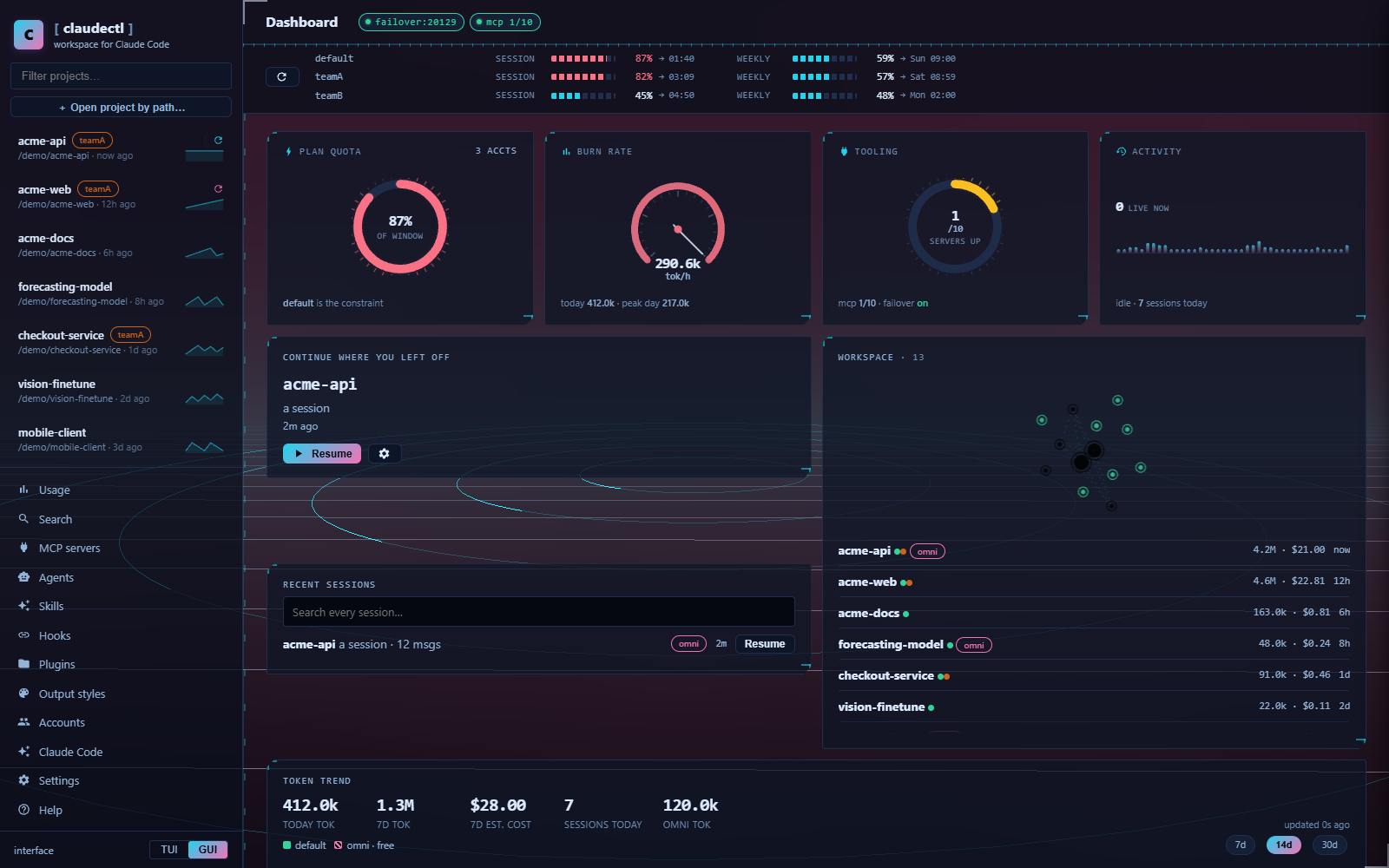
It is a terminal UI and a desktop GUI over the same engine — use whichever you prefer, they do the same things.
Quickstart
pipx install claudectl     # or: pip install claudectl
claudectl
There is nothing to build and no dependencies to install. To run it from a checkout instead:
git clone https://github.com/babarmuhammad/claudectl.git
cd claudectl
python claude-sessions.py          # terminal UI
python claude-sessions.py --gui    # desktop GUI
Requires Python 3.10+ and the
Claude Code CLI (auto-detected on
PATH or at ~/.local/bin/). No API key — it uses the Claude Code auth you
already have. No third-party packages.
It also ships as a Claude Code plugin, if you'd rather stay inside the session:
/plugin marketplace add babarmuhammad/claudectl
/plugin install claudectl@claudectl
What it looks like
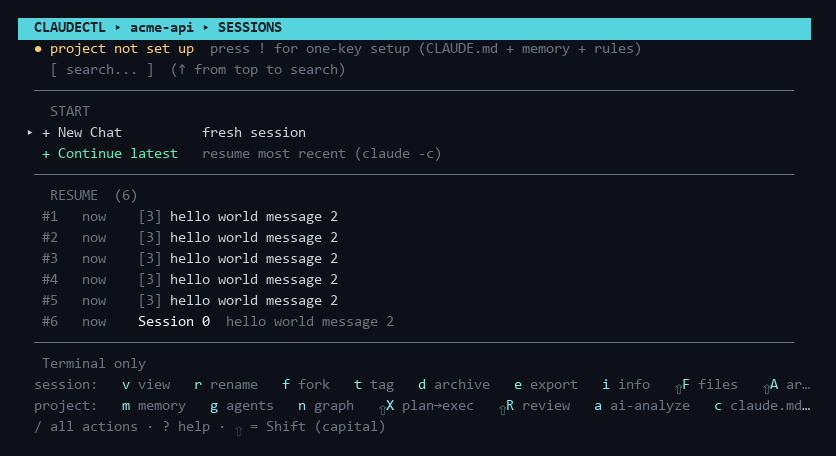
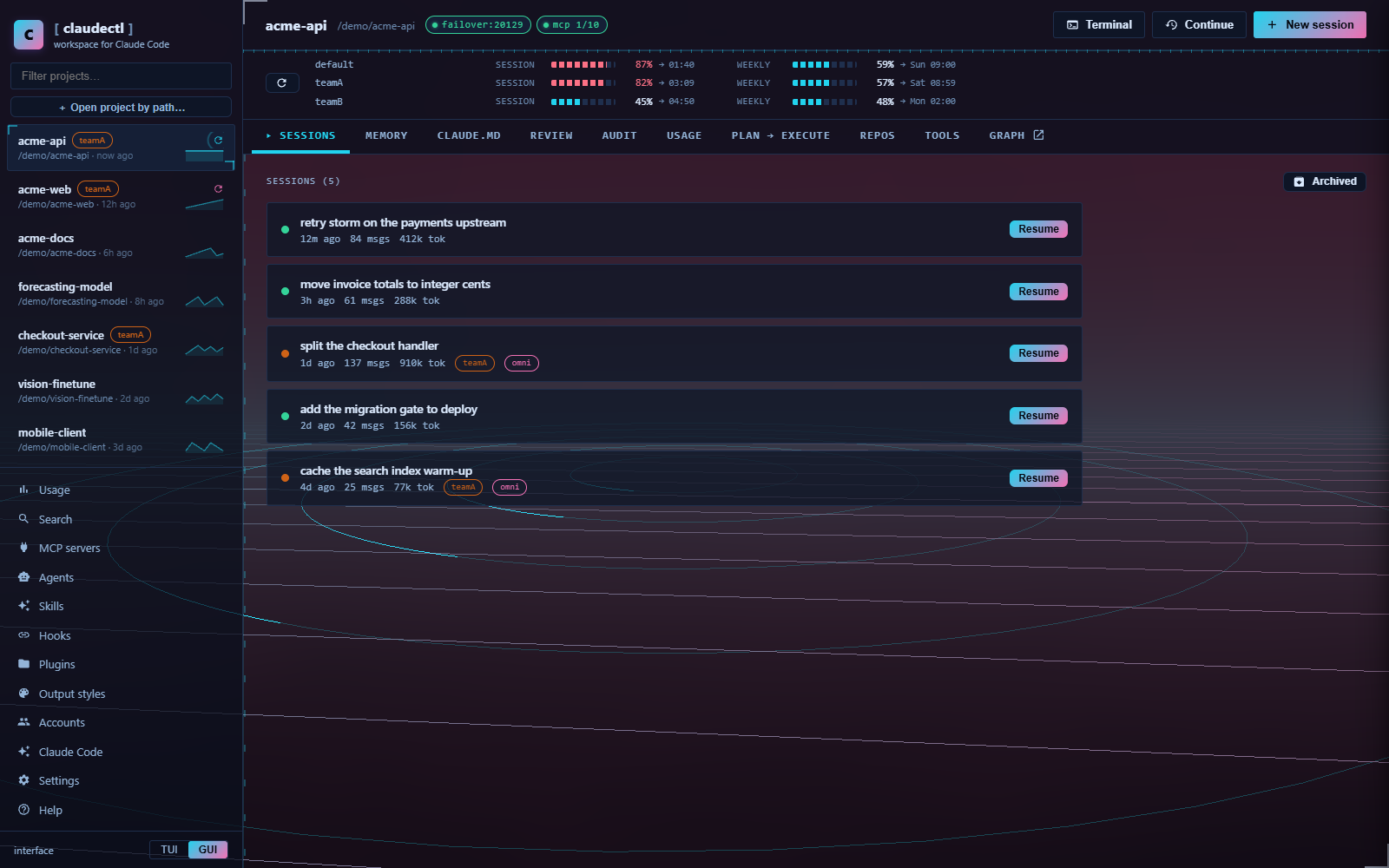 Every session, every project. Search, tag, fork, resume, archive, export — across multiple Claude accounts at once. |
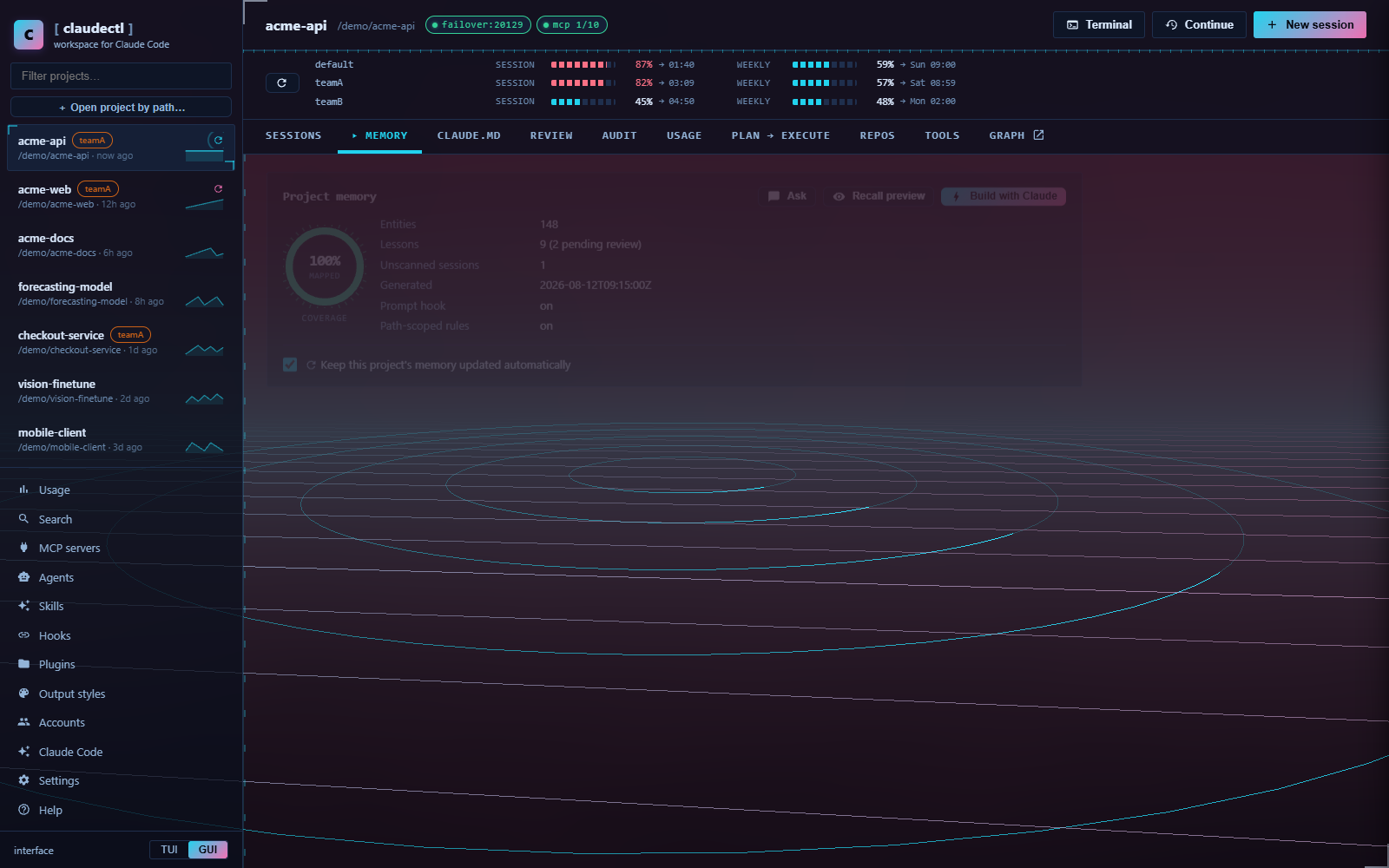 Memory Claude built about your code. Entities, relations and lessons, with the token cost of every block shown before you spend it. |
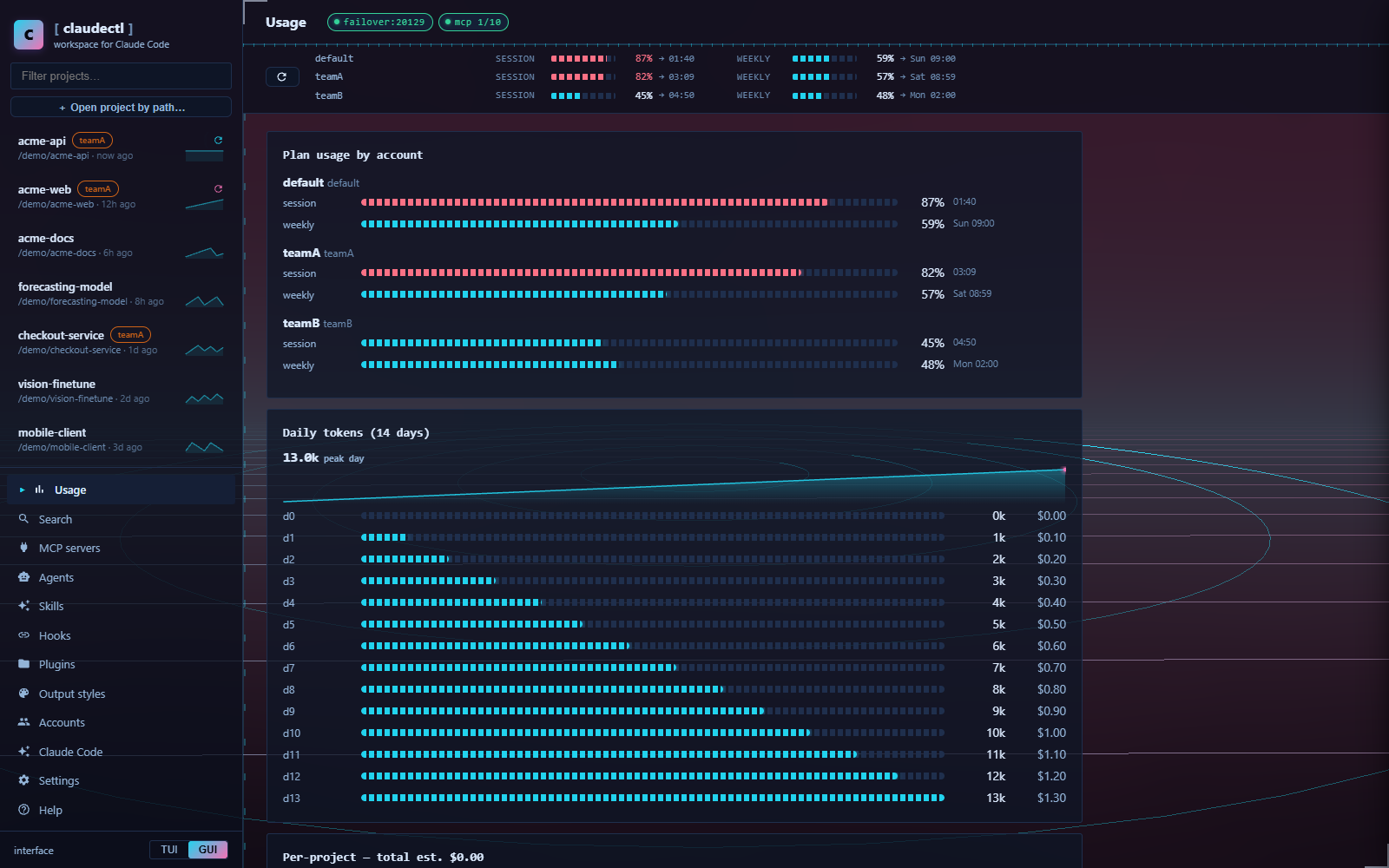 Where the tokens went. Per day, per project, per account, per model — read from your own transcripts, not an API. |
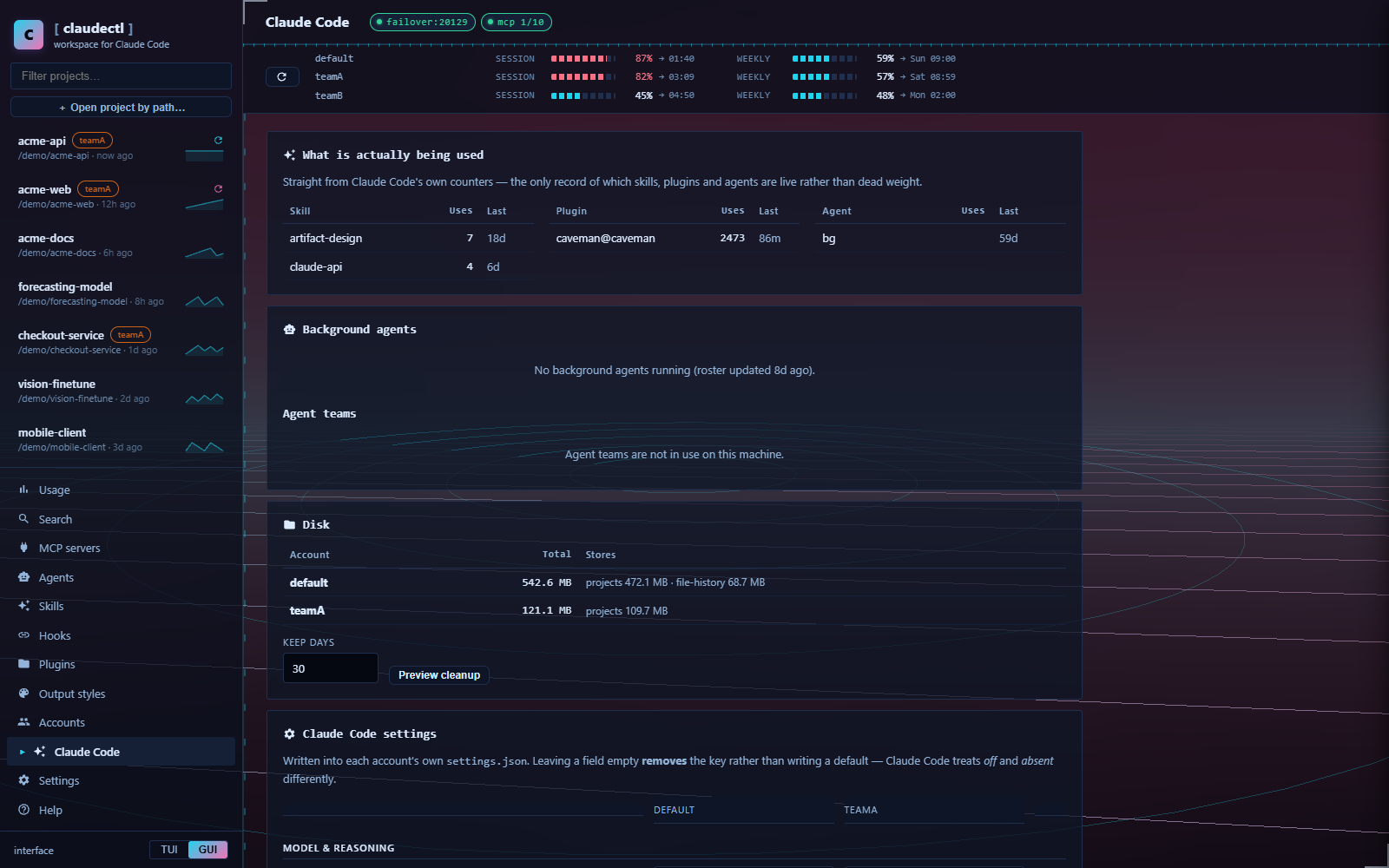 Claude Code itself, made visible. Which skills and plugins you actually use, what is on disk, and a typed editor for every account's settings. |
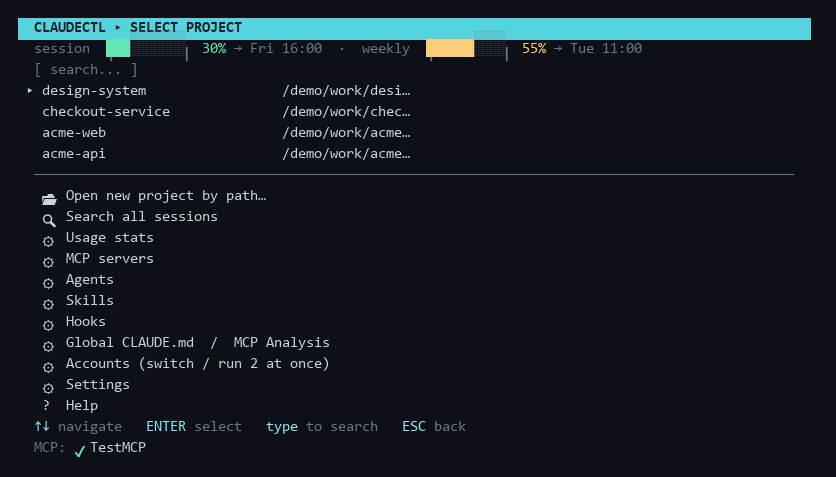
The terminal UI is the same tool, keyboard-first:
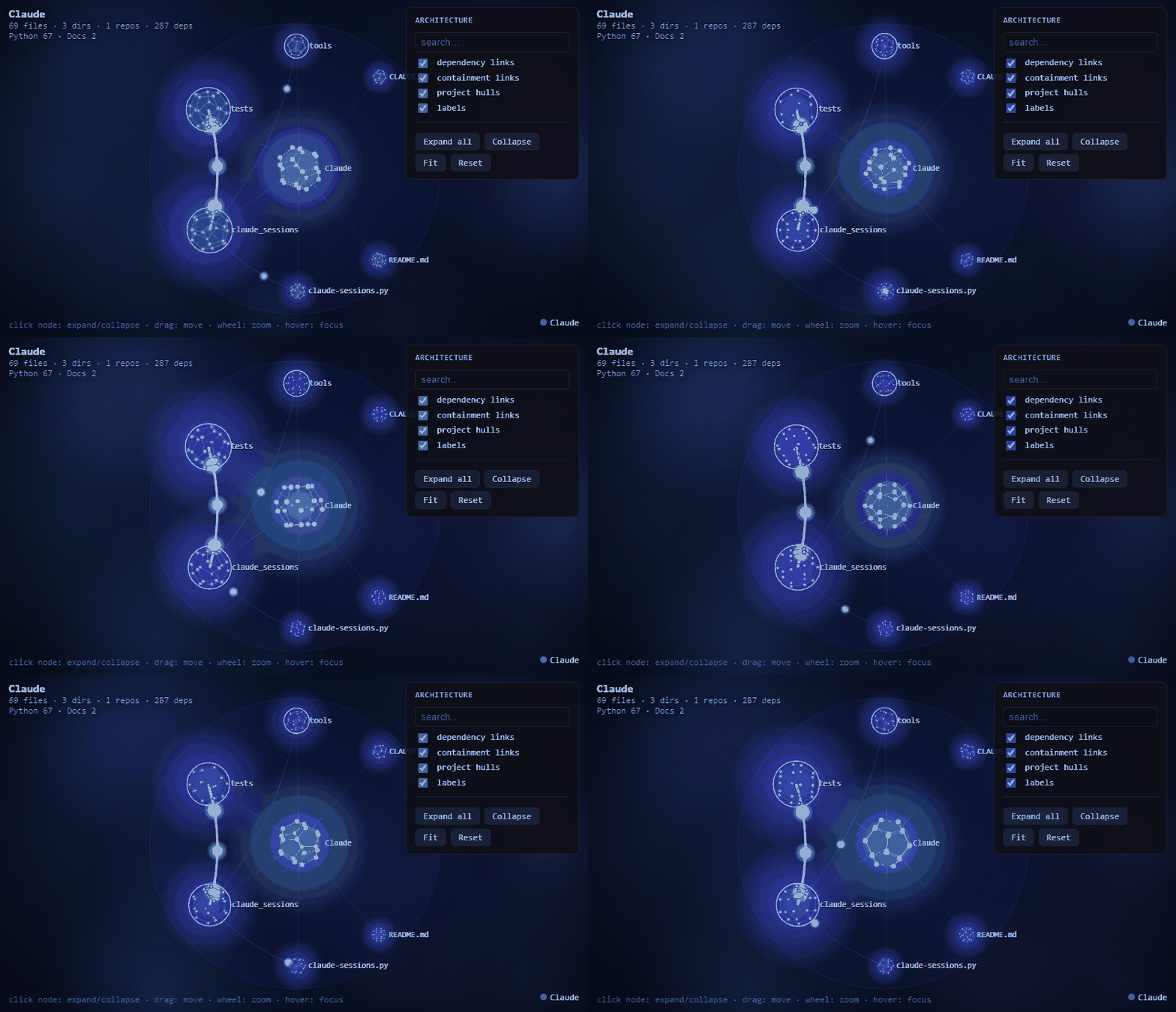
The architecture graph — every module and its dependencies,
expandable down to single files (Python · C/C++ · C# · JS/TS).
Also: 32 palettes, 8 skins and 4 themed worlds — a skin changes the shape of the app, not just its colours. See them →
Why claudectl
- 🧠 Intelligent memory, not a memory dump — task-scoped, token-budgeted injection at the launcher: a micro-index always on (≤250 tok), per-module detail loaded only when Claude touches those files, and an optional per-prompt hook that injects just the subgraph relevant to what you asked.
- 📚 It learns from every session — durable lessons (fixes, decisions, preferences) distilled from transcripts, human-reviewed, injected when relevant, decayed when stale.
- 🕸️ See your architecture — an animated, expandable dependency graph that opens at the project level and drills down to single files.
- 🩺 Auto-solves common Claude Code pain — pre-launch health checks, context-loss insurance after
/compact, permission-fatigue killer, token-burn advisor, daily usage tracking. - 🤖 Adaptive agents — the right subagents suggested (or auto-applied) per project from local signals.
- 📦 Workspace, not chats — browse, search, tag, fork, resume and archive every Claude Code session across every project and account.
- ⚡ Zero runtime dependencies — pure Python standard library; uses your existing Claude Code auth.
How claudectl saves tokens
Without claudectl, a big project either starves the agent (no context) or floods it (a huge CLAUDE.md loaded every message). claudectl spends the minimum tokens for the maximum relevant context:
- Flat always-on cost — the CLAUDE.md block is a ≤250-token index, not a full dump; it does not grow as the codebase grows.
- On-demand detail — per-module knowledge lives in path-scoped
.claude/rules/, so nothing is paid for until it's relevant. - Task-scoped injection — the optional prompt hook injects only the subgraph your prompt actually needs (budgeted, default ≤600 tok).
- No stale weight — superseded facts are invalidated, dead entities evicted.
- Cheaper model for the grunt work — Plan→Execute runs the expensive model once for the plan and a cheap (or free) one for execution.
Documentation
The full manual lives at docs.claudectl.space.
| Getting started | what it is, the three surfaces, where to go next |
| Installation | pipx, pip, checkout, plugin, GUI window, Windows shortcuts |
| Quickstart | install to first session in five minutes |
| Command line | every command, for scripts and hooks |
| Terminal UI | every screen and every key binding |
| Desktop app | the same workspace as a local app, plus the theme system |
| Configuration | every file claudectl reads and writes, and where |
| Project memory | the three injection surfaces, lessons, recall |
| Architecture graph | the interactive dependency view |
| Usage & cost | measuring and cutting the per-turn cost |
| API reference | the local HTTP API the GUI is built on |
| Troubleshooting | when something does not work |
Product pages — Features · Compare · FAQ · Download · Changelog — are on claudectl.space.
Credits
claudectl is built on ideas from the wider Claude Code ecosystem — cognee and Aider's
repo-map behind the memory graph, Anthropic's code-review plugin behind claudectl review,
claude-mem behind recent-work memory, OmniRoute behind free execution, and VoltAgent's
subagent catalog behind the agent library. Every one is credited, with links, on the
Credits page.
License
MIT — see LICENSE.
1 maintainer

Metadata
1 maintainer
Release files for claudectl 1.9.1
For a detailed explanation of source distributions (sdists) and built distributions (wheels), please see the package formats documentation.
Source distribution (sdist)
| File | Size | Uploaded | |
|---|---|---|---|
| claudectl-1.9.1.tar.gz | 1.2 MB | Details |
Built distribution (wheel)
| File | Interpreter | ABI | Platform | Reset |
|---|---|---|---|---|
| claudectl-1.9.1-py3-none-any.whl | Python 3 | none | any | Details |
Total release size: 2.2 MB
Release files / claudectl-1.9.1.tar.gz
| Download URL | claudectl-1.9.1.tar.gz |
|---|---|
| Size | 1.2 MB |
| Tags | Source |
|
SHA-256 checksum How to use checksums |
b17fca477205e9c64ee73ea13dbb865f1a30e2f295e7581ac061c1f34cf5ddfc
|
|
BLAKE2b-256 checksum How to use checksums |
595da2bc5312386b28a4ead8c5f2b32b6b0e70bfe2b8007a28e7950f51c11769
|
| Upload date | |
|
Uploaded using Trusted Publishing? What is trusted publishing? |
Yes |
| Uploaded via |
twine/7.0.0 CPython/3.13.14
|
Provenance
Provenance describes where a file came from. On PyPI, provenance is shared via attestations, which provide a verifiable record of the build or publishing details. View details, limitations and caveats.


PyPI Publish Attestation
PyPI verified that this artifact, at this checksum, originated from the publisher listed below.
Signed by GitHub Actions, verified by PyPI on Sep 8, 2026.
Transparency logRelease files / claudectl-1.9.1-py3-none-any.whl
| Download URL | claudectl-1.9.1-py3-none-any.whl |
|---|---|
| Size | 961.3 kB |
| Tags | Python 3 |
|
SHA-256 checksum How to use checksums |
cecafc48b5c30f08ce58f098667551eb643b237d85b411e09a3e9fb5b76a0cf0
|
|
BLAKE2b-256 checksum How to use checksums |
31672de8b0a41869e56dd5ee842c6daab65786ebceffdc106ffa838b49eee89d
|
| Upload date | |
|
Uploaded using Trusted Publishing? What is trusted publishing? |
Yes |
| Uploaded via |
twine/7.0.0 CPython/3.13.14
|
Provenance
Provenance describes where a file came from. On PyPI, provenance is shared via attestations, which provide a verifiable record of the build or publishing details. View details, limitations and caveats.
PyPI Publish Attestation
PyPI verified that this artifact, at this checksum, originated from the publisher listed below.
Signed by GitHub Actions, verified by PyPI on Sep 8, 2026.
Transparency log













