
cliptunnel-mcp
Operate locked-down remote machines through their clipboard — now with multi-remote support, autonomous agents, clipboard preservation, and agent heartbeat.
What it does
cliptunnel-mcp turns a shared clipboard into a reliable control channel between machines. When a remote machine sits behind a Citrix session, a locked-down VDI, or any environment that blocks SSH, file transfer, and networking but still exposes a clipboard, ClipTunnel tunnels commands through that single slot and exposes them as Model Context Protocol tools.
v0.7.0 ships the CT3 wire protocol v3 with prefixed endpoint IDs (C/R + 7 hex), announce-based discovery, multi-controller awareness, an agent heartbeat that keeps the remote roster self-healing, and clipboard preservation that restores the user's clipboard after every exchange.
The package ships four layers:
- Protocol — CT3 wire format with prefixed endpoint IDs (
C/R+ 7 hex), broadcast routing, keepalive pings, announce-based discovery, and typed messages (command, response, error, ack, ping, announce). - Endpoints —
Controller(operator side) with a remote + controller registry, and multipleAgentinstances (remote side), each with a unique prefixed ID. Both run background threads with ARQ retransmission, sequence-bound deduplication, and generation-safe lifecycle. - MCP server — a FastMCP application with 26 tools including shell, filesystem, binary transfer, sysinfo, remote agent management, connection listing, and announce-based discovery.
- Clipboard transport — backed by clipboard-event for cross-platform event-driven change detection, with user-clipboard preservation (non-protocol content is backed up and restored after each exchange).
Architecture
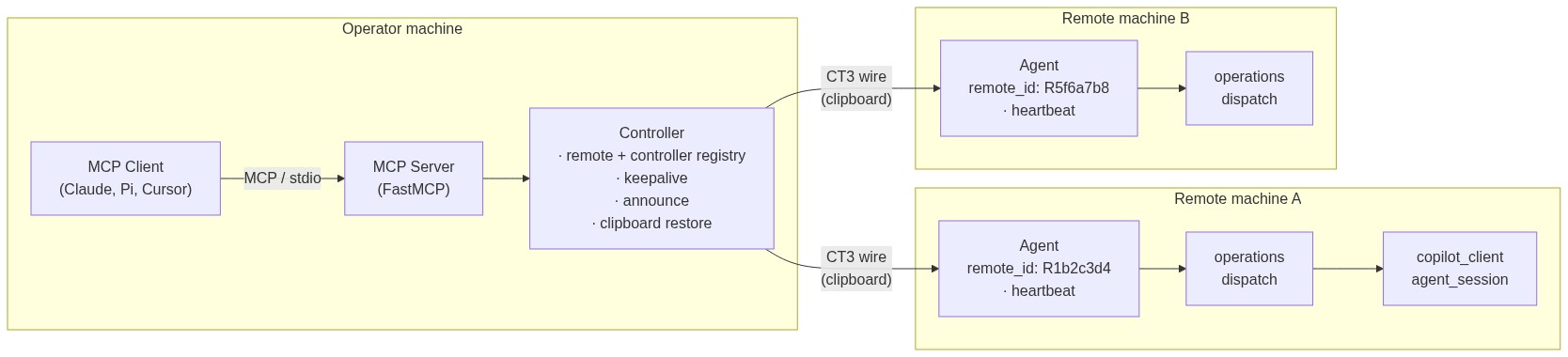
On startup the Controller broadcasts an ANNOUNCE. Each Agent generates a random prefixed ID (R + 7 hex), waits a random delay (0.1–4.0s), and sends back its sysinfo as a registration response. The Controller maintains a registry of all connected remotes and any other controllers it discovers. A keepalive thread pings remotes after 5 minutes of inactivity and marks them dead if no response is received within 30 seconds. Each Agent additionally runs a heartbeat thread that periodically re-sends its registration, so a lost announce response never leaves an agent invisible. After every exchange the Controller restores the user's clipboard content that was present before the protocol traffic.
Wire format
CT3|<from>|<to>|<seq>|<type>|<payload>
| Field | Value |
|---|---|
CT3 |
Protocol signature + version |
from |
C + 7 hex (Controller) or R + 7 hex (remote ID, e.g. R1b2c3d4) |
to |
C + 7 hex (Controller), * (broadcast), or R + 7 hex (specific remote) |
seq |
Positive integer, monotonic per session (0 = registration/heartbeat) |
type |
C (command), R (response), E (error), A (ack), P (ping), N (announce) |
payload |
Base64-encoded UTF-8 |
Registration and announce flow
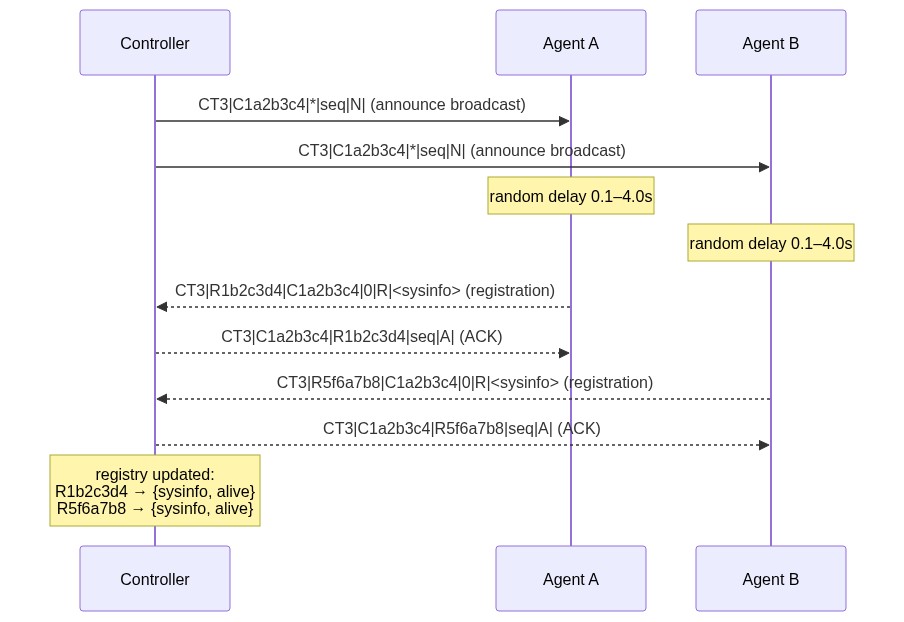
Because the clipboard is a single last-writer-wins slot, simultaneous announce responses can collide and one agent's registration may be lost. The heartbeat below makes this self-healing: the missing agent re-registers on the next cycle.
Heartbeat
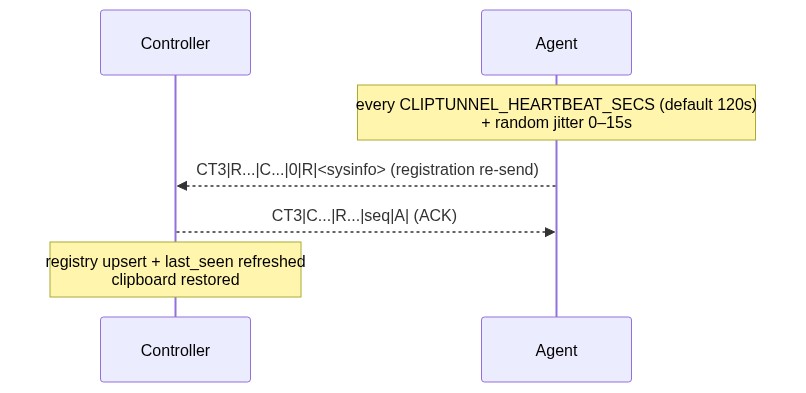
Each Agent runs a daemon thread that re-sends its registration (a RESPONSE with seq=0 carrying sysinfo) to every known controller on a configurable interval plus jitter. The jitter prevents multiple agents sharing a clipboard from synchronizing their writes. A lost heartbeat is harmless — the next one arrives. The controller's existing registration upsert path consumes it with no protocol or controller changes.
| Setting | Default | Effect |
|---|---|---|
CLIPTUNNEL_HEARTBEAT_SECS env var |
120 |
Interval in seconds. <= 0 disables the heartbeat. |
Agent(heartbeat_secs=...) |
None (resolves env, then default) |
Programmatic override of the env var. |
Keepalive
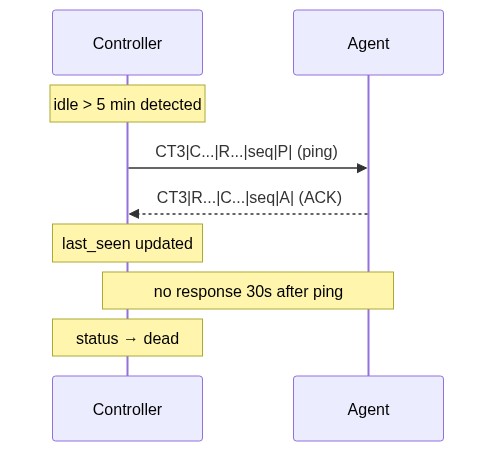
With the heartbeat active, the keepalive loop stays mostly idle — it only pings remotes that have stopped heartbeating, and is what ultimately marks a silent agent dead.
Clipboard preservation
The clipboard is the user's real pasteboard, so every protocol write would clobber whatever the user copied. ClipTunnel now preserves it:
- Backup — the transport observes every clipboard change. Any non-empty value that is not CT3 protocol traffic (
CT3|…) is retained as the user-clipboard candidate. The backup is also seeded at construction from the initial value, so a startup announce never destroys pre-existing content. - Guarded restore — after the Controller sends the final ACK of an exchange, it calls
transport.restore_user_clipboard(). The restore happens only if the OS clipboard still holds this process's last self-write; if another process or the user wrote anything in between, the restore is a silent no-op (it would otherwise clobber that content). On success the backup is written back as a self-write.
This makes the heartbeat and the restore synergistic: a racy restore that clobbers an in-flight message is cured by the next heartbeat, and the user's clipboard survives the protocol traffic.
Installation
pip install cliptunnel-mcp          # core + cliptunnel-agent binary
pip install cliptunnel-mcp[server]  # adds MCP server binary (mcp>=1.2,<2)
Dependencies: clipboard-event>=0.2.0 (cross-platform clipboard change notifications).
| Binary | Extra needed | Purpose |
|---|---|---|
cliptunnel-agent |
(none) | Runs the Agent on the local OS clipboard. |
cliptunnel-mcp |
[server] |
Runs the MCP server over stdio. |
Quick start
Agent (remote machine)
cliptunnel-agent
Antivirus / EDR workaround (Windows): unsigned
.exeentry points may be quarantined. Usepython -minstead:python -m cliptunnel_mcp.agent # instead of cliptunnel-agent python -m cliptunnel_mcp.server # instead of cliptunnel-mcp
The Agent generates a random prefixed ID, registers with the Controller by sending its sysinfo, then watches the clipboard for commands. It uses clipboard-event for change detection (event-driven on Windows and Wayland, polling on macOS and X11). A heartbeat thread re-registers every CLIPTUNNEL_HEARTBEAT_SECS (default 120s) so the Controller never loses it; set the variable to 0 or a negative value to disable it.
Controller + MCP server (operator machine)
Configure your MCP client (Claude Desktop, Cursor, Pi, etc.):
{
  "mcpServers": {
    "cliptunnel": {
      "command": "cliptunnel-mcp",
      "args": []
    }
  }
}
The server broadcasts an announce on startup, discovers connected remotes and any other controllers, and maintains a live registry with keepalive pings. After every exchange it restores the user's clipboard content.
Controller only (no MCP)
from cliptunnel_mcp.clipboard_transport import ClipboardTransport
from cliptunnel_mcp import Controller
import json

controller = Controller(transport=ClipboardTransport())

# Send to a specific remote
future = controller.send_command(json.dumps({"op": "shell", "cmd": "whoami"}), remote_id="R1b2c3d4")
result = future.result(timeout=30)

# List connected remotes
connections = controller.get_connections()
# {"remotes": {"R1b2c3d4": {"os": "Windows", "status": "alive", "last_seen": 1692634123.4, "last_seen_ago": 0.3, ...}}, "controllers": {...}}
Programmatic Agent
from cliptunnel_mcp.clipboard_transport import ClipboardTransport
from cliptunnel_mcp import Agent
from cliptunnel_mcp.operations import dispatch

agent = Agent(transport=ClipboardTransport(), handler=dispatch)
# Agent generates its own remote_id, registers automatically, and heartbeats every 120s.
# Disable the heartbeat with heartbeat_secs=0 (or CLIPTUNNEL_HEARTBEAT_SECS=0).
MCP tools
The server exposes 26 tools over stdio. All tools accept an optional remote_id parameter to target a specific remote. If omitted, the Controller picks the first alive remote.
Shell & filesystem
| Tool | Description |
|---|---|
remote_shell |
Execute a shell command; auto-sync (10s) then async with job_id polling. |
remote_shell_result |
Poll for the result of an async shell command. |
remote_fs_read |
Read a file. |
remote_fs_write |
Create or overwrite a file (creates parent dirs). |
remote_fs_list |
List directory entries. |
remote_fs_delete |
Delete a file. |
remote_fs_replace |
Search-and-replace in a file (exact-once match). |
remote_fs_search |
Regex search in a file. |
remote_fs_find |
Glob-find files under a directory. |
remote_fs_bin_read |
Read a binary file as base64. |
remote_fs_bin_write |
Write base64 content to a binary file. |
Binary transfer
| Tool | Description |
|---|---|
remote_upload |
Upload a local file to a remote machine. |
remote_download |
Download a remote file to the local machine. |
System info
| Tool | Description |
|---|---|
remote_sysinfo |
Return system info: OS, Python, CPU, memory, disk, user, shell, agent auth, clipboard backend. |
Remote agent (Copilot)
| Tool | Description |
|---|---|
remote_agent_login |
Start GitHub OAuth device flow for Copilot authentication. |
remote_agent_login_status |
Poll login state (idle/polling/done/error). |
remote_agent_models |
List available Copilot models on the remote. |
remote_agent_start |
Create an autonomous agent session (async). |
remote_agent_continue |
Send a message to an existing session. |
remote_agent_result |
Poll for the async result. |
remote_agent_status |
Query session status. |
remote_agent_list |
List active agent sessions. |
remote_agent_clear |
Clear session message history. |
remote_agent_end |
Destroy a session. |
Connections & discovery
| Tool | Description |
|---|---|
remote_connections |
List all connected remotes and controllers with sysinfo, last_seen (epoch), last_seen_ago (seconds), and status (alive/dead). |
remote_discovery |
Broadcast an ANNOUNCE to discover remotes and other controllers on the shared clipboard. |
Operations
The dispatch handler supports these operations:
| Operation | Parameters | Returns |
|---|---|---|
shell |
cmd |
JSON: {stdout, stderr, returncode} |
fs.read |
path |
JSON: {content, lines} |
fs.write |
path, content |
wrote N bytes to PATH |
fs.list |
path |
JSON: [{name, size, is_dir}] |
fs.delete |
path |
deleted PATH |
fs.replace |
path, old, new |
replaced 1 occurrence (exact-once) |
fs.search |
path, pattern |
JSON: [{line, content}] (regex) |
fs.find |
path, pattern |
JSON: [PATH, ...] (glob) |
fs.bin_read |
path |
JSON: {path, size, b64} |
fs.bin_write |
path, b64 |
wrote N bytes to PATH |
sysinfo |
— | JSON: full system info |
register |
— | JSON: sysinfo (alias for agent registration) |
agent |
action, ... |
JSON: session management (start, continue, result, status, clear, end, list, login, login_status) |
Remote agent
The Agent can run autonomous Copilot-powered agents on the remote machine. Each agent session:
- Uses the GitHub Copilot API with function calling (shell, fs_read, fs_write, fs_replace, fs_search, fs_list, fs_find)
- Runs asynchronously in a background thread
- Supports multi-turn conversations with
remote_agent_continue - Default model:
mai-code-1.1-flash
Authentication
# Via MCP tools:
remote_agent_login()          # Returns user_code + verification_uri
# Open https://github.com/login/device, enter the code
remote_agent_login_status()   # Returns {status: "done", token_saved: true}
Token stored in .copilot_agent_token on the remote machine. The token lookup is relative to the agent process working directory, so launch the agent from a directory that contains (or can access) the token file.
API surface
Controller
The operator-side endpoint with remote + controller registry, keepalive, and clipboard restore.
| Method | Description |
|---|---|
send_command(command, remote_id=None) -> Future |
Queue a command to a specific remote (or first alive). |
send_command_sync(command, remote_id=None) -> str | None |
Send and block until response or timeout. |
get_connections() -> dict |
Return {"remotes": {...}, "controllers": {...}} with sysinfo, last_seen, last_seen_ago, and status. |
close() |
Stop background threads. Idempotent. |
Agent
The remote-side endpoint with auto-registration, heartbeat, and ping handling.
| Method | Description |
|---|---|
close() |
Stop this agent (heartbeat, reader, dispatcher, pool). Idempotent. |
send_registration(controller_id=None) |
Send sysinfo to a controller (or all known controllers). Also used by the heartbeat. |
Constructor parameters: transport (required), handler (required), poll_interval, max_workers, response_ack_timeout, heartbeat_secs (default None → resolves CLIPTUNNEL_HEARTBEAT_SECS, then 120; <= 0 disables).
ClipboardTransport
| Method | Description |
|---|---|
read() -> str | None |
Return the current clipboard value (cached). |
write(text: str) |
Write to the clipboard as a self-write. |
restore_user_clipboard() -> bool |
Guarded restore of the backed-up user content; True on success, False if the slot was touched by another writer or no backup exists. |
Protocol primitives
| Symbol | Description |
|---|---|
pack(msg) -> str |
Serialize a Message into wire format. |
unpack(raw) -> Message | None |
Parse a wire string; None on malformed. |
validate(raw, my_id) -> bool |
True if addressed to my_id (C/R + 7 hex) or broadcast. |
generate_controller_id() -> str |
Generate C + 7 hex. |
generate_remote_id() -> str |
Generate R + 7 hex. |
Message |
Dataclass: frm, to, seq, mtype, payload. |
MsgType |
Enum: COMMAND, RESPONSE, ERROR, ACK, PING, ANNOUNCE. |
SeqTracker |
Per-seq dedupe state: new → processing → done. |
Clipboard backend
ClipTunnel uses clipboard-event for cross-platform clipboard access and change detection:
| Platform | Backend | Change detection | Latency |
|---|---|---|---|
| macOS | NSPasteboard changeCount |
Polling (50ms) | ~50ms |
| Windows | WM_CLIPBOARD_UPDATE |
Event-driven | Sub-ms |
| Linux / Wayland | wl-paste --watch |
Event-driven | Sub-ms |
| Linux / X11 | xclip/xsel |
Polling (100ms) | ~100ms |
The ClipboardTransport adapts clipboard-event to the Transport and RevisionMonitor protocols, backs up non-protocol clipboard content, and guards restores against concurrent writers. For custom setups, implement the Transport protocol directly.
Platform support
| Platform | Status | Clipboard | CI |
|---|---|---|---|
| macOS | Tested | clipboard-event (changeCount) | macOS + Linux + Windows × Python 3.10–3.14 |
| Windows | Tested | clipboard-event (WM_CLIPBOARD_UPDATE) | Same |
| Linux / Wayland | Tested | clipboard-event (wl-paste --watch) | Same |
| Linux / X11 | Core works | clipboard-event (xclip polling) | Same |
Development
# Create a virtual environment
uv venv && source .venv/bin/activate

# Install in development mode
uv pip install -e . pytest

# Run the test suite (275 tests)
python -m pytest -q
# or
python -m unittest discover -s tests -t .

# Bare mode — no install, just PYTHONPATH
PYTHONPATH=src:. python -m pytest -q
The test suite uses a deterministic ClipboardSlot test double. No clipboard hardware needed.
Lifecycle and coalescing semantics
- One command at a time: the Controller dispatches commands serially per target remote.
- Immediate ACK: the Agent ACKs every command before processing.
- One response at a time: the Agent holds one pending response; retransmits until the Controller's ACK.
- Announce discovery: the Controller broadcasts an ANNOUNCE on startup and on
remote_discovery; agents and other controllers reply. Replies can collide on the shared slot; the heartbeat makes this self-healing. - Heartbeat: each Agent re-sends its registration every
CLIPTUNNEL_HEARTBEAT_SECS(default 120s) + jitter (0–15s);<= 0disables. The controller upserts the roster on every heartbeat. - Keepalive: Controller pings remotes after 5 min idle, marks dead if no response within 30s. With the heartbeat active, this only fires for agents that have stopped heartbeating.
- Clipboard preservation: the transport backs up non-CT3 clipboard content; the Controller restores it (guarded) after the final ACK of every exchange.
- Broadcast routing:
to=*messages are processed by all remotes with random backoff; no ACK. - Targeted routing:
to=<R+7hex>messages are processed only by that remote; others ignore. - Stale message guard: the Controller skips R/E with
seq <= min_seq. - Generation-safe: closing and restarting never strands threads.
- Paced writes: bounded inter-write gap prevents message loss.
Limitations
- Text-only clipboard: the protocol carries UTF-8 strings, and the preservation backup is text-only. Binary files are base64-encoded; rich content (images, RTF) copied by the user is not preserved by the restore.
- Shared slot: multiple remotes and controllers share one clipboard; the protocol serializes all traffic, and announce responses can race (mitigated by the heartbeat).
- No encryption: the wire format is plain base64.
- Multi-controller: multiple controllers are discovered and tracked, but they share the single clipboard channel — the protocol is designed for one primary Controller and multiple Agents.
- CT3-looking user content: if the user copies a string starting with
CT3|, it is treated as protocol traffic and not backed up.
License
MIT — see LICENSE.
1 maintainer

Download files
Download the file for your platform. If you're not sure which to choose, learn more about installing packages.
Source Distribution
Built Distribution
Filter files by name, interpreter, ABI, and platform.
If you're not sure about the file name format, learn more about wheel file names.
Copy a direct link to the current filters
File details
Details for the file cliptunnel_mcp-0.7.0.tar.gz.
File metadata
- Download URL: cliptunnel_mcp-0.7.0.tar.gz
- Upload date:
- Size: 76.6 kB
- Tags: Source
- Uploaded using Trusted Publishing? Yes
- Uploaded via:
twine/7.0.0 CPython/3.13.14
File hashes
| Algorithm | Hash digest | |
|---|---|---|
| SHA256 |
c4a9f73c8764271e37ae575723c609c989588e242e577a83eba7e731c148a91c
|
|
| MD5 |
31f73ccaa8ea29d875fc4beded566f5e
|
|
| BLAKE2b-256 |
a6890ddf754e4cc60e8f317a41ba0d88440ddb1299d4d417a2048e17e3774d6b
|
Provenance
The following attestation bundles were made for cliptunnel_mcp-0.7.0.tar.gz:
Publisher:
publish.yml on jordi-murgo/cliptunnel-mcp
-
Statement:
-
Statement type:
https://in-toto.io/Statement/v1 -
Predicate type:
https://docs.pypi.org/attestations/publish/v1 -
Subject name:
cliptunnel_mcp-0.7.0.tar.gz -
Subject digest:
c4a9f73c8764271e37ae575723c609c989588e242e577a83eba7e731c148a91c - Sigstore transparency entry: 2567875044
- Sigstore integration time:
-
Permalink:
jordi-murgo/cliptunnel-mcp@70dcf447f3bc26b5a769d569215e453e4eeb11a1 -
Branch / Tag:
refs/tags/v0.7.0 - Owner: https://github.com/jordi-murgo
-
Access:
public
-
Token Issuer:
https://token.actions.githubusercontent.com -
Runner Environment:
github-hosted -
Publication workflow:
publish.yml@70dcf447f3bc26b5a769d569215e453e4eeb11a1 -
Trigger Event:
release
-
Statement type:
File details
Details for the file cliptunnel_mcp-0.7.0-py3-none-any.whl.
File metadata
- Download URL: cliptunnel_mcp-0.7.0-py3-none-any.whl
- Upload date:
- Size: 52.5 kB
- Tags: Python 3
- Uploaded using Trusted Publishing? Yes
- Uploaded via:
twine/7.0.0 CPython/3.13.14
File hashes
| Algorithm | Hash digest | |
|---|---|---|
| SHA256 |
a490e3a55b986fb7b6494793cc51a4972e05c166e2b8508a4b59a059908d7630
|
|
| MD5 |
c6e31a5f520fb0a395c0cdba984dd146
|
|
| BLAKE2b-256 |
9aecb8534ac6b22571f742b27361e1aa59ba36046eece656cae194fba6736199
|
Provenance
The following attestation bundles were made for cliptunnel_mcp-0.7.0-py3-none-any.whl:
Publisher:
publish.yml on jordi-murgo/cliptunnel-mcp
-
Statement:
-
Statement type:
https://in-toto.io/Statement/v1 -
Predicate type:
https://docs.pypi.org/attestations/publish/v1 -
Subject name:
cliptunnel_mcp-0.7.0-py3-none-any.whl -
Subject digest:
a490e3a55b986fb7b6494793cc51a4972e05c166e2b8508a4b59a059908d7630 - Sigstore transparency entry: 2567875065
- Sigstore integration time:
-
Permalink:
jordi-murgo/cliptunnel-mcp@70dcf447f3bc26b5a769d569215e453e4eeb11a1 -
Branch / Tag:
refs/tags/v0.7.0 - Owner: https://github.com/jordi-murgo
-
Access:
public
-
Token Issuer:
https://token.actions.githubusercontent.com -
Runner Environment:
github-hosted -
Publication workflow:
publish.yml@70dcf447f3bc26b5a769d569215e453e4eeb11a1 -
Trigger Event:
release
-
Statement type:














