
Stealth Chromium that passes every bot detection test. Drop-in Playwright replacement with source-level fingerprint patches.

Project description






Stealth Chromium that passes every bot detection test.
| Not a patched config. Not a JS injection. A real Chromium binary with fingerprints modified at the C++ source level. Antibot systems score it as a normal browser — because it is a normal browser. |
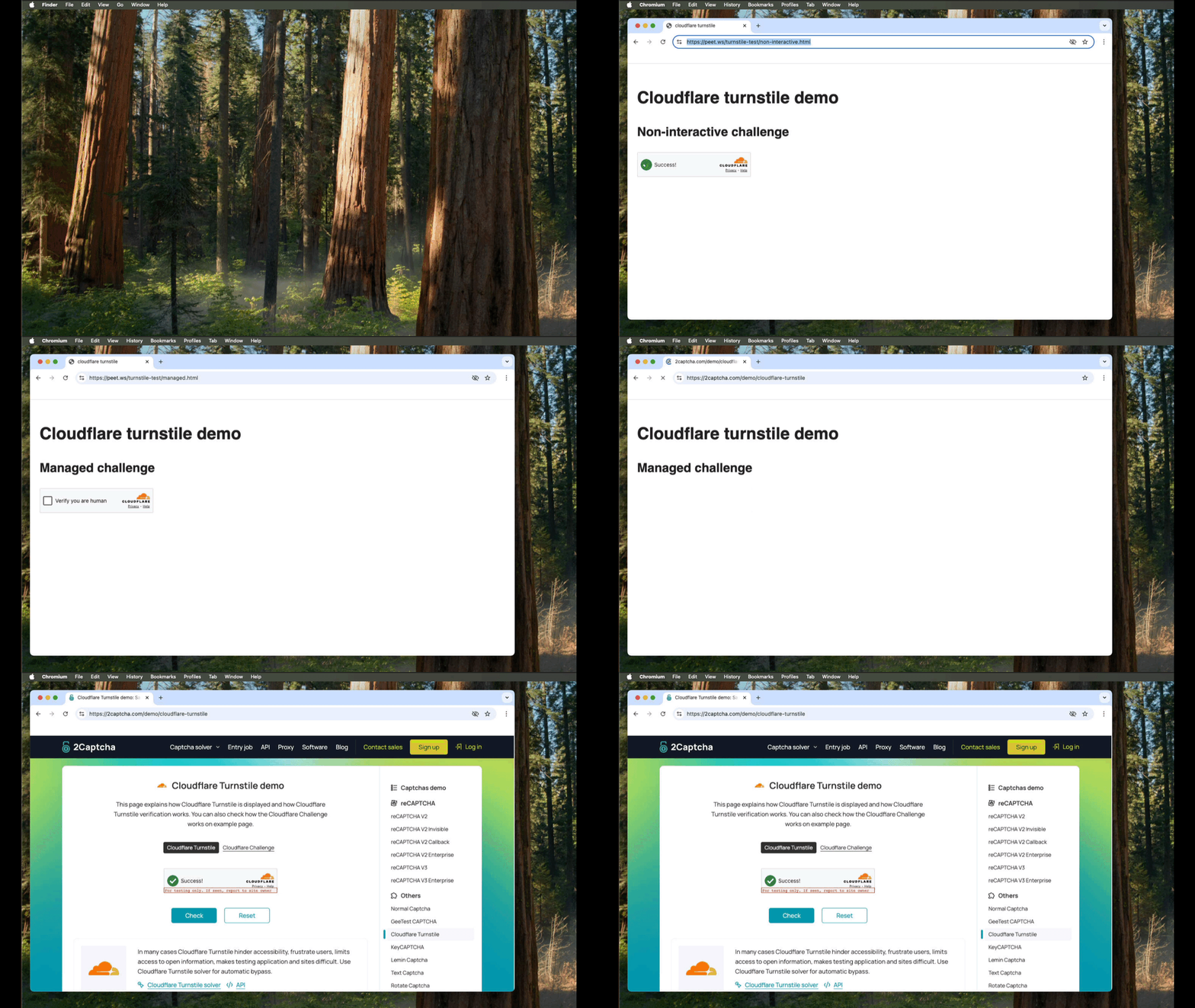
Cloudflare Turnstile — 3 live tests passing (headed mode, macOS)
Drop-in Playwright/Puppeteer replacement for Python and JavaScript.
Same API, same code — just swap the import. 3 lines of code, 30 seconds to unblock.
- 26 source-level C++ patches — canvas, WebGL, audio, fonts, GPU, screen, automation signals
- 0.9 reCAPTCHA v3 score — human-level, server-verified
- Passes Cloudflare Turnstile, FingerprintJS, BrowserScan — tested against 30+ detection sites
- Auto-updating binary — background update checks, always on the latest stealth build
pip install cloakbrowserornpm install cloakbrowser— binary auto-downloads, zero config- Free and open source — no subscriptions, no usage limits
Try it now — no install needed:
docker run --rm cloakhq/cloakbrowser cloaktest
Python:
from cloakbrowser import launch

browser = launch()
page = browser.new_page()
page.goto("https://protected-site.com")  # no more blocks
browser.close()
JavaScript (Playwright):
import { launch } from 'cloakbrowser';

const browser = await launch();
const page = await browser.newPage();
await page.goto('https://protected-site.com');
await browser.close();
Also works with Puppeteer: import { launch } from 'cloakbrowser/puppeteer' (details)
Install
Python:
pip install cloakbrowser
JavaScript / Node.js:
# With Playwright
npm install cloakbrowser playwright-core

# With Puppeteer
npm install cloakbrowser puppeteer-core
On first run, the stealth Chromium binary is automatically downloaded (~200MB, cached locally).
Optional: Auto-detect timezone/locale from proxy IP:
pip install cloakbrowser[geoip]
Migrating from Playwright? One-line change:
- from playwright.sync_api import sync_playwright
- pw = sync_playwright().start()
- browser = pw.chromium.launch()
+ from cloakbrowser import launch
+ browser = launch()

page = browser.new_page()
page.goto("https://example.com")
# ... rest of your code works unchanged
⭐ Star to show support — Watch releases to get notified when new builds drop.
Latest: v0.3.5 (Chromium 145.0.7632.109)
- All 4 platforms — Linux x64, macOS arm64, macOS x64, and Windows x64 all on Chromium 145
- 26 fingerprint patches — 10 new patches since v142 (screen, device memory, audio, WebGL, auto-spoof, and more)
- Stealthy with zero flags — binary auto-generates a random fingerprint seed at startup. No configuration required
- Full stealth audit — every patch reviewed for detection vectors, multiple fixes shipped
- CDP hardening — audited and patched known automation detection vectors
- Timezone & locale from proxy IP —
launch(proxy="...", geoip=True)auto-detects timezone and locale - Playwright + Puppeteer from one package —
import from 'cloakbrowser'orimport from 'cloakbrowser/puppeteer'. Same binary, your choice of API - Persistent profiles —
launch_persistent_context()keeps cookies and localStorage across sessions, bypasses incognito detection
See the full CHANGELOG.md for details.
Why CloakBrowser?
- Config-level patches break —
playwright-stealth,undetected-chromedriver, andpuppeteer-extrainject JavaScript or tweak flags. Every Chrome update breaks them. Antibot systems detect the patches themselves. - CloakBrowser patches Chromium source code — fingerprints are modified at the C++ level, compiled into the binary. Detection sites see a real browser because it is a real browser.
- Two layers of stealth — C++ patches handle fingerprints (GPU, screen, UA, hardware reporting), while the Patchright driver defers Playwright's binding registration and randomizes internal world names. Most stealth tools only do one or the other.
- Same behavior everywhere — works identically local, in Docker, and on VPS. No environment-specific patches or config needed.
- Works with any browser automation framework — tested and passing stealth checks with Playwright, Puppeteer, Selenium, undetected-chromedriver, browser-use, Crawl4AI, and agent-browser. Just point any Chromium-based framework at the binary path.
CloakBrowser doesn't solve CAPTCHAs — it prevents them from appearing. No CAPTCHA-solving services, no proxy rotation built in — bring your own proxies, use the Playwright API you already know.
Test Results
All tests verified against live detection services. Last tested: Mar 2026 (Chromium 145).
| Detection Service | Stock Playwright | CloakBrowser | Notes |
|---|---|---|---|
| reCAPTCHA v3 | 0.1 (bot) | 0.9 (human) | Server-side verified |
| Cloudflare Turnstile (non-interactive) | FAIL | PASS | Auto-resolve |
| Cloudflare Turnstile (managed) | FAIL | PASS | Single click |
| ShieldSquare | BLOCKED | PASS | Production site |
| FingerprintJS bot detection | DETECTED | PASS | demo.fingerprint.com |
| BrowserScan bot detection | DETECTED | NORMAL (4/4) | browserscan.net |
| bot.incolumitas.com | 13 fails | 1 fail | WEBDRIVER spec only |
| deviceandbrowserinfo.com | 6 true flags | 0 true flags | isBot: false |
navigator.webdriver |
true |
false |
Source-level patch |
navigator.plugins.length |
0 | 5 | Real plugin list |
window.chrome |
undefined |
object |
Present like real Chrome |
| UA string | HeadlessChrome |
Chrome/145.0.0.0 |
No headless leak |
| CDP detection | Detected | Not detected | isAutomatedWithCDP: false |
| TLS fingerprint | Mismatch | Identical to Chrome | ja3n/ja4/akamai match |
| Tested against 30+ detection sites |
Proof
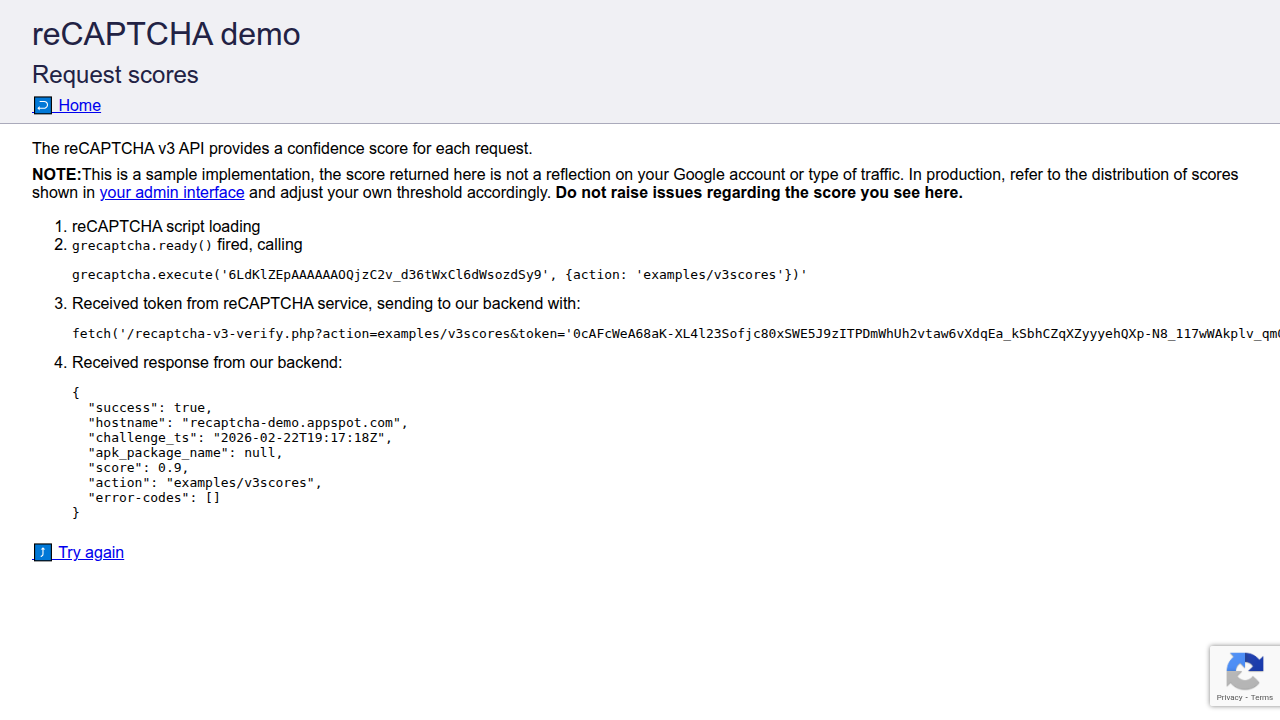
reCAPTCHA v3 score 0.9 — server-side verified (human-level)
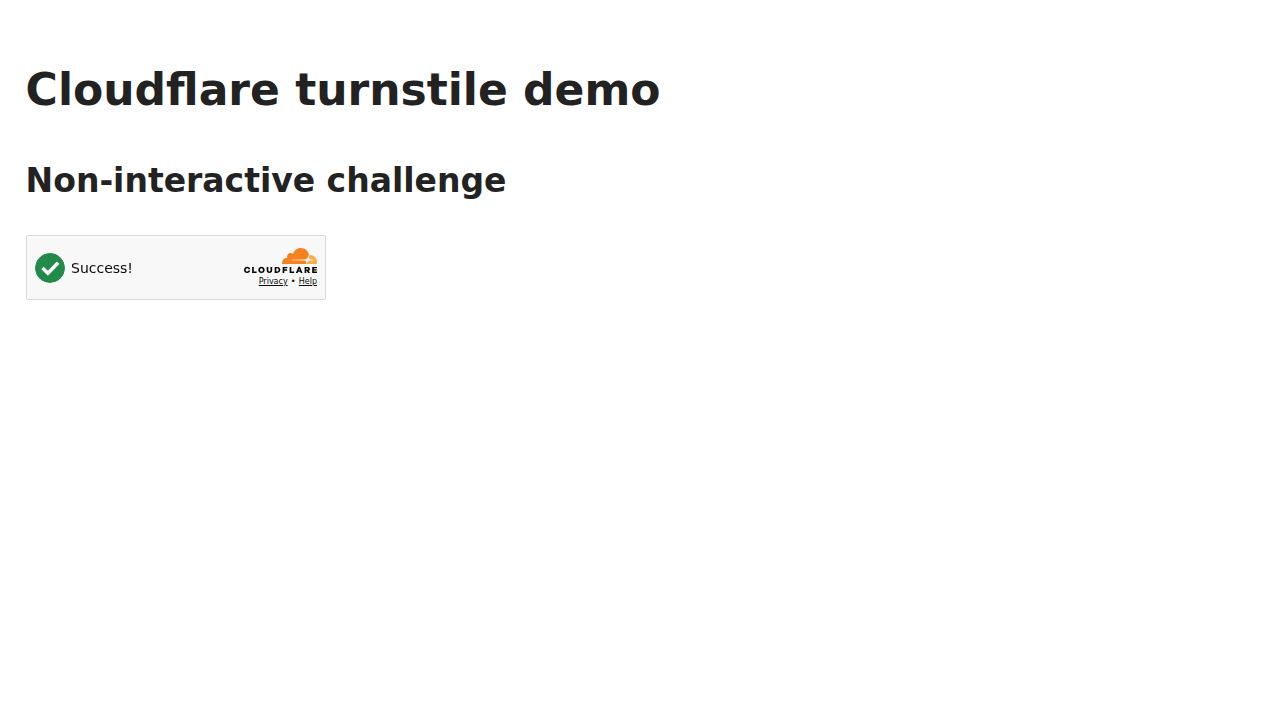
Cloudflare Turnstile non-interactive challenge — auto-resolved
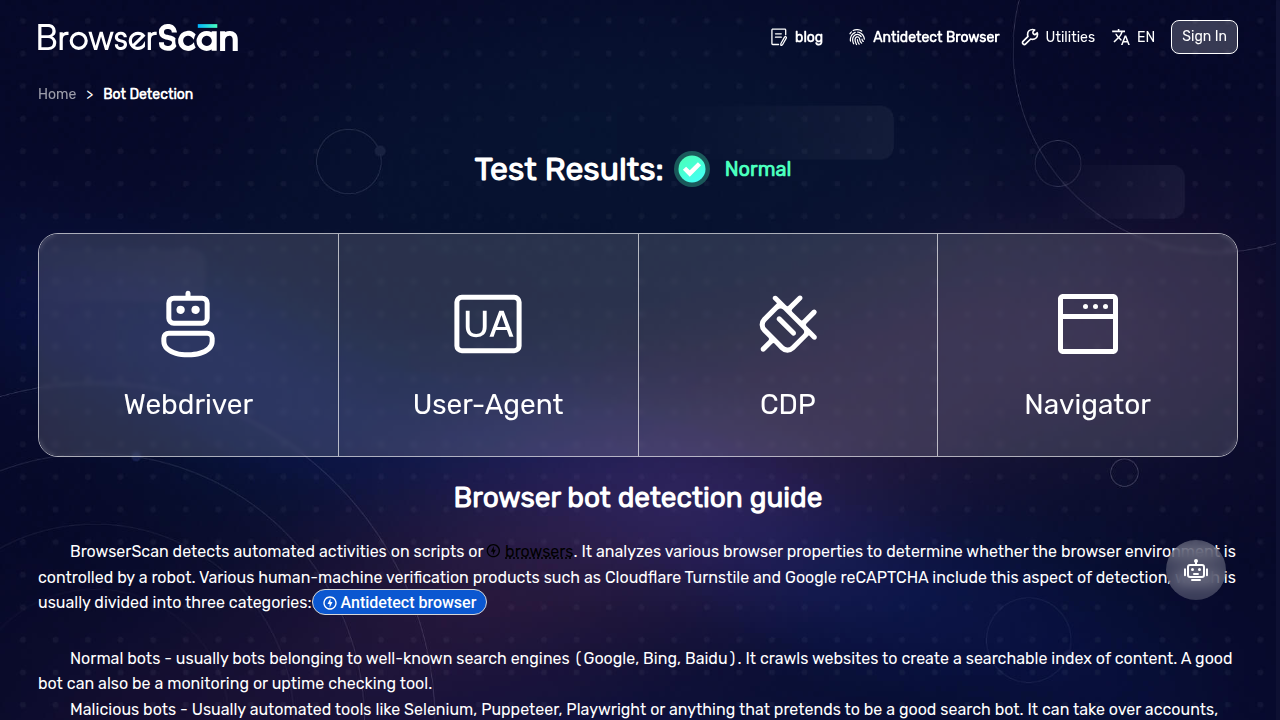
BrowserScan bot detection — NORMAL (4/4 checks passed)
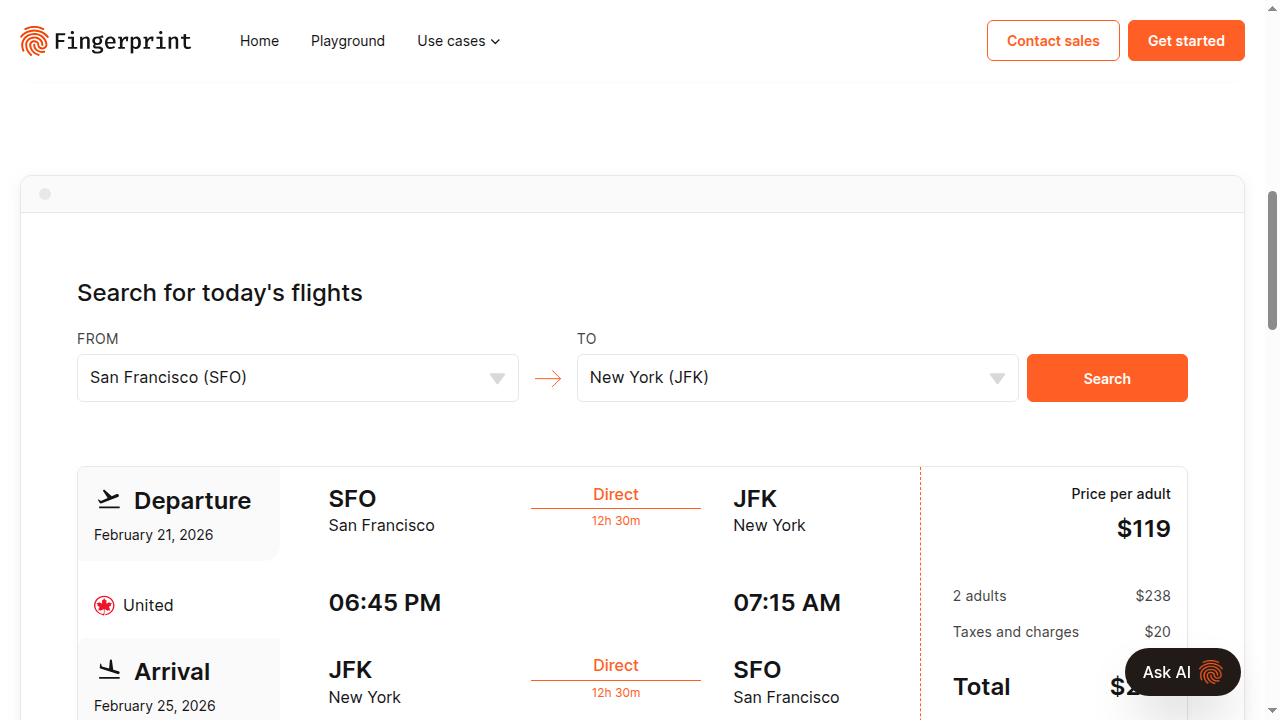
FingerprintJS web-scraping demo — data served, not blocked
Comparison
| Feature | Playwright | playwright-stealth | undetected-chromedriver | Camoufox | CloakBrowser |
|---|---|---|---|---|---|
| reCAPTCHA v3 score | 0.1 | 0.3-0.5 | 0.3-0.7 | 0.7-0.9 | 0.9 |
| Cloudflare Turnstile | Fail | Sometimes | Sometimes | Pass | Pass |
| Patch level | None | JS injection | Config patches | C++ (Firefox) | C++ (Chromium) |
| Survives Chrome updates | N/A | Breaks often | Breaks often | Yes | Yes |
| Maintained | Yes | Stale | Stale | Unstable | Active |
| Browser engine | Chromium | Chromium | Chrome | Firefox | Chromium |
| Playwright API | Native | Native | No (Selenium) | No | Native |
How It Works
CloakBrowser is a thin wrapper (Python + JavaScript) around a custom-built Chromium binary:
- You install →
pip install cloakbrowserornpm install cloakbrowser - First launch → binary auto-downloads for your platform (Chromium 145)
- Every launch → Playwright or Puppeteer starts with our binary + stealth args
- You write code → standard Playwright/Puppeteer API, nothing new to learn
The binary includes 26 source-level patches covering canvas, WebGL, audio, fonts, GPU, screen properties, hardware reporting, and automation signal removal.
These are compiled into the Chromium binary — not injected via JavaScript, not set via flags.
Binary downloads are verified with SHA-256 checksums to ensure integrity.
API
launch()
from cloakbrowser import launch

# Basic — headless, default stealth config
browser = launch()

# Headed mode (see the browser window)
browser = launch(headless=False)

# With proxy
browser = launch(proxy="http://user:pass@proxy:8080")

# With proxy dict (bypass, separate auth fields)
browser = launch(proxy={"server": "http://proxy:8080", "bypass": ".google.com", "username": "user", "password": "pass"})

# With extra Chrome args
browser = launch(args=["--disable-gpu"])

# With timezone and locale (sets both binary flags and Playwright context)
browser = launch(timezone="America/New_York", locale="en-US")

# Auto-detect timezone/locale from proxy IP (requires: pip install cloakbrowser[geoip])
browser = launch(proxy="http://proxy:8080", geoip=True)

# Explicit timezone/locale always win over auto-detection
browser = launch(proxy="http://proxy:8080", geoip=True, timezone="Europe/London")

# Without default stealth args (bring your own fingerprint flags)
browser = launch(stealth_args=False, args=["--fingerprint=12345"])
Returns a standard Playwright Browser object. All Playwright methods work: new_page(), new_context(), close(), etc.
launch_async()
import asyncio
from cloakbrowser import launch_async

async def main():
    browser = await launch_async()
    page = await browser.new_page()
    await page.goto("https://example.com")
    print(await page.title())
    await browser.close()

asyncio.run(main())
launch_context()
Convenience function that creates browser + context in one call with user agent, viewport, locale, and timezone:
from cloakbrowser import launch_context

context = launch_context(
    user_agent="Custom UA",
    viewport={"width": 1920, "height": 1080},
    locale="en-US",
    timezone="America/New_York",
)
page = context.new_page()
page.goto("https://protected-site.com")
context.close()
launch_persistent_context()
Same as launch_context(), but with a persistent user profile. Cookies, localStorage, and cache persist across sessions. Also avoids incognito detection by services like BrowserScan.
Use this when you need to:
- Stay logged in across runs (cookies/sessions survive restarts)
- Bypass incognito detection (some sites flag empty, ephemeral profiles)
- Load Chrome extensions (extensions only work from a real user data dir)
- Build natural browsing history (cached fonts, service workers, IndexedDB accumulate over time, making the profile look more realistic)
from cloakbrowser import launch_persistent_context

# First run — creates the profile
ctx = launch_persistent_context("./my-profile", headless=False)
page = ctx.new_page()
page.goto("https://protected-site.com")
ctx.close()  # profile saved

# Next run — cookies, localStorage restored automatically
ctx = launch_persistent_context("./my-profile", headless=False)
Supports all the same options as launch_context(): proxy, user_agent, viewport, locale, timezone, color_scheme, geoip.
Async version: launch_persistent_context_async().
Utility Functions
from cloakbrowser import binary_info, clear_cache, ensure_binary

# Check binary installation status
print(binary_info())
# {'version': '145.0.7632.109', 'platform': 'linux-x64', 'installed': True, ...}

# Force re-download
clear_cache()

# Pre-download binary (e.g., during Docker build)
ensure_binary()
JavaScript / Node.js API
CloakBrowser ships a TypeScript package with full type definitions. Choose Playwright or Puppeteer — same stealth binary underneath.
Playwright (default)
import { launch, launchContext, launchPersistentContext } from 'cloakbrowser';

// Basic
const browser = await launch();

// With options
const browser = await launch({
  headless: false,
  proxy: 'http://user:pass@proxy:8080',
  args: ['--fingerprint=12345'],
  timezone: 'America/New_York',
  locale: 'en-US',
});

// Convenience: browser + context in one call
const context = await launchContext({
  userAgent: 'Custom UA',
  viewport: { width: 1920, height: 1080 },
  locale: 'en-US',
  timezone: 'America/New_York',
});
const page = await context.newPage();

// Persistent profile — cookies/localStorage survive restarts, avoids incognito detection
const ctx = await launchPersistentContext({
  userDataDir: './chrome-profile',
  headless: false,
  proxy: 'http://user:pass@proxy:8080',
});
Note: Each example above is standalone — not meant to run as one block.
All Python options work in JS: stealthArgs: false to disable defaults, geoip: true to auto-detect timezone/locale from proxy IP.
Puppeteer
Note: The Playwright wrapper is recommended for sites with reCAPTCHA Enterprise. Puppeteer's CDP protocol leaks automation signals that reCAPTCHA Enterprise can detect, causing intermittent 403 errors. This is a known Puppeteer limitation, not specific to CloakBrowser. Use Playwright for best results.
import { launch } from 'cloakbrowser/puppeteer';

const browser = await launch({ headless: true });
const page = await browser.newPage();
await page.goto('https://example.com');
await browser.close();
Utility Functions (JS)
import { ensureBinary, clearCache, binaryInfo } from 'cloakbrowser';

// Pre-download binary (e.g., during Docker build)
await ensureBinary();

// Check installation status
console.log(binaryInfo());

// Force re-download
clearCache();
Configuration
| Env Variable | Default | Description |
|---|---|---|
CLOAKBROWSER_BINARY_PATH |
— | Skip download, use a local Chromium binary |
CLOAKBROWSER_CACHE_DIR |
~/.cloakbrowser |
Binary cache directory |
CLOAKBROWSER_DOWNLOAD_URL |
cloakbrowser.dev |
Custom download URL for binary |
CLOAKBROWSER_AUTO_UPDATE |
true |
Set to false to disable background update checks |
CLOAKBROWSER_SKIP_CHECKSUM |
false |
Set to true to skip SHA-256 verification after download |
Fingerprint Management
The binary is stealthy by default — no flags needed. It auto-generates a random fingerprint seed at startup and spoofs all detectable values (GPU, hardware specs, screen dimensions, canvas, WebGL, audio, fonts). Every launch produces a fresh, coherent identity.
How fingerprinting works:
| Scenario | What happens |
|---|---|
| No flags | Random seed auto-generated at startup. GPU, screen, hardware specs, and all noise patches are spoofed automatically. Fresh identity each launch. |
--fingerprint=seed |
Deterministic identity from the seed. Same seed = same fingerprint across launches. Use this for session persistence (returning visitor). |
--fingerprint=seed + explicit flags |
Explicit flags override individual auto-generated values. The seed fills in everything else. |
The binary detects its platform at compile time — a macOS binary reports as macOS with Apple GPU, a Linux binary reports as Linux with NVIDIA GPU. The wrapper overrides this on Linux by passing --fingerprint-platform=windows, so sessions appear as Windows desktops (more common fingerprint, harder to cluster). Use --fingerprint-platform for cross-platform spoofing when running the binary directly.
Tip: Use a fixed seed when revisiting the same site. A random seed makes every session look like a different device — which can be suspicious when hitting the same site repeatedly from the same IP. For reCAPTCHA v3 Enterprise and similar scoring systems, a fixed seed produces a consistent fingerprint across sessions, making you look like a returning visitor:
browser = launch(args=["--fingerprint=12345"])const browser = await launch({ args: ['--fingerprint=12345'] });
Default Fingerprint & All Flags (click to expand)
Default Fingerprint
Every launch() call sets these automatically. The wrapper applies platform-aware defaults — on Linux it spoofs as Windows for a more common fingerprint, on macOS it runs as a native Mac browser:
| Flag | Linux/Windows Default | macOS Default | Controls |
|---|---|---|---|
--fingerprint |
Random (10000–99999) | Random (10000–99999) | Master seed for canvas, WebGL, audio, fonts, client rects |
--fingerprint-platform |
windows |
macos |
navigator.platform, User-Agent OS, GPU pool selection |
--fingerprint-gpu-vendor |
NVIDIA Corporation |
Google Inc. (Apple) |
WebGL UNMASKED_VENDOR_WEBGL |
--fingerprint-gpu-renderer |
NVIDIA GeForce RTX 3070 |
ANGLE (Apple, ANGLE Metal Renderer: Apple M3, Unspecified Version) |
WebGL UNMASKED_RENDERER_WEBGL |
The binary auto-generates hardware concurrency (8), device memory (8), and screen dimensions (1920x1080 on Windows/Linux, 1440x900 on macOS) from the seed. Override with explicit flags if needed.
Using the binary directly? It works out of the box with zero flags — the binary auto-spoofs everything. Pass
--fingerprint=seedfor a persistent identity, or use explicit flags like--fingerprint-gpu-rendererto override any auto-generated value.
Production tip: For better stealth at scale, pass your own GPU, screen, and hardware values instead of relying on defaults. Custom parameters make your sessions harder to cluster by anti-bot systems that look for uniform fingerprint profiles.
Additional Flags
Supported by the binary but not set by default — pass via args to customize:
| Flag | Controls |
|---|---|
--fingerprint-hardware-concurrency |
navigator.hardwareConcurrency (auto-generated: 8) |
--fingerprint-device-memory |
navigator.deviceMemory in GB (auto-generated: 8) |
--fingerprint-screen-width |
Screen width (auto-generated: 1920 Win/Linux, 1440 macOS) |
--fingerprint-screen-height |
Screen height (auto-generated: 1080 Win/Linux, 900 macOS) |
--fingerprint-brand |
Browser brand: Chrome, Edge, Opera, Vivaldi |
--fingerprint-brand-version |
Brand version (UA + Client Hints) |
--fingerprint-platform-version |
Client Hints platform version |
--fingerprint-location |
Geolocation coordinates |
--fingerprint-timezone |
Timezone (e.g. America/New_York) |
--fingerprint-taskbar-height |
Override taskbar height (binary defaults: Win=48, Mac=95, Linux=0) |
--fingerprint-fonts-dir |
Path to cross-platform font directory |
--enable-blink-features=FakeShadowRoot |
Access closed shadow DOM elements |
Note: All stealth tests were verified with the default fingerprint config above. Changing these flags may affect detection results — test your configuration before using in production.
Examples
# Pin a seed for a persistent identity
browser = launch(args=["--fingerprint=42069"])

# Full control — disable defaults, set everything yourself
browser = launch(stealth_args=False, args=[
    "--fingerprint=42069",
    "--fingerprint-platform=windows",
    "--fingerprint-gpu-vendor=NVIDIA Corporation",
    "--fingerprint-gpu-renderer=NVIDIA GeForce RTX 3070",
])

# Override GPU to look like a different machine
browser = launch(args=[
    "--fingerprint-gpu-vendor=Intel Inc.",
    "--fingerprint-gpu-renderer=Intel Iris OpenGL Engine",
])
Examples
Python — see examples/:
basic.py— Launch and load a pagepersistent_context.py— Persistent profile with cookie/localStorage persistencerecaptcha_score.py— Check your reCAPTCHA v3 scorestealth_test.py— Run against 6 detection sitesfingerprint_scan_test.py— Test against fingerprint-scan.com and CreepJS
JavaScript — see js/examples/:
basic-playwright.ts— Playwright launch and loadbasic-puppeteer.ts— Puppeteer launch and loadstealth-test.ts— Run against 6 detection sites
Platforms
| Platform | Chromium | Patches | Status |
|---|---|---|---|
| Linux x86_64 | 145 | 26 | ✅ Latest |
| macOS arm64 (Apple Silicon) | 145 | 26 | ✅ Latest |
| macOS x86_64 (Intel) | 145 | 26 | ✅ Latest |
| Windows x86_64 | 145 | 26 | ✅ Latest |
The wrapper auto-downloads the correct binary for your platform.
macOS first launch: The binary is ad-hoc signed. On first run, macOS Gatekeeper will block it. Right-click the app → Open → click Open in the dialog. This is only needed once.
Docker
Pre-built image on Docker Hub — no install, no setup:
# Run the stealth test suite
docker run --rm cloakhq/cloakbrowser cloaktest

# Run your own script
docker run --rm cloakhq/cloakbrowser python -c "
from cloakbrowser import launch
browser = launch()
page = browser.new_page()
page.goto('https://example.com')
print(page.title())
browser.close()
"

# With a proxy
docker run --rm cloakhq/cloakbrowser python -c "
from cloakbrowser import launch
browser = launch(proxy='http://user:pass@proxy:8080')
page = browser.new_page()
page.goto('https://example.com')
print(page.title())
browser.close()
"
To extend with your own script:
FROM cloakhq/cloakbrowser
COPY your_script.py /app/
CMD ["python", "your_script.py"]
Building from source — a Dockerfile is also included if you prefer to build your own image:
docker build -t cloakbrowser .
CloakBrowser works identically local, in Docker, and on VPS. No environment-specific config needed.
Note: If you run CloakBrowser inside a web server with uvloop (e.g., uvicorn[standard]), use --loop asyncio to avoid subprocess pipe hangs.
Troubleshooting
Still getting blocked on aggressive sites (DataDome, Turnstile)?
Some sites detect headless mode even with our C++ patches. Run in headed mode with a virtual display:
# Install Xvfb (virtual framebuffer)
sudo apt install xvfb

# Start virtual display
Xvfb :99 -screen 0 1920x1080x24 &
export DISPLAY=:99
from cloakbrowser import launch

# Headed mode + residential proxy for maximum stealth
browser = launch(headless=False, proxy="http://your-residential-proxy:port")
page = browser.new_page()
page.goto("https://heavily-protected-site.com")  # passes DataDome, etc.
browser.close()
This runs a real headed browser rendered on a virtual display — no physical monitor needed. Combined with a residential proxy, this passes even the most aggressive detection services. Datacenter IPs are often flagged by IP reputation regardless of browser fingerprint — a residential proxy makes the difference.
Reddit or similar sites show CAPTCHA / "Prove your humanity"
Some sites (notably Reddit homepage) use HTTP/2 fingerprinting that detects Playwright's connection layer. Pass --disable-http2 to fall back to HTTP/1.1:
browser = launch(args=["--disable-http2"])
const browser = await launch({ args: ['--disable-http2'] });
Only use this flag for sites that require it — most sites work fine with HTTP/2.
Something not working? Make sure you're on the latest version Older versions may use outdated stealth args or download an older binary:
pip install -U cloakbrowser    # Python
npm install cloakbrowser@latest # JavaScript
docker pull cloakhq/cloakbrowser:latest  # Docker
Binary download fails / timeout Set a custom download URL or use a local binary:
export CLOAKBROWSER_BINARY_PATH=/path/to/your/chrome
New update broke something? Roll back to the previous version
When auto-update downloads a newer binary, the previous version stays in ~/.cloakbrowser/. Point CLOAKBROWSER_BINARY_PATH to the older cached binary:
# Linux
export CLOAKBROWSER_BINARY_PATH=~/.cloakbrowser/chromium-145.0.7632.109/chrome

# macOS
export CLOAKBROWSER_BINARY_PATH=~/.cloakbrowser/chromium-145.0.7632.109/Chromium.app/Contents/MacOS/Chromium

# Windows
set CLOAKBROWSER_BINARY_PATH=%USERPROFILE%\.cloakbrowser\chromium-145.0.7632.109\chrome.exe
macOS: "App is damaged" or Gatekeeper blocks launch The binary is ad-hoc signed. macOS quarantines downloaded files. Run once to clear it:
xattr -cr ~/.cloakbrowser/chromium-*/Chromium.app
"playwright install" vs CloakBrowser binary
You do NOT need playwright install chromium. CloakBrowser downloads its own binary. You only need Playwright's system deps:
patchright install-deps chromium
macOS: Blocked on some sites that pass on Linux
The macOS fingerprint profile has known inconsistencies that aggressive bot detection catches. If a site blocks you on macOS but works on Linux, switch to a Windows fingerprint profile by passing stealth_args=False and manually setting --fingerprint-platform=windows with matching GPU flags (see Fingerprint Management for the full flag list).
Site detects incognito / private browsing mode
By default, launch() opens an incognito context. Some sites (like BrowserScan) detect this. Use launch_persistent_context() instead — it runs with a real user profile, so incognito detection passes:
from cloakbrowser import launch_persistent_context

ctx = launch_persistent_context("./my-profile", headless=False)
page = ctx.new_page()
import { launchPersistentContext } from 'cloakbrowser';

const ctx = await launchPersistentContext({
  userDataDir: './my-profile',
  headless: false,
});
This also gives you cookie and localStorage persistence across sessions.
reCAPTCHA v3 scores are low (0.1–0.3)
Avoid page.wait_for_timeout() — it sends CDP protocol commands that reCAPTCHA detects. Use native sleep instead:
# Bad — sends CDP commands, reCAPTCHA detects this
page.wait_for_timeout(3000)

# Good — invisible to the browser
import time
time.sleep(3)
// Bad — sends CDP commands
await page.waitForTimeout(3000);

// Good — invisible to the browser
await new Promise(r => setTimeout(r, 3000));
Other tips for maximizing reCAPTCHA scores:
- Use Playwright, not Puppeteer — Puppeteer sends more CDP protocol traffic that reCAPTCHA detects (details)
- Use residential proxies — datacenter IPs are flagged by IP reputation, not browser fingerprint
- Spend 15+ seconds on the page before triggering reCAPTCHA — short visits score lower
- Space out requests — back-to-back
grecaptcha.execute()calls from the same session get penalized. Wait 30+ seconds between pages with reCAPTCHA - Use a fixed fingerprint seed for consistent device identity across sessions (see Fingerprint Management)
- Use
page.type()instead ofpage.fill()for form filling —fill()sets values directly without keyboard events, which reCAPTCHA's behavioral analysis flags.type()with a delay simulates real keystrokes:page.type("#email", "user@example.com", delay=50)
- Minimize
page.evaluate()calls before the reCAPTCHA check fires — each one sends CDP traffic
FAQ
Q: Is this legal? A: CloakBrowser is a browser built on open-source Chromium. We do not condone illegal use. Automating systems without authorization, credential stuffing, and account creation abuse are expressly prohibited. See BINARY-LICENSE.md for full terms.
Q: How is this different from Camoufox? A: Camoufox patches Firefox. We patch Chromium. Chromium means native Playwright support, larger ecosystem, and TLS fingerprints that match real Chrome. Camoufox returned in early 2026 but is in unstable beta — CloakBrowser is production-ready.
Q: Will detection sites eventually catch this? A: Possibly. Bot detection is an arms race. Source-level patches are harder to detect than config-level patches, but not impossible. We actively monitor and update when detection evolves.
Q: Can I use my own proxy?
A: Yes. Pass proxy="http://user:pass@host:port" to launch().
Roadmap
| Feature | Status |
|---|---|
| Linux x64 — Chromium 145 (26 patches) | ✅ Released |
| macOS arm64/x64 — Chromium 145 (26 patches) | ✅ Released |
| Windows x64 — Chromium 145 (26 patches) | ✅ Released |
| JavaScript/Puppeteer + Playwright support | ✅ Released |
| Fingerprint rotation per session | ✅ Released |
| Built-in proxy rotation | 📋 Planned |
Links
- 📋 Changelog — CHANGELOG.md
- 🌐 Website — cloakbrowser.dev
- 🐛 Bug reports & feature requests — GitHub Issues
- 📦 PyPI — pypi.org/project/cloakbrowser
- 📦 npm — npmjs.com/package/cloakbrowser
- 📧 Contact — cloakhq@pm.me
License
- Wrapper code (this repository) — MIT. See LICENSE.
- CloakBrowser binary (compiled Chromium) — free to use, no redistribution. See BINARY-LICENSE.md.
Contributing
Issues and PRs welcome. If something isn't working, open an issue — we respond fast.
Release history Release notifications | RSS feed


Download files
Download the file for your platform. If you're not sure which to choose, learn more about installing packages.
Source Distribution
Built Distribution
Filter files by name, interpreter, ABI, and platform.
If you're not sure about the file name format, learn more about wheel file names.
Copy a direct link to the current filters
File details
Details for the file cloakbrowser-0.3.7.tar.gz.
File metadata
- Download URL: cloakbrowser-0.3.7.tar.gz
- Upload date:
- Size: 5.2 MB
- Tags: Source
- Uploaded using Trusted Publishing? No
- Uploaded via: twine/6.2.0 CPython/3.14.3
File hashes
| Algorithm | Hash digest | |
|---|---|---|
| SHA256 |
1f16c858b5f3b73ce6c9dd918d322df60515126a5cc30512fc1ef0b397d79ffc
|
|
| MD5 |
847844be0de65f30f416fb6f558bbda7
|
|
| BLAKE2b-256 |
e38316b1af3afb525d9c76daff93eb07c52293736f926e53736113d282110685
|
File details
Details for the file cloakbrowser-0.3.7-py3-none-any.whl.
File metadata
- Download URL: cloakbrowser-0.3.7-py3-none-any.whl
- Upload date:
- Size: 29.6 kB
- Tags: Python 3
- Uploaded using Trusted Publishing? No
- Uploaded via: twine/6.2.0 CPython/3.14.3
File hashes
| Algorithm | Hash digest | |
|---|---|---|
| SHA256 |
28f32aabcde7807ce8d88f4dd37268e3373babf23616bac395c0b33546078f07
|
|
| MD5 |
ec5fb854cfa13d42f596fd9d7bf7cca9
|
|
| BLAKE2b-256 |
4ce12cb8245c5261b978089a5ed4725d98732ee741dce8c2b4815cd407474ca3
|






